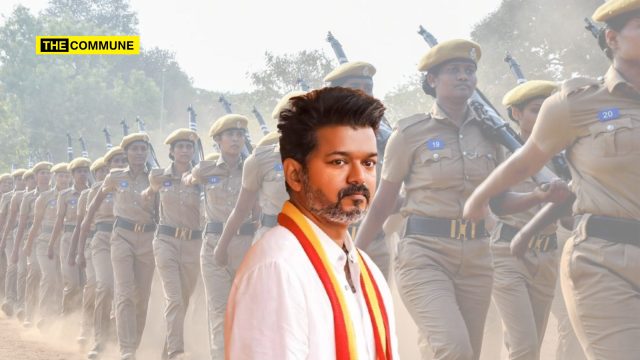
Days after Chief Minister C Joseph Vijay unveiled the “Singapen Special Task Force” as a flagship initiative for women’s safety under the new TVK government, serious questions have emerged over the force’s actual capacity, structure and purpose, with police officials and former officers pointing out that the state already possesses a far larger and deeply entrenched women-and-children policing network, as reported in Times of India.
The Tamilaga Vettri Kazhagam (TVK) ecosystem had aggressively projected the Singapen initiative as a revolutionary intervention in women’s safety and a major departure from previous administrations. However, it is noteworthy that similar women-focused patrol and safety initiatives had already existed under earlier governments in Tamil Nadu, including the “Amma Patrol” under the AIADMK regime and the “Pink Patrol” system expanded during the DMK government. The new announcement was heavily marketed as a transformative policing reform despite largely overlapping with existing institutional mechanisms already functioning across the state.
Barely a week after the announcement, the Tamil Nadu government formally constituted the Singapen Special Task Force under Inspector General of Police K Bhavaneeswari with a sanctioned strength of just 36 personnel of various ranks. The force is expected to operate across Tamil Nadu’s 37 districts and nine city police commissionerates.
The limited manpower immediately triggered criticism within police circles, particularly because Tamil Nadu already operates a specialised Crime Against Women and Children (CAWC) wing headed by an Additional Director General of Police (ADGP)-rank officer. The CAWC structure is also supported by an Inspector General-rank officer and an extensive statewide network dedicated to women and child-related policing.
Official data indicate that the CAWC wing currently has nearly 5,300 personnel, including 1,635 Child Welfare Police Officers. Apart from this, Tamil Nadu already has 244 all-women police stations, 32 Anti-Human Trafficking Units, seven Investigative Units of Crime Against Women, 43 Anti-Child Trafficking Units and 39 Special Juvenile Police Units functioning across districts and commissionerates.
Despite this elaborate infrastructure, the newly announced Singapen Task Force appears to duplicate many functions already assigned to the CAWC wing, including surveillance, monitoring crimes against women and identifying vulnerable zones.
Police sources stated that several personnel assigned to the Singapen force were being redeployed from existing police units, raising concerns that the initiative was merely redistributing already stretched manpower instead of creating fresh operational capacity. One police officer reportedly remarked that the new structure had effectively created “another posting for an IPS officer” without substantially improving policing capabilities on the ground.
Officials also pointed out that Chennai city alone already has nearly 79 personnel functioning within the CAWC framework, apart from Pink Patrol teams, awareness programmes and digital safety initiatives such as the Kavalan Udavi application.
Experts and former police officers warned that the government risked creating another bureaucratic layer without addressing deeper structural problems affecting women’s safety enforcement.
Senior police officials stated that the CAWC wing itself often functions primarily as a monitoring and coordination body rather than an empowered operational unit. One senior officer said even senior CAWC officials lacked the authority to independently take major decisions such as registering FIRs, with many key matters ultimately requiring clearance at the Commissioner or Director General of Police level.
Former Director General of Police C Sylendra Babu reportedly stated that policing reforms should focus more on maintaining databases of repeat sexual offenders, strengthening preventive intelligence gathering and improving continuous field surveillance rather than repeatedly launching new branded initiatives. He reportedly observed that long-term offender tracking systems and preventive policing mechanisms were more effective than symbolic announcements.
Retired senior police official S Aravindhan also questioned the practical effectiveness of the Singapen force in its present form. He reportedly stated that without dedicated recruitment, stronger investigative autonomy, better coordination with district police and measurable accountability mechanisms, the Singapen initiative risked becoming a visibility-driven exercise rather than a meaningful intervention in women’s safety.
Subscribe to our channels on WhatsApp, Telegram,Instagram and YouTube to get the best stories of the day delivered to you personally.
Weeks after scripting one of the most stunning electoral victories in the 2026 Tamil Nadu Assembly elections, Joseph Vijay had ministers sworn in. Among them is N. Marie Wilson, the RK Nagar MLA who is now the newly appointed Finance, Planning and Development Minister in actor-politician Vijay’s Tamilaga Vettri Kazhagam (TVK) government. But as soon as the announcement was made, we realise that Marie Wilson is at the centre of multiple controversies, pending criminal cases, accused of cheating complaint, and serious questions are raised about his past conduct.
From Campus to Cabinet
Marie Wilson, 46, is the son-in-law of the late educationist Jeppiaar, the founder of the sprawling Jeppiaar group of engineering and arts-and-science colleges in Tamil Nadu. Wilson serves as the Managing Director of Jeppiaar Institute of Technology and Managing Trustee of the Jeppiaar Remibai Educational Trust – a background that positioned him as a prominent face in Chennai’s private education sector long before he entered politics.
Contesting from the Dr. Radhakrishnan Nagar constituency in north Chennai, Wilson won by a commanding margin of 49,668 votes, polling 97,800 votes against DMK’s sitting MLA J. John Ebenezer. The landslide victory was seen as a personal triumph for Vijay, who had fielded Wilson as a strong institutional candidate in an urban constituency.
His appointment as Finance Minister, arguably the most powerful portfolio in the cabinet after the Chief Minister’s, was announced after he was sworn in on 21 May 2026. The choice, however, immediately drew scrutiny from political opponents and legal observers.
Two Pending Criminal Cases
What has set alarm bells ringing is Wilson’s own election affidavit, submitted to the Election Commission as mandatory disclosure. The document lists two pending criminal cases against him.
The first case, Crime No. 134/2022, was registered at Lawspet Police Station in Puducherry and is being tried as CC No. 558/2022 before the Judicial Magistrate Mahila Court, Puducherry. The case invokes Indian Penal Code sections 448 (house trespass), 427 (mischief causing damage), 324 (voluntarily causing hurt), 294B (obscene words and gestures), 506(i) (criminal intimidation), and 34 (acts done in furtherance of common intention). The fact that the case is being tried before a Mahila Court has drawn significant public attention and has been cited by critics who question his suitability as a minister.
The second case is even more serious on paper. Crime No. 679/2012, filed at Sunguvarchatram Police Station and tried as PRC No. 4/2014 before the Judicial Magistrate in Sriperumbudur, involves IPC sections 308 (attempt to commit culpable homicide), 304(ii) (culpable homicide not amounting to murder, with knowledge), and 34. This case, originating in 2012, has remained pending in court for over 14 years without conclusion.
6. Marie Wilson – DR.RADHAKRISHNAN NAGAR (Won)
Sections – IPC 448, 427, 324, 294 (b), 506 (i), 308, 304
Combo of house trespassing, causing hurt by dangerous weapons, obscene acts, culpable homicide not amounting to mur*er. His alleged aide ‘Paambu’ Dinesh was held in POCSO. pic.twitter.com/4EHElQxUOs
— Saikiran Kannan | 赛基兰坎南 (@saikirankannan) May 7, 2026
A Campus in Flames: The 2010 College Violence
Long before Wilson entered electoral politics, his name was associated with a violent episode at Jeppiaar Engineering College in Sholinganallur, Chennai, in October 2010. Students inside the college hostel went on a rampage, vandalising property, destroying furniture, and setting fire to a college laboratory. Senior police officers had to rush to the campus to bring the situation under control.
According to reports from that period, the violence was directly triggered by Marie Wilson being transferred out of the college management – a fallout from an internal family dispute within the Jeppiaar group. Students reportedly loyal to Wilson were said to have participated in the unrest. The episode revealed the depth of factional tensions within the Jeppiaar educational empire and placed Wilson’s institutional conduct under public scrutiny for the first time.
Trader Complains of Cheating and Intimidation
As recently as April 2026, in the middle of the election campaign, a Chennai-based trader approached the police seeking the registration of an FIR against Marie Wilson and his associates for alleged cheating, criminal intimidation, and wrongful restraint.
According to the complainant, goods worth several lakhs of rupees were supplied on credit to an institution linked to Wilson. When the dues were not paid and the trader approached Wilson’s office, he was reportedly denied access, made to wait for hours, and then allegedly confronted by a group of individuals who physically restrained him, subjected him to abusive language, and threatened him against pursuing the matter legally. The complaint sought action under relevant IPC provisions, but a formal FIR had not been confirmed as registered at the time of reporting.
Assault On Family
Multiple videos circulating on social media show Marie Wilson entering a house and beating the residents with wooden sticks and planks – the video is undated. These clips capture Wilson forcing his way into a home and attacking a man and his wife. It is not clear what the issue is but he is seen abusing women and men while also assaulting them.
தனது சொந்த அண்ணன் குடும்பத்தை பணத்திற்காக அடித்து கொலை முயற்சியில் ஈடுபடும் இவர்தான் ஆர்.கே.நகருக்கு தவெகவால் இறக்கிவிடப்பட்ட வேட்பாளர் !
ஜே.பி.ஆர் உழைப்பில் வாழும் இந்த மரியவில்சன் பிறவிக்குற்றவாளி !
TVK Finance Minister Marie Wilson faces cases under IPC 448, 427, 324, 294(b), 506(i), 308 & 304.
He rose mainly as Dr. Jeppiaar’s son-in-law. Jeppiaar Trust is widely linked to land grabbing, including the ₹2,000 crore Semmenchery land case. pic.twitter.com/nUUSzRUgMz
20 Yrs Legal Battle Later TN Govt Recovered Govt Land Worth Rs 2000 Crore Encroached By Jeppiar Trust
In September 2021, the Tamil Nadu government scored a major victory against the Jeppiaar Educational Trust in a long-running land encroachment dispute. After nearly 20 years of legal battle, the Revenue Department reclaimed 91 acres of government land at Semmenchery on Old Mahabalipuram Road in Chennai, valued at around Rs 2,000 crore, which the trust had allegedly encroached and used to build hostels for girl students. This trust and educational institutions belonged Jeppiar, Marie Wilson’s father-in-law.
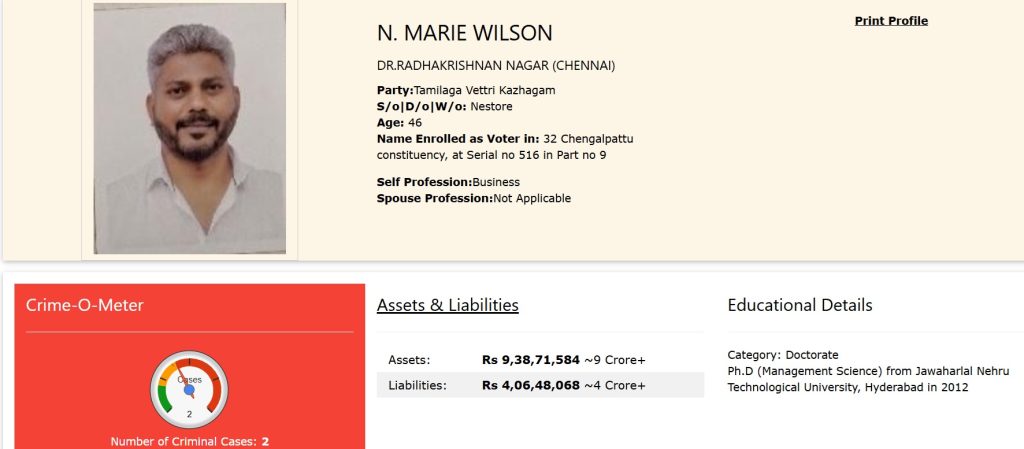
Assets Declared: ₹9.38 Crore
Wilson’s election affidavit also disclosed his financial standing. He declared total assets of ₹9.38 crore, comprising movable assets of approximately ₹4.2 crore and immovable assets of ₹5.2 crore. Total liabilities stood at ₹4.06 crore, with a declared annual income of ₹11.3 lakh. The gap between the declared income figure and the asset base is pretty noteworthy.
Source: MyNeta
A candidate with two pending criminal cases, one before a Mahila Court, was not only fielded from a constituency but has now been elevated to the Finance Ministry.
While no court has convicted him in the pending cases, the disclosures in his own election affidavit and the resurfacing of past incidents have raised serious questions about political accountability, candidate vetting, and the standards being followed by the Vijay-led government while projecting itself as a clean alternative in Tamil Nadu politics.
Subscribe to our channels on WhatsApp, Telegram,Instagram and YouTube to get the best stories of the day delivered to you personally.
The Uttar Pradesh Police have invoked the Uttar Pradesh Gangsters and Anti-Social Activities (Prevention) Act against all the accused in the alleged Mirzapur gym conversion racket, in which Muslim gym owners and trainers are accused of targeting Hindu women, trapping them in relationships, blackmailing them with obscene material and pressuring them to convert to Islam, as reported in OpIndia.
Police have named 10 accused in the case, all of whom are currently lodged in jail. Authorities have also shut down the five gyms allegedly used by the accused to run the operation – KGN-1.0, KGN-2.0, KGN-3.0, B-Fit and Iron Fire.
The case first came to light in January this year after two women from Mirzapur lodged separate complaints at different police stations. In their complaints, the women alleged that gym trainers and owners initially befriended them under the guise of fitness training before gradually drawing them into romantic relationships. The women alleged that after establishing physical relationships, the accused secretly recorded obscene photographs and videos and later used them to blackmail and extort them while forcing them to convert to Islam.
During the course of the investigation, police claimed to have uncovered a wider network allegedly involved in harassing, blackmailing and coercing female gym members into religious conversion. Investigators alleged that the accused deliberately targeted Hindu women who enrolled in the gyms and used the fitness centres as recruitment hubs for identifying and trapping potential victims.
Police said the accused operated with the intention of securing unlawful financial and other gains for themselves and their associates. According to investigators, the accused used social media platforms to identify, approach and monitor women. Once the victims were drawn into relationships, the accused allegedly established physical relations with them, recorded compromising material and then used it for blackmail, extortion and coercion.
Officials stated that more than 50 women were allegedly targeted by the network.
The accused include a police constable identified as Irshad Khan, a Maulvi named Khalilu Rahman and Faizal Khan, a bodybuilder who won the titles of ‘Mr Mirzapur’ in 2019 and ‘Mr Purvanchal’ in 2022. Police also named a Muslim woman, Sanno, as an accused in the racket. Investigators alleged that she was tasked with gaining the trust of Hindu women and helping lure them into the network.
The accused have been booked under multiple charges, including intentional insult intended to provoke breach of peace, extortion, criminal intimidation, assault or criminal force, and unlawful religious conversion. Police said further investigation into the alleged racket is ongoing.
Subscribe to our channels on WhatsApp, Telegram,Instagram and YouTube to get the best stories of the day delivered to you personally.
A temporary woman employee attached to the Hindu Religious and Charitable Endowments (HR&CE) Department at the Tiruchendur Subramania Swamy Temple has been suspended after irregularities were detected in the issuance of ₹100 paid receipts to devotees.
According to temple sources, the employee, identified as Menaka, allegedly manipulated accounts over the past few months and diverted money collected from devotees for personal use instead of remitting it to the temple’s official accounts. The discrepancies reportedly came to light during an internal audit conducted by temple authorities.
Preliminary findings of the inquiry indicated that fraud amounting to nearly ₹25 lakh may have been committed through the alleged malpractice. Following the findings, the HR&CE Department placed the employee under suspension and initiated further departmental proceedings.
Temple authorities are continuing their investigation to determine the full extent of the financial irregularities and whether any other individuals were involved in the alleged scam.
Subscribe to our channels on WhatsApp, Telegram,Instagram and YouTube to get the best stories of the day delivered to you personally.
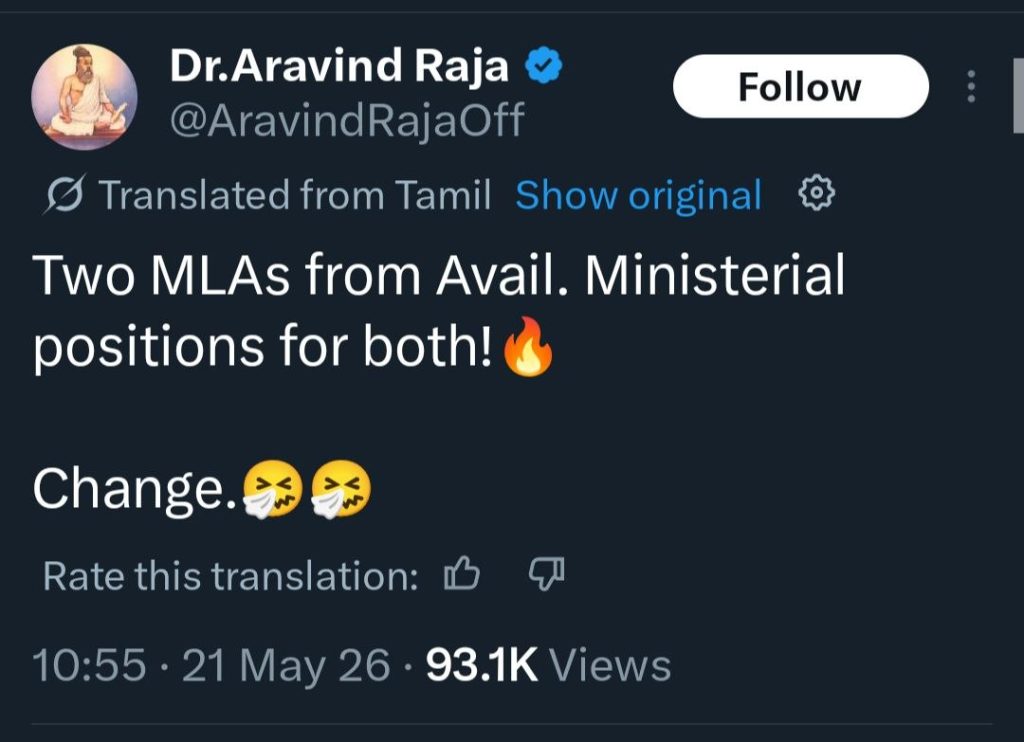
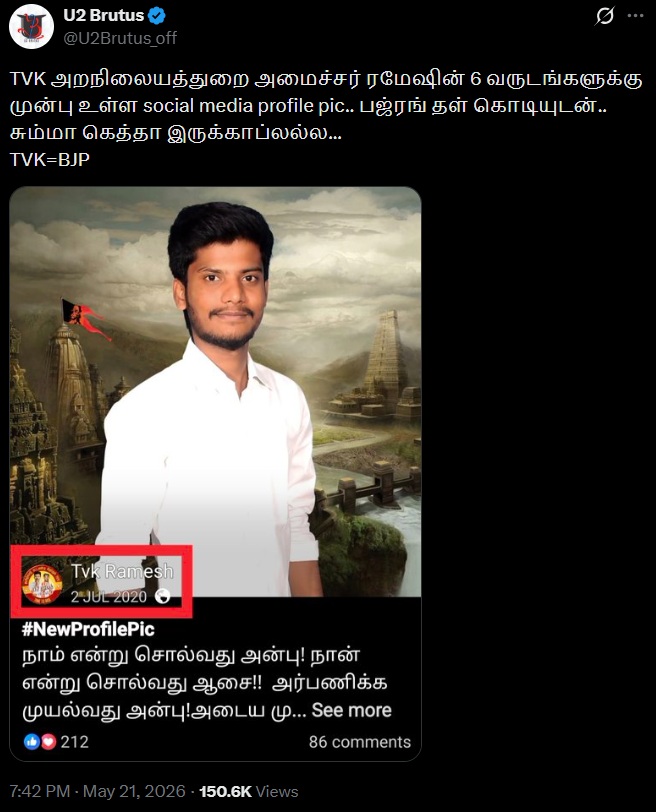
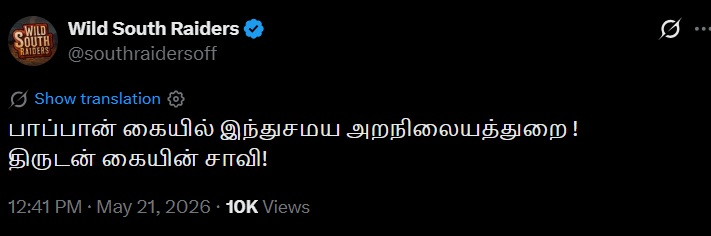
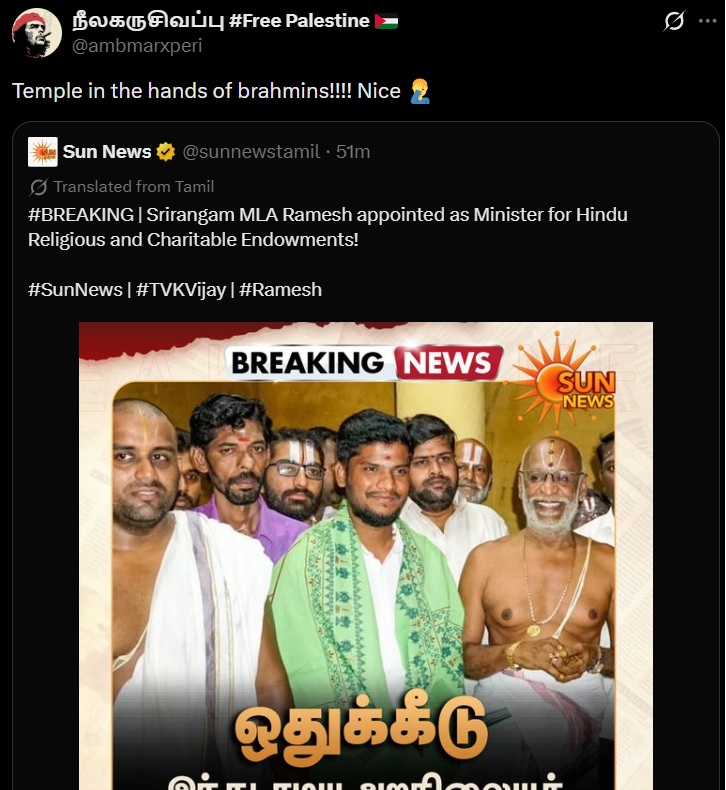
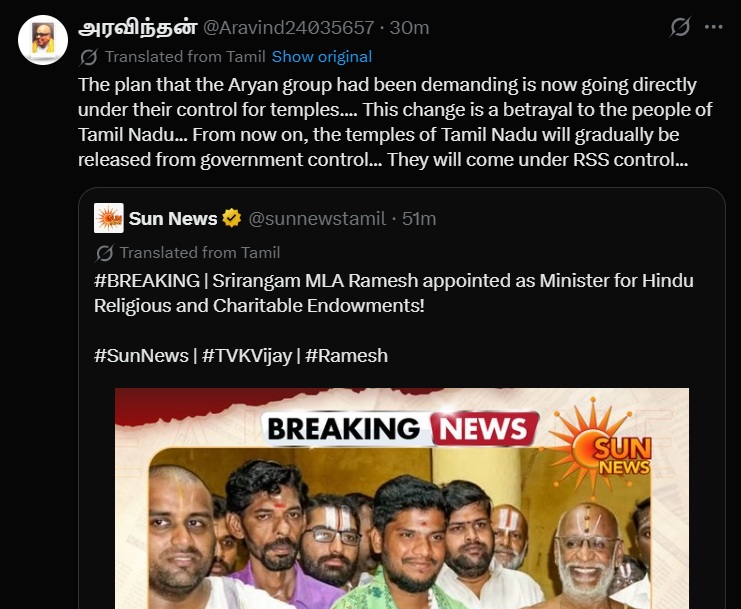
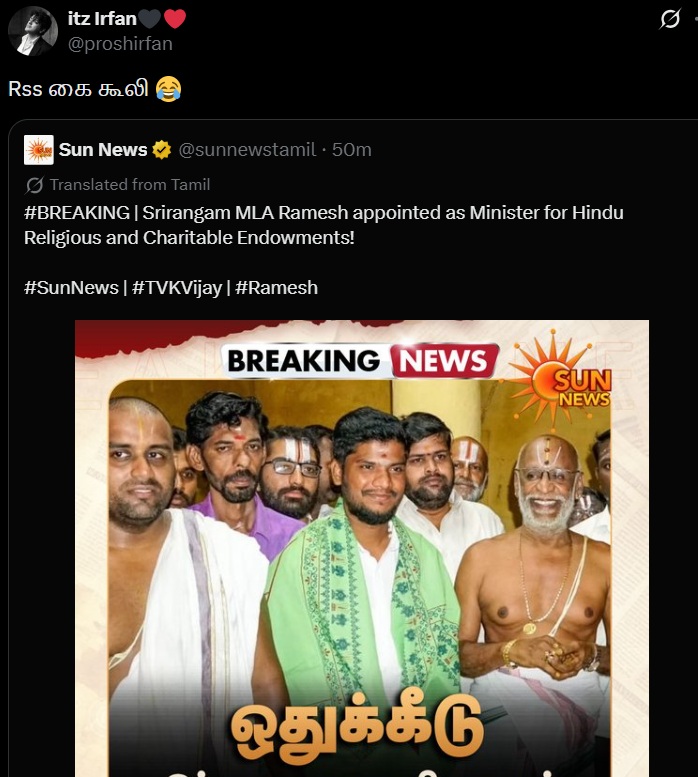
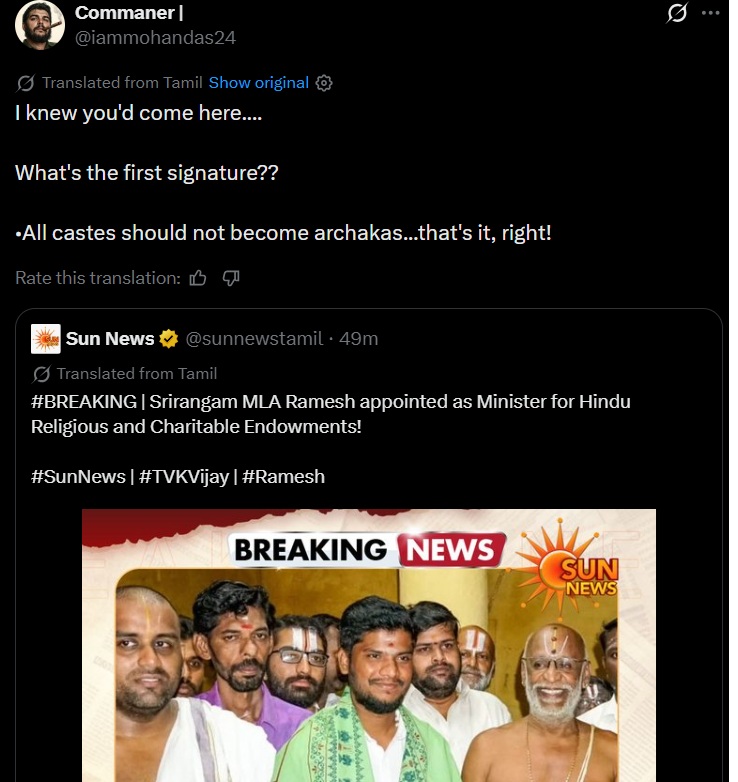
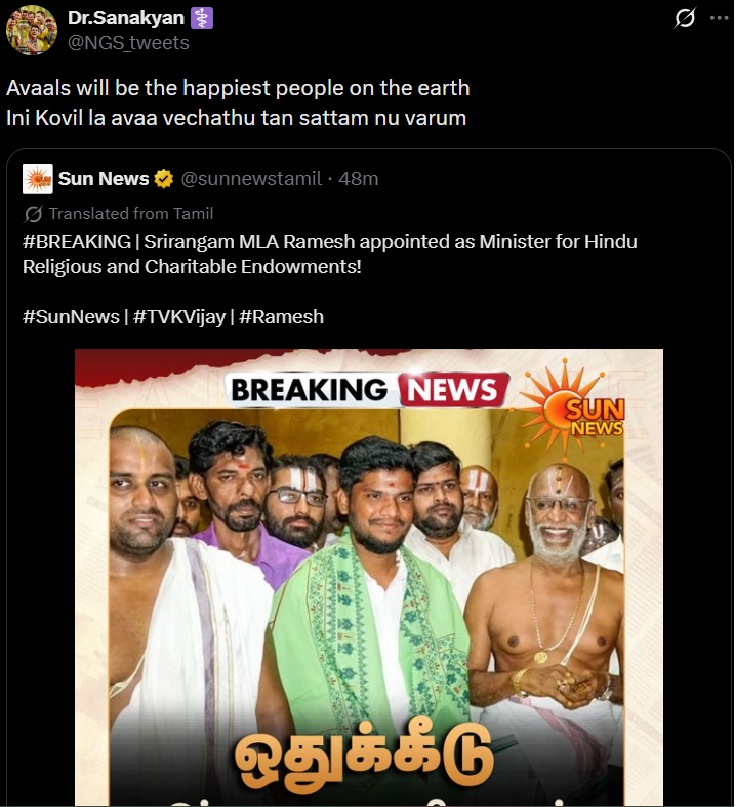
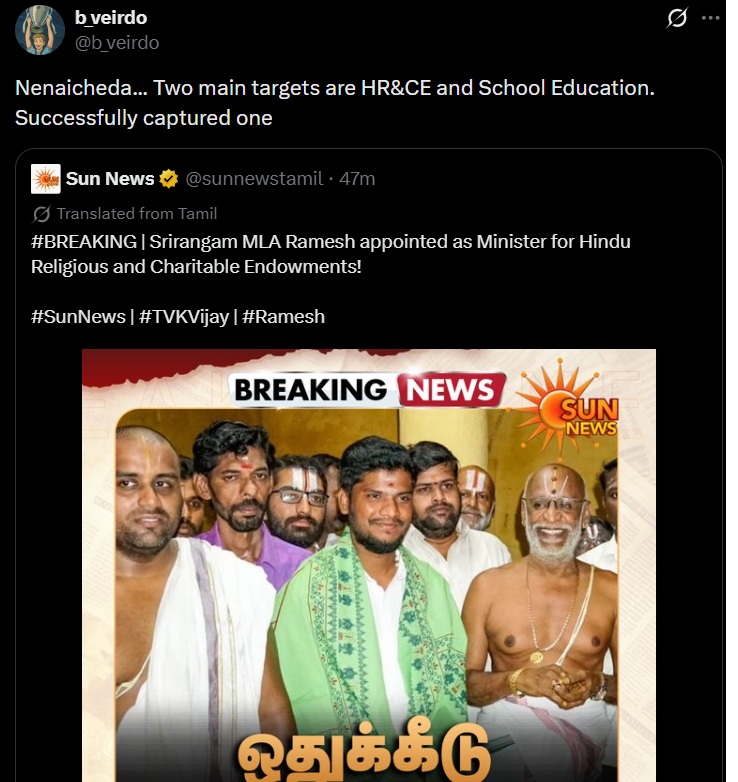
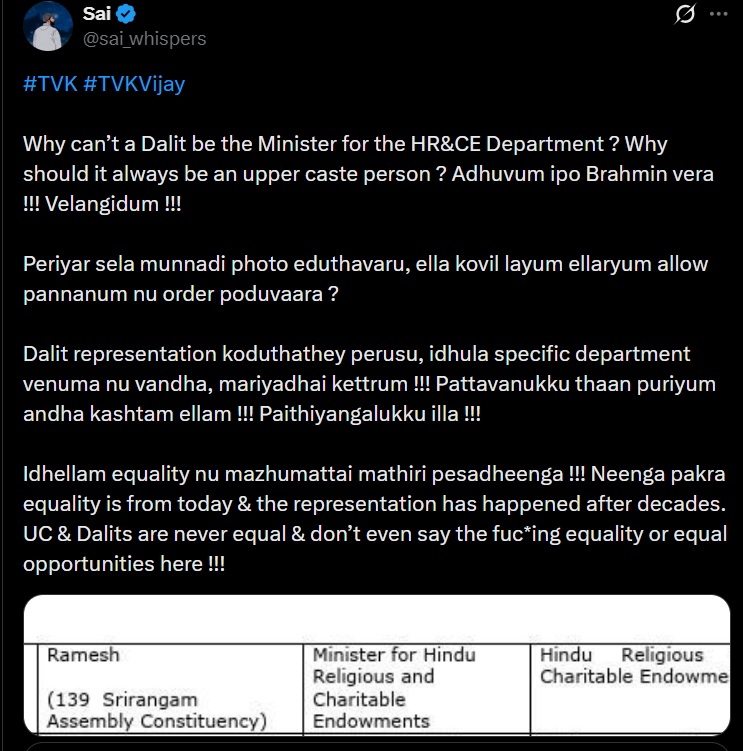
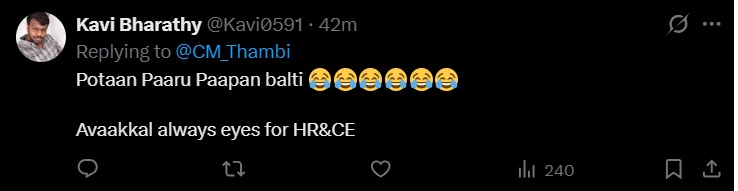
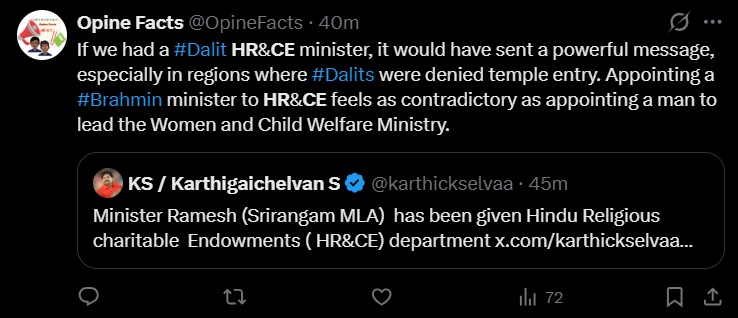
DMK supporters, Dravidianists, Dravidian stocks – whatever you call them, they start having a meltdown when there is a Brahmin in the picture. Their meltdown reached new heights when two Brahmin MLAs were elected by the people. And to add to insult to their injury, the two ministers have been inducted as ministers in the newly formed TVK government led by Joseph Vijay.
On 21 May 2026, Ramesh who won the election from Srirangam, a Brahmin from reportedly humble background, was sworn in as the minister for Hindu Religious & Charitable Endowments Department (HR&CE).
Ramesh is not an unelected outsider parachuted into office. He is the elected MLA from Srirangam, having won the 2026 Assembly election for Tamilaga Vettri Kazhagam by a margin of 33,590 votes, polling 1,03,235 votes against the DMK’s S. Durairaj. Yet the online reaction to his appointment has been marked by alarm, sarcasm and caste-coded hostility, with the Dravidianists framing the move as if temple administration itself has been handed over to a hostile force.
For decades, Dravidian parties and their ecosystem claimed they were expanding democracy by dismantling hereditary and caste monopoly in public institutions. But the outrage now surfacing suggests that equality has an invisible ceiling: representation is celebrated only when it excludes the so-called “wrong” community.
Here are some of the reactions.
The reaction also carries a contradiction. The same political culture that routinely speaks the language of social justice is now unable to tolerate the simple fact that an elected Brahmin legislator can hold ministerial responsibility in a democratic government. In practice, this turns anti-dominance politics into something else entirely: not the removal of hierarchy, but the normalization of exclusion.
It is less a debate over one man or one file and more a test of whether Tamil Nadu’s political class can accept genuinely broad representation, or whether some sections still believe that the Brahmin community may vote, contest and win, but should never be allowed to govern certain institutions.
Subscribe to our channels on WhatsApp, Telegram,Instagram and YouTube to get the best stories of the day delivered to you personally.
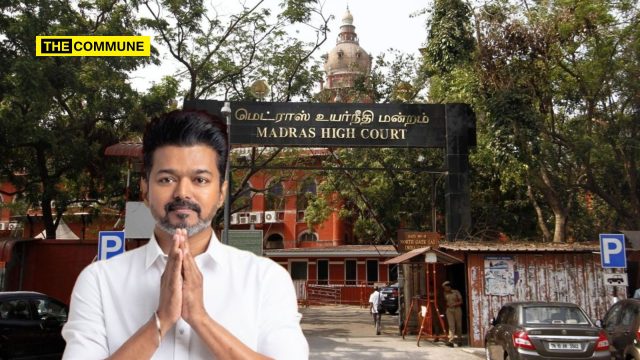
Justice GR Swaminathan of the Madras High Court has directed the Secretary of the Hindu Religious and Charitable Endowments (HR&CE) Department to file a report regarding the controversy surrounding Tamil Nadu minister CTR Nirmal Kumar’s visit to the Thirupparankundram Subramaniya Swamy Temple in Madurai.
What happened when Minister Nirmal Kumar visited the Subramaniya Swamy Temple at Thiruparankundram ?
The Madras High Court has directed the HR&CE Department Secretary to file a report regarding the controversy surrounding Minister Nirmal Kumar’s visit to the Subramaniya Swamy… pic.twitter.com/bXPRlmjhxL
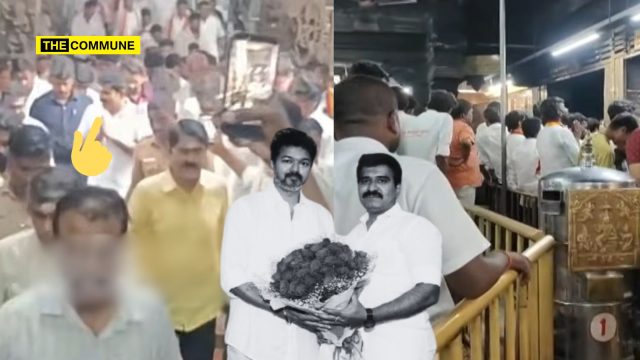
The controversy erupted after devotees alleged that the temple’s scheduled afternoon closing rituals were delayed on 16 May 2026 exclusively to accommodate the minister’s darshan, triggering criticism over alleged violation of Agama rules and preferential treatment for ruling-party figures.
The Thirupparankundram Murugan Temple, regarded as the first of Lord Murugan’s six sacred abodes, usually closes at 1:00 PM and reopens only at 4:00 PM. As part of the regular procedure, entrances begin shutting around 12:45 PM and devotees inside the temple are gradually asked to exit before the afternoon closure.
However, according to devotees, the temple remained open until around 1:30 PM on the day of the minister’s visit.
Minister Nirmal Kumar, who was elected MLA from the Thirupparankundram constituency and was making his first visit to the temple after assuming office in the Tamilaga Vettri Kazhagam government, reportedly arrived at the temple around 12:57 PM directly from the Madurai airport.
Temple Deputy Commissioner Gnanasekar, Sivachariyars and temple officials were present to receive him. The minister was escorted into the temple around 1:00 PM, where trustees, officials and party members welcomed him with shawls. Priests also accorded him Poorna Kumbha honours.
The controversy intensified after allegations emerged that the minister continued his darshan even after the scheduled closing time and was permitted access into areas near the sanctum. Devotees also alleged that large numbers of party cadres accompanying the minister were allowed inside while ordinary worshippers waiting in queues were inconvenienced.
According to reports, the minister completed his darshan and left the temple around 1:20 PM, after which the temple doors were finally closed at approximately 1:30 PM.
Several devotees questioned whether ordinary worshippers would have been granted similar concessions and alleged that long-standing temple procedures and Agama rules had been selectively relaxed for a ruling-party minister and his entourage.
Further controversy erupted after members of the minister’s entourage and TVK cadres allegedly entered areas close to the sanctum and used mobile phones to take photographs and record videos for social-media reels inside the temple premises.
Taking note of the allegations, Justice GR Swaminathan directed the HR&CE Department Secretary to submit a report within a week regarding the incident and the circumstances under which the temple’s closure procedures were allegedly delayed for the minister’s visit.
Subscribe to our channels on WhatsApp, Telegram,Instagram and YouTube to get the best stories of the day delivered to you personally.
The Madras High Court has sought responses from the Election Commission of India and major political parties on a public interest litigation alleging widespread corrupt practices during the 2026 Tamil Nadu Legislative Assembly elections, as reported in LiveLaw.
A division bench comprising Justice GR Swaminathan and Justice V. Lakshminarayanan issued notice on a plea filed by advocate L. Vasuki, who alleged that the Tamilaga Vettri Kazhagam, Dravida Munnetra Kazhagam and All India Anna Dravida Munnetra Kazhagam had engaged in illegal electoral practices during the Assembly polls.
During the hearing, the bench orally observed that election petitions are ordinarily maintainable against individual candidates and not necessarily against political parties themselves. However, the court noted that the allegations in the present case had been directed against the parties as entities rather than specific candidates.
“Election petition is maintainable against the candidate. But can a party be disqualified under Section 100 (of RP Act). Matter requires some investigation,” the bench orally remarked.
Taking note of the nature of the allegations, the court issued notice to the Election Commission as well as the political parties concerned.
In her petition, advocate Vasuki alleged that several illegal practices had taken place during the 2026 Assembly election campaign, including electoral bribery, cash-for-votes operations, undue influence on voters and the alleged use of minor children for electoral propaganda and indirect voter manipulation.
One of the key allegations raised in the plea related to Chief Minister C. Joseph Vijay, who also serves as the president of TVK. The petitioner alleged that during the campaign, Vijay had called upon children to emotionally influence or pressure their parents into voting for TVK.
According to the plea, such conduct raised “serious concern” relating to undue influence under Section 123 of the Representation of the People Act.
The petitioner further contended that serious allegations of money distribution and cash-for-votes practices had surfaced across multiple constituencies during the elections. It was argued that despite complaints and widespread circulation of such allegations, the Election Commission of India had allegedly failed to take effective action.
The plea stated that the alleged inaction of the Election Commission affected the conduct of free and fair elections and violated Articles 14, 19 and 21 of the Constitution, while also striking at the “basic structure doctrine.”
Seeking judicial intervention, the petitioner urged the High Court to direct an independent, time-bound inquiry into the allegations of corrupt electoral practices allegedly committed by the three major political parties during the Assembly elections.
The matter is expected to be taken up for further hearing after responses are filed by the Election Commission and the political parties concerned.
Subscribe to our channels on WhatsApp, Telegram,Instagram and YouTube to get the best stories of the day delivered to you personally.
Brahmins in Tamil Nadu have had very little political representation for a long time. Former Chief Minister J. Jayalalithaa, herself a Brahmin, gave the community some political visibility during her tenure. After Jayalalithaa’s tenure, Brahmins virtually disappeared from Tamil Nadu’s electoral representation, both as candidates and as ministers. The 2021 Assembly election was perhaps the last major instance of a Brahmin candidate being fielded in Tamil Nadu, when the AIADMK nominated retired DGP R. Natraj from the Mylapore constituency. But he lost. In 2024, no major party fielded a Brahmin candidate for the LS polls. In 2026 as well, none of the major political parties fielded Brahmin candidates.
After 2021 elections, Dravidianists rejoiced that TN assembly would now be ‘Brahmin-free’. Social media handles, party mouthpieces, and Dravidianist influencers ridiculed and mocked the Brahmins and hailed the move as if it was a form of justice.
That changed when TVK announced that they were fielding 2 candidates from the community that is in a minority in the state. The candidates were P. Venkataramanan from Mylapore and S. Ramesh from Srirangam and both won.
We had earlier reported about how the Assembly will see the presence of two Brahmin MLAs but now, the duo will also feature in the cabinet. On 10 May 2026, Venkataramanan was sworn-in as a minister and he was given the charge of Food and Civil Supplies.
P. Venkataramanan is the Treasurer of the Tamilaga Vettri Kazhagam. He has described anti-Brahminism as an “outdated ideology” and positioned TVK as a party of change.
TVK MLA Venkatraman
Another TVK MLA is S. Ramesh who won from Srirangam, is also reportedly from a humble background.
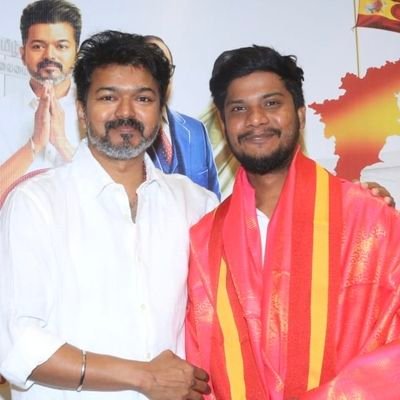
Ramesh with Vijay
On 21 May 2026, Ramesh was sworn-in as a minister too. His portfolio was the HR&CE. To have given it to him is yet another interesting move.
Vijay, by choosing the 2 Brahmin candidates seems to convey that every Tamil deserves representation, every community deserves dignity, and no identity is a legitimate target for a political party’s hatred. TVK fielded candidates across communities without making their caste their credential or their liability. And the voters responded.
Two Brahmin MLAs walking into the Tamil Nadu Assembly is not a Brahmin victory. Two Brahmin ministers entering the Cabinet is not a Brahmin victory.
It is a victory for the idea that a democracy cannot permanently exclude any of its citizens from representation.
The Dravidianists who once celebrated a ‘Brahmin-free Assembly’ will now have to confront a political reality they long believed impossible: a party that invokes EVR as one of its ideological inspirations has not only sent two Brahmins to the Assembly through democratic mandate but has also inducted them into the Cabinet.
Subscribe to our channels on WhatsApp, Telegram,Instagram and YouTube to get the best stories of the day delivered to you personally.
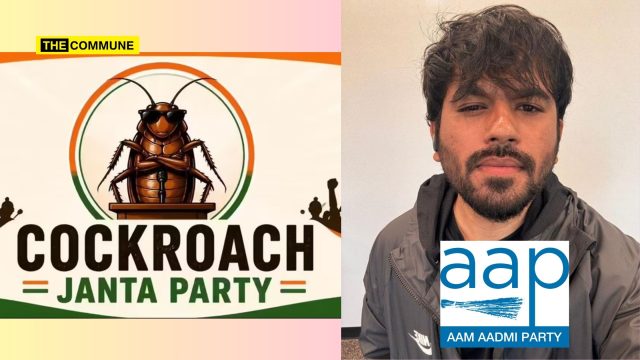
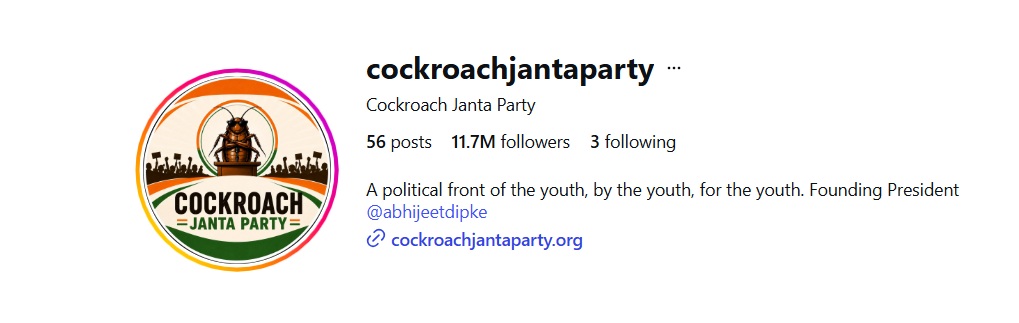
A new online political outfit calling itself the “Cockroach Janta Party” (CJP) has rapidly gone viral across social media platforms after emerging in the aftermath of controversy surrounding remarks attributed to Chief Justice of India Surya Kant.
What initially appeared to be a satirical meme campaign has now triggered wider political debate due to the background of its founder, its openly political messaging, and its aggressive attacks on institutions including the judiciary, Election Commission, media houses and the Union government.
The controversy began after remarks made by the Chief Justice during court proceedings regarding “jobless youth” entering professions such as law, journalism and activism drew criticism online. Following backlash, the CJI clarified that his remarks were being misrepresented and that he had referred specifically to individuals using bogus degrees while posing as professionals.
Soon after, a social media campaign branding itself as the “Cockroach Janta Party” surfaced online, using the controversy as the foundation for what it described as a movement representing “lazy”, “chronically online”, unemployed youth allegedly ignored by the system. The website of the so-called party declared that it existed for “the people the system forgot to count” and used slogans such as “They tried to step on us. We came back.”
Abhijeet Dipke & AAP Links
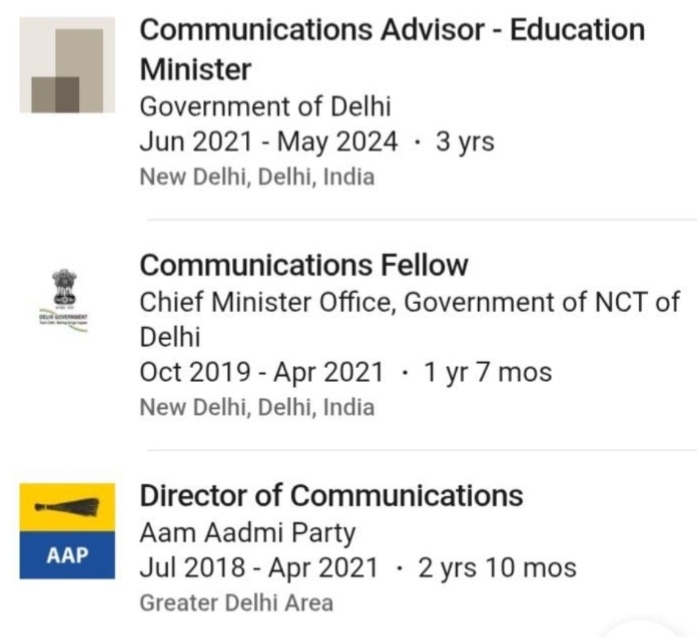
Behind the campaign is Abhijeet Dipke, a self-styled political commentator and digital campaign strategist with long-standing links to the Arvind Kejriwal-led Aam Aadmi Party ecosystem. Multiple past media reports have identified Dipke as a key member of AAP’s social media machinery during the 2020 Delhi Assembly elections, where he reportedly worked on meme campaigns, parody videos, online messaging and digital mobilisation targeting millennials and first-time voters.
Reports from that period described Dipke as part of AAP’s election war room and social media coordination team, working under AAP IT cell head Ankit Lal. He was reportedly involved in designing viral online campaigns aimed at projecting Kejriwal positively while attacking the BJP and Congress through memes, Bollywood references, edited videos and social media humour. Dipke himself reportedly stated that political messaging had to be simplified for younger audiences through “memes and videos”.
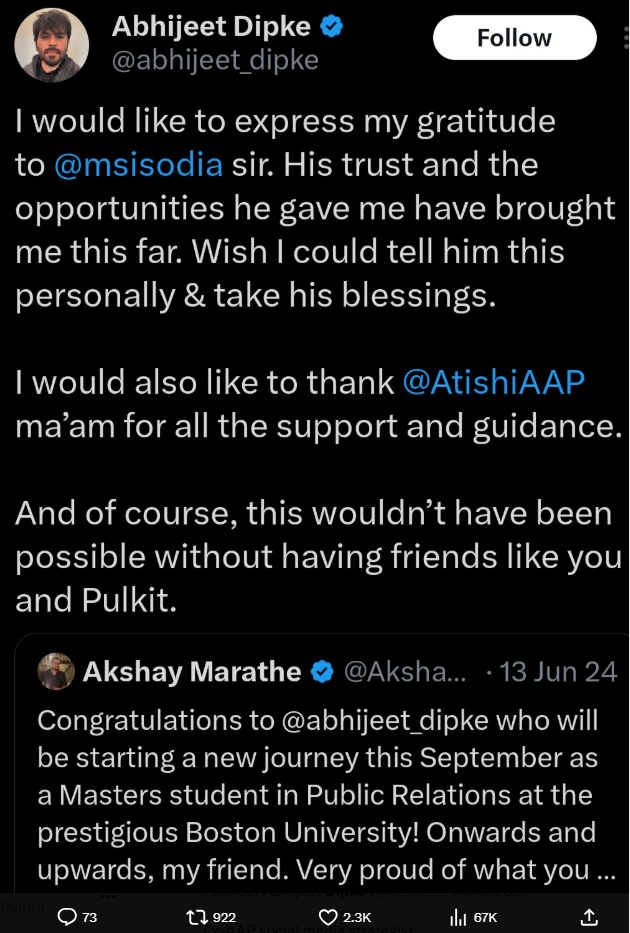
Further reports identified him as a media studies graduate from Pune who later served in communications roles connected to AAP and Delhi government outreach campaigns. According to details circulating online, Dipke later pursued a Master’s degree in Public Relations at Boston University in the United States.
Source: News Bharati
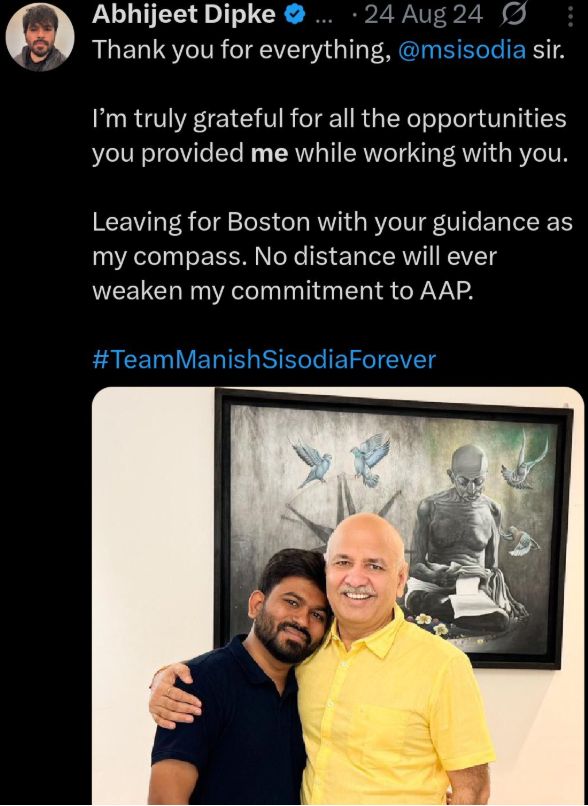
His links to AAP leader Manish Sisodia can be seen through his own elaborate posts from the past. In one post, he thanks Sisodia for giving him opportunities and also thanks Atishi after he quit the war room to continue further studies.
Source: News Bharati
In another post, he is seen hugging Sisodia and shares his ‘commitment to AAP’.
Source: News Bharati
Party & Manifesto
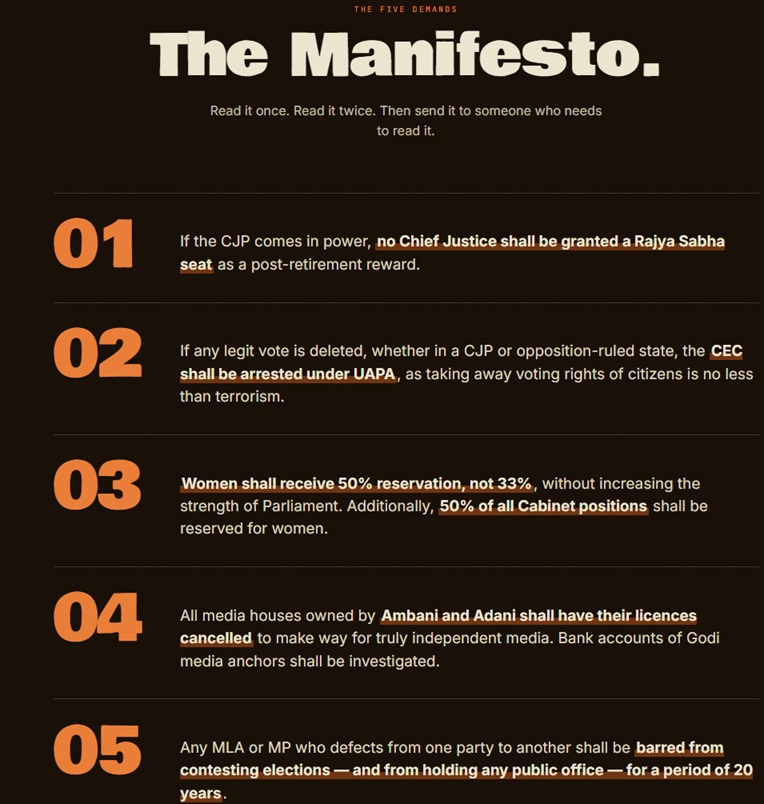
The party’s platform attacks the judiciary, Election Commission, media houses owned by industrialists, corporate groups and political defectors while simultaneously amplifying narratives frequently used by opposition parties against the BJP-led Union government.
One of the manifesto’s controversial proposals states that no Chief Justice of India should receive a Rajya Sabha nomination after retirement. Another claims that if “legitimate votes” are deleted, the Chief Election Commissioner should be arrested under UAPA, equating voter deletion with “terrorism”. Critics have pointed out that this language mirrors narratives pushed by opposition parties regarding voter revision exercises and election integrity.
The manifesto also demands cancellation of licences of media organisations allegedly linked to industrialists Mukesh Ambani and Gautam Adani, while calling for investigations into the bank accounts of so-called “Godi media” anchors. Other proposals include 50 per cent reservation for women in Parliament and Cabinet positions without increasing parliamentary strength, as well as harsh restrictions on political defectors.
Source: OpIndia
The online campaign has also attempted to tap into student-related issues such as NEET controversies, exam fraud allegations and CBSE evaluation disputes. The CJP claimed solidarity with students allegedly affected by examination irregularities and demanded removal of rechecking fees in cases where mistakes were committed by boards. Such issues were being politically weaponised under the guise of satire and meme culture.
Abhijeet Dipke & His Past Controversial Posts On Social Media
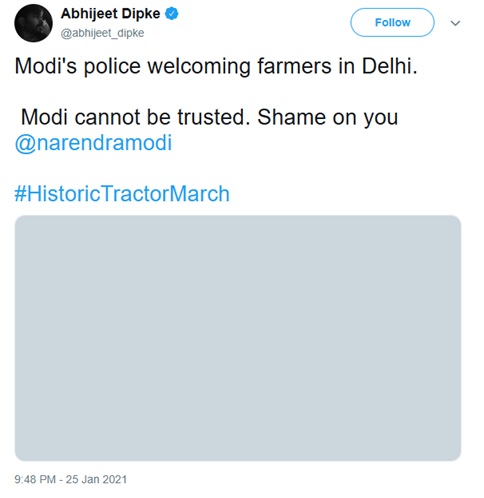
Dipke’s earlier social media activity has also resurfaced amid scrutiny over the new outfit. During the farmers’ protests and tractor rally violence in Delhi, Dipke reportedly shared posts attacking Prime Minister Narendra Modi and accusing the government of betraying farmers. One now-deleted post reportedly read: “Modi’s police welcoming farmers in Delhi. Modi cannot be trusted.”
Source: OpIndia
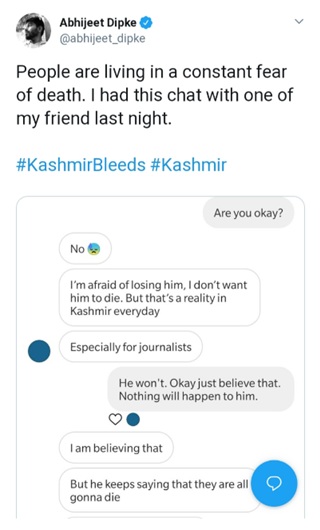
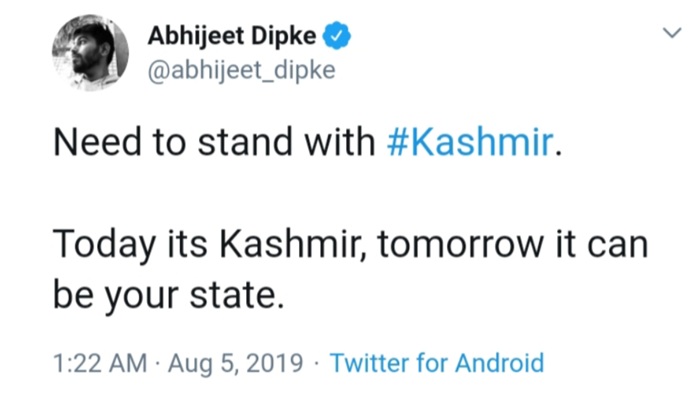
Old posts linked to Dipke from 2019 have also re-entered public discussion. During the abrogation of Article 370 in Jammu and Kashmir, Dipke allegedly posted messages claiming Kashmiris were living in fear and shared screenshots portraying panic and oppression in the Valley.
Source: News Bharati
One post reportedly stated: “Need to stand with Kashmir. Today it’s Kashmir, tomorrow it can be your state.”
Source: News Bharati
Following those posts back in 2019, NGO watchdog Legal Rights Observatory filed a complaint with Pune Police seeking action against Dipke under provisions related to sedition and unlawful activities. The complaint accused him of spreading fake news, promoting anti-India narratives and allegedly attempting to provoke support for separatist elements in Kashmir. It also reportedly sought investigation into his financial transactions, foreign travel and alleged connections with separatist groups.
Boston return, US/Pak paid n fed @abhijeet_dipke is already registered in @PuneCityPolice diary as ISI paid asset!
2019 LRO sedition complaint against him for pushing Pakistan Kashmir agenda is pending at @CPPuneCity!
Law will knock his door at appropriate time hunting cockroach! pic.twitter.com/RuDE6uizG6
— Legal Rights Observatory- LRO (@LegalLro) May 20, 2026
What the actual hell
In 2019, Legal Rights Observatory had lodged FIR against Abhijeet Dipke, founder of Cockroach Junta Party, in Pune for spreading false news of Indian atrocity in Kashmir and provoking “hurriyat like separatism” among Kashmiris pic.twitter.com/LYUHI9q1sH
— Legal Rights Observatory- LRO (@LegalLro) August 6, 2019
Abhijeet Dipke has previously pushed claims questioning the credibility of election outcomes, alleging that the BJP continued winning elections despite declining popularity only because voters were allegedly being deleted from electoral rolls.
CJP & Dipke’s Narratives
The political messaging of the so-called “Cockroach Janta Party” goes far beyond satire and increasingly mirrors familiar opposition narratives around elections and student unrest.
The ‘party’ seems to be following the same narrative as Dipke and is also evident in the CJP manifesto, which compares “vote deletion” to terrorism and even demands the arrest of the Chief Election Commissioner under UAPA — language that can be described as a dangerous attempt to delegitimise constitutional institutions through conspiracy-driven politics.
Simultaneously, the outfit has sought to tap into student anger over NEET, CBSE and exam fraud controversies, repackaging youth frustration into meme-based political mobilisation. Critics argue that this follows a broader pattern within sections of the opposition ecosystem, where social unrest, institutional distrust and online outrage are converted into coordinated anti-government campaigns disguised as satire or activism.
Real Followers Or …
The CJP ‘s handle on Instagram claimed to hit more followers than BJP, the largest party in the world. But it came to be known that majority of the followers were from Pakistan and other Islamic countries like Bangladesh and Turkey.
People from Pakistan, Bangladesh, and Turkey are following the Cockroach Janta Party in extremely large numbers.
— Office Of Vijay Patel (@VijayGajeraO) May 20, 2026
AAP & CJP
The timeline surrounding the emergence of the so-called “Cockroach Janta Party” has raised serious political questions about whether the outrage was spontaneous or carefully engineered. On 13 May 2026, even before the controversy erupted, Arvind Kejriwal and AAP-linked digital operative Abhijeet Dipke were already seen amplifying Gen Z-centric political messaging online.
On 15 May 2026, Chief Justice of India Surya Kant made oral courtroom remarks regarding unemployed youth entering professions using bogus degrees – remarks that were later clarified after backlash and were not specifically directed at “Gen Z.”
Yet, by 16 May 2026, Dipke already had social media handles, branding material, and a fully functioning website for the “Cockroach Janta Party” ready to launch, suggesting a level of preparation that critics argue goes far beyond spontaneous satire. The controversy was quickly weaponised and redirected politically toward the BJP, Prime Minister Narendra Modi and institutions associated with the ruling establishment, despite the original remarks having come from the judiciary.
Now, if the outrage was genuinely about the CJI’s comments, the anger should logically have been aimed at the judicial system itself. Instead, the party’s manifesto rapidly pivoted toward familiar opposition talking points targeting the Election Commission, industrialists like Gautam Adani, the BJP, Modi, and broader institutional structures, leading many to argue that the “meme party” is less an organic youth rebellion and more a politically packaged digital campaign aligned with the opposition ecosystem.
Timeline of the birth of Aam Aadmi Party’s new venture, Cockroach Janta Party.
13th May: Kejriwal and Abhijeet Dipke were instigating Gen Z.
15th May: CJI gave an oral remark on the Indian youth. While there is nothing in this case about Gen Z.
— Office Of Vijay Patel (@VijayGajeraO) May 20, 2026
Satire Or Instigating ‘GenZ Revolution’?
The scrutiny around Abhijeet Dipke is not limited to the sudden rise of the “Cockroach Janta Party.” His past social media activity during the 2019 abrogation of Article 370 has also resurfaced, raising fresh political questions. The resurfacing of his Kashmir related propagandaposts, combined with his AAP-linked digital background and the rapid launch of the Cockroach Janta Party, paints a larger picture of a politically motivated online mobilisation campaign rather than a spontaneous satirical movement.
Subscribe to our channels on WhatsApp, Telegram,Instagram and YouTube to get the best stories of the day delivered to you personally.
Fresh controversy has erupted in Tamil Nadu after a series of viral videos showed cadres and functionaries associated with the ruling TVK allegedly conducting “inspections” inside government institutions, triggering accusations of parallel governance and misuse of political influence.
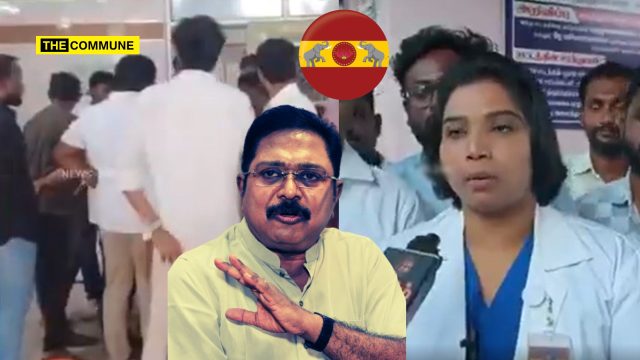
In recent days, videos from Tenkasi district have circulated widely on social media showing members linked to the “TVK Medical Wing” entering a government hospital, interacting with doctors and staff, and publicly claiming to have conducted an inquiry into allegations of medical negligence.
The individuals, some wearing medical coats and speaking in an official tone, stated before the media that they had held discussions with the Dean, reviewed hospital protocols, examined staffing shortages and assessed equipment requirements. One member claimed that a “high-level committee” had discussed measures to prevent such incidents in future and asserted that the inspection had been carried out with the Dean’s permission through the district secretary.
She is not even doctor, she is Nurse from TVK. For Insta reels, news gimmicks they are doing this! pic.twitter.com/T2hp3vGqBb
The visuals immediately sparked criticism online, with many questioning under what legal or administrative authority political party cadres were carrying out reviews and inquiries inside a state-run medical institution. Critics pointed out that audits, inspections and administrative reviews of hospitals fall under the jurisdiction of authorised government departments, health officials and medical regulatory bodies – not ruling party wings.
The controversy intensified further after another viral video showed a TVK district secretary conducting an inspection at an Amma Unavagam, the State-run subsidised canteen scheme.
In the footage, the functionary was seen questioning staff about food quality, cleanliness, salaries, maintenance work and refrigerator repairs while simultaneously issuing instructions regarding weekly inspections and corrective measures. He was also heard directing local authorities to clean water tanks immediately, improve maintenance standards and resolve wage-related grievances of workers, while claiming he would personally revisit the facility for another inspection.
Another surprise…
Earlier TVK medical wing inspecting government hospitals.
Now district secretary inspecting AMMA Unavagam which is a state government entity.
Who are actually giving them the authority to do this???
— Vasanth Lakshman (@VasanthLakshman) May 20, 2026
The videos triggered sharp reactions across social media, with several commentators alleging that TVK cadres were behaving as though they were government officers despite possessing no constitutional or administrative mandate. Others drew comparisons with earlier phases in Indian politics where ruling party workers allegedly exercised extra-constitutional influence over public institutions by invoking political proximity.
Amid the growing controversy, AMMK chief TTV Dhinakaran launched a direct attack on the ruling party and Chief Minister C. Joseph Vijay through a strongly-worded statement posted on X.
“TVK members trespassing into government offices and hospitals in the name of ‘inspection’ – the misuse of power by ruling party members in departments functioning for public welfare deserves strong condemnation. Reports have emerged in the media that, in Tenkasi district, some individuals claiming to belong to the TVK doctors’ wing entered a government hospital and conducted an ‘inspection’, while others claiming to be TVK district secretaries carried out inspections at Amma Unavagams. It is highly condemnable that some TVK members, intoxicated by the arrogance of being the ruling party, are conducting sudden inspections in government offices, issuing instructions to officials, misusing authority, and creating inconvenience for the public. When there is already an administrative structure within the government to conduct proper inspections and take action in government offices, who granted such powers to ruling party members? Chief Minister C. Joseph Vijay, who had declared during his swearing-in ceremony that ‘whoever commits wrongdoing, even if they are close to me, I will not spare them,’ must explain why no action has so far been taken against his own party members involved in abuse of power inside government offices. Further, since Mr. Joseph Vijay assumed office as Chief Minister, the public itself has been alleging that government offices including the Chief Minister’s office and public spaces have increasingly been turned into shooting locations. Under the guise of being ruling party cadres and fans, discussions taking place inside the Chief Minister’s office are allegedly being recorded, while causing inconvenience to the public for the sake of glorifying the Chief Minister through Instagram Reels has now become the ‘achievement’ and trend of the TVK government. Therefore, I urge Chief Minister and TVK leader Mr. Joseph Vijay to make his party cadres understand that publicity is different from public service, and to take appropriate action against TVK members indulging in misuse of authority in government offices and public places before such behaviour becomes entrenched,” he wrote.
அரசு அலுவலகங்களிலும் மருத்துவமனைகளிலும் ஆய்வு எனும் பெயரில் அத்துமீறும் தவெகவினர் – மக்கள் நலனுக்காக இயங்கும் துறைகளில் ஆளும் கட்சியினரின் அதிகார துஷ்பிரயோகம் கடும் கண்டனத்திற்குரியது.
தென்காசி மாவட்டத்தில் தவெக மருத்துவரணி எனும் பெயரில் சிலர் அரசு மருத்துவமனைக்குள் புகுந்து… pic.twitter.com/jioVXfHTj6