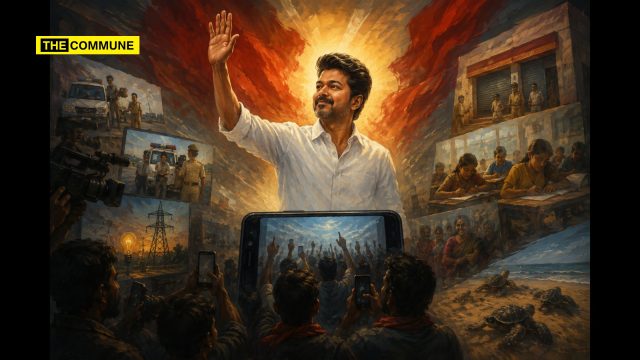
Barely days into the new government, the online machinery surrounding Joseph Vijay and the Tamilaga Vettri Kazhagam appears to have settled into a familiar pattern: present ordinary administrative continuity as revolutionary governance, aggressively amplify symbolic optics, and repackage long-existing schemes under fresh stickers carrying Vijay’s branding.
Across Instagram reels, YouTube shorts, X handles, fan pages and coordinated hashtag campaigns, TVK’s digital ecosystem has been projecting Vijay as if he has fundamentally transformed governance overnight. But a closer look at many of the celebrated “achievements” shows that several are either existing welfare schemes continued from previous governments, temporary policy tweaks exaggerated into historic reforms, or old programmes simply relaunched with new names and visuals.
Rebranding Existing Schemes As “Historic Firsts”
TVK supporter ecosystem branded all the existing schemes as historic firsts. Here is a look at a few of them.
200 Units Free Electricity
One of the clearest examples is the “200 units free electricity” narrative heavily promoted by pro-TVK handles. Online propaganda projected the move as though Tamil Nadu had never seen free electricity support before Vijay assumed office.
View this post on Instagram
In reality, Tamil Nadu already had a long-running free electricity subsidy system well before TVK entered power. The earlier 100-unit free electricity model was introduced during the AIADMK era under J. Jayalalithaa and continued later by the DMK government. What TVK announced was not the invention of free electricity itself, but a modified extension with several conditions attached.
What Vijay promised was 200 units of free electricity per month but what was given as the ‘first signature’ was 200 units free per billing cycle (of 2 months) and if the consumption went beyond 500 units, then only the existing 100 free units was applicable.
TVK’s online ecosystem deliberately flattened the details of the current implementation, including billing cycle limits and conditional applicability, to market it as a sweeping revolutionary giveaway personally delivered by Vijay.
Singapenn Special Task Force
A similar pattern is visible in the much-publicised women’s safety patrol initiative. TVK supporters promoted “Singapenn” special task force/patrol branding as if 24-hour women’s safety squads began only after Vijay became Chief Minister. Yet Tamil Nadu had already operated women-focused patrol systems such as Amma Patrol under the AIADMK government and Pink Patrol under the DMK government. Several viral videos even pointed out that many patrol vehicles now showcased online were essentially existing police jeeps with fresh stickers and renamed branding.
அதிமுக ஆட்சியில Amma Patrol பெரிய விளம்பரமின்றி தொடங்கப்பட்டது..
திமுக ஆட்சியில் PINK PATROL என பெயர் மாற்றி அது தொடரப்பட்டது !
இப்போது சிங்கப்பெண் Patrol என்று பெயர் மாற்றி பெரிய சாதனை செய்தது போல் ரீல்ஸ் போட்டு மக்களை ஏமாற்றிக் கொண்டிருக்கிறது அந்த கட்சி.. pic.twitter.com/dpDFeqEoOw
— Kwood Gangster 🙂 (@Kwood_Gangster) May 16, 2026
The actual change was largely cosmetic, while the online narrative deliberately implied that women’s 24-hour safety patrols themselves began only after TVK formed the government.
TASMAC Closures Presented As Moral Revolution
TVK’s online ecosystem also aggressively marketed the closure of 717 TASMAC liquor outlets as though Vijay had launched an unprecedented moral cleansing operation across Tamil Nadu.
The online mafia framed the move as proof that Vijay alone possessed the courage to act against liquor proliferation near schools, temples and bus stands.
But the actual order largely followed a long-established regulatory pattern already used by previous governments.
Successive administrations under AIADMK and DMK had repeatedly shut down, relocated or rationalised TASMAC outlets based on court rulings, public pressure and distance regulations. The 500-metre logic itself was the only thing that was probably new.
If such rules were implemented literally in dense urban areas like Chennai, very few TASMAC outlets could function at all due to the concentration of schools, hospitals and religious institutions. Earlier governments therefore used phased relocations and selective enforcement.
But TVK’s online propaganda converted a continuation of an existing administrative policy approach into a dramatic morality play where Vijay was portrayed as single-handedly “saving Tamil society.”
Several handles even took pictures of TASMAC outlets reportedly ‘shut down’ but only to find them being fact checked that they took the pictures before the opening hours and they opened as usual later in the day.
“First Woman”, “First Dalit” Claims Ignore Tamil Nadu’s Political History
Another striking pattern has been the inflation of routine political appointments into fake “historic firsts.”
TVK-aligned handles celebrated certain appointments by claiming Vijay had delivered Tamil Nadu’s “first woman minister” or “first Dalit representation” in governance.
தமிழ்நாட்டின் முதல் பெண் அமைச்சர் கீர்த்தனா.
தமிழ்நாட்டின் முதல் தலித் அமைச்சர் ராஜ்மோகன்.
தமிழ்நாட்டின் முதல் முதலமைச்சர் விஜய்.
தமிழ்நாட்டின் முதல் தேர்தல் 2026 சட்டமன்றத் தேர்தல்.
போதுமா, வேற ஏதும் ஒத்துக்கணுமா?
— sugunadiwakar (@sugunadiwakar) May 17, 2026
The problem is that Tamil Nadu has already had women Ministers, even two women chief ministers and Dalit ministers across multiple governments for decades.
The Post claim this lady is the 1st Woman Minister!
5,17,000+ people liked it with even verifying the fact..
But the facts are:
#1
Rukmini Lakshmipathi (also spelled Rukmani Lakshmipathi) was the first woman minister in the Madras Presidency (precursor to Tamil Nadu), serving… pic.twitter.com/qgYDyq1qkB— We Dravidians (@WeDravidians) May 12, 2026
From J. Jayalalithaa to several women ministers under both AIADMK and DMK, female political representation in Tamil Nadu predates TVK by generations. Similarly, a Dalit minister for education have already been seen in earlier governments as well – ADMK had Benjamin and DMK had Govi Chezhian.
Fake news alert.
Benjamin was appointed by Jayalalithaa as the first Dalit Minister of School Education in Tamil Nadu.
Ko .vi Chezhiyan was appointed by M.K. Stalin as the first Dalit Minister of Higher Education in Tamil Nadu. https://t.co/nS3EHRTELL
— Bala vetrivel N (@vetrivel1996) May 16, 2026
TVK’s digital ecosystem deliberately blurs the distinction between “first inside TVK” and “first in Tamil Nadu history,” allowing fan networks to create the illusion that social justice representation itself began only after Vijay entered Fort St. George.
Free Coaching Schemes Already Existed Long Before TVK
TVK propaganda also celebrated “free coaching for TN youth” as though the state had never previously supported competitive exam preparation.
Misinformation mafia/ cartel
From day 1 till now its working like a cartel. Who are they?First woman minister in Tamil Nadu
CM giving evil smile at the AIADMK camp after they extended support
Big move: CM launched new free coaching classes for UPSC aspirants
Having lunch at… pic.twitter.com/lQngSvAWBv
— Pearson abraham/பியர்சன் (@pearsonlenekar) May 16, 2026
In reality, Tamil Nadu has operated free coaching centres for UPSC, TNPSC and other government examinations for years through state-run agencies and district-level programmes.
The official Tamil Nadu Career Services site (under the employment department) states that Study Circles have been functioning at all District Employment and Career Guidance Centres since 1999, “with a view to assist aspirants of various competitive examinations by rendering them free coaching and guidance.”
What TVK largely appears to be doing is expanding, renaming or reorganising existing structures while marketing them as entirely original welfare inventions of Vijay’s administration.
This can be described as “sticker politics” which was practiced by the DMK during their regime – existing schemes continue functioning, but with fresh logos, slogans and social media packaging designed to emotionally associate every state activity with Vijay personally.
Even A White Towel Became “Historic Governance Reform”
Perhaps the clearest example of optics overpowering substance was the viral campaign surrounding Vijay removing the traditional white towel from the Chief Minister’s chair.
Some digital news desks today are so desperate for clicks that if a paperweight goes missing from the Secretariat tomorrow, they may declare it a silent revolution against colonialism.( all major digital desks throughout the Nation)
A climate activist shared a photo of CM Vijay… pic.twitter.com/GUY6xf4Gxx
— Pearson abraham/பியர்சன் (@pearsonlenekar) May 16, 2026
TVK supporters and several national media outlets projected the move as a revolutionary anti-VIP reform symbolising the collapse of political elitism.
Tamilnadu CM Joseph Vijay removed the white towel from his chair after climate activist Licypriya Kangujam urged him to end the “white towel culture” on VIP chairs.
pic.twitter.com/bBoYninO7e— News Algebra (@NewsAlgebraIND) May 17, 2026
But such gestures have virtually no impact on governance, administration or state hierarchy. Political observers also noted that earlier leaders had not always strictly followed identical symbolic traditions either.
Since yesterday, Joseph Vijay fans and TVK supporters have been celebrating, saying, “Look, Vijay removed the white VIP towel from behind the chair.”
Yes, it is good that it was removed. But those claiming that Vijay is the first CM to do this should know that India’s PM… pic.twitter.com/xQAlJvcw4u
— Amit Kumar Sindhi (@AMIT_GUJJU) May 16, 2026
Yet online propaganda transformed a furniture-related symbolic choice into a civilisation-level political reform narrative.
The same happened with convoy videos. Posts claiming it was Vijay who introduced the ‘no traffic halt’ rule for convoy allowing traffic movement were circulated as though Tamil Nadu had never previously seen controlled convoy movement under earlier administrations.
𝐅𝐚𝐜𝐭 𝐂𝐡𝐞𝐜𝐤: 𝐃𝐢𝐝 𝐕𝐢𝐣𝐚𝐲 𝐢𝐧𝐭𝐫𝐨𝐝𝐮𝐜𝐞 𝐧𝐨 𝐭𝐫𝐚𝐟𝐟𝐢𝐜 𝐡𝐚𝐥𝐭𝐬 𝐩𝐨𝐥𝐢𝐜𝐲 𝐟𝐨𝐫 𝐂𝐌’𝐬 𝐜𝐨𝐧𝐯𝐨𝐲?
Fans of actor-turned-politician Vijay have taken to social media to brag about positive policy changes the new Chief Minister of Tamil Nadu has… pic.twitter.com/RJBHXIA4zX
— IndiaToday (@IndiaToday) May 16, 2026
AI-Generated Images And Manufactured “Simple Man” Branding
The propaganda ecosystem surrounding Vijay has also faced scrutiny over manipulated or AI-generated visuals designed to build a carefully curated “people’s leader” image.
Several viral images showed Vijay allegedly bringing food from home, eating modest meals with his hands, or living with extreme simplicity. Some of these visuals were later flagged by fact-checkers as digitally manipulated or AI-generated.
Vijay is gaining attention online for his simple daily routine as Chief Minister. 🍱🇮🇳
According to reports, CM Vijay carries home-cooked food to the Secretariat, works long hours, and prefers eating simple meals by hand inside his office just like an ordinary employee.
The… pic.twitter.com/Z4QYKciTN5
— Kalam Center (@KalamCenter) May 18, 2026
But by the time corrections emerged, the emotional branding had already spread across social media ecosystems.
This reflects a broader shift where governance itself increasingly becomes secondary to image engineering. Instead of discussing policy execution, budgetary sustainability or administrative performance, online discourse becomes centred around constructing a mythological “simple CM” persona.
Olive Ridley Turtle Release Became A Vijay Achievement
One of the most outrageous examples involved viral TVK narratives around Olive Ridley turtle hatchlings being released into the sea.
Pro-TVK pages circulated visuals implying Vijay had spearheaded a major environmental conservation initiative almost immediately after becoming Chief Minister.
Fake news is being spread as if “CM Vijay ordered turtles to be released.”oh wow..
Please pause
But turtle conservation in Chennai is not new at all. This initiative has existed for many years through the work of volunteers and environmental activists.
I myself volunteered in… pic.twitter.com/ipJsNt7VAQ
— Abinya Selvan (@abinyaselvan) May 17, 2026
But conservationists quickly pointed out that Olive Ridley hatchling releases have been taking place annually for decades under routine forest department and volunteer conservation programmes along the Tamil Nadu coastline.
Social media propaganda simply repackaged the annual ecological exercise into a personalised Vijay achievement story.
Vijay & His Online TVK Mafia
In the end, the criticism against Tamilaga Vettri Kazhagam is not that it promotes its leader aggressively – every party does that. The accusation is that TVK’s online machinery appears determined to manufacture a political mythology around Joseph Vijay by converting ordinary governance into cinematic heroism. Existing schemes are rebranded as revolutionary breakthroughs, symbolic gestures are sold as systemic reforms, and decades-old government programmes are projected as if they began the day Vijay took oath. Tamil Nadu is increasingly witnessing “sticker governance” where changing the logo and flooding social media matters more than delivering genuinely original policy transformation.
Subscribe to our channels on WhatsApp, Telegram, Instagram and YouTube to get the best stories of the day delivered to you personally.