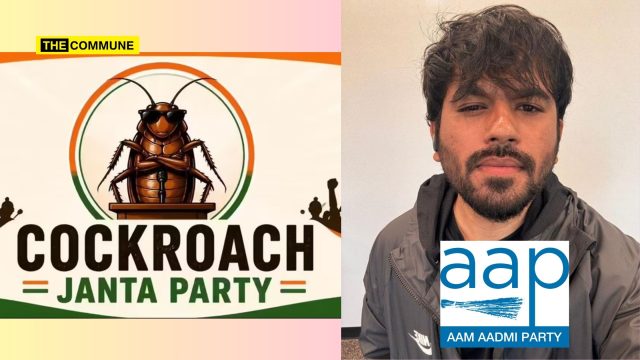
A new online political outfit calling itself the “Cockroach Janta Party” (CJP) has rapidly gone viral across social media platforms after emerging in the aftermath of controversy surrounding remarks attributed to Chief Justice of India Surya Kant.
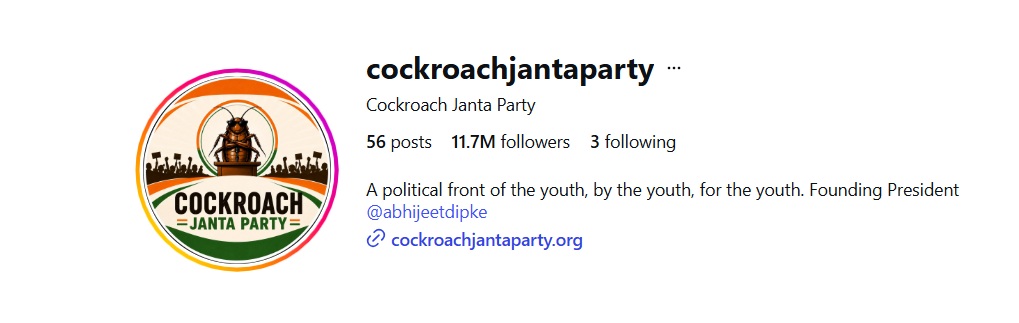
What initially appeared to be a satirical meme campaign has now triggered wider political debate due to the background of its founder, its openly political messaging, and its aggressive attacks on institutions including the judiciary, Election Commission, media houses and the Union government.
The controversy began after remarks made by the Chief Justice during court proceedings regarding “jobless youth” entering professions such as law, journalism and activism drew criticism online. Following backlash, the CJI clarified that his remarks were being misrepresented and that he had referred specifically to individuals using bogus degrees while posing as professionals.
Soon after, a social media campaign branding itself as the “Cockroach Janta Party” surfaced online, using the controversy as the foundation for what it described as a movement representing “lazy”, “chronically online”, unemployed youth allegedly ignored by the system. The website of the so-called party declared that it existed for “the people the system forgot to count” and used slogans such as “They tried to step on us. We came back.”
Abhijeet Dipke & AAP Links
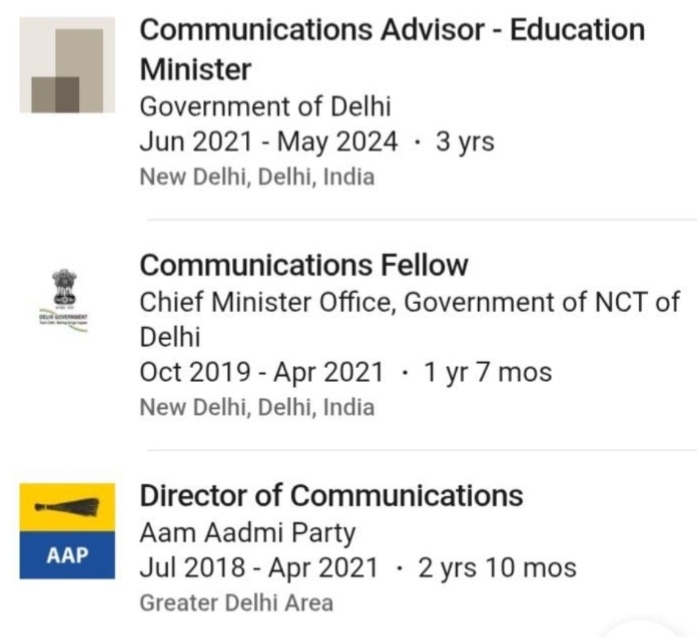
Behind the campaign is Abhijeet Dipke, a self-styled political commentator and digital campaign strategist with long-standing links to the Arvind Kejriwal-led Aam Aadmi Party ecosystem. Multiple past media reports have identified Dipke as a key member of AAP’s social media machinery during the 2020 Delhi Assembly elections, where he reportedly worked on meme campaigns, parody videos, online messaging and digital mobilisation targeting millennials and first-time voters.
Reports from that period described Dipke as part of AAP’s election war room and social media coordination team, working under AAP IT cell head Ankit Lal. He was reportedly involved in designing viral online campaigns aimed at projecting Kejriwal positively while attacking the BJP and Congress through memes, Bollywood references, edited videos and social media humour. Dipke himself reportedly stated that political messaging had to be simplified for younger audiences through “memes and videos”.
Further reports identified him as a media studies graduate from Pune who later served in communications roles connected to AAP and Delhi government outreach campaigns. According to details circulating online, Dipke later pursued a Master’s degree in Public Relations at Boston University in the United States.
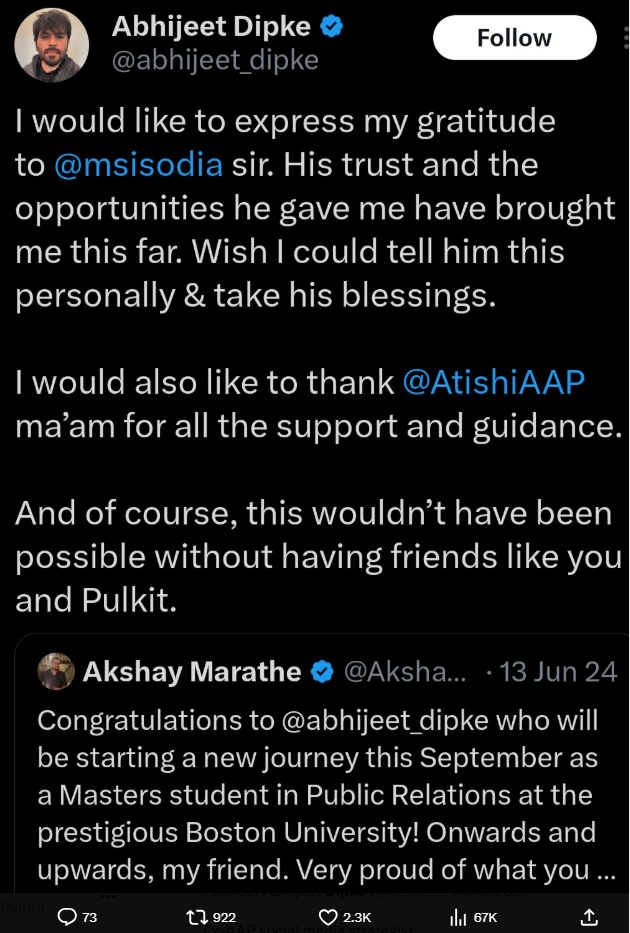
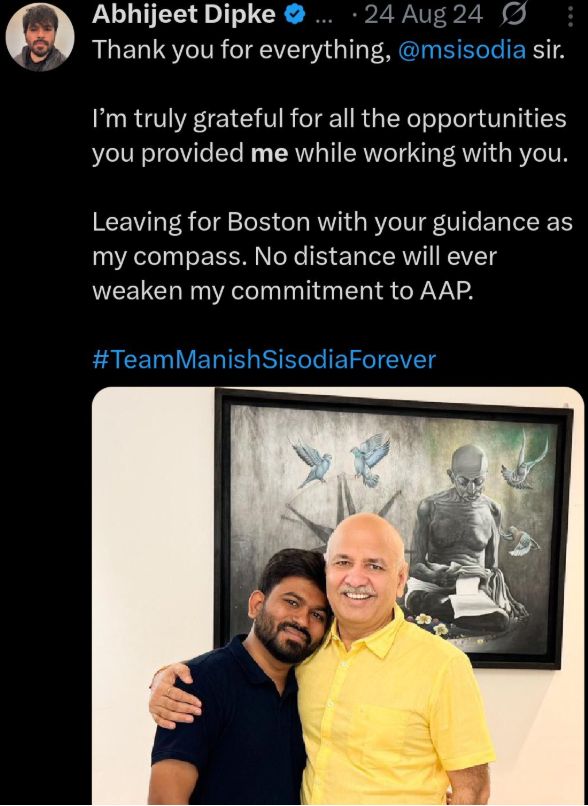
His links to AAP leader Manish Sisodia can be seen through his own elaborate posts from the past. In one post, he thanks Sisodia for giving him opportunities and also thanks Atishi after he quit the war room to continue further studies.
In another post, he is seen hugging Sisodia and shares his ‘commitment to AAP’.
Party & Manifesto
The party’s platform attacks the judiciary, Election Commission, media houses owned by industrialists, corporate groups and political defectors while simultaneously amplifying narratives frequently used by opposition parties against the BJP-led Union government.
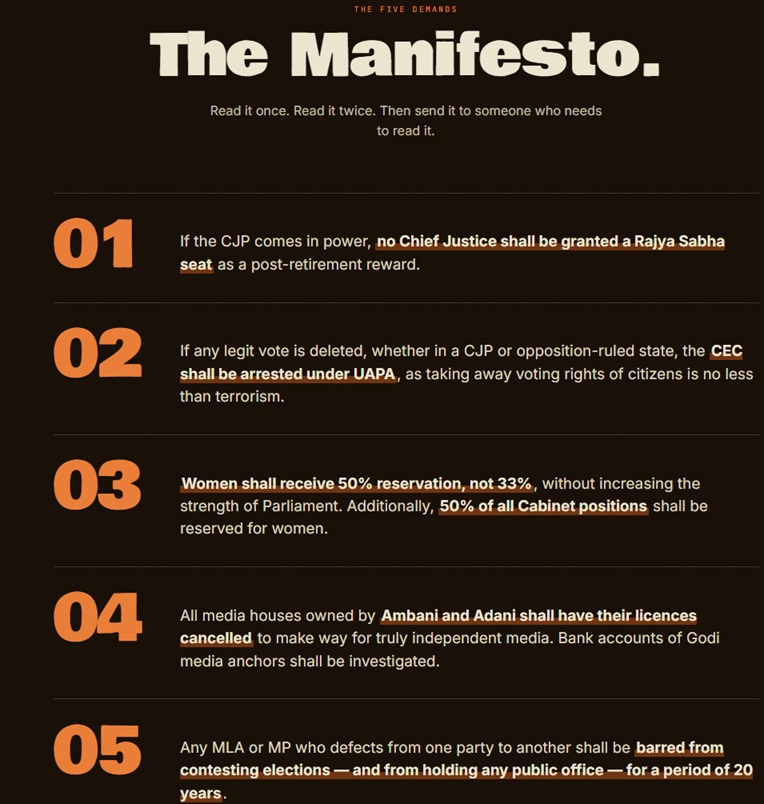
One of the manifesto’s controversial proposals states that no Chief Justice of India should receive a Rajya Sabha nomination after retirement. Another claims that if “legitimate votes” are deleted, the Chief Election Commissioner should be arrested under UAPA, equating voter deletion with “terrorism”. Critics have pointed out that this language mirrors narratives pushed by opposition parties regarding voter revision exercises and election integrity.
The manifesto also demands cancellation of licences of media organisations allegedly linked to industrialists Mukesh Ambani and Gautam Adani, while calling for investigations into the bank accounts of so-called “Godi media” anchors. Other proposals include 50 per cent reservation for women in Parliament and Cabinet positions without increasing parliamentary strength, as well as harsh restrictions on political defectors.
The online campaign has also attempted to tap into student-related issues such as NEET controversies, exam fraud allegations and CBSE evaluation disputes. The CJP claimed solidarity with students allegedly affected by examination irregularities and demanded removal of rechecking fees in cases where mistakes were committed by boards. Such issues were being politically weaponised under the guise of satire and meme culture.
Abhijeet Dipke & His Past Controversial Posts On Social Media
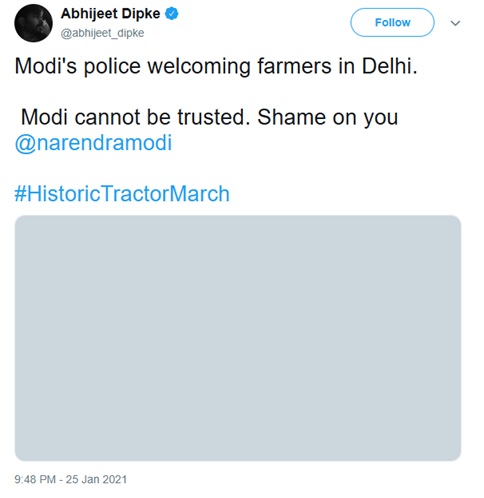
Dipke’s earlier social media activity has also resurfaced amid scrutiny over the new outfit. During the farmers’ protests and tractor rally violence in Delhi, Dipke reportedly shared posts attacking Prime Minister Narendra Modi and accusing the government of betraying farmers. One now-deleted post reportedly read: “Modi’s police welcoming farmers in Delhi. Modi cannot be trusted.”
Old posts linked to Dipke from 2019 have also re-entered public discussion. During the abrogation of Article 370 in Jammu and Kashmir, Dipke allegedly posted messages claiming Kashmiris were living in fear and shared screenshots portraying panic and oppression in the Valley.
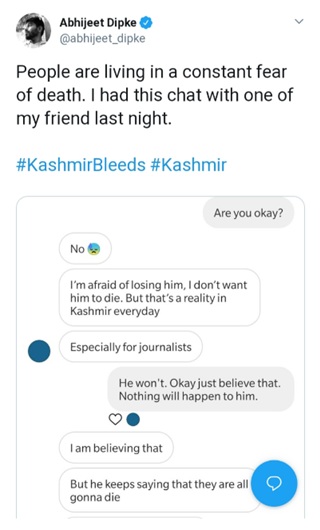
One post reportedly stated: “Need to stand with Kashmir. Today it’s Kashmir, tomorrow it can be your state.”
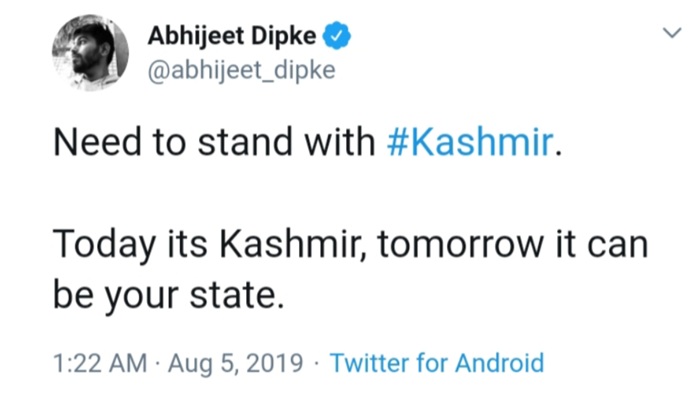
Following those posts back in 2019, NGO watchdog Legal Rights Observatory filed a complaint with Pune Police seeking action against Dipke under provisions related to sedition and unlawful activities. The complaint accused him of spreading fake news, promoting anti-India narratives and allegedly attempting to provoke support for separatist elements in Kashmir. It also reportedly sought investigation into his financial transactions, foreign travel and alleged connections with separatist groups.
Boston return, US/Pak paid n fed @abhijeet_dipke is already registered in @PuneCityPolice diary as ISI paid asset!
2019 LRO sedition complaint against him for pushing Pakistan Kashmir agenda is pending at @CPPuneCity!
Law will knock his door at appropriate time hunting cockroach! pic.twitter.com/RuDE6uizG6— Legal Rights Observatory- LRO (@LegalLro) May 20, 2026
What the actual hell
In 2019, Legal Rights Observatory had lodged FIR against Abhijeet Dipke, founder of Cockroach Junta Party, in Pune for spreading false news of Indian atrocity in Kashmir and provoking “hurriyat like separatism” among Kashmiris pic.twitter.com/LYUHI9q1sH
— Muji Singh Rangi (@mujifren) May 20, 2026
Following the complaint, he deleted his posts.
Till ysrday @abhijeet_dipke was
AAP’s Natl SM Convener; after getting caught for separatist/ seditious tweets, he deleted tweets, “AAP” reference disappeared from his bio! Someone frm @PuneCityPolice @CPPuneCity must hv intimated him abt #LRO complaint! @AamAadmiParty pic.twitter.com/7eTDthniD7— Legal Rights Observatory- LRO (@LegalLro) August 6, 2019
Abhijeet Dipke has previously pushed claims questioning the credibility of election outcomes, alleging that the BJP continued winning elections despite declining popularity only because voters were allegedly being deleted from electoral rolls.
CJP & Dipke’s Narratives
The political messaging of the so-called “Cockroach Janta Party” goes far beyond satire and increasingly mirrors familiar opposition narratives around elections and student unrest.
The ‘party’ seems to be following the same narrative as Dipke and is also evident in the CJP manifesto, which compares “vote deletion” to terrorism and even demands the arrest of the Chief Election Commissioner under UAPA — language that can be described as a dangerous attempt to delegitimise constitutional institutions through conspiracy-driven politics.
Simultaneously, the outfit has sought to tap into student anger over NEET, CBSE and exam fraud controversies, repackaging youth frustration into meme-based political mobilisation. Critics argue that this follows a broader pattern within sections of the opposition ecosystem, where social unrest, institutional distrust and online outrage are converted into coordinated anti-government campaigns disguised as satire or activism.
Real Followers Or …
The CJP ‘s handle on Instagram claimed to hit more followers than BJP, the largest party in the world. But it came to be known that majority of the followers were from Pakistan and other Islamic countries like Bangladesh and Turkey.
People from Pakistan, Bangladesh, and Turkey are following the Cockroach Janta Party in extremely large numbers.
India is facing challenges on so many fronts. pic.twitter.com/OVEQKlyYXE
— Office Of Vijay Patel (@VijayGajeraO) May 20, 2026
In fact, the admin himself sits in Dubai!
What a coincidence!
Nabil Shaikh, who is settled in Dubai, is the admin of the Cockroach Janata Party’s another Instagram account, and He is also roaming in the USA! https://t.co/n2TCiiHpbW pic.twitter.com/vrd9S6ENv9
— Office Of Vijay Patel (@VijayGajeraO) May 20, 2026
AAP & CJP
The timeline surrounding the emergence of the so-called “Cockroach Janta Party” has raised serious political questions about whether the outrage was spontaneous or carefully engineered. On 13 May 2026, even before the controversy erupted, Arvind Kejriwal and AAP-linked digital operative Abhijeet Dipke were already seen amplifying Gen Z-centric political messaging online.
On 15 May 2026, Chief Justice of India Surya Kant made oral courtroom remarks regarding unemployed youth entering professions using bogus degrees – remarks that were later clarified after backlash and were not specifically directed at “Gen Z.”
Yet, by 16 May 2026, Dipke already had social media handles, branding material, and a fully functioning website for the “Cockroach Janta Party” ready to launch, suggesting a level of preparation that critics argue goes far beyond spontaneous satire. The controversy was quickly weaponised and redirected politically toward the BJP, Prime Minister Narendra Modi and institutions associated with the ruling establishment, despite the original remarks having come from the judiciary.
Now, if the outrage was genuinely about the CJI’s comments, the anger should logically have been aimed at the judicial system itself. Instead, the party’s manifesto rapidly pivoted toward familiar opposition talking points targeting the Election Commission, industrialists like Gautam Adani, the BJP, Modi, and broader institutional structures, leading many to argue that the “meme party” is less an organic youth rebellion and more a politically packaged digital campaign aligned with the opposition ecosystem.
Timeline of the birth of Aam Aadmi Party’s new venture, Cockroach Janta Party.
13th May: Kejriwal and Abhijeet Dipke were instigating Gen Z.
15th May: CJI gave an oral remark on the Indian youth. While there is nothing in this case about Gen Z.
16th May: Abhijeet was ready… pic.twitter.com/nshOD6QDTv
— Office Of Vijay Patel (@VijayGajeraO) May 20, 2026
Satire Or Instigating ‘GenZ Revolution’?
The scrutiny around Abhijeet Dipke is not limited to the sudden rise of the “Cockroach Janta Party.” His past social media activity during the 2019 abrogation of Article 370 has also resurfaced, raising fresh political questions. The resurfacing of his Kashmir related propagandaposts, combined with his AAP-linked digital background and the rapid launch of the Cockroach Janta Party, paints a larger picture of a politically motivated online mobilisation campaign rather than a spontaneous satirical movement.
Subscribe to our channels on WhatsApp, Telegram, Instagram and YouTube to get the best stories of the day delivered to you personally.