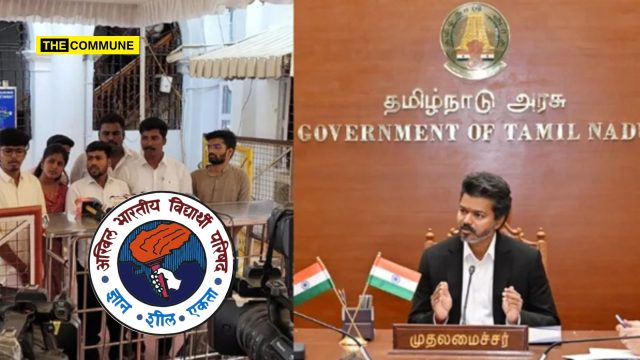
A delegation of the Akhil Bharatiya Vidyarthi Parishad (ABVP), Tamil Nadu, met Tamil Nadu Chief Minister C. Joseph Vijay at Fort St. George in Chennai on May 19 and submitted a detailed 16-point memorandum raising concerns over school education, higher education, student welfare, and campus safety in the State, as reported in Organiser.
According to ABVP, the memorandum highlighted several issues that it claimed were often absent from official reports and textbooks. The student organisation stated that more than 1,200 schools had been shut down over the last five years and alleged that many Class 5 students in rural areas continued to struggle to read Tamil at the level expected of a Class 2 student. It also pointed to the continued dependence on guest lecturers who, it said, had been working for years on low honorariums.
The organisation further alleged that Internal Complaints Committees meant to address issues faced by women students remained inactive or non-functional in several educational institutions. ABVP stated that these issues reflected a deep crisis in the education system rather than isolated statistical concerns.
The delegation demanded the introduction of medical and engineering education in Tamil medium, arguing that such a move was necessary to support rural students who had been deprived of professional education because of language barriers.
ABVP also sought the immediate removal of the ban on student union elections in the State, which it said had continued for more than a decade. The organisation stated that the restriction went against democratic values and student rights. Referring to the recommendations of the J.M. Lyngdoh Committee, ABVP argued that structured and disciplined student democracy had already been envisaged under Supreme Court-backed guidelines and questioned the continued delay in implementing student elections.
The delegation additionally raised concerns regarding the condition of SC/ST and OBC hostels across Tamil Nadu. ABVP alleged that several hostels lacked basic facilities such as cleanliness, security, and quality food, forcing students from marginalised communities to live in unacceptable conditions.
ABVP also drew the State government’s attention to the Prime Minister Schools for Rising India (PM SHRI) Scheme. The organisation alleged that Tamil Nadu was losing nearly ₹2,000 crore in central assistance because the State government had not signed the required Memorandum of Understanding (MoU). According to ABVP, the funds were intended to strengthen infrastructure in rural schools and students should not be denied such support due to political considerations.
The memorandum further called for the immediate appointment of Vice-Chancellors in universities where vacancies remained unfilled, increased budgetary allocations for educational infrastructure and research, and the establishment of a dedicated anti-narcotics task force near educational campuses across the State.
Karyakartas of ABVP Tamil Nadu today met Chief Minister of Tamil Nadu Shri C. Joseph Vijay at the State Secretariat and submitted a 16-point memorandum concerning various student issues across the state.
The delegation highlighted key demands including introduction of Tamil… pic.twitter.com/xeCc2LxlsN
— ABVP (@ABVPVoice) May 19, 2026
ABVP reiterated its demand for a drug-free Tamil Nadu and urged the government to treat campus safety as a priority issue.
Speaking after the meeting, Yuvraj Damodaran stated that the delegation had presented 16 demands concerning students in the State. He said the Chief Minister had immediately agreed to eight of the demands and had assured the delegation that the remaining issues would also be examined.
Karyakartas of ABVP Tamil Nadu today met Hon’ble Chief Minister of Tamil Nadu Shri C. Joseph Vijay at the State Secretariat and submitted a 16-point memorandum concerning various student issues across the state.
The delegation highlighted key demands including introduction of…
— ABVP (@ABVPVoice) May 19, 2026
He further stated that ABVP had sought the introduction of Tamil language courses and student union elections across universities and educational institutions, along with increased allocations for infrastructure and research. He added that the organisation had also demanded appointments to vacant Vice-Chancellor posts and the creation of a special anti-narcotics task force near campuses to ensure a drug-free Tamil Nadu.
ABVP also welcomed the State government’s decision to shut down 717 TASMAC outlets located near schools, temples, and bus stands. Calling it a positive step, the organisation expressed hope that similar seriousness would be shown in addressing issues concerning educational institutions, universities, and student hostels.
Subscribe to our channels on WhatsApp, Telegram, Instagram and YouTube to get the best stories of the day delivered to you personally.