Home Blog Page 48

“Instagram Reels Cannot Replace Governance”: AMMK Chief TTV Dhinakaran Blasts TVK Over Viral ‘Inspection’ Videos
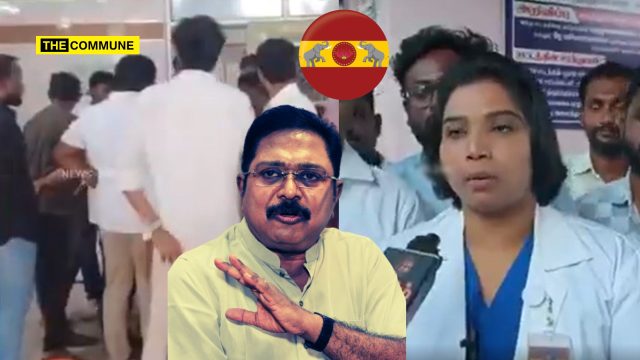
“Instagram Reels Cannot Replace Governance”: AMMK Chief TTV Dhinakaran Blasts TVK Over Viral ‘Inspection’ Videos

Fresh controversy has erupted in Tamil Nadu after a series of viral videos showed cadres and functionaries associated with the ruling TVK allegedly conducting “inspections” inside government institutions, triggering accusations of parallel governance and misuse of political influence.

In recent days, videos from Tenkasi district have circulated widely on social media showing members linked to the “TVK Medical Wing” entering a government hospital, interacting with doctors and staff, and publicly claiming to have conducted an inquiry into allegations of medical negligence.

The individuals, some wearing medical coats and speaking in an official tone, stated before the media that they had held discussions with the Dean, reviewed hospital protocols, examined staffing shortages and assessed equipment requirements. One member claimed that a “high-level committee” had discussed measures to prevent such incidents in future and asserted that the inspection had been carried out with the Dean’s permission through the district secretary.

The visuals immediately sparked criticism online, with many questioning under what legal or administrative authority political party cadres were carrying out reviews and inquiries inside a state-run medical institution. Critics pointed out that audits, inspections and administrative reviews of hospitals fall under the jurisdiction of authorised government departments, health officials and medical regulatory bodies – not ruling party wings.

The controversy intensified further after another viral video showed a TVK district secretary conducting an inspection at an Amma Unavagam, the State-run subsidised canteen scheme.

In the footage, the functionary was seen questioning staff about food quality, cleanliness, salaries, maintenance work and refrigerator repairs while simultaneously issuing instructions regarding weekly inspections and corrective measures. He was also heard directing local authorities to clean water tanks immediately, improve maintenance standards and resolve wage-related grievances of workers, while claiming he would personally revisit the facility for another inspection.

The videos triggered sharp reactions across social media, with several commentators alleging that TVK cadres were behaving as though they were government officers despite possessing no constitutional or administrative mandate. Others drew comparisons with earlier phases in Indian politics where ruling party workers allegedly exercised extra-constitutional influence over public institutions by invoking political proximity.

Amid the growing controversy, AMMK chief TTV Dhinakaran launched a direct attack on the ruling party and Chief Minister C. Joseph Vijay through a strongly-worded statement posted on X.

“TVK members trespassing into government offices and hospitals in the name of ‘inspection’ – the misuse of power by ruling party members in departments functioning for public welfare deserves strong condemnation. Reports have emerged in the media that, in Tenkasi district, some individuals claiming to belong to the TVK doctors’ wing entered a government hospital and conducted an ‘inspection’, while others claiming to be TVK district secretaries carried out inspections at Amma Unavagams. It is highly condemnable that some TVK members, intoxicated by the arrogance of being the ruling party, are conducting sudden inspections in government offices, issuing instructions to officials, misusing authority, and creating inconvenience for the public. When there is already an administrative structure within the government to conduct proper inspections and take action in government offices, who granted such powers to ruling party members? Chief Minister C. Joseph Vijay, who had declared during his swearing-in ceremony that ‘whoever commits wrongdoing, even if they are close to me, I will not spare them,’ must explain why no action has so far been taken against his own party members involved in abuse of power inside government offices. Further, since Mr. Joseph Vijay assumed office as Chief Minister, the public itself has been alleging that government offices including the Chief Minister’s office and public spaces have increasingly been turned into shooting locations. Under the guise of being ruling party cadres and fans, discussions taking place inside the Chief Minister’s office are allegedly being recorded, while causing inconvenience to the public for the sake of glorifying the Chief Minister through Instagram Reels has now become the ‘achievement’ and trend of the TVK government. Therefore, I urge Chief Minister and TVK leader Mr. Joseph Vijay to make his party cadres understand that publicity is different from public service, and to take appropriate action against TVK members indulging in misuse of authority in government offices and public places before such behaviour becomes entrenched,” he wrote.

Subscribe to our channels on WhatsAppTelegram, Instagram and YouTube to get the best stories of the day delivered to you personally.
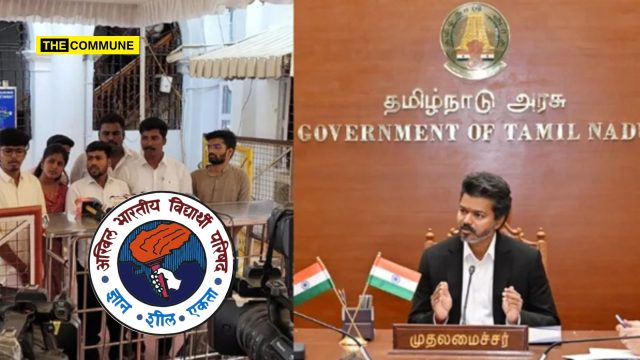
ABVP Meets CM Vijay, Submits 16-Point Memorandum; Govt Agrees To 8 Demands

ABVP Meets CM Vijay, Submits 16-Point Memorandum; Govt Agrees To 8 Demands

A delegation of the Akhil Bharatiya Vidyarthi Parishad (ABVP), Tamil Nadu, met Tamil Nadu Chief Minister C. Joseph Vijay at Fort St. George in Chennai on May 19 and submitted a detailed 16-point memorandum raising concerns over school education, higher education, student welfare, and campus safety in the State, as reported in Organiser.

According to ABVP, the memorandum highlighted several issues that it claimed were often absent from official reports and textbooks. The student organisation stated that more than 1,200 schools had been shut down over the last five years and alleged that many Class 5 students in rural areas continued to struggle to read Tamil at the level expected of a Class 2 student. It also pointed to the continued dependence on guest lecturers who, it said, had been working for years on low honorariums.

The organisation further alleged that Internal Complaints Committees meant to address issues faced by women students remained inactive or non-functional in several educational institutions. ABVP stated that these issues reflected a deep crisis in the education system rather than isolated statistical concerns.

The delegation demanded the introduction of medical and engineering education in Tamil medium, arguing that such a move was necessary to support rural students who had been deprived of professional education because of language barriers.

ABVP also sought the immediate removal of the ban on student union elections in the State, which it said had continued for more than a decade. The organisation stated that the restriction went against democratic values and student rights. Referring to the recommendations of the J.M. Lyngdoh Committee, ABVP argued that structured and disciplined student democracy had already been envisaged under Supreme Court-backed guidelines and questioned the continued delay in implementing student elections.

The delegation additionally raised concerns regarding the condition of SC/ST and OBC hostels across Tamil Nadu. ABVP alleged that several hostels lacked basic facilities such as cleanliness, security, and quality food, forcing students from marginalised communities to live in unacceptable conditions.

ABVP also drew the State government’s attention to the Prime Minister Schools for Rising India (PM SHRI) Scheme. The organisation alleged that Tamil Nadu was losing nearly ₹2,000 crore in central assistance because the State government had not signed the required Memorandum of Understanding (MoU). According to ABVP, the funds were intended to strengthen infrastructure in rural schools and students should not be denied such support due to political considerations.

The memorandum further called for the immediate appointment of Vice-Chancellors in universities where vacancies remained unfilled, increased budgetary allocations for educational infrastructure and research, and the establishment of a dedicated anti-narcotics task force near educational campuses across the State.

ABVP reiterated its demand for a drug-free Tamil Nadu and urged the government to treat campus safety as a priority issue.

Speaking after the meeting, Yuvraj Damodaran stated that the delegation had presented 16 demands concerning students in the State. He said the Chief Minister had immediately agreed to eight of the demands and had assured the delegation that the remaining issues would also be examined.

He further stated that ABVP had sought the introduction of Tamil language courses and student union elections across universities and educational institutions, along with increased allocations for infrastructure and research. He added that the organisation had also demanded appointments to vacant Vice-Chancellor posts and the creation of a special anti-narcotics task force near campuses to ensure a drug-free Tamil Nadu.

ABVP also welcomed the State government’s decision to shut down 717 TASMAC outlets located near schools, temples, and bus stands. Calling it a positive step, the organisation expressed hope that similar seriousness would be shown in addressing issues concerning educational institutions, universities, and student hostels.

Subscribe to our channels on WhatsAppTelegram, Instagram and YouTube to get the best stories of the day delivered to you personally.
“TANGEDCO Is Empty… Now You Want To Empty Temples Too?”: Madras High Court Slams TN Govt’s Move To Park Temple Funds In State NBFCs

interim maintenance madras high court

Madras High Court on Wednesday, 20 May 2026, agreed to hear a public interest litigation (PIL) challenging a Tamil Nadu government order permitting surplus temple funds to be deposited with two State-controlled non-banking financial companies (NBFCs), raising serious concerns over financial risk and statutory compliance, as reported in Bar and Bench.

The PIL, filed by petitioner TR Ramesh, challenges a Government Order dated 17 February 2026, issued by the DMK-led State government. The order amended the Religious Institutions (Custody, Investments and Lending or Borrowing of Moneys) Rules, 1963, allowing temple surplus funds to be invested in Tamil Nadu Power Finance and Infrastructure Development Corporation Limited and Tamil Nadu Transport Development Finance Corporation Limited.

A Division Bench comprising GR Swaminathan and V Lakshminarayanan expressed sharp reservations during the hearing, questioning the rationale behind routing temple funds into these NBFCs.

“TANGEDCO is also empty, huh? Then you are planning to empty the temple along with it?” the Bench orally remarked, indicating concern over the financial health of State-linked entities.

The petitioner argued that the amendment violates Section 116 of the Tamil Nadu Hindu Religious and Charitable Endowments Act, 1959, which restricts the State’s rule-making powers to safeguarding temple properties. According to the plea, the government has effectively converted temple funds into a financing source for its own corporations.

The petition further contended that the amendment is arbitrary and violates Articles 14, 25, and 26 of the Constitution. It pointed out the absence of safeguards such as credit rating thresholds, depositor protection mechanisms, or risk assessment frameworks.

Serious concerns were raised about the financial condition of the two NBFCs. The petitioner stated that TNPFC carries a BBB(-) credit rating and has faced multiple audit flags, including misclassification of deposits, understatement of liabilities, overstated profits, and disputed tax liabilities exceeding ₹850 crore.

Similarly, TNTDFC was said to be facing structural financial stress, including a going-concern qualification, heavy exposure to loss-making State Transport Undertakings, unresolved RBI inspection issues, and liquidity risks.

The plea also alleged that temple deposits were being classified as “other deposits” instead of public deposits to bypass RBI-imposed limits on deposit-taking by NBFCs.

During the hearing, Senior Advocate Ravi Seshadri, appearing for the petitioner, submitted that these NBFCs were not previously approved institutions for temple fund deposits. He also informed the Court that a legal notice had been issued on January 19, 2026, following which the State introduced the amendment.

The Bench questioned why temple funds could not continue to be placed with safer options such as scheduled banks or cooperative banks.

“Co-operative bank, scheduled district co-operative bank, okay. Why this Tamil Nadu Transport Development Corporation, other Finance Corporation?” the Court asked.

The petitioner further pointed out that there is no explicit government guarantee backing these deposits. He also highlighted that nearly 92 percent of TNPFC’s deposit portfolio is linked to Tamil Nadu Generation and Distribution Corporation, raising concerns over concentration risk.

An interim application in the case has sought directions to restrain the State and the Hindu Religious and Charitable Endowments (HR&CE) Commissioner from depositing or renewing temple funds in NBFCs or instruments rated below AAA.

The petitioner warned that approximately ₹2,700 crore worth of deposits is due for renewal shortly and urged the Court to intervene to prevent further exposure.

The Court declined to pass interim orders immediately but indicated that it would take up the matter for final disposal next week. It directed that the concerned officials be informed about the pendency of the writ petition and the interim application.

Subscribe to our channels on WhatsAppTelegram, Instagram and YouTube to get the best stories of the day delivered to you personally.
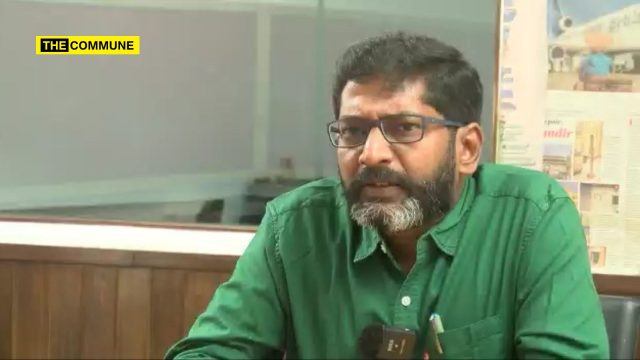
TN Govt Orders Release Of YouTuber Savukku Shankar After Advisory Board Finds No Grounds For Detention

TN Govt Orders Release Of ‘Savukku’ Shankar After Advisory Board Finds No Grounds For Detention

The Tamil Nadu government on Tuesday, 19 May 2026, ordered the immediate release of YouTuber A. Shankar, popularly known as Savukku Shankar, from preventive detention after the Advisory Board concluded that there was no sufficient cause to continue holding him under the Tamil Nadu Preventive Detention Act, 1982, as reported in The Hindu.

In its order issued on 19 May 2026, the government directed that Shankar be released forthwith unless he was required to be detained under any other law or was serving a sentence imposed by a court following conviction in another case.

The government stated that the grounds of detention had been placed before the Advisory Board under Section 10 of the Tamil Nadu Preventive Detention Act. The Board examined the detention records, including the report submitted by the detaining authority, and also heard the oral representation made by the detenue.

Following its review, the Advisory Board reportedly expressed a unanimous opinion that there was no sufficient cause for Shankar’s continued detention. Based on this recommendation, the Tamil Nadu government revoked the detention order.

This marks the third occasion on which preventive detention proceedings initiated against ‘Savukku’ Shankar have been set aside. In August 2024, the Madras High Court had quashed an earlier detention order against him. Soon after that order was struck down, he was detained again in connection with an alleged offence registered under the Narcotic Drugs and Psychotropic Substances (NDPS) Act in Theni district.

More recently, Shankar had also moved the Madras High Court seeking to quash a case registered against him over the alleged publication of a confidential document relating to Prime Minister Narendra Modi’s 2021 visit.

Last week, the Madras High Court granted bail to Shankar in an attempt-to-murder case registered against him following his arrest in Ongole, Andhra Pradesh, on 8 April 2026. The case was linked to allegations that he had pelted stones at escort police personnel while being transported to Chennai after his arrest.

Subscribe to our channels on WhatsAppTelegram, Instagram and YouTube to get the best stories of the day delivered to you personally.

TVK Functionary Accused Of Driving Over Threads For Weaving Work In Tirunelveli, File Police Complaint

TVK Functionary Accused Of Driving Over Threads For Weaving Work In Tirunelveli, File Police Complaint

Tension erupted in Veeravanallur in Tirunelveli district after a dispute broke out between local weavers and a TVK functionary over threads stretched across a residential street used for weaving work.

The incident took place at Veerasakthi Vinayagar Koil Street in Bharathi Nagar, where several weaving families reside. The area is known for its traditional weaving activity associated with GI-tagged saree production. As part of their routine work, weavers often stretch threads across the road to correct and align them before weaving. Residents said the threads are usually lifted temporarily whenever vehicles pass through the street.

According to locals, TVK union secretary Siva arrived at the spot in a car and objected to the threads being tied across the road. An argument reportedly broke out between him and the weavers. Residents claimed the weavers informed him that they would immediately clear the way for the vehicle. However, tensions escalated after he allegedly drove the car over the stretched threads and entered into a heated altercation with the weavers.

Following the incident, shocked residents and weavers lodged a complaint at the Veeravanallur police station alleging high-handed behaviour by the TVK functionary. Police subsequently called both parties for an inquiry and held peace talks.

Subscribe to our channels on WhatsAppTelegram, Instagram and YouTube to get the best stories of the day delivered to you personally.
After TVK Formed Govt In TN, The Hindu Discovered Journalism?

After TVK Formed Govt In TN, The Hindu Discovered Journalism?

For the past 5 years, large sections of Tamil Nadu’s mainstream media behaved less like watchdogs and more like unofficial mouthpieces of the ruling establishment – the DMK. When the DMK was in power, basic journalistic skepticism often disappeared under layers of selective outrage, carefully curated narratives, and ideological loyalty. Yet suddenly, within barely a week of TVK forming the government, parts of the same media ecosystem have rediscovered “fact-checking”, “accountability”, and “critical scrutiny”. The transformation is so abrupt that it raises an uncomfortable question: was journalism sleeping all these years, or was it selectively awake only for certain political targets?

The Hindu’s Sudden Vigilance

In this “Focus Tamil Nadu” episode, The Hindu’s Tamil Nadu desk dives deep into fake narratives, inflated claims, AI fakery and statistical jugglery around Vijay and TVK – all legitimate subjects of scrutiny. The problem is not what they investigate, but when they suddenly decide to put on this aggressive watchdog costume.

The video painstakingly debunks exaggerated claims by TVK supporters: fake “historic firsts”, inflated social justice narratives, AI-generated propaganda images, recycled government schemes being marketed as revolutionary achievements, and emotional branding that clashes with official affidavits. All of this criticism is legitimate. In fact, much of it is necessary. Democracy requires scrutiny of propaganda regardless of who is in power.

But here is the real issue: where exactly was this energy when the DMK government and its ecosystem were manufacturing narratives for years? Did The Hindu magically grow a spine on 10 May 2026 after years of hibernation?

Where were these aggressive reality checks when every routine administrative action under the DMK regime was elevated into civilizational greatness? When ordinary welfare announcements were marketed as unprecedented social revolutions? When dynastic politics was wrapped in the language of “social justice”? When political branding masqueraded as governance? When ministers routinely made theatrical claims that collapsed under basic scrutiny?

Tamil Nadu has lived through years of carefully manufactured mythology under the DMK ecosystem. Media houses amplified personality cults, projected inherited political power as moral virtue and normalised a propaganda machinery where perception often mattered more than outcomes. Entire narratives were built on emotional symbolism rather than measurable delivery. Yet many mainstream outlets rarely applied the kind of forensic scepticism they are suddenly displaying toward TVK. The contrast is impossible to ignore.

When the Alleged Watchdog Walked with the State

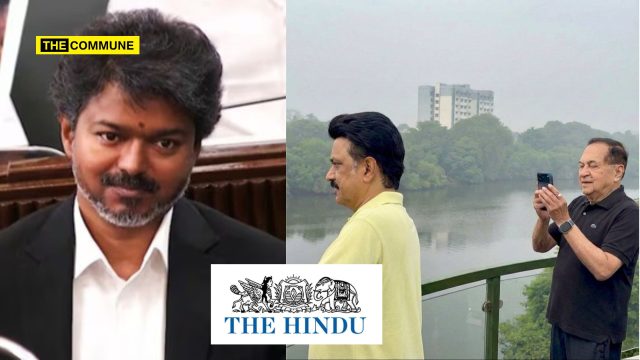
That contrast becomes sharper when you factor in the visible proximity between sections of The Hindu’s leadership and the previous regime. N. Ram, the paper’s former Editor‑in‑Chief and public face of its brand, has for years been seen taking morning walks with M.K. Stalin, often filming or photographing him like a personal chronicler. When the man who personifies The Hindu’s institutional identity appears more like the Chief Minister’s documentarian than his critic, it is hardly surprising that the paper discovered its “fact‑checking spine” only after a different party came to power. If the watchdog is strolling alongside the state, no one should be shocked when it barks only after the regime changes.

Now, after Vijay’s rise, the same establishment media appears eager to prove it still has teeth. Suddenly, viral narratives are being dissected, claims cross‑verified with Election Commission affidavits, historical inaccuracies corrected, AI propaganda exposed and old schemes traced to their original origins. The press has rediscovered the basic function of journalism: verification. Excellent. But why now? Had this level of scrutiny existed consistently, Tamil Nadu’s political culture would look very different.

The Hindu Isn’t Exposing TVK. It’s Exposing Itself.

The problem with The Hindu’s new “Focus Tamil Nadu” crusade is not the fact‑checking itself – it’s the timing. For five years under the DMK, the same paper watched a stream of grand promises, unkept assurances, corruption allegations and personality‑cult politics without ever deploying this level of forensic aggression against the ruling dispensation. On key questions of delivery, accountability and scandal, it mostly looked away or confined itself to tame, process‑driven coverage. Now, barely a week after TVK comes to power, it suddenly discovers arithmetic, affidavits and archival memory and sells this as a heroic return to real journalism.

When the brand face of The Hindu is literally pacing alongside the Chief Minister, nobody believes this institution was helplessly muzzled; it chose comfort over confrontation. So when the same paper now sneers at “Vijay era” mythology, what it really reveals is that these watchdog muscles always existed and were simply never used on its friends. Silence under DMK, swagger under TVK – that is not courage, it is repositioning, and readers can see the switch.

Subscribe to our channels on WhatsAppTelegram, Instagram and YouTube to get the best stories of the day delivered to you personally.
Norwegian ‘Journalist’ Who Heckled PM Modi Works For Dagsavisen, Which Reportedly Received Grants Through Soros-Linked Networks

Norwegian journalist Helle Lyng Svendsen became the centre of international attention after publicly heckling Prime Minister Narendra Modi during his visit to Oslo, as reported in The Mint.

The incident took place after a joint media appearance involving Modi and Norwegian Prime Minister Jonas Gahr Støre. As Modi was leaving the venue, Svendsen called out asking why he would not take questions from “the freest press in the world”.

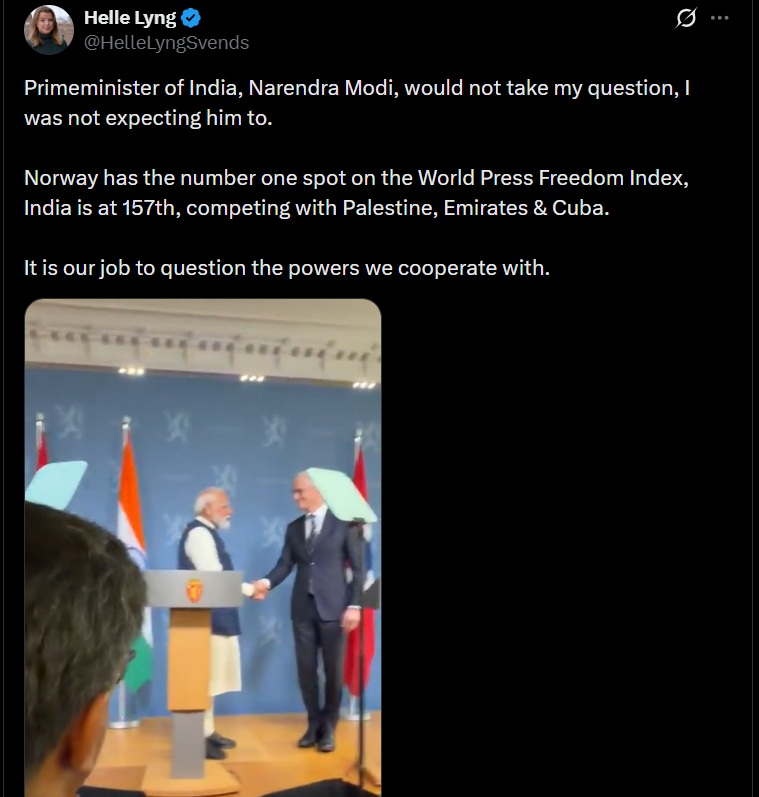
Soon afterwards, she posted on X: “Narendra Modi would not take my question; I was not expecting him to. Norway has the number one spot on the World Press Freedom Index, India is at 157th.”

The post rapidly went viral internationally and triggered widespread political debate online.

Indian Embassy Responds Publicly

The Embassy of India in Oslo responded directly to Svendsen’s post and invited her to attend an official media briefing later that evening.

In its public response, the embassy stated that she was “most welcome to come and ask your questions” at a press briefing scheduled at the Radisson Blu Plaza Hotel in Oslo.

The episode came shortly after another confrontation involving Indian officials in Europe. Earlier, Sibi George, Secretary (West) in the Ministry of External Affairs, was questioned by Dutch journalists in The Hague over allegations concerning freedom of expression in India.

Who Is Helle Lyng Svendsen?

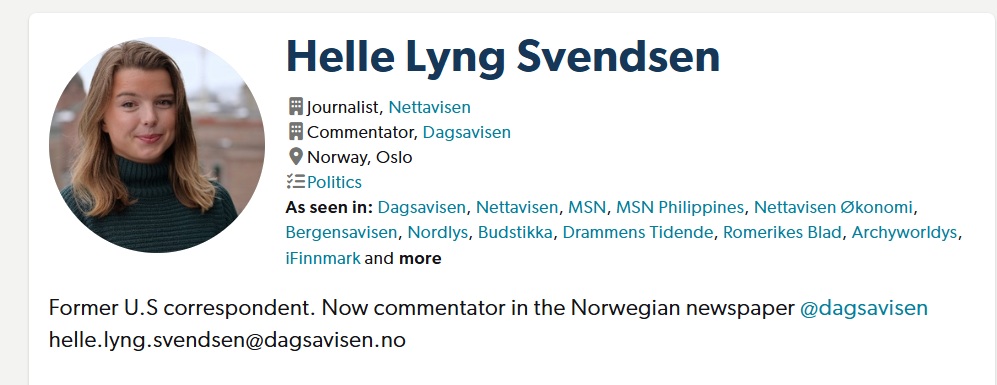
According to her Muck Rack profile, Helle Lyng Svendsen has worked as a freelance journalist with several Norwegian media outlets and MSN. She is currently associated as a commentator with the Oslo-based newspaper Dagsavisen, as reported in OpIndia.

Reports indicate that Dagsavisen has a circulation of fewer than 14,000 readers.

Although the Oslo incident turned her into a viral figure overnight, Svendsen’s prior online activity related to India appeared extremely limited.

Before posting about Modi, her last activity on X reportedly dated back to 10 April 2024, when she shared an article about cocaine addiction among young people. Before that, her earlier posts were sparse, including a repost in 2021 featuring Modi alongside world leaders at the G20 summit in Rome.

Her social media following reportedly surged from under 800 followers to over 17,000 within hours after the Oslo incident.

Responding to questions about her newly acquired blue verification badge on X, Svendsen stated that she had subscribed to the service only recently because she wanted the ability to edit posts. She also remarked that she was usually more active on TikTok, Instagram and Facebook.

Her Coverage Of India

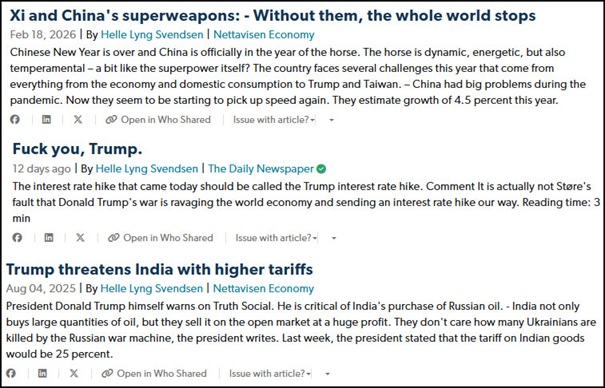
A review of Svendsen’s authored articles on Muck Rack reportedly showed that since January 2025, she had mentioned India only once – in connection with US President Donald Trump threatening tariffs on India.

Her published work showed strong hostility toward Trump while appearing relatively softer toward China and Chinese President Xi Jinping.

Image Source: OpIndia

It is noteworthy that India had never previously been a central focus of her reporting.

Dagsavisen And Funding Networks

The controversy later expanded beyond the journalist herself and moved toward questions about institutional and funding connections linked to Dagsavisen.

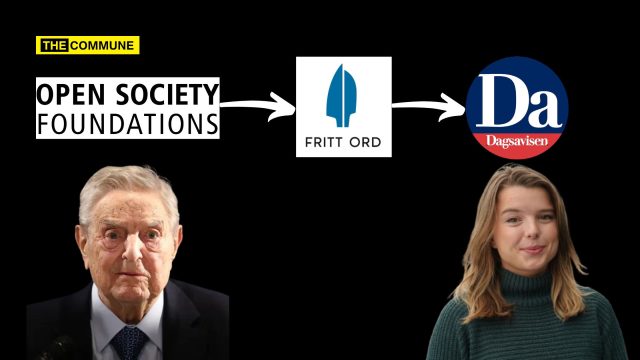
Links between billionaire financier George Soros, the Open Society Foundations, Journalismfund Europe and Norway’s Fritt Ord Foundation started making the rounds.

Open Society Foundations is a donor to Journalismfund Europe, while journalism-related grants in Norway are reportedly routed through or connected to the Fritt Ord Foundation.

The Fritt Ord Foundation has reportedly provided grants to Dagsavisen, the newspaper where Svendsen works as a commentator.

These connections became a major talking point among political commentators online, especially within Indian political discourse surrounding foreign-funded activism and international media narratives targeting India.

Rahul Gandhi’s Norway Visit Draws Attention Again

The controversy also revived discussion about Congress leader Rahul Gandhi and his visit to Norway in 2023.

During that visit, Rahul Gandhi met former Norwegian Prime Minister Erna Solberg, who is associated with Norway’s opposition politics and is linked to the European Council on Foreign Relations (ECFR).

The ECFR has previously received support from Soros-linked Open Society Foundations, prompting fresh online speculation and political commentary following the Oslo incident.

One wonders whether ideological and political networks connected through European institutions, think tanks and media funding organisations were influencing international narratives concerning India and the Modi government.

Subscribe to our channels on WhatsAppTelegram, Instagram and YouTube to get the best stories of the day delivered to you personally.
‘Thooya Sakthi’ Or ‘Poli Sakthi’? TVK’s “Educated MLA” Narrative Falls Apart As Bogus Degrees And Dubious Doctorates Surface

‘Thooya Sakthi’ Or ‘Poli Sakthi’? TVK’s “Educated MLA” Narrative Falls Apart As Bogus Degrees And Dubious Doctorates Surface

After claims of ‘humble/poor’ backgrounds of TVK MLAs fell apart within days of forming the government, now the claims of their educational qualifications are also falling like a pack of cards.

Serious questions are now being raised over the educational credentials claimed by several first-time MLAs of the ruling Tamilaga Vettri Kazhagam (TVK), with multiple discrepancies emerging between official election affidavits and the qualifications projected in campaign material, social media profiles and public posters.

The controversy centres around allegations that several TVK legislators used inflated academic claims, unverified qualifications and even honorary “doctorate” titles despite lacking recognised doctoral degrees, as reported in DT Next.

The issue has gained traction after social media users, researchers and public commentators began comparing the affidavits submitted to the Election Commission with the public image projected by various MLAs during the campaign.

The controversy comes amid growing scrutiny over unrecognised institutions allegedly selling honorary doctorates through private ceremonies and paid events. Earlier investigations had revealed that such organisations offered honorary titles for amounts ranging from ₹15,000 to ₹45,000, allowing recipients to use the “Dr” prefix despite holding no recognised doctoral qualification.

Kavundampalayam MLA Kanimozhi

Among those facing scrutiny is Kanimozhi Santhosh, the TVK MLA from Kavundampalayam. Her election affidavit reportedly stated that she had completed a Bachelor of Arts and Bachelor of Law degree, but she allegedly projected herself publicly as “Dr. Kanimozhi Santhosh” across campaign material and social media platforms.

She even got awards and certificates issued under the name “Mahatma Gandhi Desh Seva Purashkar” carried registration details of a private NGO, creating the impression that the award had central government backing. She also faced backlash over controversial statements related to astrology and skin colour that resurfaced online.

The honorary doctorate she received came from a so-called “International Peace University”, which allegedly has no recognised academic standing and whose listed address reportedly points to a residential property in the United States.

Virudhunagar MLA SP Selvam

Virudhunagar MLA S. P. Selvam also came under scrutiny after using the “Dr” prefix in public despite his affidavit reportedly showing only a Diploma in Civil Engineering qualification.

Avadi MLA R. Ramesh Kumar

Similar criticism was directed at Avadi MLA R. Ramesh Kumar, who allegedly used the “Dr” title despite holding only a BA degree.

Tambaram MLA D. Sarath Kumar

Questions were also raised over Tambaram MLA D. Sarath Kumar, who was allegedly projected during the election campaign as an MBA graduate. However, his election affidavit reportedly mentioned only a BBA degree from MM Jain College in Chennai. The college name itself had been incorrectly listed in the affidavit. There is only an AM Jain College in Tambaram.

Polur MLA R. Abhishek

Polur MLA R. Abhishek was also accused of exaggerating his qualifications. Campaign publicity and social media descriptions reportedly projected him as “MS, MBA”, while his affidavit mentioned only an integrated software engineering degree from VIT Chennai and contained no MBA qualification.

Kumarapalayam MLA C. Vijayalakshmi

In another case, Kumarapalayam MLA C. Vijayalakshmi allegedly appeared in campaign material as a BCom graduate even though her election affidavit reportedly stated that she had studied only up to Class XII. Some claimed she had pursued the course without completing the degree.

Thanjavur MLA Vijay Saravanan

Tanjavur MLA Vijay Saravanan also reportedly faced allegations of falsely projecting himself as a BBA graduate despite having studied only up to Class X.

Ambattur MLA G. Balamurugan

Ambattur MLA G. Balamurugan allegedly advertised technical diploma qualifications during the campaign, while his affidavit reportedly mentioned only SSLC and an ADCA computer certification course.


View this post on Instagram


A post shared by inscoop (@inscoopdigital)

Egmore MLA & Education Minister Rajmohan

The controversy has even extended to School Education Minister A. Rajmohan. In his election affidavit, Rajmohan reportedly declared that he completed a business management diploma in 2010 from the “Indian Institute of Business Management and Technology”. It is noteworthy that the institute lacked recognition from any government authority.

Researcher A Shankar Prakash, who has repeatedly campaigned against fake honorary doctorates, reportedly argued that politicians purchasing such titles from unrecognised institutions were “willing partners in misleading the public”. He said public representatives had a responsibility to be transparent about their qualifications and alleged that several discrepancies existed between election affidavits and public projections.

According to party insiders, the TVK candidate selection process was carried out under intense time pressure, with multiple last-minute changes before the final candidate list was announced. A senior party leader reportedly claimed that the party focused primarily on identifying electorally strong candidates and did not independently verify every public claim made by them, while insisting that all candidates had disclosed their educational qualifications in their official affidavits.

The controversy has further intensified after TVK and its supporters initially celebrated the educational profile of the party’s legislators after forming the government. It had earlier been claimed that 63% of TVK’s 108 MLAs were graduates, including several PhD holders, IIT graduates, engineers, lawyers and doctors. However, independent scrutiny by researchers and online commentators has now raised questions over how many of those claims were exaggerated, misleading or based on dubious honorary titles rather than recognised academic qualifications.

Subscribe to our channels on WhatsAppTelegram, Instagram and YouTube to get the best stories of the day delivered to you personally.
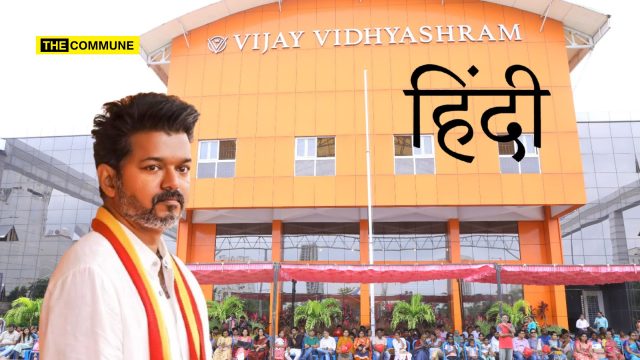
TVK Govt Opposes Three-Language Policy Politically But Vijay Runs A CBSE School Vijay Vidyashram That Teaches Hindi

TVK Govt Opposes Three-Language Policy Politically But Vijay Runs A CBSE School Vijay Vidyashram That Teaches Hindi

Much like the DMK, the Tamilaga Vettri Kazhagam (TVK) under Chief Minister C. Joseph Vijay is publicly rejecting the National Education Policy’s three-language formula and insisting that Tamil Nadu will strictly follow the traditional two-language policy of Tamil and English in all schools. Yet, Vijay’s own CBSE institution, Vijay Vidyashram, offers Hindi and follows a three-language pattern, raising sharp questions of double standards.

TVK’s hard line against NEP

Tamil Nadu’s new TVK government has categorically ruled out implementing the National Education Policy (NEP) 2020, especially its three-language formula that requires students to study three languages, at least two of them Indian. School Education Minister A. Rajmohan has repeatedly said there will be “no compromise” on the state’s two-language framework, asserting that students in Tamil Nadu need only Tamil (as mother tongue) and English (for wider communication).

What the TVK leaders are doing is projecting as a continuation of the Dravidian legacy, insisting that both government and private schools in the state should remain within the Tamil–English, two-language structure.

Vijay’s school and Three-Language Practice

In sharp contrast to this political line, Vijay Vidyashram – a CBSE school network run under the Vijay Educational Trust – openly follows a three-language framework. The school’s own academic information shows that from middle-school level, students have English as first language, while Tamil and Hindi are offered as second and third languages.

Vijay Vidyashram, an English-medium CBSE school located in Padur near Chennai, follows the three-language policy.

A flyer seeking applications for teachers for Hindi and a few other subjects was shared on social media following his anti-Hindi and anti-NEP remarks. The flyer advertised vacancy for teachers for the subjects English, Maths, Hindi, Science, Computer Science, Social Studies, and PT.

Some videos of the students at the school have been circulating on social media. These are most likely from the school’s Instagram handle. In one such video is a Hindi play performed by Class 3 students.

This is from a performance for Hindi Diwas.

In another post, we find a picture of two students on the occasion of Hindi Pariyojana Diwas.

The post caption reads, “Echo of Hindi tradition! We had a lively celebration of Hindi culture on our Project Day, where students showcased their talents through music, dance and art. We are grateful to have this opportunity to preserve and promote our cultural heritage! #ProjectDay #हमारीमूलतत्त्व #हिंदीसंस्कृति (HindiCulture) #हिंदीभाषा (HindiLanguage) #हिंदीकला (HindiArt) #हिंदीकविता (HindiPoetry) #हिंदीगीत (HindiSongs) #हिंदीप्रेरणा (HindiInspiration) #हिंदीकहानी (HindiStory) #हिंदीसंवर्धन (HindiPromotion) #हमारीहिंदी (OurHindi) #हिंदीपारंपरिकता (HindiTradition)”

The school literally celebrates Hindi language and conducts several programmes around the subject in conjuction with the prescribed NEP syllabus.

From opposing Hindi to NEP, Vijay has exposed his hypocrisy blatantly – do one thing and preach something else for the general public to gain political traction.

Evidence Of Vijay’s Link To Vijay Vidyashram

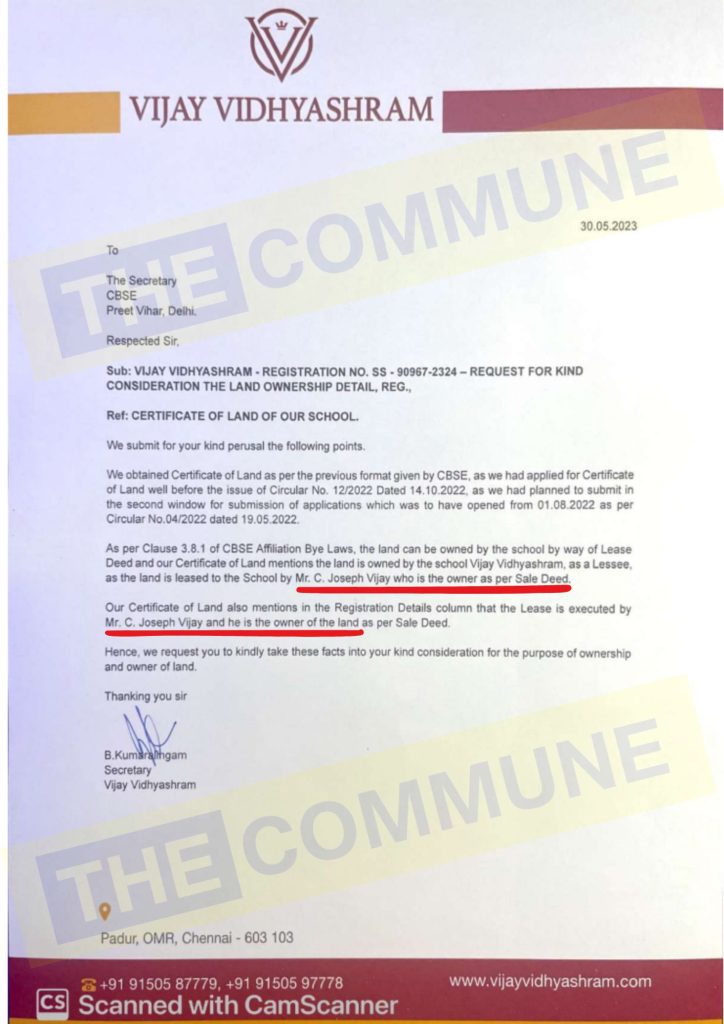
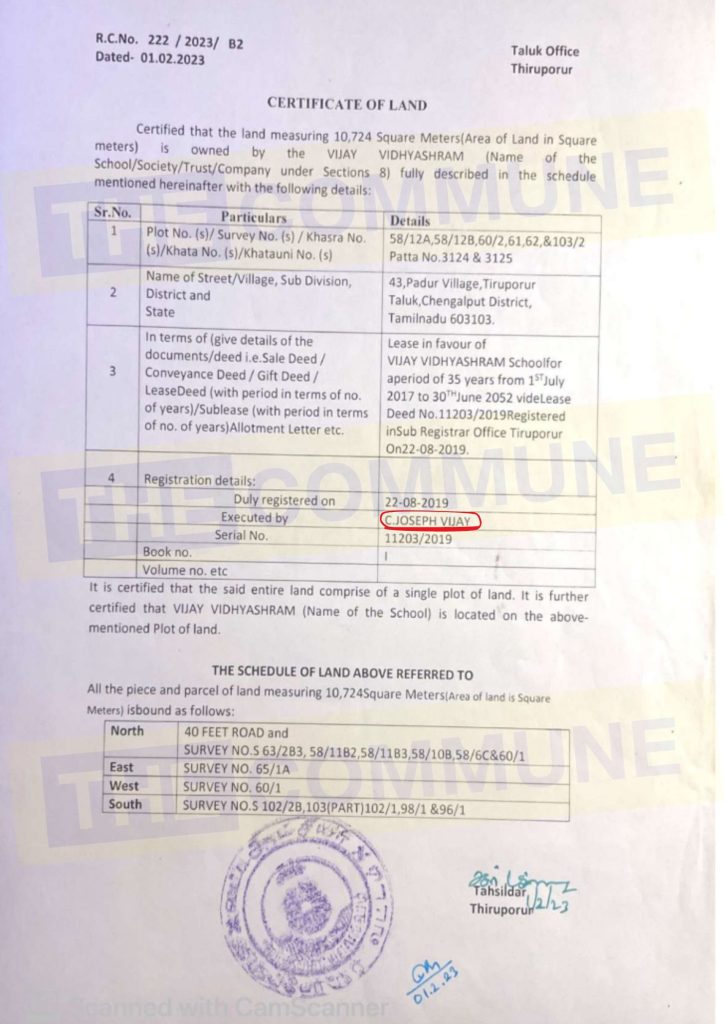
Here are documents accessed by The Commune that prove that the school is linked to part-time politician Vijay.

The land on which Vijay Vidyashram is built is owned by C. Joseph Vijay, as documented in the Sale Deed. He has leased the 10,724-square-meter property to the school. The Certificate of Land confirms that Vijay Vidyashram holds the land, and the lease agreement was made in favor of the school by Joseph Vijay.

Tamil Nadu seems to be denying children of its state the exposure to additional languages. Parents have the right to choose multilingual education, including Hindi, for their children. The real controversy is the contradiction between TVK’s public politics, and the practices followed within institutions linked to its own ecosystem. While the party attacks the three-language formula in public, a CBSE school associated with Vijay’s family continues to function with Hindi and additional language options. This creates a system where multilingual education remains available for students in elite private schools, while government school students are denied the same opportunities in the name of policy – just like the DMK.

Subscribe to our channels on WhatsAppTelegram, Instagram and YouTube to get the best stories of the day delivered to you personally.
Tamil Nadu Scores Lowest Among Southern States In Learning Outcomes: PGI Report

Tamil Nadu Scores Lowest Among Southern States In Learning Outcomes: PGI Report

Tamil Nadu has recorded the lowest score in the learning outcomes category among all southern states in the latest Performance Grading Index (PGI) 2.0 report released by the Union education ministry, raising fresh concerns over foundational learning levels in the state’s school system, as reported in Times of India.

According to the PGI 2.0 report for 2024-25, students from Classes III, VI and IX in Tamil Nadu scored just 55.1 out of 240 in the learning outcomes domain based on the Parakh assessment test conducted by the National Council of Educational Research and Training (NCERT) in 2024.

Among southern states, Kerala emerged far ahead with a score of 140.3 out of 240. Andhra Pradesh scored 79.6, Karnataka secured 72.7 and Telangana recorded 69, all performing significantly better than Tamil Nadu in the learning outcomes category.

Punjab topped the national rankings in learning outcomes with 150.4 out of 240.

Despite the poor performance in learning attainment, Tamil Nadu registered comparatively stronger scores in other educational indicators. The state scored 72.2 out of 80 in access, 108 out of 190 in infrastructure, 231 out of 260 in equity, and 76.3 out of 100 in teacher education and training.

Overall, Tamil Nadu improved its aggregate score compared to the previous academic year, recording 582.4 out of 1,000 and moving up one level in the national education index.

The district-wise PGI data also revealed sharp regional disparities within the state. Krishnagiri, Kanyakumari, Erode, Tiruchirappalli and Dharmapuri performed strongly across most domains, while Pudukkottai, Cuddalore, Ramanathapuram, Ranipet and Tenkasi recorded weaker scores across categories.

Former director of school education K Devarajan said the state needed to prioritise classroom teaching to improve learning outcomes. He argued that teachers should not be burdened with data-entry and administrative work during school hours and said classrooms should return to more traditional teaching methods.

Su Moorthy, state coordinator of the Federation of Education Development, reportedly attributed the weak learning outcomes primarily to teacher shortages in primary and middle schools. He pointed out that nearly 11,000 primary schools in Tamil Nadu were functioning with only two teachers and argued that the government should appoint at least one teacher for every class in all primary schools to address foundational learning gaps.

Officials from the school education department, however, maintained that the Parakh assessment reflected the performance of students assessed in 2024 and did not represent the present batch of students.

According to department officials, the state government conducted a large-scale State-Level Achievement Survey (SLAS) in 2025 and identified around 7.47 lakh students from Classes VI to IX with learning gaps. Officials claimed that a targeted intervention programme implemented during the previous academic year helped more than seven lakhs of those students attain basic learning outcomes.

Subscribe to our channels on WhatsAppTelegram, Instagram and YouTube to get the best stories of the day delivered to you personally.