The BBC is at it again, demeaning India, showing India in a poor light as always. This time, it has targeted the metro.
The article claims India has splurged billions on metro trains but has no commuters.
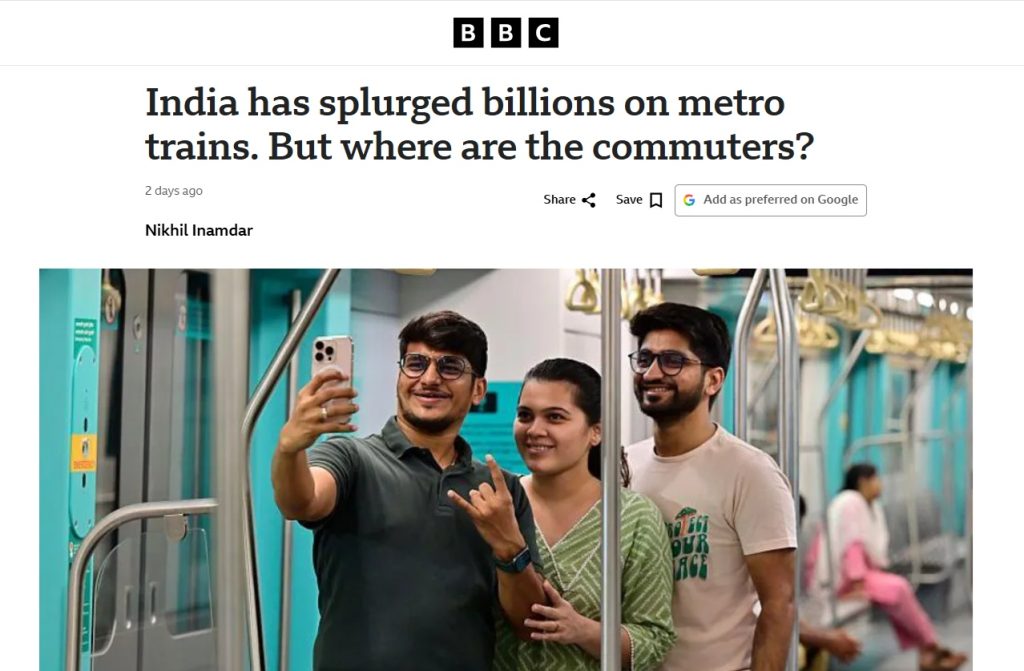
BBC’s article gets one thing right: some Indian metro systems have fallen short of the ridership promised in their DPRs, as per an IIT Delhi report. But it turns that valid caution into a sweeping narrative of “splurge” and underuse, ignoring both the scale of actual demand already visible and the fact that metro systems are long-gestation urban assets whose benefits extend beyond a narrow snapshot of current ticket counts.
What The Article Leaves Out
India’s metro expansion is not a vanity project by any serious measure. Official data says the network grew from 248 km in 2014 to 1,095 km by 2025, expanding from 5 cities to 26 cities, with metros now serving over 1 crore passengers daily nationwide. That is not evidence of empty infrastructure; it is evidence of one of the fastest urban transit build-outs in the world.
Delhi alone recorded 235.8 crore passenger journeys in 2025, averaging 64.6 lakh daily, with punctuality of about 99.9%, which makes it one of the busiest and most reliable metro systems anywhere. Even the debate over whether Delhi has exceeded original projections is more nuanced than BBC suggests: IIT-Delhi-linked reporting said Delhi was below 50% of projected ridership in one analysis, but DMRC has directly said weekday ridership of around 67 lakhs has already exceeded DPR projections. That alone should have forced BBC to avoid a blanket thesis.
Additionally, Bengaluru Metro has crossed 10 lakhs in single-day ridership after expansion.
Mumbai’s metro network has crossed 100 km, though the verified ridership figure here is well below 2.94 lakh daily as of June 2025.
Ahmedabad Metro is around 1.4–1.5 lakh daily and growing.
Lucknow Metro averages roughly 87,000 to 1 lakh passengers daily, though it has crossed 1.3 lakh on peak days.
The Wrong Benchmark
The article leans heavily on DPR projections as if they are the only meaningful measure of success. But DPRs are forecasts, not verdicts, and transport planners themselves acknowledge that such estimates can be inflated, conservative, distorted by phased openings, or overtaken by shocks like Covid-19 and staggered network completion. Judging a network purely against early projected ridership while large sections are still maturing is like declaring an airport a failure before the surrounding city has fully developed.
More importantly, metro systems are built not only to maximize immediate farebox returns but to shape long-term urban form. The government’s own framing emphasizes ease of living, faster travel, lower congestion, and cleaner mobility, and that is the correct lens for evaluating mass transit. A metro can be strategically valuable even before every corridor reaches textbook occupancy.
BBC Keeps Showing India In Poor Light
Over the years, BBC seems to have only one agenda at hand – show India in poor light. A few examples below are proof enough of that and it seems they want to derail any developmental work that comes across for India.
Pattern is clear same byline, same framing. From “water crisis” to “oil shock” to now metros consistent negative spin on India’s growth story.
Selective reporting ≠ journalism.
India is building at scale, planning for decades ahead not for headline optics.
Time to call out… pic.twitter.com/uq86XVL6DY
— India First Post (@ifpost47) April 20, 2026
Subscribe to our channels on WhatsApp, Telegram, Instagram and YouTube to get the best stories of the day delivered to you personally.