Home Blog Page 29

‘Normalize Indian Hate, People Shouldn’t Hesitate To Beat Or Even Kill Them’: Pakistani-Canadian Behind Anti-India Propaganda Network Exposed
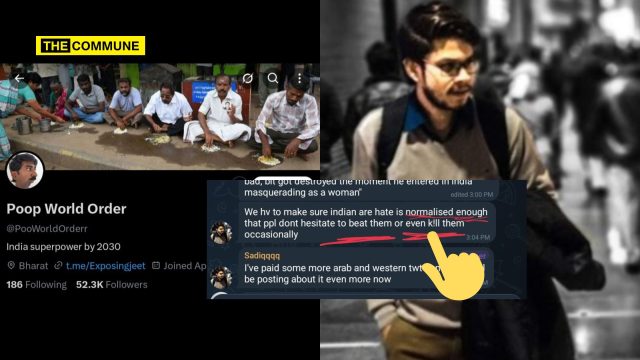
‘Normalize Indian Hate, People Shouldn’t Hesitate To Beat Or Even Kill Them’: Pakistani-Canadian Behind Anti-India Propaganda Network Exposed

A Pakistani-Canadian individual identified as Sadiq Ali, based in Toronto, has come under scrutiny after being exposed for allegedly operating a large-scale online ecosystem dedicated to spreading anti-India propaganda, misinformation, and hatred against Indians. The revelations triggered widespread outrage online and eventually led to the deletion of one of his Telegram groups and the suspension of one of his associated X accounts, as reported in OpIndia.

The controversy erupted after screenshots from a Telegram group named “Poop World Order” went viral on social media. The group was reportedly administered by Sadiq Ali under the handle “Sadiqqqq”. In one of the messages, Sadiq openly encouraged followers to intensify efforts to normalise hatred against Indians to such an extent that people would not hesitate to assault or even kill them occasionally.

The message centred around a viral claim involving a Korean content creator who was falsely portrayed as a pregnant woman allegedly harassed in India. Using the incident, Sadiq attempted to fuel anti-India sentiment among his followers.

Referring to a video posted through his X account @iShowPooo, Sadiq celebrated the viral reach of the content and instructed followers to push it further. He reportedly wrote, “amplify it even harder now, we are winning.”

Sadiq informed members that his primary X account had become “search banned” and that he was operating through an alternative account. He directed followers to circulate the video using captions claiming that a young Korean had attempted to prove India was not a bad country but was allegedly “destroyed” immediately upon entering India while disguised as a woman.

He then escalated the rhetoric further, writing that hatred against Indians needed to be normalised to the point where people would not hesitate to beat or occasionally kill them. Sadiq also claimed that he had paid several Arab and Western social media accounts to further amplify the narrative online.

However, the entire premise behind the campaign collapsed after the Korean content creator involved in the video publicly clarified the facts.

Korean Creator Debunks Viral Claim

The Korean content creator, Sumin, issued a statement on Threads condemning the misuse of his content.

In his statement, Sumin said he was deeply troubled that his videos were being deceptively edited and weaponised to incite hostility against a specific country. He stated that misinformation was being spread through manipulated versions of his content for the purpose of generating hatred.

Sumin clarified that the incident shown in the viral footage had not taken place in India at all but in Bangladesh.

He further explained that he had visited India during Holi celebrations without any disguise and rejected claims that he had been cross-dressing or pretending to be a pregnant woman. According to Sumin, such allegations were entirely baseless and appeared to stem solely from the fact that he had long hair.

The clarification exposed the central claim being circulated by Sadiq and his network.

While the actual incident occurred in Bangladesh, Sadiq allegedly transformed it into an anti-India campaign, presenting it as evidence against India and encouraging followers to spread the false narrative aggressively. He also openly claimed that he had financially incentivised others to help amplify the misinformation.

Screenshots Reveal Coordinated Propaganda Efforts

The Telegram screenshots further suggested that Sadiq viewed social media manipulation as a coordinated operation.

Messages showed him boasting about his ability to influence algorithms and manufacture viral anti-India narratives through coordinated amplification campaigns.

However, once screenshots from the Telegram discussions began circulating widely, they generated significant backlash online.

Particularly controversial was Sadiq’s explicit call to normalise violence against Indians. As criticism intensified, the Telegram group linked to the discussions was deleted.

Shortly thereafter, his X account @PooWorldOrderr was suspended. His alternative account, however, remains active.

Allegations of Organised Anti-India Network

X user @AgniVesa_07 subsequently published additional findings and identified Sadiq Ali as the alleged head of a network referred to as “TF-2990” or “Task Force 2990”.

The user shared screenshots from Telegram discussions associated with TF-2990 and TF-2992, alleging that Sadiq coordinates a large ecosystem of accounts dedicated to anti-India propaganda.
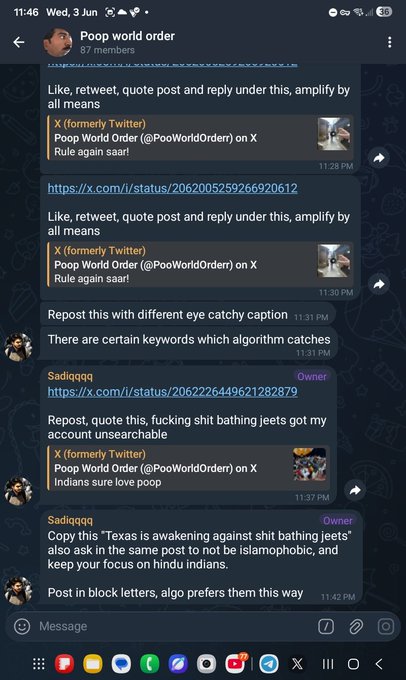
Source: @AgniVesa_07 X handle

According to the thread, the network operates across multiple Telegram groups collectively comprising thousands of members.

Participants are allegedly instructed to create larping and impersonation accounts, cross-post content across platforms, strategically deploy specific keywords to manipulate algorithms, and target what are described as “low-hanging fruit” subjects capable of generating racist engagement against Indians.

The thread further claimed that these activities accelerated significantly following Operation Sindoor, India’s military response launched in May 2025 after terror attacks.

The same thread also alleged that TF-2990 was originally initiated by Pakistan’s Directorate General of Inter-Services Public Relations (DGISPR) to conduct anti-India influence operations online. However, no publicly available documentary evidence has been presented to independently verify that specific allegation.

Fake Hindu Identities Allegedly Used

Sadiq Ali’s social media ecosystem reportedly includes a large number of follower accounts that consistently amplify his content.

Observers have pointed out that many of these accounts use Hindu and Indian names while simultaneously posting anti-India and Hinduphobic content, raising suspicions that they may be operating under false identities.

According to @AgniVesa_07, access to Sadiq’s primary Telegram discussion group was obtained using a fake account. Screenshots collected from inside the groups allegedly reveal discussions about content amplification strategies and coordinated efforts to push anti-India narratives across platforms.

Telegram Group Deleted, X Account Suspended After Exposure

As screenshots from the Telegram groups gained traction online and backlash mounted, one of the principal Telegram groups associated with Sadiq Ali was deleted.

Indian social media users also launched mass-reporting campaigns targeting his accounts.

Following the reports, Sadiq’s primary X account was suspended.

Alternative Account Continues Anti-India Campaign

Despite the suspension of his main account, Sadiq’s alternative X account, @iShowPooo, remains active.
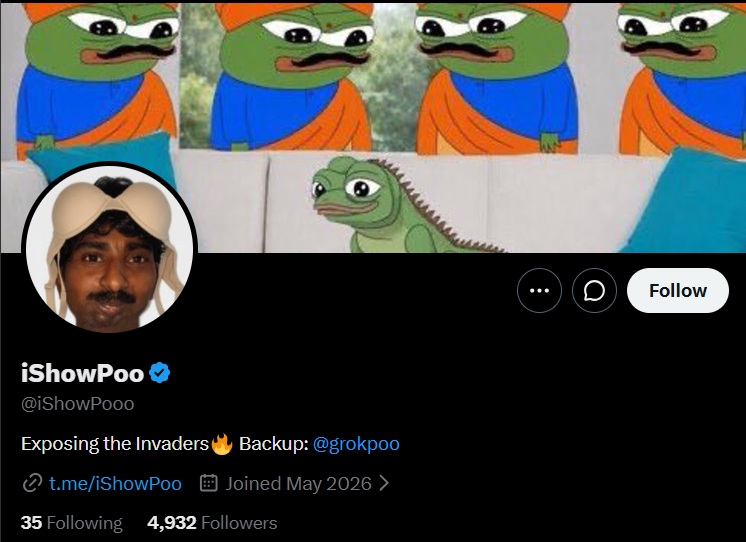
A review of the account shows a steady stream of content portraying India negatively.

The account frequently shares videos of dirty drains, unhygienic street food vendors, and isolated incidents in an apparent effort to portray such scenes as representative of the entire country.

It also regularly amplifies videos involving Indians abroad, often accompanied by misleading or false claims.

The account has been repeatedly posting videos originating from Pakistan, Bangladesh, and other countries while falsely claiming that the footage was recorded in India.

The exposure of Sadiq Ali’s Telegram activities has intensified scrutiny of coordinated anti-India influence operations on social media, particularly those relying on misinformation, fake identities, and algorithm-driven amplification campaigns to spread hostility against Indians worldwide.

Subscribe to our channels on WhatsAppTelegram, Instagram and YouTube to get the best stories of the day delivered to you personally.
Inside CJP’s Discord Channel: Terror Accused Umar Khalid Glorified As ‘Revolutionary’, ‘Freedom Fighter’ And Future Defence Minister

The June 6 protest called by Cockroach Janta Party (CJP) founder Abhijeet Dipke turned out to be largely underwhelming despite claims from Dipke and his associates that it was a major success. Ground reports from Jantar Mantar suggested that only a few thousand supporters attended the event. Contrary to the image projected by the movement, a significant portion of the participants were not Gen Z youth but middle-aged and older individuals.

The turnout raised questions among many observers because CJP, which claims to have amassed more than 22 million followers across social media platforms, appeared unable to convert its online popularity into a substantial on-ground mobilisation.

While calls to join the protest were circulated across X, Facebook, Instagram, and other platforms, one of the key hubs for discussion among CJP supporters has been the party’s Discord server. Launched around ten days before the protest, the server reportedly crossed 20,000 members, with over 1,500 users online at any given time.

An examination of discussions on the Discord server by OpIndia revealed repeated expressions of support for anti-Hindu Delhi Riots larger conspiracy accused Umar Khalid, with several users portraying him as a victim, activist, revolutionary, and even a symbol of the movement.

Image Source: OpIndia
Initial Discussions on Umar Khalid

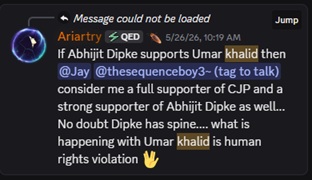
On 26 May 2026, members were discussing the authenticity of social media handles and websites allegedly associated with CJP. During that discussion, one user stated that while he supported the idea behind CJP, he did not support Abhijeet Dipke.

Image Source: OpIndia

When another member asked why, a user responded by saying that Dipke was associated with the Aam Aadmi Party.

Image Source: OpIndia

After another participant pointed out that Dipke was only formerly associated with AAP, the discussion shifted when a user alleged that Dipke supports Umar Khalid.

Image Source: OpIndia

This was the first mention of Khalid during the conversation, after which several users openly came forward in his defence.

One participant declared that if Dipke indeed supported Umar Khalid, he would become a full supporter of both CJP and Dipke. The user argued that Khalid was facing a human rights violation and praised Dipke for having the courage to support him.

Image Source: OpIndia

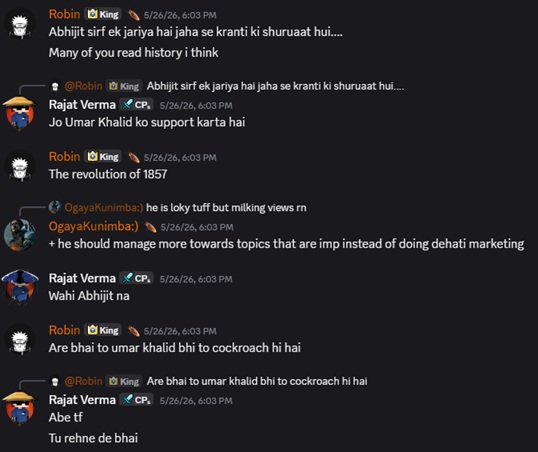
Later the same day, another discussion described Dipke as merely a medium through which a revolution had begun. During that conversation, a participant once again referred to Dipke’s support for Khalid, while another user suggested that Khalid was one of them and referred to him as a fellow “cockroach”.

Image Source: OpIndia
Supporters Unaware of Details of Delhi Riots Case

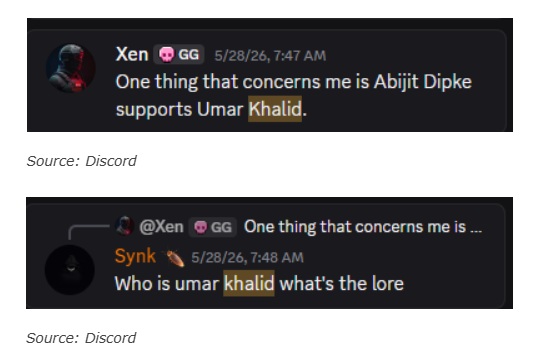
On 28 May 2026, Umar Khalid once again became the subject of discussion. The conversations suggested that several CJP supporters were unfamiliar with the details of the allegations against him in the Delhi Riots larger conspiracy case.

The conversations suggested that several CJP supporters were unfamiliar with the details of the allegations against him in the Delhi Riots larger conspiracy case.

Image Source: OpIndia

When one participant stated that Dipke’s support for Khalid was a matter of concern, another user asked who Khalid was and what the controversy surrounding him involved.

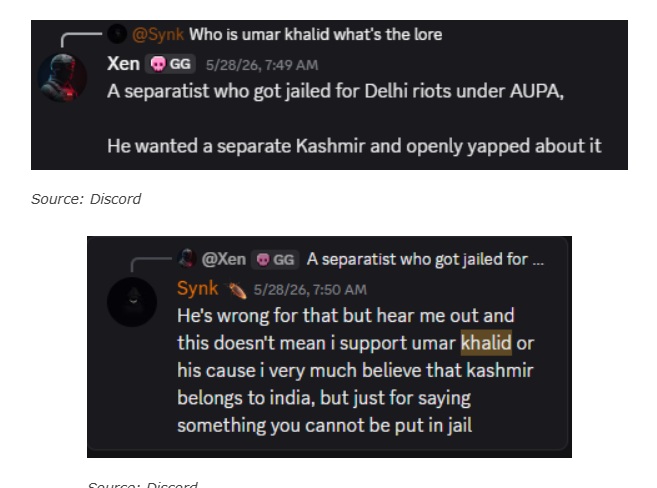
A participant responded by describing Khalid as a separatist who had been jailed in connection with the Delhi Riots and booked under the Unlawful Activities (Prevention) Act (UAPA). The same user alleged that Khalid had advocated for a separate Kashmir.

Another user replied that imprisonment merely for expressing such views was unjustified.

Image Source: OpIndia

The discussion then shifted to the delay in Khalid’s trial.

One participant argued that if authorities had failed to prove Khalid guilty in five years, it suggested weakness in the case. The user further argued that individuals can change their opinions over time and maintained that Khalid could not be considered a terrorist because, according to him, such allegations would have been proven by now if they were true.

Image Source: OpIndia

The argument reflected a broader narrative frequently advanced by Khalid’s supporters, focusing on the delay in the judicial process while downplaying questions surrounding the allegations and proceedings in the case.

Calls to “Free Umar Khalid”

On 1 June 2026, during one of the Discord video discussions titled “Chai Pe Charcha”, Khalid’s name resurfaced.

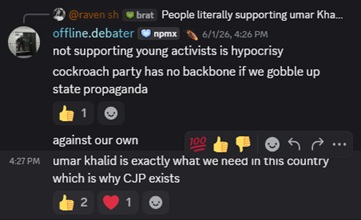
In the related text discussion, a participant claimed that Umar Khalid represented exactly what India needed and suggested that this was one of the reasons CJP existed.

Image Source: OpIndia

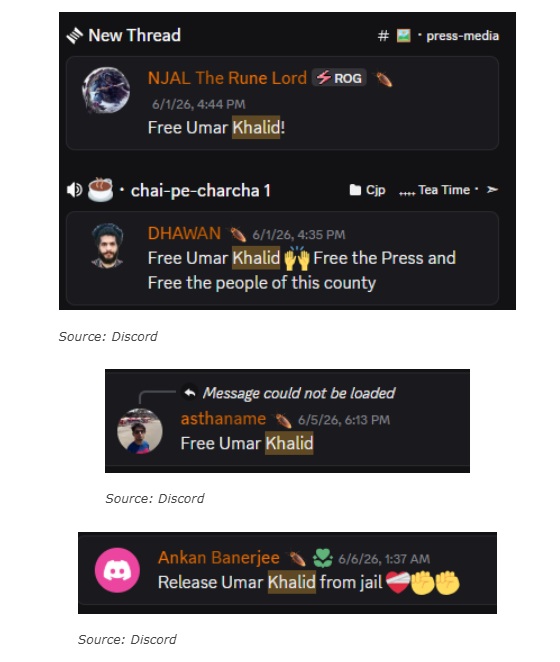
Throughout the same day, multiple calls were made across different discussion forums on the server demanding the release of Umar Khalid.

Image Source: OpIndia

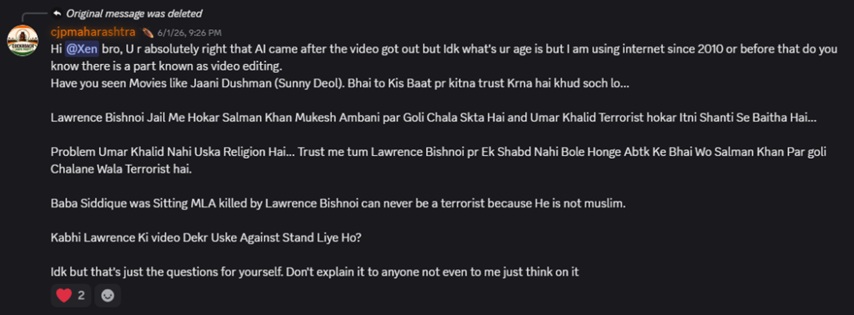
In one exchange, a participant argued that Khalid’s religion, rather than the allegations against him, was the real issue behind his prosecution. The user attempted to draw comparisons between Khalid’s case and that of gangster Lawrence Bishnoi.

Image Source: OpIndia

When another participant objected to bringing religion into the discussion and argued that doing so ignored the facts of the case, Khalid’s supporter responded by asking why he had not yet been convicted.

Image Source: OpIndia

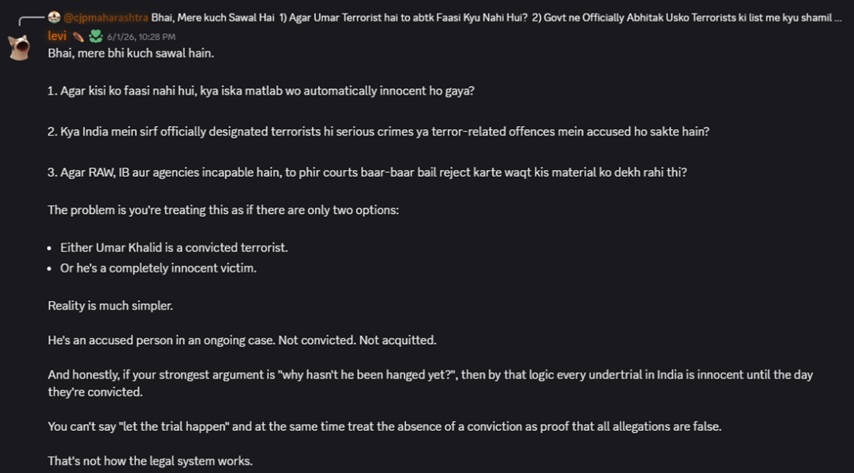
Another participant countered that supporters could not simultaneously insist that the trial should be allowed to conclude while also claiming that the absence of a conviction amounted to proof of innocence.

Image Source: OpIndia

As the debate continued, criticism was directed towards the judicial system itself.

During the discussion, a participant identifying himself as a law student asserted that all allegations against Umar Khalid were baseless.

Khalid Portrayed as Revolutionary and Freedom Fighter

On June 4, another user asked fellow members for their views on Umar Khalid.

One participant described him as a revolutionary.

Image Source: OpIndia

In a separate discussion the same day, another supporter claimed that all of Khalid’s speeches promoted peaceful protest and unity. The user argued that none of his statements could reasonably be interpreted as encouraging violence.

The same participant further alleged that the judiciary was compromised and concluded by describing both Khalid and Abhijeet Dipke as fighters for freedom.

Kashmir Discussion and Defence of Khalid

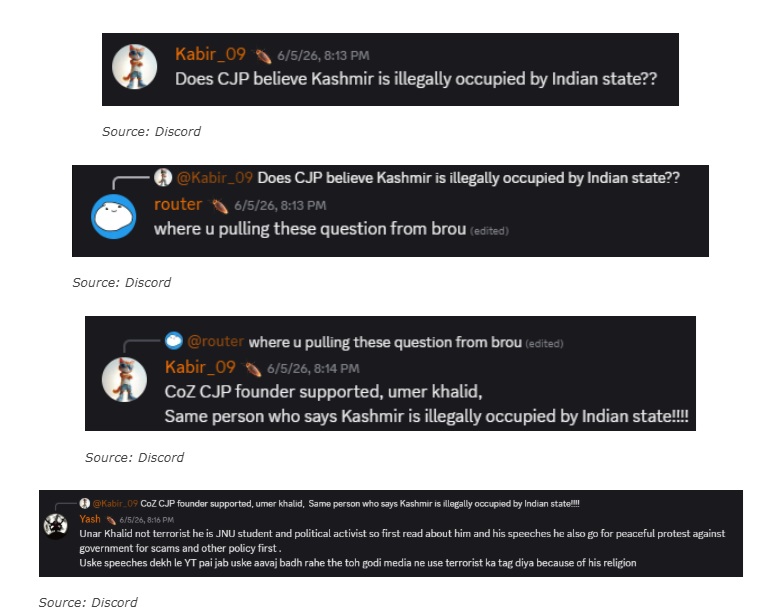
On 5 June 2026, one user questioned whether CJP believed that Kashmir was illegally occupied by the Indian state.

Another participant asked why such a question had been raised.

The user replied that the question arose because CJP’s founder was allegedly supportive of Umar Khalid, whom he accused of describing Kashmir as illegally occupied by India.

Supporters of Khalid quickly intervened in the discussion.

One participant argued that Khalid was not a terrorist but rather a former JNU student and political activist. The user urged others to watch Khalid’s speeches and maintained that he had participated in peaceful protests against government policies and alleged scams.

Image Source: OpIndia

The same participant further claimed that media organisations had branded Khalid a terrorist because of his religion.

In another discussion, a user described having dreamt about meeting Umar Khalid and referred to the charges against him as false and frivolous. The participant characterised Khalid’s imprisonment as a stain on India’s judiciary and expressed admiration for what he described as Khalid’s resilience and spirit.

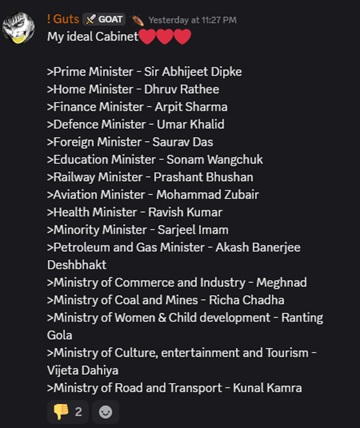
On 7 June 2026, discussions in the Hindi Video Chat section took an even more unusual turn.

One participant described a scenario in which Abhijeet Dipke became Prime Minister of India while Umar Khalid served as Defence Minister, with several other left-liberal figures occupying key positions in the government.

Image Source: OpIndia
Similar Sentiments Seen at Jantar Mantar Protest

The glorification of Umar Khalid was not limited to Discord discussions.

At the June 6 protest held at Jantar Mantar, several CJP supporters publicly expressed solidarity with Khalid.

One participant reportedly suggested that both Sharjeel Imam and Umar Khalid were suitable candidates for positions such as President or Prime Minister.

In another incident, an elderly supporter became involved in an argument with a woman who opposed Khalid. During the exchange, he allegedly responded by asking whether Khalid had personally harmed her, using language that many observers considered offensive and inappropriate.

Umar Khalid’s Role in the Delhi Riots Larger Conspiracy Case

Umar Khalid’s role in the Delhi Riots conspiracy case is not presented as that of a street-level rioter. Instead, there is prima facie evidence of his role behind the events.

The speech delivered by Khalid in Amravati on 20 February 2020, during which he referred to 24 February 2020, the day of then-US President Donald Trump’s visit to India. Riots broke out in Delhi four days later.

Khalid’s name has also figured in FIR 59, FIR 114, and chargesheets connected to the larger conspiracy investigation.

Investigative agencies have cited the January 8 Shaheen Bagh meeting, alleged links involving Khalid Saifi and Tahir Hussain, discussions concerning large-scale action against the Citizenship Amendment Act (CAA) and National Register of Citizens (NRC), alleged funding and logistical support from the Popular Front of India (PFI), WhatsApp groups, pamphlets, speeches, digital communications, witness testimonies, and various meetings as elements supporting the prosecution’s case.

The prosecution has also cited post-riot communications involving activists, journalists, celebrities, and media personalities as part of its argument that efforts were made to build a favourable public narrative around Khalid.

Last Word

The discussions observed across CJP’s Discord ecosystem reveal a consistent pattern in which Umar Khalid is portrayed not as an accused in the Delhi Riots larger conspiracy case but as a victim, revolutionary, activist, and symbol of resistance.

Rather than directly engaging with the allegations against him, supporters focused on issues such as trial delays, religion, institutional bias, media narratives, and human rights concerns.

Whenever questions were raised about Khalid’s alleged separatist statements, his UAPA case, or his alleged role in the Delhi Riots conspiracy, supporters often responded by emphasising his status as a student activist, political dissenter, or victim of what they described as media and institutional targeting.

The discussions suggest an ongoing effort among sections of CJP supporters to normalise and elevate Khalid’s image among younger and politically impressionable followers, presenting support for him as a symbol of ideological conviction while portraying criticism of his record as inherently unjustified.

Subscribe to our channels on WhatsAppTelegram, Instagram and YouTube to get the best stories of the day delivered to you personally.
Priceless Ancient Artefacts At Chennai Government Museum Allegedly Left Amid Construction Debris During Ongoing Renovation

Priceless Ancient Artefacts At Chennai Government Museum Allegedly Left Amid Construction Debris During Ongoing Renovation

Serious concerns have been raised over the handling of centuries-old artefacts at the Government Museum in Egmore, Chennai, as renovation and modernization works continue across the historic museum complex.

The Government Museum, one of India’s oldest museums and home to a vast collection of archaeological treasures, is currently undergoing extensive restoration and infrastructure upgrades. As of 2026, several galleries remain closed to visitors due to renovation work, including the Zoology, Botany, Geology, Anthropology, Contemporary Art and Children’s sections. Official notices indicate that only select galleries such as Archaeology, Bronze, Numismatics and National Art remain accessible to the public while restoration activities continue.

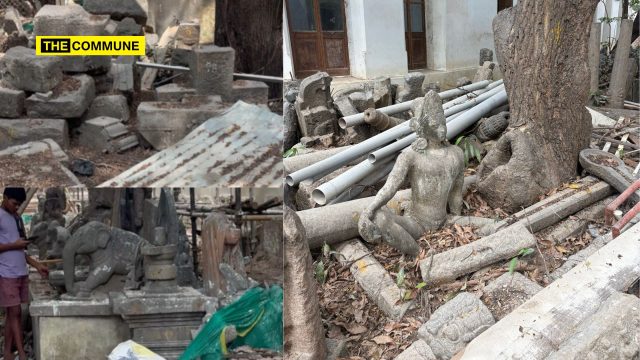
However, images and videos emerging from the museum premises have sparked alarm among heritage enthusiasts and observers. Visuals show ancient stone sculptures and artefacts, some dating back to the 3rd century CE and earlier, lying exposed in areas where active construction work is underway.

The visuals show historical sculptures surrounded by construction materials, pipes, rubble and heavy machinery. In several instances, the artefacts appear to be placed directly within work zones, raising concerns about their preservation and protection during the renovation process.

One wonders whether adequate safeguards have been put in place to protect these irreplaceable relics while modernization efforts are being carried out. Artefacts representing centuries of Tamil and Indian history deserve the highest standards of conservation and should not be exposed to conditions that could potentially damage them.

The Government Museum complex houses some of the most significant archaeological collections in South India, including rare stone sculptures, inscriptions, bronzes and antiquities that serve as important records of the region’s cultural and civilizational heritage.

With renovation work continuing across the sprawling heritage campus, concerns are mounting over whether sufficient care is being taken to ensure that restoration of museum infrastructure does not come at the cost of preserving the priceless artefacts the institution was established to protect.

Subscribe to our channels on WhatsAppTelegram, Instagram and YouTube to get the best stories of the day delivered to you personally.
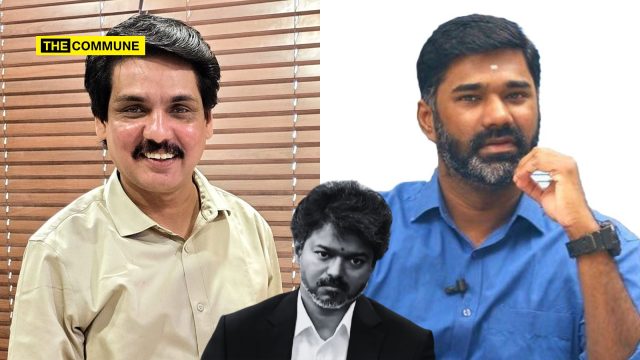
Massive Embarassment For Joseph Vijay’s TVK: YouTuber Maridhas Released As Magistrate Refuses Remand

TVK=DMK: YouTuber Maridhas Arrested By Police, Had Posted Videos/Tweets Exposing Joseph Vijay's Govt

Just weeks after coming to power promising a departure from the political culture of the DMK, Joseph Vijay’s Tamilaga Vettri Kazhagam (TVK) government is facing accusations of adopting the very tactics it once criticised.

In a significant setback for the TVK government, YouTuber and political commentator Maridhas, who was arrested by the Chennai Cyber Crime Police on Monday (8 June 2026), was released on a personal bond after the Saidapet Magistrate declined to grant police remand.

Maridhas was produced before the Saidapet court following his arrest from his residence in Madurai. The Magistrate ordered his release on a bail bond of ₹10,000 and directed him to appear before the investigating officer and sign periodically for one week.


View this post on Instagram


A post shared by Polimer News (@polimernews)

The arrest had triggered widespread criticism after Maridhas revealed that more than ten police personnel had arrived at his residence in the early hours of Monday morning.

According to reports, officers attached to the Chennai Cyber Crime Wing conducted a search at his residence before taking him into custody and transporting him to Chennai.

The case stems from complaints filed by TVK functionaries alleging that Maridhas had circulated defamatory content targeting Chief Minister Vijay, TVK ministers, MLAs and party office-bearers. The complaints further alleged that he had shared AI-generated images and made false accusations against party leaders.

One of the allegations related to an AI-generated image of Tamil Nadu Industries Minister Keerthana, which police claimed was defamatory in nature.

Police officials reportedly examined electronic devices and other materials during the search operation. At the time of the arrest, authorities had not publicly disclosed the complete details of the charges or the legal provisions invoked in the case.

The arrest generated intense political debate, with critics drawing parallels to the previous DMK government’s frequent use of police complaints, defamation cases and criminal proceedings against political opponents, journalists and social media commentators.

TVK had campaigned on promises of political change and democratic openness. However, the decision to deploy a large police team to arrest a political commentator over online content has raised questions about whether the new administration is following a different path or merely continuing the practices it once condemned.

The Magistrate’s refusal to remand Maridhas and the subsequent order releasing him on personal bond has further intensified scrutiny of the government’s handling of the case, with critics describing the episode as an early embarrassment for the fledgling TVK administration.

Subscribe to our channels on WhatsAppTelegram, Instagram and YouTube to get the best stories of the day delivered to you personally.

Joseph Vijay’ TVK Govt Takes No Action On Rabid Sexist YouTuber Mukthar Ahmed Who Derogates Women While Rushes To Arrest Maridhas For Criticizing TVK Govt

Joseph Vijay' TVK Govt Takes No Action On Rabid Sexist YouTuber Mukthar Ahmed Who Derogates Women While Rushes To Arrest Maridhas For Criticizing TVK Govt

On 8 June 2026, a special team of the Chennai City Cyber Crime Police travelled all the way from Chennai to Madurai to arrest YouTuber Maridhas from his residence. The arrest followed a case registered suo motu by the Cyber Crime department based on Maridhas’s allegedly critical commentary against the TVK government, Chief Minister C. Joseph Vijay, and several state ministers.

More specifically, Maridhas was booked for sharing an altered image and making derogatory posts about Tamil Nadu Industries Minister S. Keerthana, under Sections 79 and 353(2) of the Bharatiya Nyaya Sanhita and Section 66D of the Information Technology Act.

It is noteworthy that Maridhas has been critical of the TVK government and has made several videos while also providing evidence of his accusations.

That is the official version. Now let us ask the obvious question that the TVK government would rather you didn’t: where is the same urgency when the offender happens to be on the right side of the political aisle?

The Image That Triggered a Multi-District Police Operation?

The specific trigger for Maridhas’s arrest was an AI-generated image involving Minister Keerthana. Police clarified that Maridhas was arrested in connection with the alleged circulation of an AI-generated image and defamatory remarks targeting Minister Keerthana.

The image itself, showing the minister seated with a person standing beside her, was not inherently obscene. The controversy, critics argue, lay in the accompanying text Maridhas posted questioning the identity of the individual in the image and their relationship with the minister.

If Maridhas merely shared something already viral on social media, rather than generating it himself, the proportionality of a dramatic multi-district arrest becomes far harder to justify. Instead of summoning him for questioning, the police went straight to custody.

The Supreme Court has repeatedly held, in a long line of directives, that arrest should be the last resort – warranted only where there is a genuine risk of the accused fleeing or destroying evidence.

Was a political commentator with a fixed address and a known public profile either of those things? The TVK government apparently thought so.

Sexist Abuser Mukthar Ahmed: Still at Large

Now turn to YouTuber Mukthar Ahmed. Mukthar Ahmed, previously known for his role at Sathiyam News, conducted an interview with Tiruchi Suriya Siva and during which the discussion quickly degenerated into inappropriate and double-entendre remarks about a BJP member.

A few days ago, BJP functionary and former national motorcycle racer Alisha Abdullah filed a criminal complaint against YouTuber Mukhtar and Tiruchi Surya Siva for posting a derogatory video that allegedly abused her and made defamatory remarks about her newborn twin children. The YouTube podcast, uploaded on Mukhtar’s “MY INDIA 24×7” channel, contained highly objectionable content including obscene language, questions about the paternity of her twins, and false allegations linking her to former BJP leader Annamalai to tarnish her reputation.

Alisha Abdullah submitted her complaint to Neelankarai Police Station in Chennai on 3 June 2026 and also approached the Chennai Police Commissioner for action. Following the complaint, Tiruchi Surya Siva was arrested by Chennai Cyber Crime police on 4 June 2026, while Mukhtar has been absconding, with police actively hunting for him.

In several of his videos, Mukhtar has indulged in derogating women, he even spoke extremely derogatorily about actor Trisha who is CM Vijay’s close friend and alleged partner.

That is not all. As documented and discussed widely on social media, Mukthar has made several explicit statements to the effect that women associated with TVK were no better than prostitutes. He produced content objectifying women in the film industry. He even created videos with thumbnails depicting Tamil Nadu’s sitting Chief Minister in a deeply degrading manner – content that no other YouTube channel, not even the most strident critics of Vijay, dared to publish in that form.

The result of all this? As of the time of writing, Mukthar Ahmed has not been arrested.

TVK = DMK 2.0, With a Film Star at the Top

Before coming to power, CM Vijay spoke passionately about freedom of expression and condemned the arrest of those who voiced against the government. That was then. Now, Maridhas was picked up from his residence and brought to Chennai for further interrogation after a suo motu case registered not on a woman’s complaint, but by the state machinery itself. That he was released after the whole drama is another thing – the point in question is his arrest.

The TVK government came to power promising a break from the authoritarian patterns of the DMK. Within weeks of assuming office, it has replicated the DMK’s most criticised tactic: using the police and Cyber Crime wing as a political instrument against inconvenient voices.

Under the DMK, YouTubers like Savukku Shankar were hounded across multiple FIRs, detained under the Goondas Act, and dragged through courts for years. The aesthetics have changed. The playbook has not.

The question before the public is no longer whether Maridhas crossed a line or whether Mukthar Ahmed’s remarks were offensive. The question is why the full machinery of the State can travel across districts to arrest a government critic over an allegedly defamatory post, while a YouTuber accused of repeatedly degrading women, targeting a mother and her newborn children, and publishing content that even many political partisans found indefensible appears to face no comparable urgency.

If criticism of ministers invites swift police action but misogyny, vulgar abuse, and character assassination are met with delay and hesitation, then the issue is not law enforcement, it is selective enforcement. The TVK government came to power promising to be different from the DMK.

What the TVK is doing is, it is reinforcing the growing perception that its much-promised political change risks looking increasingly like DMK 2.0, with a different face at the top.

Subscribe to our channels on WhatsAppTelegram, Instagram and YouTube to get the best stories of the day delivered to you personally.

Tirunelveli: James Raja, Held Earlier For Alleged Remarks Against CM Joseph Vijay, Arrested Again

Tirunelveli Engineer Arrested After Posting Alleged Defamatory Videos Targeting CM Vijay

James Raja, a DMK supporter from Tirunelveli who was previously arrested for allegedly posting defamatory content against Chief Minister C. Joseph Vijay, has reportedly been arrested once again by the Tirunelveli City Police while out on conditional bail.

According to reports, James Raja was taken into custody after police accused him of posting vulgar and obscene videos on Instagram. The latest arrest comes just weeks after he was granted conditional bail in an earlier case relating to alleged defamatory remarks against the Chief Minister.

In May 2026, the 30-year-old resident of the Munneerpallam area in Tirunelveli district was arrested by the police for allegedly posting defamatory remarks targeting Chief Minister Vijay on social media.

According to reports at the time, James had allegedly uploaded content on social media platforms that was considered defamatory towards the Chief Minister. A complaint was also lodged accusing him of making defamatory verbal remarks against Vijay.

Police sources stated that one of the videos uploaded by James allegedly contained abusive and obscene language directed at the Chief Minister.

Following the complaint, the Palayamkottai Police registered a case against him under four sections of law and launched an investigation.

After completing their preliminary inquiry, police arrested James, produced him before a court, and he was subsequently remanded to judicial custody.

Investigators had identified James as a computer engineering graduate who had previously worked for several companies, including Apple Inc.

Police sources further alleged that James had been regularly posting videos expressing support for the Dravida Munnetra Kazhagam (DMK) while criticising Chief Minister Vijay and the Tamilaga Vettri Kazhagam (TVK) government.

News18 Tamil Nadu had also reported that James had reportedly undergone treatment for mental health-related issues at a hospital several years ago and later resumed work as a software engineer following his discharge.

Despite being released on conditional bail in the earlier case, James has now once again come under the scanner of law enforcement authorities. According to reports, Tirunelveli City Police arrested him afresh after he allegedly uploaded vulgar content on Instagram while out on bail.

Subscribe to our channels on WhatsAppTelegram, Instagram and YouTube to get the best stories of the day delivered to you personally.
How TVK’s Incompetency And DMK’s Handling Of The Thoothukudi Shipyard Project May Have Cost Tamil Nadu Mazagon Dock

How TVK's Incompetency And DMK's Handling Of The Thoothukudi Shipyard Project May Have Cost Tamil Nadu Mazagon Dock

A major shipbuilding investment planned for Tamil Nadu’s Thoothukudi has become the subject of controversy after questions were raised over the process through which South Korean shipbuilding giant HD Hyundai was brought in as the proposed anchor shipyard for the State’s ambitious greenfield shipbuilding cluster project, as reported in The Hindu.

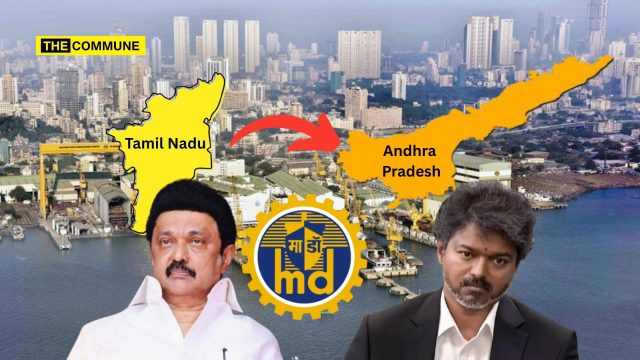
The controversy has gained further attention after state-owned Mazagon Dock Shipbuilders Limited (MDL), which had earlier committed to investing ₹15,000–18,000 crore in a greenfield shipyard project in Thoothukudi, began exploring an even larger investment opportunity in neighbouring Andhra Pradesh.

MDL had signed a Memorandum of Understanding (MoU) with Guidance Tamil Nadu on 19 September 2025, for establishing a greenfield shipyard on India’s eastern coast. During the Government of India’s “Samudra se Samriddhi” event in Bhavnagar, both MDL and Cochin Shipyard signed agreements with the Tamil Nadu government for greenfield shipyard projects in Thoothukudi, with a combined proposed investment of around ₹30,000 crore.

In November 2025, during its Q2 FY26 earnings call, MDL publicly referred to its proposed Thoothukudi shipyard project and stated that it envisaged an investment of ₹15,000–18,000 crore. The project was planned as a 1,050-acre greenfield shipyard to be developed over a period of 10 to 12 years, targeting very large crude carriers (VLCCs) of up to 3,00,000 deadweight tonnage (DWT).

According to available information, MDL had secured board approval for the project and was awaiting further action from the Tamil Nadu government, including the issuance of an Expression of Interest (EoI) process through the Special Purpose Vehicle (SPV) that was expected to oversee the development of the cluster.

However, developments took a different turn in December 2025.

On 7 December 2025, South Korean shipbuilding company HD Hyundai announced the signing of what it described as an “Exclusive Business Cooperation Agreement” with the Government of Tamil Nadu for the development of a new shipyard in Thoothukudi. The announcement was made during the TN Rising Investment Conclave in Madurai in the presence of then Chief Minister MK Stalin.

HD Hyundai described the proposed project as a plan to create a “second Ulsan” in Tamil Nadu, with reports placing the potential investment between $2 billion and $4 billion.

The agreement has since come under scrutiny because the Union Government’s Shipbuilding Development Scheme (SbDS) Guidelines had not yet been formally notified when the agreement was signed.

The Ministry of Ports, Shipping and Waterways (MoPSW) notified the Shipbuilding Development Scheme Guidelines only on 26 December 2025 – nineteen days after HD Hyundai signed the exclusive cooperation agreement with the Tamil Nadu government.

The guidelines laid down a sequential process for the development of greenfield shipbuilding clusters, including the mechanism through which anchor shipyards would be selected.

Questions have therefore been raised over why HD Hyundai was allegedly chosen as the anchor shipyard by the DMK government before the governing framework had come into existence.

Further questions have also been raised regarding the timing of the creation of the Special Purpose Vehicle responsible for implementing the project.

In January 2026, the National Shipbuilding & Heavy Industries Park Tamil Nadu (NSHIP TN) was formally incorporated as a 50:50 joint venture between the V.O. Chidambaranar Port Authority (VOCPA) and SIPCOT.

It is argued that HD Hyundai was allegedly selected as the anchor shipyard before the SPV that was supposed to oversee such a selection process had even been incorporated.

The controversy has intensified because the project is considered strategically significant. Thoothukudi has been identified by the Government of India as one of the country’s premier locations for a greenfield mega shipbuilding cluster due to factors such as extensive coastal land availability, natural cyclone shielding, lower atmospheric salinity, proximity to international shipping routes, and the presence of an existing deep-water port.

The proposed cluster is intended to develop approximately 1.2 million gross tonnage per annum of shipbuilding capacity and is expected to receive substantial support from both the Union and State governments.

The developments have also prompted questions about whether Indian shipyards were given an adequate opportunity to compete for the project through a transparent bidding process, particularly at a time when the Government of India is emphasising indigenous manufacturing under the Maritime Amrit Kaal Vision 2047.

Against this backdrop, MDL has now turned its attention towards Andhra Pradesh.

Having failed to secure the Tamil Nadu project, MDL has reportedly expressed interest in becoming the anchor investor for a proposed mega shipbuilding cluster in Andhra Pradesh. The company is now considering an investment exceeding ₹29,000 crore and is expected to undertake a feasibility study for developing a shipbuilding capacity of approximately 1.2 million tonnes at the proposed cluster.

The shift has fuelled allegations that Tamil Nadu may have lost a major investment opportunity from one of India’s leading public-sector shipbuilders after the State chose to move ahead with HD Hyundai.

The Tamil Nadu government was approached with a detailed set of questions regarding the project, the selection process, and the timeline of events. However, no response was received.

Subscribe to our channels on WhatsAppTelegram, Instagram and YouTube to get the best stories of the day delivered to you personally.
“Mere Existence Of A Dargah Cannot Automatically Be Treated As Waqf Property”, Says Madras High Court

"Mere Existence Of A Dargah Cannot Automatically Be Treated As Waqf Property", Says Madras High Court

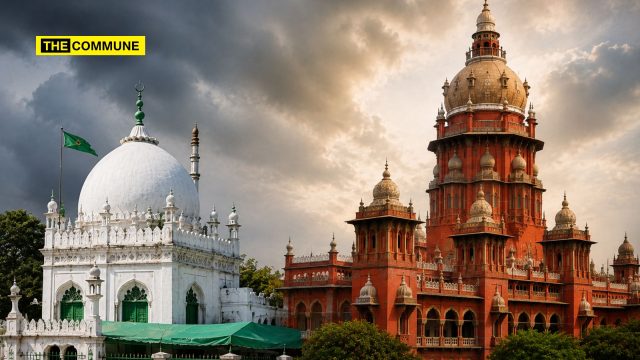
The Madras High Court has held that the mere religious use of a property or the existence of a tomb or shrine is not sufficient to automatically treat it as waqf property. Setting aside a decision of the Tamil Nadu Waqf Board appointing a Mutawalli for a Dargah in Chennai’s Triplicane, the Court observed that a Dargah can be declared waqf only if it satisfies the legal requirements prescribed under the Waqf Act, as reported in LawBeat.

Justice K. Govindarajan Thilakavadi passed the order while allowing an appeal filed by the representative of Sarkar Syed Habibullah Sha Khadari Arif Rabbani Hazarat Dargah. The appeal challenged an order of the Tamil Nadu Waqf Tribunal which had upheld the Board’s appointment of A. Shainsha as Mutawalli of the shrine.

The dispute concerns a Dargah located on Kamaraj Road in Triplicane, Chennai. The appellant contended that his family had been maintaining and serving the Dargah for over 40 years and asserted that the land on which the shrine stands belongs to the Public Works Department (PWD).

The appellant challenged the Tamil Nadu Waqf Board’s resolution dated 23 August 2023, appointing the fifth respondent, A. Shainsha, as Mutawalli, as well as the consequential order issued on 14 September 2023.

The Tamil Nadu Waqf Board defended its action, arguing that the institution was a waqf and that the appointment of the fifth respondent had been made following a proper enquiry.

The Public Works Department, however, maintained that the land in question was Government poromboke land and had been allotted to the Bharat Scouts and Guides.

Addressing the central issue of whether a Dargah can be treated as waqf merely because it exists, the High Court held that while a waqf may come into existence through permanent dedication of property for religious, charitable, or pious purposes, or in certain circumstances through long public user, waqf status cannot simply be presumed from the existence of a shrine.

The Court observed that there must be permanent dedication of property by a Muslim for purposes recognized by Muslim law as pious, religious, or charitable. According to the Court, such dedication had not been established in the present case.

The judgment further noted that every grave or Dargah cannot automatically be treated as waqf property. The Court stated that it is necessary to distinguish between a private family tomb and a saint’s shrine maintained as a public religious endowment.

Examining the records placed before it, the High Court found that none of the documents produced by either the Waqf Board or the fifth respondent demonstrated that the property had been included in the statutory list of auqaf.

The Court also held that the claim that the property had become a “waqf by user” remained unproven. It observed that there was no evidence showing that the land belonged to the Dargah or that the trust deed relied upon by the fifth respondent had ever been acted upon.

According to the judgment, the respondents failed to establish the essential legal ingredients required to classify the property as waqf by user.

A substantial portion of the judgment dealt with the statutory framework under the Waqf Act, 1995, as amended by the Waqf Amendment Act, 2025.

The Court held that conducting a survey under Sections 4 and 5 of the Waqf Act is a sine qua non before any property can be declared waqf property.

The judgment noted that both the Waqf Act, 1954, and the Waqf Act, 1995 require a survey, the preparation of reports, and the publication of a list of waqfs in the Official Gazette. The Court held that only after completion of this statutory process can a property be recognized as waqf property.

The Court recorded that it was an admitted position that no such survey had been conducted and that no notification had been issued in respect of the disputed property.

Rejecting the respondents’ contention that the survey process was still underway, the Court held that the pendency of the statutory exercise could not justify treating the property as waqf before completion of the process prescribed by law.

The High Court also examined whether the Waqf Board could appoint a Mutawalli before establishing that the institution was legally a waqf.

Answering the question in the negative, the Court held that the appointment of a Mutawalli necessarily presupposes the existence of a waqf.

“Mere religious use or existence of a tomb or shrine is not automatically sufficient” to treat a property as waqf, the Court observed.

The judgment further stated, “Mere existence of a Dargah does not automatically confer jurisdiction upon the Board unless the institution is established or treated as a Waqf in accordance with law,” adding that the Board must first establish jurisdictional facts before exercising control over any institution.

Holding that the Tamil Nadu Waqf Board’s resolution dated August 23, 2023, and the consequential order dated September 14, 2023, were legally unsustainable, the High Court set both aside.

However, the Court declined to grant the injunction sought by the appellant.

Noting that both the appellant and the fifth respondent claimed rights as founders of the Dargah, the Court held that the dispute regarding those claims would have to be adjudicated in accordance with law before a competent civil court.

Subscribe to our channels on WhatsAppTelegram, Instagram and YouTube to get the best stories of the day delivered to you personally.
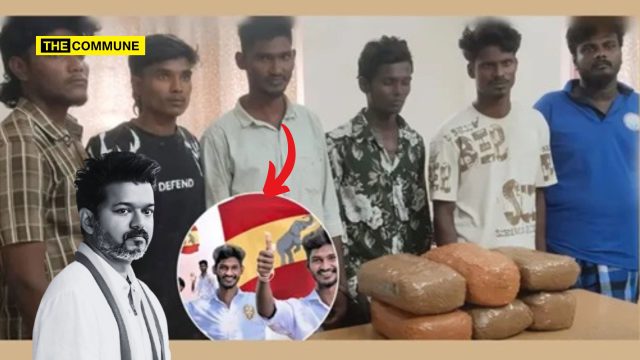
‘Thooya Sakthi’ TVK Functionary Among Six Arrested In Salem Ganja Smuggling Case; 12.5 Kg Seized

TVK Functionary Among Six Arrested In Salem Ganja Smuggling Case; 12.5 Kg Seized

Six young men, including a functionary of the Tamilaga Vettri Kazhagam (TVK), were arrested near Sankagiri in Salem district in connection with an alleged ganja smuggling operation, as reported in Tamil Getlokalapp.

According to police sources, the accused were intercepted during a vehicle check near Sankagiri. During the operation, authorities allegedly recovered 12.5 kilograms of ganja from their possession. Three two-wheelers believed to have been used in the transportation of the contraband were also seized.

Among those arrested was Boopathi Raja, who is reported to be associated with TVK. The remaining accused were also taken into custody and booked under relevant provisions of the law relating to narcotic substances.

Following their arrest, all six were produced before the Sankagiri Judicial Magistrate. Acting on the court’s orders, the accused were remanded to judicial custody and lodged in Salem Central Prison.

The case has drawn attention because one of the accused is reported to be a functionary of the ruling party. The arrests come amid growing scrutiny over criminal cases involving individuals associated with TVK. In recent months, several party members and office-bearers have reportedly faced allegations or been arrested in connection with offences ranging from murder and theft to extortion and narcotics-related crimes.

Subscribe to our channels on WhatsAppTelegram, Instagram and YouTube to get the best stories of the day delivered to you personally.
Public Protests Erupt In CM Joseph Vijay’s Own Constituency As Recurring Power Cuts Leave Perambur Residents Struggling

Public Protests Erupt In CM Joseph Vijay's Own Constituency As Recurring Power Cuts Leave Perambur Residents Struggling

Barely weeks after assuming office, the TVK government is facing growing public anger over recurring power outages and significantly, some of the loudest protests are emerging from Perambur, the Assembly constituency represented by Chief Minister Vijay himself.

Residents across Perambur and adjoining localities have been grappling with repeated power cuts, with many alleging that electricity supply has been disrupted multiple times during the night. Areas including Sathyamurthy Nagar, Vyasarpadi, and Kodungaiyur witnessed frequent interruptions in power supply from last night onwards, triggering protests by frustrated residents.

Unable to sleep because of the recurring outages, residents came out of their homes late into the night and staged demonstrations in several locations. In residential neighborhoods, people gathered on the streets and raised slogans against the functioning of the Electricity Board, demanding immediate action to address the problem.

The protests have drawn attention because they are taking place in the Chief Minister’s own constituency. Residents questioned how such prolonged disruptions could continue in Perambur despite repeated complaints and appeals to authorities.

According to residents, the situation has become particularly difficult due to the prevailing heat conditions. Families with elderly members, young children, and patients were among those most affected by the outages. Several residents complained that prolonged power cuts during the night had made normal life increasingly difficult and disrupted sleep for entire neighborhoods.

Residents alleged that despite repeated complaints, the problem remained unresolved. They demanded that Electricity Board officials take immediate steps to identify the cause of the disruptions and implement a permanent solution rather than temporary fixes.

The unrest was not confined to Perambur alone. Similar complaints and protests were reported from other parts of Chennai and its suburban regions, where residents alleged that intermittent power cuts had become increasingly frequent in recent days.

While officials were reportedly examining the cause of the disruptions and monitoring the situation, residents in some affected areas warned that their protests would continue until electricity supply returned to normal and authorities provided a lasting solution to the recurring outages.

Subscribe to our channels on WhatsAppTelegram, Instagram and YouTube to get the best stories of the day delivered to you personally.