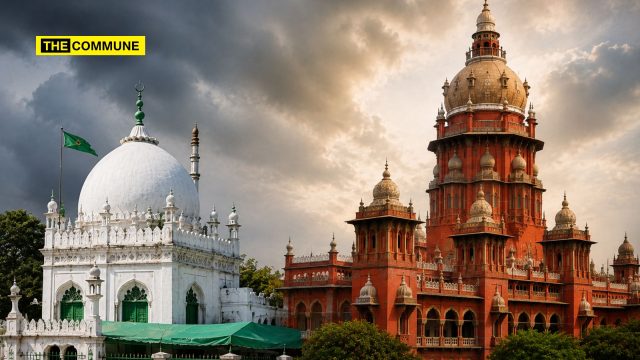
The Madras High Court has held that the mere religious use of a property or the existence of a tomb or shrine is not sufficient to automatically treat it as waqf property. Setting aside a decision of the Tamil Nadu Waqf Board appointing a Mutawalli for a Dargah in Chennai’s Triplicane, the Court observed that a Dargah can be declared waqf only if it satisfies the legal requirements prescribed under the Waqf Act, as reported in LawBeat.
Justice K. Govindarajan Thilakavadi passed the order while allowing an appeal filed by the representative of Sarkar Syed Habibullah Sha Khadari Arif Rabbani Hazarat Dargah. The appeal challenged an order of the Tamil Nadu Waqf Tribunal which had upheld the Board’s appointment of A. Shainsha as Mutawalli of the shrine.
The dispute concerns a Dargah located on Kamaraj Road in Triplicane, Chennai. The appellant contended that his family had been maintaining and serving the Dargah for over 40 years and asserted that the land on which the shrine stands belongs to the Public Works Department (PWD).
The appellant challenged the Tamil Nadu Waqf Board’s resolution dated 23 August 2023, appointing the fifth respondent, A. Shainsha, as Mutawalli, as well as the consequential order issued on 14 September 2023.
The Tamil Nadu Waqf Board defended its action, arguing that the institution was a waqf and that the appointment of the fifth respondent had been made following a proper enquiry.
The Public Works Department, however, maintained that the land in question was Government poromboke land and had been allotted to the Bharat Scouts and Guides.
Addressing the central issue of whether a Dargah can be treated as waqf merely because it exists, the High Court held that while a waqf may come into existence through permanent dedication of property for religious, charitable, or pious purposes, or in certain circumstances through long public user, waqf status cannot simply be presumed from the existence of a shrine.
The Court observed that there must be permanent dedication of property by a Muslim for purposes recognized by Muslim law as pious, religious, or charitable. According to the Court, such dedication had not been established in the present case.
The judgment further noted that every grave or Dargah cannot automatically be treated as waqf property. The Court stated that it is necessary to distinguish between a private family tomb and a saint’s shrine maintained as a public religious endowment.
Examining the records placed before it, the High Court found that none of the documents produced by either the Waqf Board or the fifth respondent demonstrated that the property had been included in the statutory list of auqaf.
The Court also held that the claim that the property had become a “waqf by user” remained unproven. It observed that there was no evidence showing that the land belonged to the Dargah or that the trust deed relied upon by the fifth respondent had ever been acted upon.
According to the judgment, the respondents failed to establish the essential legal ingredients required to classify the property as waqf by user.
A substantial portion of the judgment dealt with the statutory framework under the Waqf Act, 1995, as amended by the Waqf Amendment Act, 2025.
The Court held that conducting a survey under Sections 4 and 5 of the Waqf Act is a sine qua non before any property can be declared waqf property.
The judgment noted that both the Waqf Act, 1954, and the Waqf Act, 1995 require a survey, the preparation of reports, and the publication of a list of waqfs in the Official Gazette. The Court held that only after completion of this statutory process can a property be recognized as waqf property.
The Court recorded that it was an admitted position that no such survey had been conducted and that no notification had been issued in respect of the disputed property.
Rejecting the respondents’ contention that the survey process was still underway, the Court held that the pendency of the statutory exercise could not justify treating the property as waqf before completion of the process prescribed by law.
The High Court also examined whether the Waqf Board could appoint a Mutawalli before establishing that the institution was legally a waqf.
Answering the question in the negative, the Court held that the appointment of a Mutawalli necessarily presupposes the existence of a waqf.
“Mere religious use or existence of a tomb or shrine is not automatically sufficient” to treat a property as waqf, the Court observed.
The judgment further stated, “Mere existence of a Dargah does not automatically confer jurisdiction upon the Board unless the institution is established or treated as a Waqf in accordance with law,” adding that the Board must first establish jurisdictional facts before exercising control over any institution.
Holding that the Tamil Nadu Waqf Board’s resolution dated August 23, 2023, and the consequential order dated September 14, 2023, were legally unsustainable, the High Court set both aside.
However, the Court declined to grant the injunction sought by the appellant.
Noting that both the appellant and the fifth respondent claimed rights as founders of the Dargah, the Court held that the dispute regarding those claims would have to be adjudicated in accordance with law before a competent civil court.
Subscribe to our channels on WhatsApp, Telegram, Instagram and YouTube to get the best stories of the day delivered to you personally.