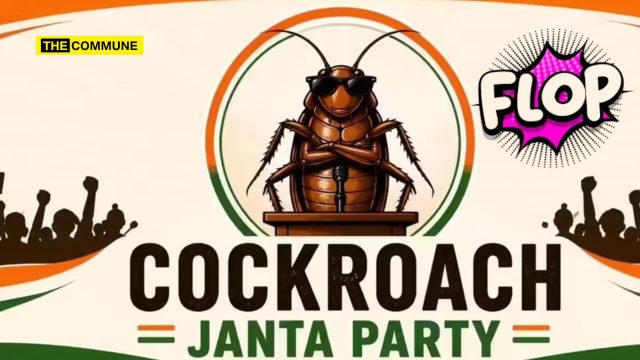
For weeks, the Cockroach Janta Party (CJP) ecosystem built up the June 6 ‘protest‘ as a make-or-break moment. Social media influencers hyped it. Opposition figures amplified it. Activists promised a youth uprising. The target was Union Education Minister Dharmendra Pradhan.
The result? A protest that generated noise but achieved nothing.
Despite all the hype, the demonstration at Delhi’s Jantar Mantar ended without any major political impact. Protesters gathered, slogans were raised, and then nothing happened. There were no dramatic confrontations, no mass detentions, and no visuals capable of dominating the national news cycle which they were expecting.
That was precisely the problem.
CJP’s strength has never been on the ground. Its influence comes from social media virality. The movement thrives on outrage, confrontation, and emotional mobilisation. With zero visuals of police action or a law-and-order flashpoint, the protest lost the very fuel needed to sustain momentum online.
The Delhi Police appeared to have anticipated the playbook. Security personnel were deployed in large numbers well before the protest began, ensuring that the gathering remained contained and peaceful. With no confrontation to exploit, the event quickly lost steam.
CJP tried to create such an atmosphere by not getting permission to protest a week in advance. After this was exposed, Dipke claimed he would apply for permission on the day he arrived in India.
Abhijeet Dipke, the former AAP-linked social media operative who flew in from the United States to participate in the agitation, attempted to project the protest as a major youth movement. However, even the planned airport reception for him was quietly dropped before the event.
Several opposition-linked figures had invested significant political capital in the mobilisation. Former AAP functionaries, activists associated with the movement, and opposition politicians had all projected June 6 as a turning point. Instead, the protest highlighted a different reality: social media reach does not automatically translate into street power.
Even the participation of climate activist Sonam Wangchuk failed to generate the momentum organisers had hoped for.
This video shows that the cockroaches, as they call themselves, are a big bunch of jokers.
These cockroaches are acting like circus clowns. 🤣😭
And we’re supposed to believe they’re going to bring a revolution?
Abhijeet Dipke, weren’t you even a little embarrassed calling this a Gen Z movement? 🤣😹 pic.twitter.com/kownm2rHt8
— Amit Kumar Sindhi (@AMIT_GUJJU) June 6, 2026
The participants even had paid protestors like these old men.
Looking at them, does it really seem like their NEET paper got leaked? 😭🤣
It feels more like they lost their pension receipts and came here to take out their frustration. 😭😂 pic.twitter.com/D6nvfjqjCt
— Amit Kumar Sindhi (@AMIT_GUJJU) June 6, 2026
We heard Azadi slogans being chanted at the protest. Now we know who has always been a part of the ‘revolution’ called CJP.
Communists have suddenly become Cockroaches overnight
Naach Gaana Party Pro Max
😂😂😂 pic.twitter.com/r0YrjII5jl— Sensei Kraken Zero (@YearOfTheKraken) June 6, 2026
The protestors had permission till 5PM but they reportedly left the site by 3PM itself.
The CJP protest had permission till 5 PM, but people started heading back by 3 PM itself.
Apparently, they’re already tired.
And these are the people who claim they’ll bring a revolution? 🤣 pic.twitter.com/y6WPIQNiiJ
— Amit Kumar Sindhi (@AMIT_GUJJU) June 6, 2026
A journalist with over 15 years of experience covering protests shared on his X handle that the June 6 CJP protest at Jantar Mantar was among the most poorly organised demonstrations he had witnessed.
Drawing comparisons with movements such as the India Against Corruption agitation, the Farmers’ Protest, and the Wrestlers’ Protest, he said the CJP gathering appeared forced and lacked genuine public participation.
According to him, unlike earlier mass movements driven by ordinary citizens, the event resembled a mobilisation led largely by left-leaning student activists (Azadi slogans are an indicator). He further stated that even Delhi’s Pride Parades attracted larger crowds and noted that, despite being projected as a youth movement, the gathering had more elderly participants than young people.
He also spotted visible class divisions, with organisers enjoying VIP arrangements while supporters stood in the heat, adding that the protest appeared fragmented, directionless, and sparsely attended.
My experience after attending today’s CJP Protests:
I have covered various protests for my media house over the last 15 years.
I have attended the IAC protests, Farmers’ Protest, Wrestlers’ Protest, and now the CJP Protest.
Let me share my experience comparing the CJP Protest… pic.twitter.com/8cbDCc3MJV
— Amit Kumar Sindhi (@AMIT_GUJJU) June 6, 2026
In the end, the protest seems to have neither forced a resignation nor created the political spectacle its organisers appeared to be seeking. The crowds came, the slogans were chanted, the protestors left early, the hashtags trended briefly, and the day ended without consequence.
Far from becoming a watershed moment, the June 6 agitation may be remembered as the day CJP discovered that viral popularity and political influence are not the same thing.
Subscribe to our channels on WhatsApp, Telegram, Instagram and YouTube to get the best stories of the day delivered to you personally.