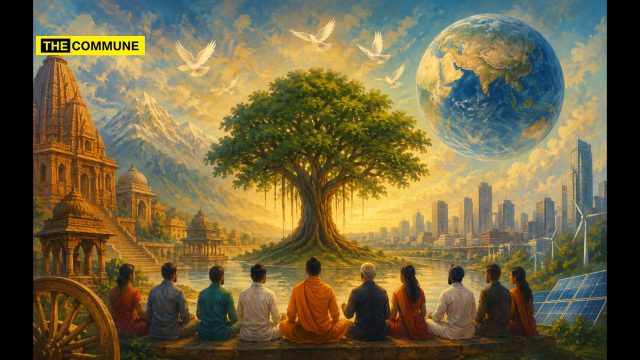
As the world searches for sustainable models of peace and progress, India’s civilizational wisdom offers enduring answers.
In an era marked by geopolitical rivalry, technological disruption, and growing social fragmentation, nations are increasingly seeking sources of stability that go beyond military strength and economic power. India, one of the world’s oldest continuous civilizations, offers a distinctive perspective rooted in its cultural and philosophical traditions. Rather than relying solely on material progress, India’s civilizational ethos emphasizes harmony, pluralism, ethical living, and spiritual inquiry. These enduring values provide not only a framework for national development but also a potential contribution to addressing global challenges.
India’s cultural identity has evolved over thousands of years without losing its essential character. Unlike many civilizations that disappeared or were absorbed into others, Indian civilization has demonstrated remarkable resilience. It has weathered invasions, colonialism, political upheavals, and economic transformations while preserving its philosophical foundations. This continuity is reflected in the coexistence of diverse languages, religions, customs, and traditions within a shared civilizational framework. The ability to embrace diversity without sacrificing unity has become one of India’s greatest strengths.
The principles embedded in Indian philosophy remain strikingly relevant today. Concepts such as Vasudhaiva Kutumbakam (the world is one family), Sarva Dharma Sambhava (equal respect for all faiths), and Ahimsa (non-violence) promote cooperation rather than conflict. At a time when religious intolerance, nationalism, and ideological polarization are intensifying across the globe, these values encourage dialogue, mutual respect, and peaceful coexistence. They remind humanity that progress cannot be measured solely by economic indicators but must also include moral and social well-being.
India’s democratic experience further reflects this civilizational outlook. Governing a nation of more than 1.4 billion people representing countless ethnicities, languages, and belief systems is an extraordinary achievement. While India undoubtedly faces challenges related to inequality, social tensions, and governance, its constitutional commitment to democracy and pluralism remains deeply connected to its broader cultural heritage. The country’s success in maintaining democratic institutions amidst immense diversity offers valuable lessons for other multicultural societies.
The growing global interest in Indian traditions also highlights the country’s expanding cultural influence. Yoga, Ayurveda, meditation, classical arts, and Indian literature have gained recognition worldwide, not merely as cultural exports but as practical tools for improving physical health, mental well-being, and emotional resilience. In an age where stress, anxiety, and lifestyle-related diseases are increasing, these traditions have acquired renewed relevance. Their widespread acceptance demonstrates that India’s soft power lies not in imposing ideas but in offering knowledge systems that people voluntarily embrace.
At the same time, cultural confidence should not become cultural triumphalism. Celebrating India’s heritage must be accompanied by an honest acknowledgment of the nation’s ongoing responsibilities. Social inequalities, environmental degradation, educational disparities, and economic challenges cannot be ignored in the name of civilizational pride. True cultural greatness is demonstrated not through nostalgia but through the ability to apply timeless values to contemporary problems. India’s philosophical traditions encourage self-reflection, continuous learning, and ethical action principles that remain essential for national progress.
Modern India also illustrates that tradition and innovation are not mutually exclusive. The country has emerged as a global leader in information technology, digital public infrastructure, space exploration, and pharmaceutical production while maintaining strong connections to its cultural roots. This balance between technological advancement and civilizational identity represents a distinctive development model. Rather than choosing between modernity and tradition, India increasingly seeks to integrate both, demonstrating that cultural heritage can coexist with scientific progress.
Internationally, India’s foreign policy increasingly reflects its aspiration to act as a bridge between different regions and civilizations. Whether through humanitarian assistance, climate initiatives, development partnerships, or participation in multilateral institutions, India often presents itself as a responsible global stakeholder. Its emphasis on dialogue, strategic autonomy, and inclusive development resonates with many countries seeking alternatives to rigid geopolitical blocs. Although these aspirations must be matched by consistent action, they illustrate how civilizational values can influence contemporary diplomacy.
However, India’s greatest contribution to the world may ultimately lie not in economic size or military capability but in its enduring belief that humanity is interconnected. As climate change, pandemics, cyber threats, and economic instability transcend national borders, no country can prosper in isolation. The Indian philosophical tradition has long emphasized interconnectedness between individuals, societies, nature, and the cosmos. This holistic worldview offers an ethical framework for addressing global problems that require cooperation rather than competition.
In conclusion, India’s cultural continuity is not merely a matter of preserving ancient customs; it is about sustaining values that remain relevant in an increasingly uncertain world. Its civilizational heritage encourages pluralism, ethical leadership, peaceful coexistence, and intellectual openness. Yet the true measure of India’s cultural strength will depend on how effectively these ideals are translated into inclusive governance, social justice, environmental responsibility, and human development. If India succeeds in aligning its ancient wisdom with modern aspirations, it will not only strengthen its own future but also offer a meaningful model for a world searching for balance, resilience, and shared progress.
Dr. Prosenjit Nath is a techie, political analyst, and author.
Subscribe to our channels on WhatsApp, Telegram, Instagram and YouTube to get the best stories of the day delivered to you personally.