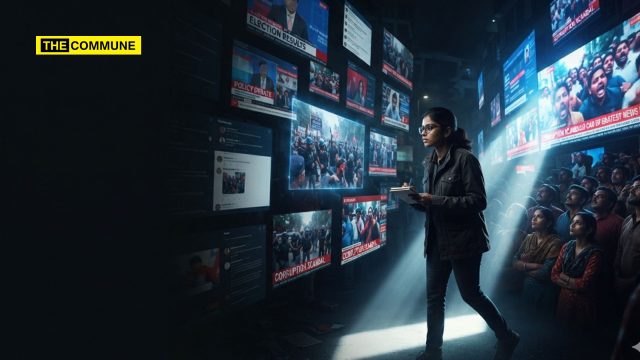
Today’s world is saturated with narratives, echo chambers, and information overload, all of which can distract people from reality and, more importantly, the truth. Geopolitics plays a significant role in shaping these narratives, often influencing public opinion and, at times, making a mockery of democracy.
Young people are particularly vulnerable. They have grown up in an environment where information travels through social media at unprecedented speed, often without the editorial gatekeeping that traditionally helped distinguish credible reporting from misinformation. This has created enormous opportunities not only to share knowledge but also to spread falsehoods, manipulate public opinion, and shape political narratives.
This is precisely why media literacy matters. But I would argue that media literacy alone is not enough. What we need to develop is intellectual independence.
The Greatest Danger is Not Propaganda
We often worry about young people encountering propaganda. But that, in itself, is not the greatest danger. Young people will inevitably encounter propaganda, misinformation, political persuasion, and biased narratives. The real danger lies in encountering them within an environment that continually reinforces the same beliefs.
A person who encounters a false claim once may question it. However, a person who encounters the same claim repeatedly, sees thousands of people apparently agreeing with it, receives social approval for sharing it, and rarely encounters a credible alternative may eventually begin to accept that claim as an obvious truth.
When repetition replaces evidence and social approval replaces critical thinking, misinformation becomes deeply embedded in people’s understanding of reality. This is why the issue is not simply media literacy. It is intellectual independence: the ability to think critically, question prevailing narratives, evaluate evidence, and arrive at conclusions without being dictated to by others’ opinions.
We need to teach young people to ask better questions before accepting what they see, hear, or read.
- Who is trying to influence me?
- Why am I seeing this information?
- Who benefits if I believe it?
- What emotion is this information trying to create?
- What evidence supports this claim?
- What evidence challenges it?
- Whose perspective is missing?
- Am I looking at the original information or someone else’s interpretation of it?
- Is this information, persuasion, activism, propaganda, or some combination of these?
- What evidence would convince me that I might be wrong?
These questions are not intended to make young people distrust everything. They are intended to help them distinguish between what is asserted and what is established, between what is emotionally appealing and what is factually supported.
Let us apply this approach to a contemporary political issue in India.
The Delhi Protests and the Special Intensive Revision
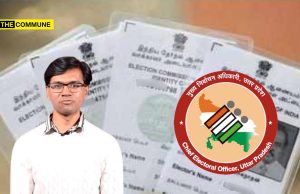
The recent protests in Delhi concerning the Special Intensive Revision (SIR) of electoral rolls provide an opportunity to examine how political narratives are constructed, communicated, and accepted.
The opposition and the Cockroach Party have claimed that approximately 13 crore voters were removed without legitimate reasons. They have questioned the transparency of the process and targeted the Chief Election Commissioner. Rather than accepting or rejecting these claims on the basis of political affiliation, we should begin by asking the right questions: What do the records actually say? Who conducted the exercise? What were the stated reasons for the changes? What evidence supports the allegations?
According to the figures cited by Election Commission of India (ECI) in this debate, approximately 6.3 crore voters had permanently shifted, 2.8 crore were deceased, around one crore were identified as duplicates, and another three crore were untraceable. These categories are presented as explanations for the changes in the electoral rolls. If you have questions, the figures and their underlying documentation must be examined carefully, including the methodology used, the status of individual cases, and the safeguards available to voters who believe their names have been wrongly excluded. If these figures are accurate and refer to the same exercise and reporting period, they offer a substantially different explanation from the claim that all the affected voters were arbitrarily removed.
The next question is: who is conducting the exercise? The Election Commission of India (ECI), through the electoral administration, including Booth Level Officers and the prescribed verification procedures. Political parties also have opportunities to participate through their designated agents and representatives. The essential point is that we should examine the actual process and the available evidence rather than accept a political interpretation as an established fact.
The next claim is that the Election Commission is compromised and that the government is manipulating elections.
Here, too, we must ask questions. If the electoral system is entirely controlled by the ruling party, how have opposition parties been able to win elections and form governments in states such as Tamil Nadu, Kerala, Telangana, Karnataka, and Jharkhand at different points in time?
Does this, by itself, prove that every aspect of the electoral process is beyond question? Certainly not. Electoral integrity must be assessed through evidence, independent scrutiny, and transparent procedures. However, these results are relevant evidence that any serious argument about systematic electoral manipulation must address. They cannot simply be ignored because they complicate the narrative being promoted.
This is where intellectual independence becomes essential. We must consider the perspective of the Election Commission, examine the evidence presented by the opposition, and distinguish between documented facts, reasonable concerns, and unsubstantiated allegations. When we hear only one side of an argument, we are not necessarily becoming informed. We may simply be absorbing someone else’s interpretation of events.
Political Activism, Evidence, and Accountability
Let us take the argument further.
India is the world’s largest democracy and conducts elections on an extraordinary scale. The legitimacy of its democratic institutions matters not only to Indian citizens but also to the wider international community.
The opposition has every right to challenge the government, question electoral procedures, organise protests, and demand accountability. These are legitimate features of a democracy. The government and the Election Commission must be open to scrutiny, and allegations of electoral irregularities deserve serious investigation when supported by credible evidence.
But the opposition also has a responsibility to substantiate its claims.
If the objective is to remove a democratically elected government, the constitutional route is to persuade voters and win elections. If the claim is that the electoral process itself is compromised, then the argument must be supported by verifiable evidence and pursued through appropriate legal, institutional, and democratic channels.
The Leader of the Opposition occupies an important constitutional and parliamentary position. Parliament provides an important forum for questioning the government, presenting evidence, demanding explanations, and holding institutions accountable. Public protests can complement this process, but they cannot substitute for evidence. The question, therefore, is not whether protests are legitimate. They are. The question is whether the specific allegations being made are supported by evidence and whether the methods being employed are likely to resolve the issue.
Young people should ask: Are the claims being made backed by verifiable facts? Are alternative explanations being considered? Are the organisers offering a credible path towards resolving the problem, or are they relying primarily on emotional mobilisation?
These questions are essential to distinguishing democratic accountability from political theatre.
Who Benefits From the Narrative?
There is another dimension that deserves examination: the geopolitical context.
India is an increasingly important economic and strategic player in a multipolar world. Its economic growth, international partnerships, technological capabilities, and geopolitical positioning have implications for other countries. Consequently, the narratives surrounding India can have consequences beyond domestic politics. International perceptions influence investment decisions, diplomatic relationships, and strategic partnerships.
It is reasonable to ask whether particular actors might benefit from portraying a country as politically unstable. It is equally important, however, to distinguish a legitimate geopolitical analysis from an allegation that specific groups are funding or orchestrating protests. Such claims require credible evidence, including verifiable financial links, documented coordination, or reliable investigative findings.
This distinction matters. Intellectual independence requires us to question both the narratives promoted by political opponents and the narratives promoted by those who support the government. We cannot demand evidence from one side while accepting speculation from the other.
Ultimately, the most important question is this: How does the ordinary citizen benefit from the political activity being undertaken in their name?
India has made substantial progress in poverty reduction over the past decade. Estimates from the World Bank and other institutions have documented significant improvements, although the scale varies according to the poverty measure and period considered. These gains, alongside the country’s continuing developmental challenges, deserve serious attention.
For millions of families, access to education, healthcare, employment, infrastructure, and economic opportunity matters far more than the political fortunes of any individual party.
If political mobilisation contributes to stronger institutions, greater transparency, and better public policy, it serves a constructive purpose. If it merely deepens polarisation, spreads unverified claims, and diverts attention from substantive public concerns, we must question its value. The youth of India should be asking whether the narratives they encounter are helping them understand the country’s challenges or simply encouraging them to join one side of a political argument.
Frantz Fanon and the Politics of Influence
I would also like to draw attention to the ideas of Frantz Fanon, the psychiatrist, philosopher, and anti-colonial thinker whose work examined colonialism, racism, identity, and revolutionary struggle. Fanon’s writings offer useful perspectives for analyzing how power operates through culture, identity, political elites, and economic structures. His work encourages us to examine how dominant narratives shape people’s understanding of themselves, their societies, and their political choices.
His ideas can also inform contemporary discussions about neocolonialism and the ways in which influence may extend beyond direct military or political control. Economic dependence, cultural power, institutional arrangements, and control over information can all shape the choices available to societies.
We should be careful not to attribute every contemporary feature of digital propaganda directly to Fanon. Nevertheless, his broader intellectual framework offers a valuable starting point for questioning who exercises power, how that power is legitimised, and whose interests it ultimately serves.
In today’s digital environment, these questions have acquired a new urgency. Information platforms, algorithms, online communities, and political communication networks can influence what people see, what they believe, and how they interpret events. The danger is not merely that young people may encounter misleading information. It is that they may gradually lose the habit of questioning the information that confirms their existing beliefs.
Intellectual Independence, Not Herd Mentality
I strongly believe that the youth of this country must learn to ask difficult questions before accepting political claims as truth.
Do not believe something simply because a political leader says it. Do not reject something simply because a political opponent says it. Do not assume that a claim is true because thousands of people share it on social media. And do not mistake emotional conviction for factual evidence.
Question the government. Question the opposition. Question the media. Question social media influencers. And, perhaps most importantly, question your own assumptions.
Being intellectually independent does not mean refusing to take a position. It means being willing to examine evidence before taking one, to change your mind when the evidence demands it, and to acknowledge uncertainty when the facts are inconclusive.
Democracy depends on more than the right to vote or the freedom to protest. It also depends on citizens who can distinguish facts from opinions, evidence from speculation, and legitimate criticism from deliberate manipulation. The greatest danger to a young mind is not that it encounters a false narrative. It is that it becomes so accustomed to hearing that narrative that it no longer feels the need to question it. In an age of information overload, the ability to think independently is not merely an academic skill. It is a democratic responsibility.
The real question for today’s youth is not simply what they believe, but why they believe it. Intellectual independence, not herd mentality, is the foundation of a genuinely informed citizenry.
Dr. Santha Kumar is an education leader, author, and public commentator on civilizational history, geopolitics, and contemporary issues affecting Sanatana Dharma.
Subscribe to our channels on WhatsApp, Telegram, Instagram and YouTube to get the best stories of the day delivered to you personally.