The Cockroach Janata Party, in a very short period of time since its creation, has captured the imagination of all and sundry. The media, as has been their wont for the past two decades, has suddenly found yet another great Indian hope in them. The youth of the country is also behind them, and we are all blessed to be living at a time when the next mega revolution is just a week away. From my living memory, the last time something like this that collectively lifted our spirits and oneness, and brought about a sense of personal satisfaction was on April 2nd, 2011, when MSD hit that ball for a six…. Nah… Not that one. It happened 3 days later at Jantar Mantar, when Anna Hazare started his indefinite hunger strike demanding a strong Jan Lokpal Bill.
Wait? Did I get something wrong again? Yeah. The Cockroach Janata Party is not yet born. It is a monster which is not yet born. Shell companies have a legal presence, even if they don’t have a physical presence. Even amoeba has a physical presence, even if it lacks a shape or a form. It is more of a virus, variant of which steals its protective outer shell from the host’s membrane during the budding process. That pretty much sums up what the CJP is all about. An unincorporated association (akin to your whatsapp group created for that friend’s tour), shapeless, formless, generally unalive and uninspiring, but active enough to jump to claim credit should something happens. There is a saying in Tamil “காக்கை உட்காரப் பனம்பழம் விழுந்தது போல”
And when change eventually comes, the question of what actually caused it quietly disappears. The personality gets the credit. The underlying forces escape scrutiny. The purpose of this post is not to test this theory. My larger concern is whether powerful external interests have, at different points in our history, encouraged or benefited from this very process. And whether the resulting narratives have helped obscure their own political, commercial or historical responsibilities.
To examine that possibility, we must go back much further than Anna Hazare, Arvind Kejriwal or the latest political sensation (trust I wanted to avoid this word, but my limited English just gave up). We must go back to the greatest political transformation in modern Indian history. 1947.
1947
In March 1947, Winston Churchill stood in the House of Commons (in all probability, puffing his cigar) orgasming over doomsday prediction for the post-British subcontinent. Even discounting the often attributed phrase (“India was being handed over to rascals, rogues and freebooters”), the one that I could verify was this –
“In handing over the Government of India to these so-called political classes we are handing over to men of straw, of whom, in a few years, no trace will remain…..
“If we leave India to these men, India will be lost in political squabbles… You will have an army of political adventurers who will fight among themselves, and India will revert to the state of confusion and anarchy which existed before the British rule.”
In essence, Churchill sneered that all Indian leaders were weak, lack substance, or any real authority, and just a figurehead, controlled by others. And consequently, will reduce nation a to rubble by fighting among themselves for power.
As VP Menon had captured in his book “The Transfer of Power in India” (paraphrased), the British ruling class genuinely believed two things in 1947: first, that India—an impossible mosaic of 565 princely states, dozens of languages, and endless castes—would collapse into bloody civil war the moment the white man packed his bags; second, that Pakistan, bound by the unifying force of Islam and anchored by a loyal military, would thrive as a stable, pro-Western bulwark against the Soviet Union.
Fast forward through history, and both predictions stand as monumentally foolish imperial delusions. India, which was expected to fragment, held together. Pakistan, supposedly united by religion, lost its eastern half within twenty-four years.
The Myth of the Non-Violent Exit: The Ultimate “Useful Idiot”
I, like any other school going teenager, grew up reading popular classroom / school history that believed in the sanitized fairytale –Mahatma Gandhi’s (MKG) moral authority and Ahimsa (non-violence) single-handedly shamed the mighty British Empire into packing its trunks (both varieties) and sailing home.
An impassionate study / analysis reveals a very different reality. MKG was largely a sideshow to the real historical forces that dismantled the British Raj—acting less as the driver of liberation and more as a convenient mechanism for the colonial state itself. I would prefer using a more modern euphemism for him, which can unleash the wrath of quite a lot of people, if this article gets to the reading screens of those manchild, who still believe in fairytales. In modern political parlance, MKG functioned as the ultimate “useful idiot” for the British Empire: a manageable, predictable nuisance whom the Old Blighty repeatedly utilized to neutralize far more dangerous, existential threats to colonial rule.
Whenever revolutionary fervor reached a boiling point that genuinely threatened British control, MKG invariably stepped in to apply the brakes, serving as a safety valve for imperial interests, in many instances, such as –
a. The 1922 Chauri Chaura Call Off: When the Non-Cooperation Movement had monumental momentum, a single violent clash at Chauri Chaura prompted Gandhi to unilaterally call off the entire national campaign. The British, facing a potential nationwide uprising, watched in relief as Gandhi dismantled his own movement overnight [Sumit Sarkar, Modern India 1885–1947].
b. Marginalizing Real Revolutionaries: The British were terrified of armed revolutionaries like Bhagat Singh, Chandrashekhar Azad, and Subhas Chandra Bose—men who possessed the capacity to ignite military mutinies. By aggressively promoting non-violence as the only legitimate path, Gandhi effectively did the Raj’s security work for them, turning the Indian public against militant anti-colonial fighters.
The way I see it, for the Brit’s Gandhi was the ideal opponent: moralistic, harmless, and fundamentally opposed to armed insurrection. By keeping Gandhi at the center of negotiations, the British successfully sidelined radical trade unions, peasant uprisings, and military dissenters.
When the actual exit strategy was drawn up between 1945 and 1947, Gandhi was no longer even a factor in the room. When the former British Prime Minister Clement Attlee was asked a question on how much Gandhi’s non-violent movement had influenced Britain’s “sudden” exit, his one word answer was “Minimal” (as recollected by P. B. Chakraborty, the late West Bengal CM). In effect, the fly had outlived its utility, and was no longer on the discussion menu.
The Real Triggers for the Exit
The undeniable truth isn’t found in spinning wheels or peaceful marches; it is found in the brutal arithmetic of post-World War II realpolitik.
a. Britain Was Bankrupt
This is the simplest and most truthful reason. The World War II had inverted the economic dynamic. Britain went from a position of financial strength to a position of net borrower. Sunk under massive debt, facing severe domestic rationing, and begging Washington for a $3.75 billion lifeline, the Old Blighty simply could not afford to maintain an occupying army abroad. And that also marked the beginning of what continues to be Britain’s unstated military position viz a viz the US of A – Britain is USA’s Unofficial Second in Command in wars.
b. The Revolt of the Armed Forces
British rule in India never relied on a massive British army; it rested on a small British officer class commanding millions of Indian soldiers. WWII completely shattered that blind loyalty. When the British tried to prosecute officers of Subhas Chandra Bose’s Indian National Army (INA) at the Red Fort, public outrage spilled into the military barracks
Most notably, in 1946, over 20000 Indian sailors of the Royal Indian Navy (RIN) mutinied across 78 ships, hoisting Congress, Muslim League, and Red flags together in Bombay. Mutinies quickly echoed through the Royal Indian Air Force (even before the Navy, probably) and police units in Bihar and Delhi. And when the British realized that suppressing a full-scale military uprising would require sending fresh British batches / divisions of troops they didn’t have; or couldn’t afford to have — they realized the game was up.
c. “Operation Madhouse” and Bureaucratic Collapse
Around the same time, the “Steel Frame” of the country i.e. Indian Civil Service (ICS) had broken down. The Government had frozen recruit owing to World War II, leading to just about 1000 British Officers for a country of 40 Crore people Indian bureaucrats and police officers were taking less orders from the British, and answering future Indian leaders.
And those interested in history and secret operations, do look up for “Operation Madhouse” – A plan under which British troops and civil servants will abandon India province-by-province. Leaving the country to its fate, fearing a total and humiliating administrative disintegration.
d. The Panic Button for Accelerated Exit
It is a known fact that, Lord Mountbatten moved the independence deadline forward by 10 Months, compressing what was a monumental political division into a chaotic 72 Day Sprint. Two Statements of Lord Mountbatten is relevant to know the British mind –
“I was determined to keep the administrative machinery from breaking down completely before we got out… If we had stayed till June 1948, as Attlee originally planned, the whole place would have blown up in our hands. The administrative machinery was collapsing week by week.”
“Let them sort it out themselves. My job is to get us out without a British soldier being killed”
In effect, faced with impending chaos, Lord Mountbatten hit the panic button.
And MKG was not the factor. Even remotely.
The Modern Echo
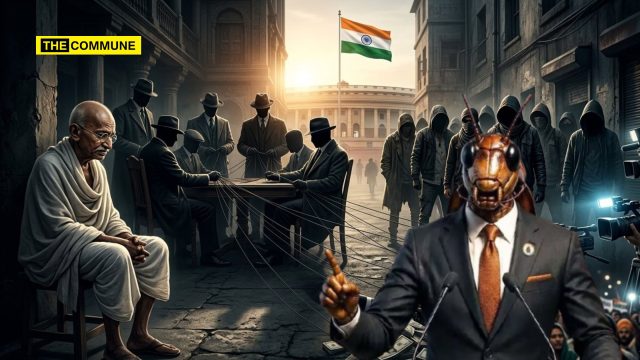
The imperial impulse didn’t vanish in 1947; it simply swapped red coats for non-governmental organizations, activist fronts, and pop-up political setups. They still want the control, but don’t want to carry the blame when seeking to benefit economically and aiming for control politically. Having lost their direct military grip, Western handlers turned to soft-power interventionism, bankrolling domestic outfits—including activist fronts and artificial political entities like the Cockroach Janata Party—to instigate protests, tie down the sovereign Indian state, and manufacture narrative warfare. This is both cheap (in all senses) and convenient. You get to pinch the baby and also rock the cradle.
Driven by foreign grants, FCRA routing, and shadowy financiers, these orchestrated disruptions function as modern “useful idiots” for foreign interests still reeling from the historic loss of their crown jewel.
Yet, this modern proxy playbook is doomed to fail just as miserably as Mountbatten’s rushed borders. That’s because the players have missed one angle – unlike the 1900s, the modern Indian isn’t that naïve or ignorant. They have started noticing the financial mechanics of these setup groups that reveal a glaring contradiction: individuals with zero political lineage, no mass base, and modest personal background somehow command endless capital for business class travel, five-star hotel stays, top-tier Supreme Court advocates, and non-stop media coverage.
Without organic roots or genuine popular support, these funded setups collapse the moment their financial plumbing is exposed—leaving their foreign handlers holding yet another handful of history’s eggs.
Carrying Eggs on Their Face
Seven decades later, history stands as an absolute refutation of imperial smugness. The British fled India not out of moral awakening or because Gandhi shamed them, but because they lost control of the army, ran out of money, and feared being slaughtered in a civil war. In their haste, they left behind drawn-in-a-hurry borders and broken promises—only for the very nation they wrote off to emerge as a global superpower, leaving the architects of Partition and their modern proxy networks carrying the eggs of history squarely on their faces.
The most recent attempt by the very same forces will meet the same end. It is pertinent again to quote the former Prime Minister of England, which was relevant then, and continues to be relevant today –
“Nationalist feeling runs right through all the Indian classes. That is the reason why you cannot carry on against the will of the Indian people.”
A bunch of useful idiots can, at best, act as hurdles. What future do they have against a nation of 1.5 billion people hurtling towards the future at breakneck speed? They will be blown to smithereens and consigned to oblivion. We will witness a repeat of 1947 and 2011 in 2026. This nation will create new history, notwithstanding the usual idiots.
G Saimukundhan is a Chartered Accountant.
Subscribe to our channels on WhatsApp, Telegram, Instagram and YouTube to get the best stories of the day delivered to you personally.