Tamil Nadu’s political landscape is entering a phase where the structure of competition itself is beginning to change. The emergence of Tamizhaga Vettri Kazhagam under Joseph Vijay has significantly reshaped the emotional centre of politics, particularly among younger voters and first-time electors. At the same time, the organisational presence of Dravida Munnetra Kazhagam continues across Tamil Nadu’s 234 constituencies, around 75000 polling booths, and 38 districts, though its influence increasingly resembles a legacy structure rather than the primary axis of future political imagination.
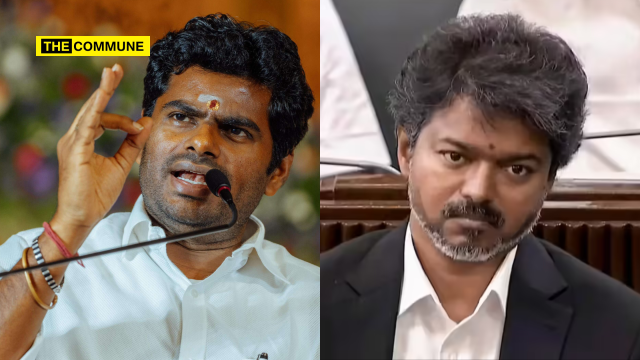
Within this evolving environment, the positioning of K. Annamalai is best understood not as participation in a crowded multipolar contest, but as an attempt to reshape the very architecture of competition. The strategic objective is to gradually simplify Tamil Nadu politics into a bipolar framework where voters are effectively choosing between two distinct governing philosophies.
Having observed Annamalai for a long time now, he surely has a good plan in his mind but here are my two cents on the strategy he needs to apply while he converts his people movement currently to a political party down the line.
From Fragmentation To Structured Bipolarity
For many years, Tamil Nadu politics has been characterised by layered competition, shifting alliances, and multiple centres of influence. That structure is now showing signs of simplification. What must emerge instead that would be favourable for Annamalai is a gradual consolidation of political imagination into two dominant poles.
On one side stands TVK, which increasingly represents emotional legitimacy and mass appeal. On the other side is the possibility of a governance-centric alternative represented by Annamalai, built around systems thinking, institutional discipline, and measurable accountability. In this emerging configuration, DMK continues to exist as an organisational reality, but its role is slowly transitioning into that of a legacy system whose influence is more structural than agenda-setting. I don’t see any space for AIADMK going forward in the narrative.
The deeper strategic shift here is that elections are no longer just about competing parties—they are increasingly about competing frameworks through which voters interpret governance itself.
Clear Nationalistic Ideology
No political movement in Tamil Nadu can sustain itself without a clear ideological foundation, but ideology in this context is not about abstract doctrine. It is about how governance is defined, how trust is earned, and how citizens evaluate political performance.
In this sense, the ideological position that K. Annamalai must articulate cannot be generic reform language. It has to function as a compact governing philosophy that is immediately understandable, emotionally grounded, and operationally clear.
A workable ideological statement for this movement should sound like:
“We believe Tamil Nadu must move from rule by slogans to rule by systems; from identity-based politics to performance-based governance; and from promises of welfare to pathways of opportunity.
We do not seek power as privilege, but as responsibility measured through outcomes.
Our commitment is to build a Tamil Nadu where every citizen’s dignity is secured not by dependency, but by access to education, skills, employment, and enterprise.
We believe governance must be transparent, measurable, and continuously accountable to the people it serves.
And we believe Tamil Nadu’s cultural strength is not a political tool, but a civilisational foundation—reflected in education, civic life, and public institutions, where pride in heritage coexists with ambition for global competitiveness.
Above all, we believe the energy of Tamil youth must be transformed into productive power—away from cycles of addiction and disengagement, and toward learning, building, and contributing meaningfully to society.”
This statement works because it is not ideological in the traditional sense of political camps. It is administrative ideology translated into political language—simple enough for voters, but structured enough to guide governance design.
It reframes the movement not as opposition, but as an alternative operating system for governance.
This is not anti-emotion—it is re-channelled emotion:
From loyalty → verification
From dependency → aspiration
From identity → capability
This ideological framing is important because it does not attempt to suppress Tamil Nadu’s emotional political culture. Instead, it redirects it into evaluative citizenship, where emotion still exists—but is filtered through performance, outcomes, and accountability.
In practical terms, it changes the voter’s internal question from “Who represents me?” to “Who delivers for me?” without dismissing identity or belonging. This sounds difficult but is not impossible to achieve.
Strengthening Booth Structure As Engine
Tamil Nadu’s electoral outcomes are ultimately shaped across approximately 75,000 polling booths distributed across 234 constituencies. This micro-structure is where political sentiment is converted into electoral reality.
TVK’s strength lies in emotional mobilisation at scale. DMK retains organisational familiarity in several regions. For any alternative to be competitive, the decisive requirement is sustained booth-level infrastructure that operates continuously rather than episodically.
This involves voter engagement systems that are embedded, persistent, and locally responsive—where political presence is measured not by visibility alone, but by consistent interaction and feedback loops at the household level.
Consolidating Anti-Incumbency
Anti-incumbency in Tamil Nadu is unlikely to behave as a single wave. It will remain fragmented across governance fatigue, transition uncertainty, and legacy dissatisfaction.
The political opportunity exists only if this fragmentation is structured into a coherent comparison between two alternatives. Without that structure, dissatisfaction disperses; with it, it becomes politically decisive.
The strategic requirement is therefore to convert sentiment into a clear binary evaluation of governance alternatives across districts, constituencies, and sectors.
Repositioning Of Legacy Politics
Legacy political forces continue to exist as organisational structures across Tamil Nadu, but their role in shaping future political imagination is gradually diminishing. They remain relevant at the local level but are less central in defining the direction of voter aspiration.
The strategic shift underway is not elimination, but reduction of agenda-setting power—where legacy frameworks no longer define the primary comparison set for voters.
State-Wide Presence Should Be Non-Negotiable
A bipolar system cannot exist unless both poles have statewide reach. TVK already occupies that condition. The alternative must match it across Tamil Nadu’s full geographic and demographic spread.
This requires consistent presence across industrial belts, agrarian regions, urban centres, and transitional constituencies, ensuring that the political alternative is not regionally concentrated but structurally statewide.
Shadow Governance: Building Credibility Before Power
A credible political alternative must demonstrate governance readiness before assuming office. This is where structured shadow governance becomes essential.
It includes clearly articulated approaches to economic growth, employment generation, agriculture, water management, education reform, and industrial policy—each connected to district-level realities rather than abstract planning.
The purpose is simple: to establish the movement as a government-in-waiting rather than a reactive opposition voice.
Focus On Governance Evaluation
In modern politics, attention is volatile, but evaluation is durable. TVK currently dominates emotional attention cycles, while legacy actors continue to influence historical interpretation.
The competitive space available for Annamalai lies in evaluation—how governance competence is assessed over time through consistency, data, field presence, and policy clarity.
Attention creates visibility. Evaluation creates legitimacy.
Coalition Strategy Should Lead To Bipolarity
Alliances might have to be considered, practically speaking although ideally it is better off if Annamalai does not ally with any other party as most of them will dilute his clean transformational agenda. Coalitions in Tamil Nadu often fragment political structure. Therefore, alliance design becomes a tool to reinforce bipolarity. Annamalai must carefully select alliances that strengthen Annamalai vs. TVK frame. He should engage with smaller parties early to prevent fragmentation. Alliances must simplify political choices and not complicate it. Coalitions must reinforce structure, not dilute it.
The Final Objective: A Clean Binary Field
The strategic endpoint is not fragmentation management, but structural simplification of Tamil Nadu politics into two dominant governing philosophies:
- TVK: emotional governance continuity
- Annamalai: systems-driven governance alternative
As this structure stabilises, voters move from navigating complexity to making direct comparisons. And in political systems, clarity is often the point at which outcomes begin to shift decisively. It must clearly become Vijay vs. Annamalai.
The real question is not merely who competes in 2031—but whether the political field itself can be shaped in advance so that competition becomes a two-way referendum on the future of governance in Tamil Nadu. It will be clearly advantage Annamalai in 2031, if smartly managed.
M. Ananth Narayan is a political commentator.
Subscribe to our channels on WhatsApp, Telegram, Instagram and YouTube to get the best stories of the day delivered to you personally.