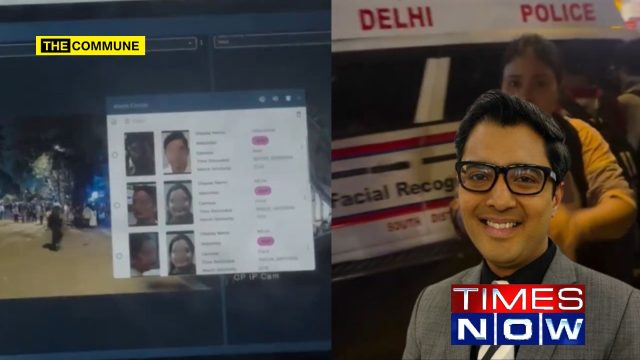
As student protested at Delhi’s Jantar Mantar, cockroaches began crying over the technology being used to monitor demonstrators. Videos circulating on social media show Delhi Police personnel using AI-powered facial recognition systems housed inside surveillance vehicles.
Times Now Managing Editor Zakka Jacob, a former CCTV employee, began frothing at his mouth about the legality of the deployment, citing privacy concerns and the Puttaswamy judgment. But a closer examination of the legal framework, judicial precedent, and current court proceedings reveals that his overreaction is just that.
What the Videos Show
Videos filmed at the protest site are spreading rapidly on X, with several users claiming that Delhi Police personnel are using AI-powered facial recognition systems to identify protesters instantly. The clips, which were also shared by CJP on X, appear to show footage from a live CCTV surveillance vehicle equipped with 360-degree cameras. The screen inside the vehicle also appears to display the names, photographs, and other details of select protesters.
Delhi police using facial recognition van system jaha van ke aage camera hai that is recording live names and other details of protestors at jantarmantar….
adhar details ka use aise kiya ja rha hai no privacy left pic.twitter.com/AHSpB45jtj
— Kavish aziz (@azizkavish) July 23, 2026
Part -2 how police using facial recognition van system to record live footage of protesters ….i bring exclusive coverage from Jantarmantar#cjpprotest #facialrecognition #jantarmantar pic.twitter.com/5ywaloUQFN
— Ila Kazmi (@ila_kazmi) July 23, 2026
The videos do not mention Aadhaar anywhere. However, as reported in India Today, because the system is reportedly able to pull up personal information after scanning faces, many social media users have questioned whether it is connected to Aadhaar or another government database.
Zakka Jacob’s Outburst
Times Now Managing Editor Zakka Jacob shared the videos (as above) and wrote, “Under whose orders has Delhi police placed this here? Is this not violative of the Puttaswamy judgement? Violation of privacy as a fundamental right? Will any SC lawyer take this up pro bono? Will Honourable CJI take this up suo motu? Or ‘no time’ for this also?”
Under whose orders has Delhi police placed this here? Is this not violative of the Puttaswamy judgement? Violation of privacy as a fundamental right? Will any SC lawyer take this up pro bono? Will Honourable CJI take this up suo motu? Or ‘no time’ for this also? https://t.co/qEmRFcToDY
— Zakka Jacob (@Zakka_Jacob) July 24, 2026
Why Zakka Jacob’s Argument Is Flawed
The Ministry of Home Affairs has confirmed that the Delhi Police’s facial recognition program operates under an official internal police order issued on 9 June 2022, authorizing the technology to identify “suspected individuals or known criminals”. In response to a Rajya Sabha question in 2025, the MHA stated that the system operates under Standing Order No. Tech. & PI/04/2022.
Furthermore, the system is anchored by the Safe City Project, a ₹798 crore central government-funded initiative to enhance urban security and surveillance infrastructure, including the establishment of an Integrated Command, Control, Communication & Computer Centre (C4I). The project was formally expanded by the Union Home Minister in February 2026. Law enforcement is executing an established internal security protocol, not acting without administrative backing.
An Indian Express report states that Delhi Police has positioned two surveillance vehicles near the protest site. One functions as a mobile monitoring unit that receives live feeds from CCTV cameras installed around the area. The second vehicle uses artificial intelligence to analyse those video feeds and compare faces captured on camera with images available in a police database.
Officials say the technology is not meant to identify every protester. Instead, its purpose is to alert police if someone with a criminal record is detected in the crowd.
“We have a large database of criminals, with their pictures. So, we run facial recognition on the footage that is received from the various CCTVs in the area, to see if it flags any face the software matches with someone on our criminal database,” a senior police officer told Indian Express.
The Ikshana Vehicle
The facial recognition system is housed inside the Ikshana vehicle, which Delhi Police first introduced ahead of the 2023 G20 Summit as part of its surveillance infrastructure. Developed in collaboration with CP PLUS, the vehicle is equipped with eight “state-of-the-art fixed cameras” for 360-degree field of view, AI-powered ANPR cameras, mobile PTZ cameras, and face detection and recognition functions. It is manned by trained CCTV operators and has its own fully integrated Command & Control Centre for real-time monitoring.
The Constitutional Counter: What Puttaswamy Actually Says
Zakka Jacob’s arguments on violation of privacy and invoking the Puttaswamy judgement actually misrepresents it.
The Supreme Court in the Puttaswamy judgment explicitly ruled that the right to privacy is not absolute and can be restricted if the state meets specific conditions: a legitimate state aim and proportionality.
Legitimate State Aim: Maintaining public order and identifying known criminals at highly volatile gatherings is a recognized state interest. The protests have witnessed clashes, stone-pelting, and attacks on police personnel. More than 60 protesters and 118 police personnel were injured in the violence, while 15 to 20 government vehicles, including police vehicles, were damaged.
Proportionality: The Central Government formally argued before the Delhi High Court that the system is not actively identifying every peaceful student. Instead, it functions selectively to cross-match live feeds against existing police criminal databases which contain approximately 350,000 criminal records to flag individuals with criminal histories or those involved in recent stone-pelting.
Police sources have stated that the AI cameras will help police identify those who were involved in clashes with the police, damaging government vehicles and attacking police personnel. Their criminal records will be checked using the police database and they will be arrested.
The Judicial Process Counter: Courts Are Already Engaged
The insinuation that the courts have “no time” or are ignoring the issue misrepresents how the legal system functions. The judiciary is already actively dealing with this exact matter.
A Public Interest Litigation filed by former JNU Students’ Union president Aishe Ghosh is currently being heard by a Division Bench of the Delhi High Court. The plea alleges that Delhi Police subjected protesters to “continuous, indiscriminate and intrusive surveillance,” including installation of a permanent surveillance tower and blanket deployment of videographers.
The High Court has already intervened, ordering the preservation of all protest footage and demanding that the Delhi Police clarify their Standard Operating Procedures (SOPs) for biometric tracking. The court has asked whether any SOP exists to regulate policing at protest sites and has listed the matter for further hearing.
During a hearing on 20 July 2026, Delhi Police, represented by Solicitor General Tushar Mehta, told the High Court that videography and photography at Jantar Mantar were being carried out solely to maintain law and order and ensure public safety, and “not for surveillance or snooping”.
When high-profile senior advocates are already representing student interests in active court cases, there is no procedural need for the Supreme Court to take suo motu cognizance. The established legal channel is working exactly as intended.
The Violence That Necessitated the Response
The clashes broke on 20 July 2026 when protesters led by the CJP attempted to march towards Parliament and were stopped by security personnel, triggering confrontations in areas around Parliament Street, Connaught Place and adjoining roads.
According to police, protesters tried to breach barricades erected to stop them from heading towards Parliament, leading to clashes and stone-pelting. More than 60 protesters and 118 police personnel were injured in the violence, while 15 to 20 government vehicles, including police vehicles, were damaged.
An FIR was filed by a Rapid Action Force (RAF) personnel who was allegedly assaulted by protesters. A video of the incident had gone viral on social media.
Conclusion
The criticism of Delhi Police’s AI surveillance deployment at Jantar Mantar does not withstand scrutiny. The technology operates under established legal frameworks as mentioned above. The Puttaswamy judgment does not provide an absolute right to privacy that overrides public safety concerns, and the state has articulated both a legitimate aim and proportionality in its deployment.
The courts are already actively engaged with the matter through a PIL before the Delhi High Court, making calls for Supreme Court intervention procedurally unnecessary. Critics would be better served by examining the actual legal framework rather than advancing arguments that misrepresent both the law and the facts on the ground.
Subscribe to our channels on WhatsApp, Telegram, Instagram and YouTube to get the best stories of the day delivered to you personally.