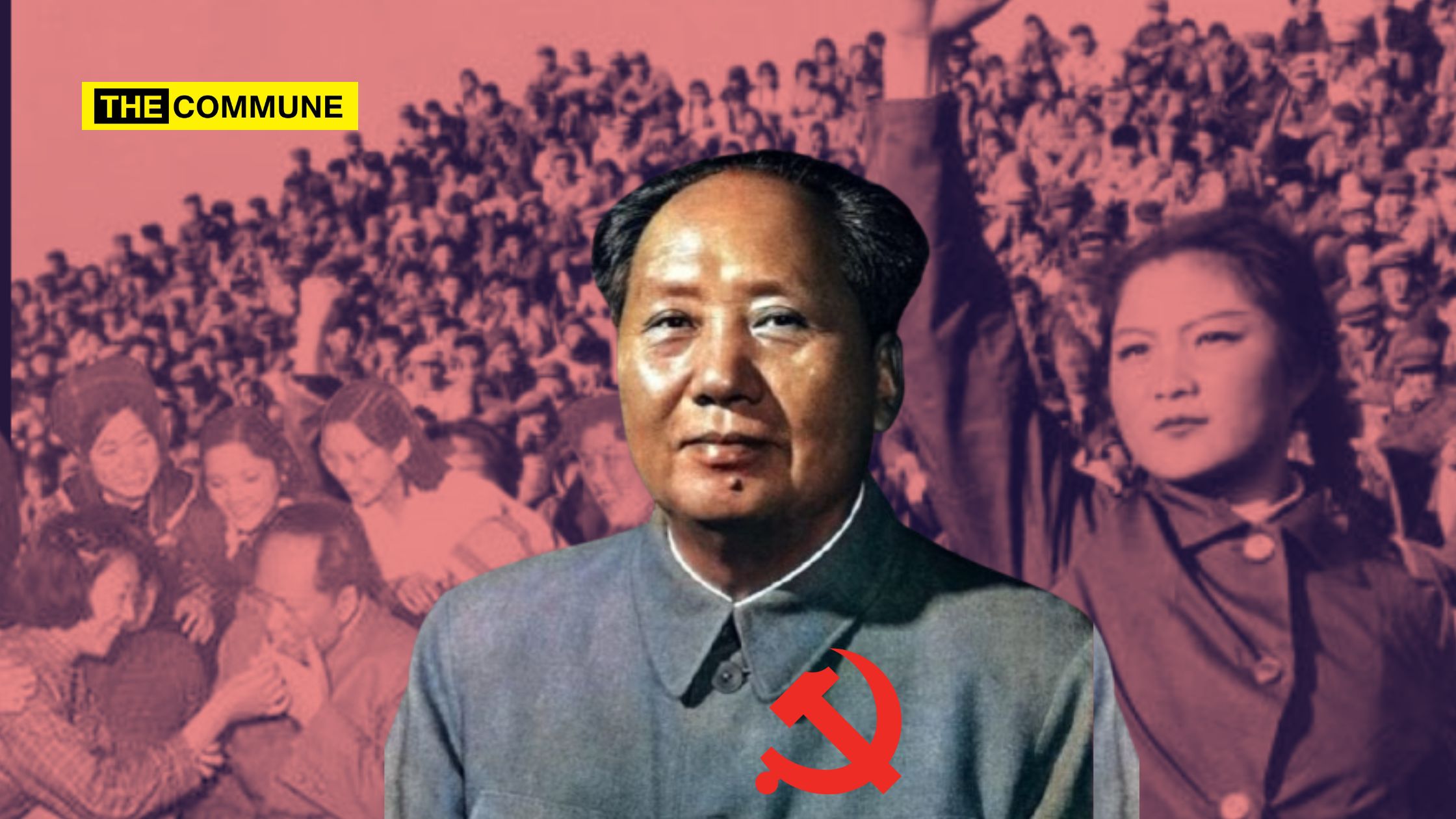
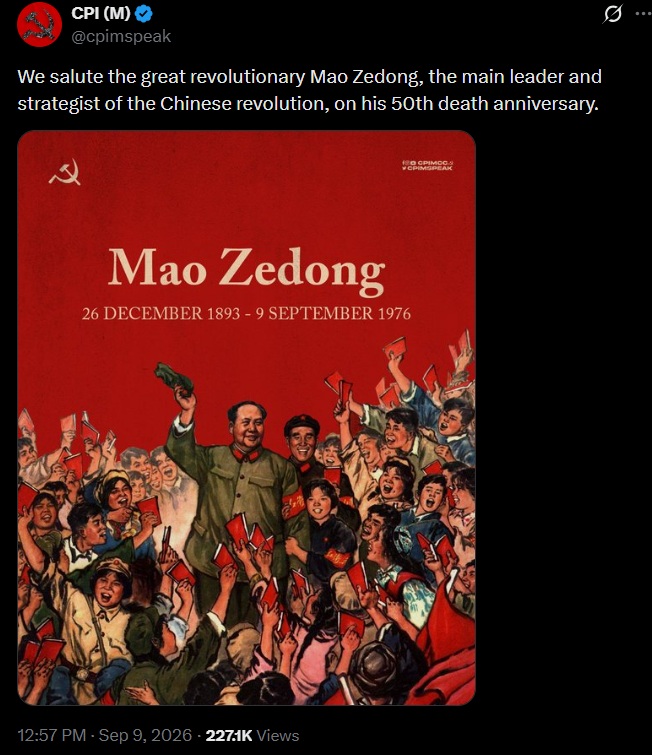
The Communist Party of India (Marxist) has marked the 50th death anniversary of Chinese Communist leader Mao Zedong by describing him as a “great revolutionary” and the “main leader and strategist of the Chinese revolution.”
The CPI(M), through its official social media account, posted: “We salute the great revolutionary Mao Zedong, the main leader and strategist of the Chinese revolution, on his 50th death anniversary.” Mao died on 9 September 1976.
Mao’s legacy was anything but benign: his decades in power brought mass political repression, forced collectivisation, a famine that killed millions and the violence of the Cultural Revolution. Yet the CPI(M) calls him a “great revolutionary.”
His rule resulted in widespread persecution, economic disruption and chaos, while the Chinese Communist Party itself later described the Cultural Revolution as a grave mistake, primarily attributed to Mao.
Mao came to power after the Chinese Communist revolution and founded the People’s Republic of China in 1949. His rule lasted until his death in 1976. Among his most consequential campaigns was the Great Leap Forward, launched in 1958 with the objective of rapidly transforming China into an industrialised communist economy.
The campaign imposed agricultural collectivisation and redirected huge sections of the rural population towards industrial production. Unrealistic production targets, coercive policies, false reporting by local officials and the state’s seizure of grain contributed to a devastating famine between 1958 and 1962.
The exact death toll remains disputed, but there is no serious dispute over the enormous scale of the disaster. Historian Yang Jisheng has estimated about 36 million famine deaths, while historian Frank Dikötter estimated at least 45 million deaths during the Great Leap Forward, including people who died from starvation, overwork and state violence. Other scholars have produced lower estimates.
Mao’s record was not limited to famine. His Cultural Revolution, launched in 1966, unleashed a decade of political turmoil in which intellectuals, officials, educators and people labelled ideological enemies were persecuted. Millions were subjected to imprisonment, forced labour, public humiliation and violence. Estimates of deaths attributable to the Cultural Revolution vary, with historian Song Yongyi cited at around two to three million, while other historians have given lower estimates.
The scale of deaths attributed to Mao’s rule therefore remains a matter of historical debate, particularly when famine deaths and deaths resulting from political campaigns are combined. Estimates ranging into the tens of millions are widely discussed, while the often-repeated figure of more than 70 million comes primarily from Jung Chang and Jon Halliday’s highly controversial biography Mao: The Unknown Story and is substantially higher than estimates used by many other historians.
In fact, Mao Zedong may have overseen the maximum number of killings in a ‘peace time’ scenario compared to his ‘peer dictators’.
Yet it is this figure’s ideological legacy that makes the CPI(M)’s tribute particularly striking in the Indian context.
When Indian Communists Split Over China
Mao was not merely the leader of a distant communist country. His China went to war with India in 1962, after years of deteriorating relations and a border dispute. Chinese forces attacked Indian positions in October 1962, resulting in an Indian military defeat and the occupation of territory in Ladakh and the northeast.
The war exposed a deep ideological crisis within India’s Communist Party.
The undivided Communist Party of India was itself sharply divided between sections that supported India’s position and a powerful pro-China faction. The Indian Express notes that the CPI had already been divided over the Sino-Soviet split, with sections of Indian communists looking to Beijing for ideological guidance. During the 1962 conflict, a strong pro-Chinese wing opposed giving unconditional support to the Nehru government.
The divisions became so severe that the war ultimately contributed to the 1964 split of the CPI and the formation of the Communist Party of India (Marxist).
The history is more complicated than simply saying that the entire CPI supported China. Several CPI leaders, including S.A. Dange, condemned the Chinese attack and supported India’s position. But a substantial pro-China section opposed the party’s line and was subsequently associated with the faction that became the CPI(M).
The contradiction is therefore difficult to ignore: the political tradition that emerged from that pro-China faction continues to publicly salute Mao as a “great revolutionary” more than six decades after Mao’s China went to war against India.
The historical record also goes beyond the 1962 conflict. Before the war, the CPI had taken positions favourable to Beijing on issues such as the Tibetan uprising. The Indian Express records that a 1959 CPI statement praised China’s suppression of the Tibetan revolt and blamed the uprising on Tibetan “serf owners” backed by Indian reactionaries and Western imperialists.
The China question was so divisive that it became one of the defining issues behind the eventual split in Indian communism.
Mao Still Gets a Salute
The CPI(M) has chosen to salute Mao Zedong as a “great revolutionary” and “main leader and strategist” on his 50th death anniversary. But what exactly is the party celebrating?
Mao’s rule brought forced collectivisation, mass political repression, disastrous economic campaigns and one of history’s deadliest famines. The Cultural Revolution unleashed a decade of political persecution, violence and social chaos. Millions died or suffered under policies carried out in the name of communist revolution.
For India, Mao’s legacy carries another bitter chapter. His China invaded India in 1962, while sections of India’s communist movement sided with Beijing rather than unequivocally backing the Indian war effort.
Five decades after Mao’s death, the CPI(M) is still saluting him. That is more than a historical acknowledgement. It is a choice and one that raises a blunt question: why does an Indian political party continue to honour a leader whose regime devastated millions and whose China went to war with India?
Subscribe to our channels on WhatsApp, Telegram, Instagram and YouTube to get the best stories of the day delivered to you personally.