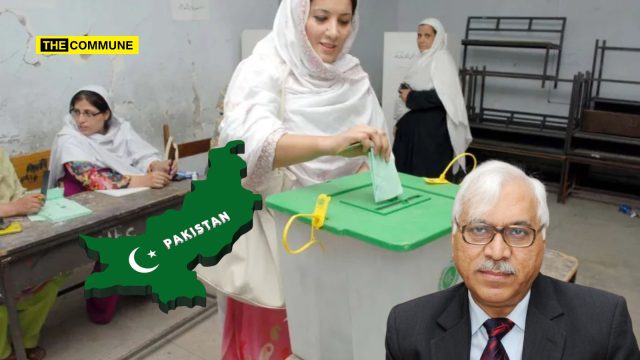
Former Chief Election Commissioner (CEC) of India SY Quraishi triggered a controversy in July 2018 after declaring Pakistan’s general elections free and fair, even as other members of the international observer team raised serious concerns over the political environment and alleged attempts to influence the electoral process, as reported in Times of India.
Quraishi, who was among the observers from the European Union and the Commonwealth, told NDTV, “I think it was a very free, fair and transparent election.”
However, his assessment contrasted sharply with that of Michael Gahler, chief of the European Union’s Election Observation Mission, who highlighted several shortcomings that had affected the electoral process before polling day.
EU Observers Flag Unequal Electoral Environment
While Gahler said his team had not observed rigging on polling day, he expressed serious reservations about pressure on the media, efforts to encourage politicians to switch parties, and the conduct of the judiciary.
“The entire process was not as good as in 2013 (when elections were last held),” Gahler said.
He further stated, “We have concluded there was a lack of equality of opportunity. The overall process was not as good as in 2013.”
The EU had deployed 120 observers to monitor the elections.
Gahler’s assessment focused on the wider political environment preceding the vote, arguing that developments before polling day had negatively influenced the electoral process.
Allegations of Pressure on Nawaz Sharif’s Party
Pakistan’s former Prime Minister Nawaz Sharif and his daughter Maryam Nawaz had been disqualified ahead of the elections on controversial grounds. Several political figures associated with Sharif’s Pakistan Muslim League-Nawaz (PML-N) subsequently switched allegiance to Imran Khan’s Pakistan Tehreek-e-Insaf (PTI).
The PML-N alleged that its electoral prospects had been undermined months before polling because of the role of what its leaders called “Khalai Maqhluq,” or “extra-terrestrials” — a euphemism used to refer to Pakistan’s Inter-Services Intelligence (ISI).
According to PML-N leaders, more than 30 candidates had left the party under pressure from the ISI.
The EU observation mission’s report also highlighted violence and concerns about the political and judicial environment before the elections.
“A number of violent attacks, targeting political parties, party leaders, candidates and election officials, affected the campaign environment,” the report stated.
It added, “Most interlocutors acknowledged a systematic effort to undermine the former ruling party through cases of corruption, contempt of court and terrorist charges against its leaders and candidates.”
The report also noted that the timing and substance of court decisions involving prominent PML-N candidates had raised concerns among political stakeholders about the politicisation of the judiciary.
“These cases reshaped the political environment ahead of the elections,” the report said.
Concerns Over Extremist Political Groups
The EU mission also expressed concern over the emergence of extremist political parties with links to terrorist organisations or individuals associated with violence.
Without naming the Milli Muslim League, the political front associated with Lashkar-e-Taiba chief Hafiz Saeed, the report noted “the emergence of extremist parties with affiliations either to terrorist groups, or individuals linked to organisations that have used, incited or advocated violence”.
Hafiz Saeed was accused of involvement in the 2008 Mumbai terror attacks. The Milli Muslim League fielded more than 150 candidates in the 2018 Pakistani general elections.
Quraishi Defends His Assessment of Polling Day
Explaining the basis for his assessment, Quraishi said international observers had spoken to polling agents representing different political parties at polling stations in Islamabad and Rawalpindi.
“All of them, about 200 that we spoke to, were satisfied with the election process, saying that everything was fine, free and fair. Despite our probing, they did not make a single complaint,” the former Indian CEC stated.
Quraishi also acknowledged that international observers, including himself, had raised concerns with Pakistan’s Chief Election Commissioner about the presence of army personnel inside polling stations.
According to Quraishi, Pakistan’s CEC explained that the military had been deployed inside polling stations to prevent irregularities, following complaints of rigging during the 2013 elections when troops had been stationed outside polling booths.
“He (Pakistan’s CEC) told us that during 2013 elections, the troops were deployed outside polling booths and there were a lot of complaints of rigging. He said the presence of one soldier inside the polling booth, this time, was for the purpose to control rigging,” Quraishi said.
He added that observers had closely monitored the military’s presence during their visits.
“but we found that their presence was just innocuous. They were just hanging around with one man inside the booth and one outside checking identity cards of the voters and it was all going on very smooth,” Quraishi said.
Former Chief Election Commissioner of India, SY Quraishi calls the Pakistan elections free, fair and transparent https://t.co/2kFHiZZ59C
— TIMES NOW (@TimesNow) July 29, 2018
Subscribe to our channels on WhatsApp, Telegram, Instagram and YouTube to get the best stories of the day delivered to you personally.