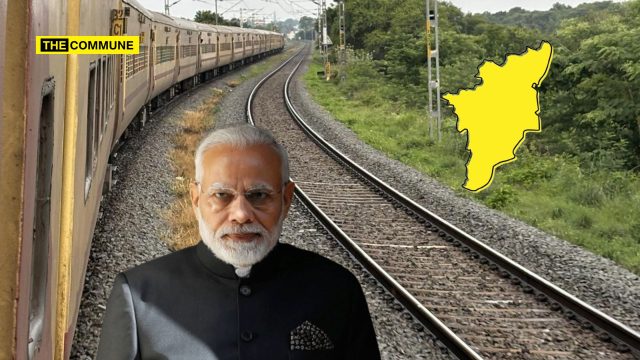
The Union Cabinet on Wednesday, 9 September 2026, approved three major railway infrastructure projects covering key routes in Tamil Nadu as part of a larger package of eight multi-tracking projects sanctioned across the country at a total cost of ₹20,804 crore, as reported in The Hindu.
The Cabinet Committee on Economic Affairs (CCEA), chaired by Prime Minister Narendra Modi, approved the projects aimed at increasing railway capacity, easing congestion and improving the movement of passengers and freight.
The three projects covering Tamil Nadu are the Arakkonam–Renigunta third and fourth lines, Hosur–Omalur doubling project, and Salem–Karur–Dindigul doubling project.
The Arakkonam–Renigunta third and fourth lines will cover approximately 77 km and have been sanctioned at an estimated cost of ₹1,936 crore. The additional lines are expected to enhance capacity on the heavily utilised corridor, allowing more trains to operate while reducing congestion and improving reliability and punctuality.
The Hosur–Omalur doubling project, covering around 147 km, has been approved at an estimated cost of ₹1,948 crore. The doubling work is expected to increase the number of trains that can operate on the route, reduce travel time and facilitate smoother movement of both passenger and freight traffic.
The third project, the Salem–Karur–Dindigul doubling project, will cover approximately 159 km at an estimated cost of ₹2,242 crore. The project is expected to increase line capacity, improve schedule adherence and strengthen rail connectivity supporting industrial and regional growth.
Together, the three Tamil Nadu projects account for an estimated ₹6,126 crore in investment.
The Railway Ministry said the larger set of multi-tracking projects approved by the Cabinet would provide seamless connectivity for the movement of people, goods and services across Tamil Nadu, Andhra Pradesh, Karnataka and Telangana.
The first five projects in the package, including the three routes involving Tamil Nadu, will cover 17 districts across the four States and improve connectivity to around 2,121 villages with a combined population of approximately 52 lakhs, according to the Ministry.
The capacity enhancement is also expected to improve rail access to several major tourist and religious destinations. In Tamil Nadu, the projects are expected to benefit connectivity to destinations including Tiruttani, Kolar Gold Fields, Hogenakkal Falls, Hosur Fort, Mettur Dam, Kodaikanal Hills, Sathyamangalam Wildlife Sanctuary, Namakkal Anjaneyar Temple, Namakkal Fort and the Kalyana Pasupatheswar Temple, among others.
The Railway Ministry said the routes covered under the projects were important for transporting commodities such as coal, cement, iron and steel, containers, automobiles, food grains, petroleum products and fertilisers.
The capacity augmentation under the first set of projects is expected to generate additional freight-handling capacity of around 47 million tonnes per annum (MTPA).
The remaining three projects approved as part of the eight-project package include the Kharagpur–Jharsuguda fourth line, Katni–Pendra Road fourth line and Bilaspur (Uslapur)–Pendra Road third line, covering parts of West Bengal, Jharkhand, Odisha, Madhya Pradesh and Chhattisgarh.
The Railway Ministry said these projects would collectively increase the Indian Railways network by around 1,196 km.
The projects have been planned under the PM Gati Shakti National Master Plan, with an emphasis on integrated planning, multi-modal connectivity and improving logistics efficiency through coordination among stakeholders.
For Tamil Nadu, the approval of all three projects in a single Cabinet decision marks a major step forward for long-pending capacity augmentation works on some of the State’s important railway corridors.
Subscribe to our channels on WhatsApp, Telegram, Instagram and YouTube to get the best stories of the day delivered to you personally.