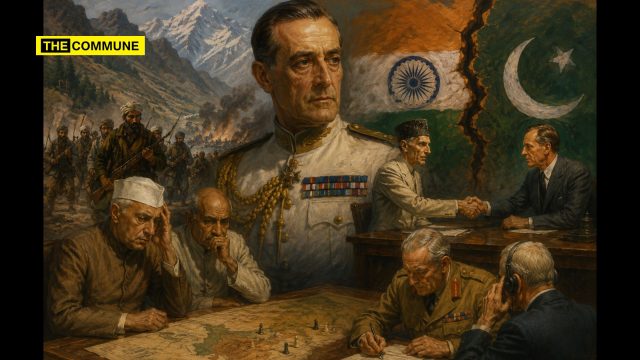
Britain ensured India was divided when they left and kept at it even after. In a recent book, it has come to light that Britain gave Pakistan the green light to invade Kashmir in 1947, and Lord Mountbatten, still governor general of India at the time, spent the following months systematically wrecking every option New Delhi had to hit back, according to documented archival evidence laid out in Anger Management: The Troubled Diplomatic Relationship between India and Pakistan by Ajay Bisaria.
The Rigged Constitutional Setup
The book’s account starts with the basic imbalance built into Partition itself. Mountbatten, as India’s British head of state, was handed the chair of the cabinet’s defence committee, giving him an effective veto over India’s military decisions. Pakistan faced no such constraint. Jinnah, as governor general, had a freer military hand; only British officers serving under him, not a head of state, needed to be kept in the loop.
The Standstill Agreement And Pakistan’s First Violation
At Independence, Britain had engineered “standstill” agreements binding India, Pakistan, and the princely states to freeze the status quo until fresh arrangements were made in 1948. Brigadier Akbar Khan’s covert operation to arm and direct the tribal invasion of Kashmir was itself a breach of the standstill pact between Pakistan and the state of Kashmir – a violation that gets little attention compared to what followed.
The Secret Stand-Down Order Nehru and Patel Never Knew About
Weeks before the crisis broke, Field Marshal Auchinleck quietly ordered British officers commanding both the Indian and Pakistani armies to stand down. The order went out on 30 September 1947. Nehru and Patel were never told. What they did realise was that British officers in Indian uniform were taking orders from London, not from the Indian government and that Mountbatten, now running the cabinet’s key military committee, could not simply be worked around.
London backed Auchinleck to the hilt. The British cabinet endorsed the stand-down policy on 13 October – a full week before the tribal raiders crossed into Kashmir on 22 October. Prime Minister Attlee personally cabled his approval to Auchinleck on 15 October. By the time the invasion began, the fix was already in place.
Mountbatten Blocks the Counter-attack
Once fighting started, Mountbatten made sure Indian troops never advanced to the Pakistan border in the Poonch and Mirpur sectors that November. He undercut his own government’s plan for a “cordon sanitaire” enforced by air strikes on the raiders, blocked contingency plans for a cross-border counter-strike and instead pushed Nehru toward the United Nations. The book’s source, historian C. Dasgupta, is blunt about the consequence: British interference cost India the speed, secrecy and surprise any effective military response needed, and international intervention then closed off the cross-border option entirely.
The author does not mince words on what this made Mountbatten: not a ceremonial figurehead but the actual executive head of India’s military decision-making, and a party to a secret order that amounted to British betrayal. Ordinary political morality, the book argues, should have forced his resignation. It didn’t happen — these, as the author notes, were “extraordinary times.”
Junagadh and The Arms Embargo That Wasn’t Supposed to Exist
The pattern repeated over Junagadh. Mountbatten and Army Commander-in-Chief General Rob Lockhart worked to stop India from taking the military route. Lockhart, again on Auchinleck’s advice, sat on the Indian government’s own order to send military supplies to the Maharaja of Kashmir, and withheld intelligence he’d received from his counterparts across the border about tribesmen massing to invade. India’s leadership had to first satisfy Mountbatten’s demand that the Maharaja’s accession be formally secured before they got any military assistance at all including the airlift that eventually went in.
The Governor General Who Wanted to Mediate Against His Own Country
Mountbatten then tried to install himself as a mediator between India and Pakistan – a conflict of interest with no precedent, and, Dasgupta writes, likely none since the only case in the annals of diplomacy of a head of state of one country attempting to mediate between that country and another. This despite Mountbatten privately having little doubt that the tribal invasion was a deliberate Pakistani proxy operation. He still worked to keep Indian forces away from the border.
Britain’s Fingerprints, Confirmed from Pakistan’s Own Side
The book cites Pakistan’s own acting army chief, General Douglas Gracey, stating flatly that London knew of the invasion plan in advance. Evidence further suggests British foreign secretary Noel Baker personally cleared the Pakistani move into Kashmir without taking it to the British cabinet. Most Indian historians read this as colonial perfidy; ironically, Pakistani writers cite the same British interference to explain their own military failure in Kashmir. On 27 October 1947, Jinnah ordered Gracey to send regular Pakistani troops in to counter India’s action – Gracey refused and referred the decision up to Auchinleck in New Delhi instead.
Dasgupta’s broader argument: India’s own contingency plan for a cross-border counterattack couldn’t be executed until the military leadership was “Indianized” – a process not completed until five years later. It was only in August 1952 that Nehru could tell Parliament that any further Pakistani aggression over Kashmir would mean all-out war, not confined to Kashmir. That doctrine was finally acted on in 1965.
London approved Pak invasion of Kashmir in 1947 while Mountbatten sabotaged the counter attack at every turn.
Nehru’s relationship with Mountbatten cost us 1/3rd of Kashmir and gave us a festering wound for 75 years. pic.twitter.com/SXmbRWIpjS— Diva Jain (@DivaJain2) July 19, 2026
Sri Prakasa’s Freelance Diplomacy And Nehru’s Fury
The book also documents an episode involving Sri Prakasa, India’s high commissioner in Karachi, who was kept entirely outside the actual negotiations over Kashmir and had no real briefings on the diplomatic or military picture. Exasperated by the bloodshed and by what he saw as Pakistan’s obsession with Kashmir, Prakasa took it on himself to propose a solution: hand Kashmir to Pakistan outright for the sake of peace. He raised this with Mountbatten in New Delhi. Mountbatten passed the suggestion on to Nehru at a meeting on 25 November 1947.
Nehru’s reaction was immediate. He wrote to Prakasa that same afternoon, calling it extraordinary that Mountbatten had even floated the idea, warning that no government doing “anything of the kind” would survive and that it would mean war with Pakistan, and telling his own envoy plainly: “we cannot and we will not leave Kashmir to its fate.” It stands as a rare documented instance of Nehru formally reprimanding one of his own diplomats for freelancing on Kashmir.
The UN Reference
By the winter of 1947, with fighting at a lull, Mountbatten’s persistent pressure on Nehru to take the dispute to the United Nations finally paid off. On 1 January 1948, India filed a complaint against Pakistan with the UN Security Council under Article 35 of Chapter 6 of the UN Charter, asking the Council to direct Pakistan to stop backing the invaders. On 5 January 1948, the UN announced it would set up a plebiscite administration. The same day India took the Kashmir issue to the UN, it also got a new British commander-in-chief for its army: General Roy Bucher, succeeding Lockhart.
Gandhian Sri Prakasa, as Indian envoy to Pak, wanted to hand over Kashmir to Pak and lobbied Mountbatten for it. Even Nehru was mortified to hear this.
It is miracle that this country has survived the tomfoolery of Gandhian clowns who permeated every facet of the state. pic.twitter.com/sIgwSJOyjl— Diva Jain (@DivaJain2) July 19, 2026
The Cost of Deference
Britain approved Pakistan’s invasion of Kashmir, then used its own officers inside the Indian army to stop India from winning the war that followed. Auchinleck’s secret stand-down order, backed by Attlee’s cabinet, tied India’s hands from the start. Mountbatten went further: blocking the counter-strike at Poonch and Mirpur, sitting on arms for Junagadh, and appointing himself mediator against the country he served. Pakistan’s own army chief confirms London knew and approved it.
None of this happened in a vacuum. India let a British governor general veto its cabinet’s military decisions three months after independence. Sri Prakasa’s offer to simply hand Kashmir over shows how deep that deference ran. Nehru was right to be furious with him and should have questioned the arrangement itself.
The result: a third of Kashmir gone, a UN reference that froze the dispute, and a war lost not on the battlefield but in New Delhi.
Subscribe to our channels on WhatsApp, Telegram, Instagram and YouTube to get the best stories of the day delivered to you personally.