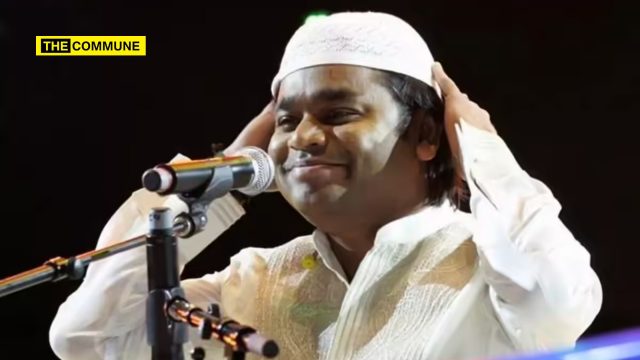
Fans of music composer AR Rahman often come to his defence when the comparison is done with music maestro Ilaiyaraaja or when Rahman’s critics call out his talent.
Whether AR Rahman is inherently talent is not what we are going to debate here. In this article, we will take a look at all the bigoted and Islamist acts that AR Rahman has indulged in across his career in a way to delegitimise Hinduism, Hindu deities and promote his religion Islam.
Let us take a look at the instances over the years that expose his anti-Hindu and bigoted face.
New (2004) – “Kaalaiyil Thinamum” – Refusing to Call Mother “Deivam”
An interesting anecdote about A.R. Rahman’s religious beliefs and a popular Tamil film song resurfaced, with filmmaker S.J. Suryah confirming the story narrated earlier by lyricist Vaali in a Vikatan report.
The incident concerns the song “Kaalaiyil Thinamum Kan Vizhithal” from S.J. Suryah’s 2004 directorial New, which had music by A.R. Rahman and lyrics by Vaali.
According to Vaali, the original line he had written for the song was “Kaalaiyil Thinamum Kan Vizhithal Naan Kai Thozhum Deivam Amma”
The line described the mother as the “Deivam” — God — whom the protagonist worships every morning.
However, Vaali said Rahman later called him and requested that the word “Deivam” be changed. Rahman, according to the anecdote, deeply respected and loved his mother but, because of his religious beliefs, did not want a human being to be directly equated with God.
Vaali subsequently changed the line by replacing “Deivam” with “Devathai”, meaning “angel”.
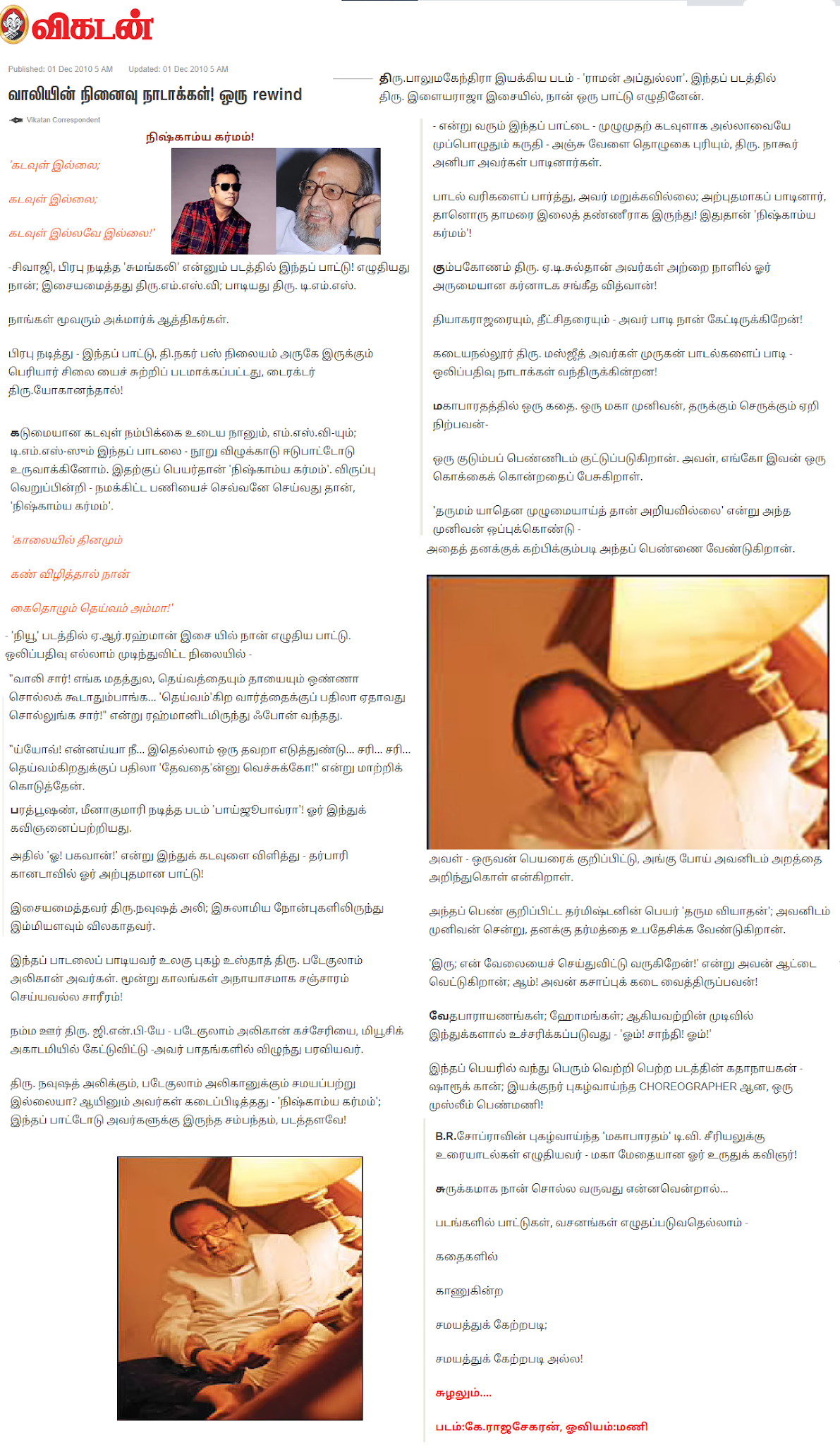
The final version became: “Kaalaiyil Thinamum Kan Vizhithal Naan Kai Thozhum Devathai Amma”
This was also confirmed by director SJ Suryah in various interviews. He recounted the same incident, explaining that Rahman’s objection was rooted in his religious belief that human beings should not be called or equated with God. At the same time, Suryah in what seemed like an attempt to soften the issue, stressed Rahman’s deep love and respect for his mother.
“Amma can’t be called God…it’s not allowed in my religion..pls change the lyrics”
#ARR called Vaali on a morning & told this..
Vaali has put this on record in an article with frustration..
Dir SJ Surya admits this happened, but tries to sugar coat it..Humble & kind..u know.. https://t.co/n82YycJQ4K
— Rajaram (@Rajaram93584674) September 11, 2026
Lagaan (2001) – “O Paalanhaare” – A “Universal Prayer,” Not a Hindu Bhajan
The long-running claim that “O Paalanhaare” from Lagaan is a Hindu devotional bhajan is contradicted by the song’s own creators – AR Rahman and Javed Akhtar – both Muslims.
During a Spotify podcast marking 25 years of Lagaan, director Ashutosh Gowariker, lyricist Javed Akhtar, actor-producer Aamir Khan and music director AR Rahman discussed the making of the film’s iconic soundtrack. Their conversation about “O Paalanhaare” makes one thing particularly clear: the song was conceived as a universal prayer rather than a specifically Hindu devotional song.
The distinction matters because the song is often cited by AR Rahman’s fans as evidence of his contribution to Hindu devotional music, particularly whenever criticism of his remarks on religion resurfaces. Yet the explanation offered by Rahman and Akhtar themselves points in a different direction.
In Lagaan, the song accompanies villagers praying for divine intervention before their decisive cricket match against the British. The film’s visuals explicitly portray their worship through imagery associated with Shri Krishna. But the lyrics themselves carefully avoid directly invoking Krishna or any other named deity.
The song repeatedly uses words such as “Paalanhaare”, “Prabhu”, “Bhagwan”, “Swami” and “Nirgun” – terms that are presented as broad references to the divine rather than an invocation of a particular Hindu deity.
Javed Akhtar himself explained this during the podcast.
“The fact is, the song contains no religious word. ‘Palanhare’ is not a religious term; it isn’t tied to any specific faith—anyone, from any religion in the world, can use it—nor is ‘Nirgun.’ Now, there was some hesitation or apprehension regarding the word ‘Nirgun.’ ‘Nirgun’ implies an absence of attributes—so how can one describe the Supreme Being as ‘Nirgun’? It isn’t my word; it is Kabir’s. Kabir used ‘Nirgun’ frequently and offered a brilliant explanation: he argued that by attributing a specific quality to God, you are limiting Him; the quality itself imposes a limit, even if it is meant as praise. Do not ascribe specific attributes to Him—hence, ‘Nirgun.'”
Akhtar’s explanation leaves little room for describing the lyrics as an explicitly Hindu prayer. His emphasis was precisely on the absence of words identifying a particular religious tradition.
Rahman went even further when discussing the reaction the song received.
“The most praises I received for this song was from Muslim people and Christian people —and I don’t know why, but it surpassed the boundaries of religion.”
That observation is significant. Rahman did not describe the song as being embraced primarily because listeners recognised it as a Hindu devotional. Instead, he highlighted appreciation from Muslims and Christians and attributed it to the song having “surpassed the boundaries of religion.”
Akhtar’s explanation provides the answer to why. The song’s language was deliberately universal. “Palanhare”, he said, could be used by anyone, regardless of religion. Even “Nirgun” was explained through the teachings of Kabir, whose devotional tradition itself challenged rigid religious categorisation.
The musical composition also deliberately reinforces that universality.
Asked about the song, Akhtar said, “I have written perhaps more than a thousand songs—that’s for sure—but sometimes, when people ask me to name a song I found challenging to write, I always mention ‘O Paalanhaare.’ You see, try doing one thing: remove the lyrics and listen to the melody on instruments. Play this tune to an Eskimo, a Masai, a tribal person, someone from Manhattan, someone from Moscow—anyone, anywhere—and ask them, ‘What do you think this tune is saying?’ Invariably—I can guarantee this—if they have a musical ear, they will say it is a tune of devotion. The melody speaks for itself; in fact, the melody actually intimidated me because it was so pure and so real—it didn’t sound man-made.”
ARR says Muslims and Christians praised O Palanhare (implied – more than Hindus). This makes sense – Muslims and Christians didn’t consider it to be a Hindu religious song, they saw it for what it was – a secular song of worship. Lyricist Javed Akhtar himself says it’s not a Hindu religious song – “Palanhara koi bhi bol sakta hai… from any religion of the world”. Like I said, people wrongly think O Palanhare is a bhajan because of the film’s visuals and the musical format.
— Param Arunachalam (@taparam) June 14, 2026
Akhtar’s point was therefore not that the melody was specifically Hindu. His argument was that the musical language communicated devotion across cultures, independent of the identity of the deity.
This makes Ashutosh Gowariker’s role particularly important. The film’s visual storytelling supplied the explicitly Hindu context that the lyrics themselves avoided. The villagers are shown praying to Krishna, making the song appear to audiences as a Krishna bhajan even though the words do not name Krishna.
In other words, the visuals did the religious heavy lifting that the lyrics deliberately did not.
Baba (2002) – “Sakthi Kodu” – Avoiding the Deity’s Name Or Mentioning Female Deity
In the film Baba, there is a song where Rajinikanth prays to Kalilambal for strength. If you notice the lyrics of the song, nowhere does it mention the deity’s name or just a generic mention of Kali. Additionally, he also exhibits his misogyny and his religious preference – a male deity is preferred over a female and no mention of it either. The song says ‘Sakthi kodu’ and is gender neutral. Even the mantras that appear in the song refer to One God – Ekameva advitiyam – the one and only god.
Boys (2003) – Lord Ayyappa Song – Outsourced to Associate
In the film Boys, there is a song for Lord Ayyappa. That was originally composed by his associate Pravin Mani.
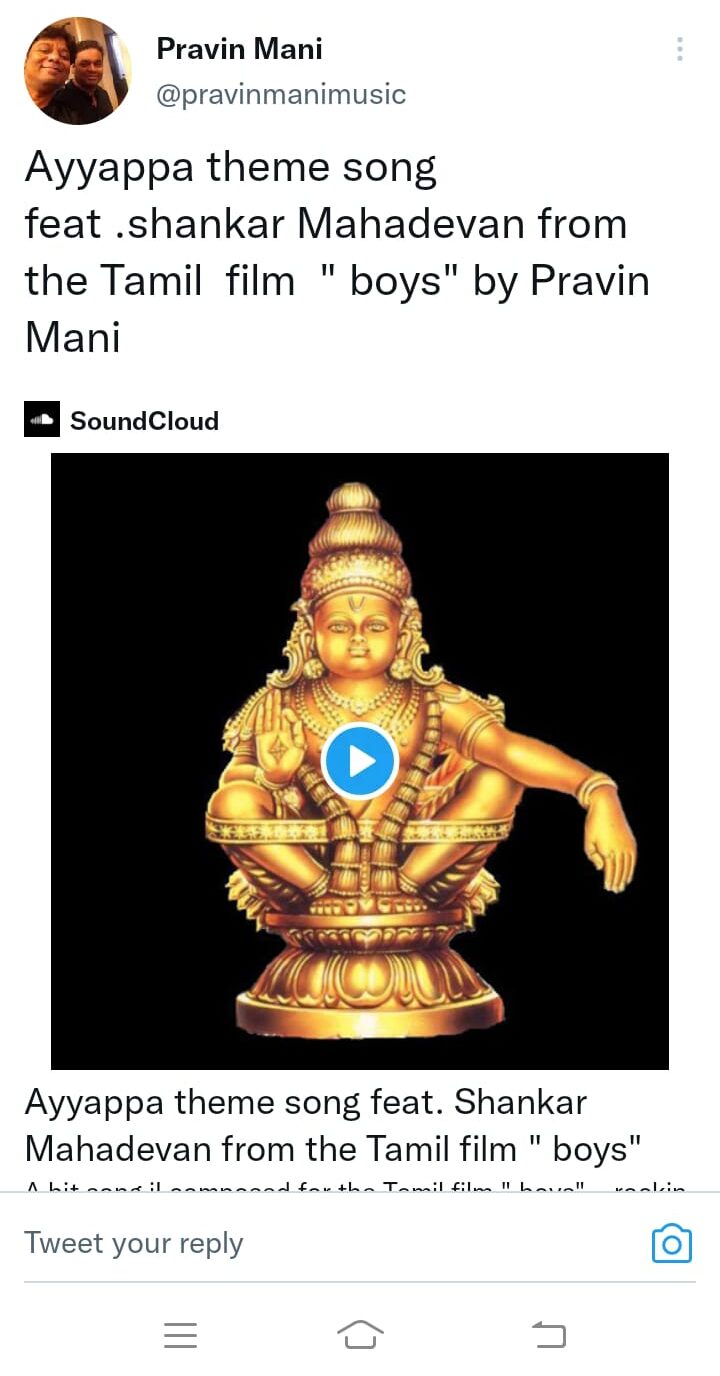
Even the casette/CD cover of the music album does not mention the Ayyappa Song.

While it is speculated that Rahman chose to not compose the Ayyappa song as it would be in contradiction to his Islamic beliefs, what is worth mentioning is that the same Rahman had composed the enchanting ‘Anbendra Mazhayile‘ a song venerating Jesus from the film Minsara Kanavu (1997) – this song too seems to glorify the one and only God.
It is also reported that once he began getting students at his KM conservatory, they took care of all Hindu related songs and hence in Ponniyin Selvan they were co-credited for the music.
Indian (1996) – “Kappaleri Poyachu” – Azaan in Patriotic Song
Wherever possible he would insert azaan style Islamic prayer melodies. For example, in the Kappaleri Poyachu from Indian, during the Independence Day celebration where Kamal Haasan is seen saluting the Indian flag, the background music eerily seems similar to their azaan.
Ponniyin Selvan 2 (2023) – “Veera Raja Veera” – Refusing Credit to Dagar Brothers
Refused to give credit to Dagar brothers for “Veera Raja Veera” song from a classical composition titled “Shiva Stuti” performed and fixed in recording by his late father and uncle, the Junior Dagar Brothers, in the 1970s.
Additionally, the songs from the film Ponniyin Selvan did not explicitly have any reference to Shiva when the Cholas were staunch Shaivites.
Kashmir Remarks – “Past Was Past” – Denying Hindu Past of Kashmir
Speaking to reporters during a visit to Jammu and Kashmir to shoot an advertisement, Rahman urged filmmakers to showcase the region’s natural beauty rather than its violent past:
“I think that is what should happen from now. They should bring the beauty and the peace, what you see in nature, as a positive thing, than taking anything about violence or the past. The past was past, the future is bright.”
He added that the region offered artists a rare sense of clarity:
“As artists, we seek inspiration. And when we come here, it is uncluttered, beautiful, and it inspires us.”
He also backed greater collaboration between Bollywood and folk musicians from Jammu and Kashmir, citing his work on Rockstar:
“I came here for Rockstar and I recorded ladies singing folk songs, and we used it in Rockstar. And we want to come and do more things here.”
The problem here is that Rahman saying “past was past” is an easy thing to say, especially when you have never been asked to account for whose past it was — the exodus of Kashmiri Pandits, the violence that drove them out, and the fact that their return to the valley remains under grave threat. Rahman’s framing treats the region’s history as something to be moved past aesthetically, without ever having condemned that violence or advocated for the community it displaced. The silence is the point.
Chhaava (2025) – Calling It “Divisive”
During an interview with BBC Asian Network, he used the opportunity to peddle Muslim victimhood in India narrative. When he was asked about Chhaava, AR Rahman said he was ‘very proud of its soundtrack’. He went on to say: “It is divisive. I think it cashed in on divisiveness and but I think the core of it is to show the bravery, because the director, I told him like why do you need me for this, he said we need only you for this, so I think had a very and it is a enjoyable finish but definitely I think people are smarter than that whatever do you think people are going to get influenced by movies? They have something called internal conscience which knows what the truth is and what manipulation is.”
Less Work Because ‘Communal Environment’
In the same interview as above, AR Rahman claimed less work is coming his way for the past 8 years. He said, “You know people who are not creative have the power now to decide things and this might have been a communal thing also but not in my face but I’ve hear you know like Chinese whispers that this happened and they they booked you and the other company the music company went and funded the movie and got their five composers and I said ‘Oh that’s great! Rest for me I can chill out with my family.'”
He also said, “Any person who has realized religion will never talk about divisive stuff because I think beyond religion is where the real truth is, right, these are just parts where those who are near the destination will never argue and they would find it foolish to even try anything negative.”
Pahalgam Terror Attack (2025) – Silence on Massacre, Emojis for “Peace”
On 7 May 2025, following the Indian Armed Forces’ precise retaliation against the Pakistani terrorists responsible for the attack, Rahman posted a cryptic message on X using just two emojis, “🕊️❤️🇮🇳.”
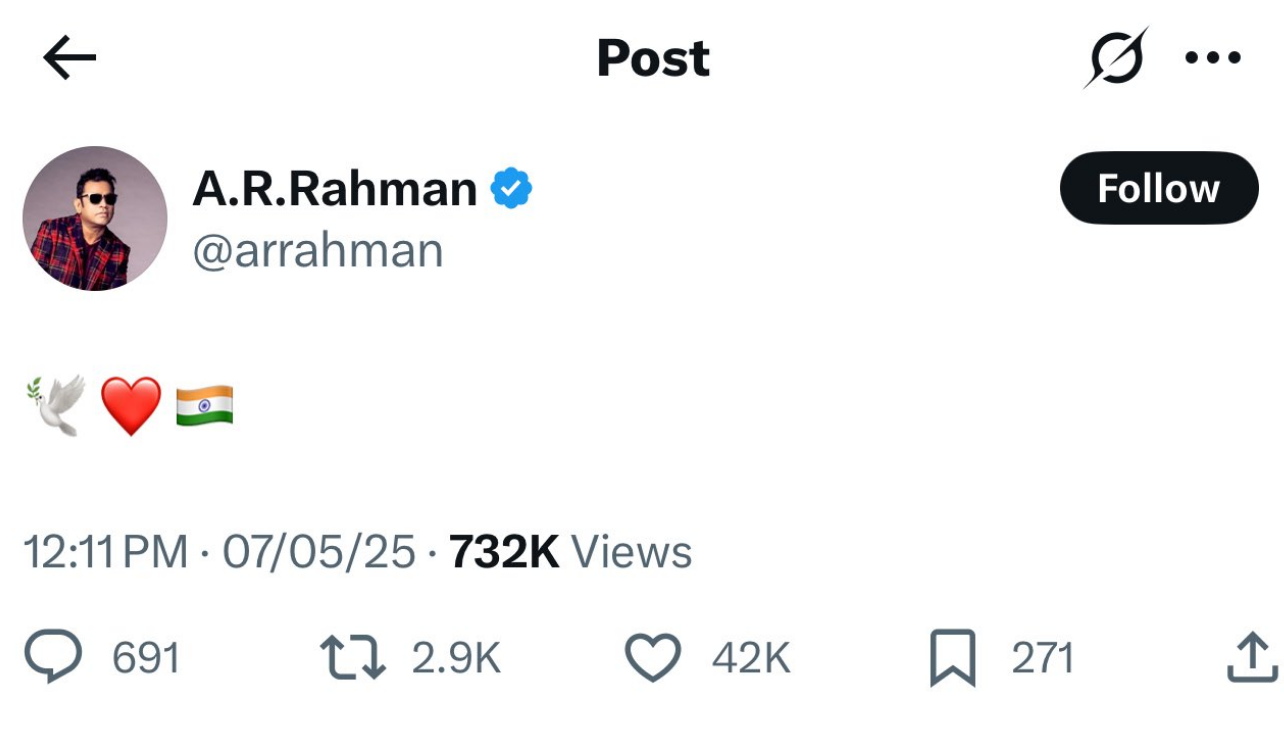
While likely intended to signal peace, the post was seen as tone-deaf and morally inconsistent especially given his complete silence on the massacre itself.
Removing Vibhooti – Incident with Lyricist Piraisoodan
Piraisoodan is a famous award-winning Tamil poet who has penned lyrics for many Tamil songs. He had worked with Rahman during his initial days when the latter was scoring ad jingles. Piraisoodan has also penned lyrics for some of the songs of Rahman.
In an interview to a Tamil YouTube channel, Piraisoodan said that once when he had gone to Rahman’s home, he was asked to remove the Vibhuti (sacred ash) and Kumkum (vermilion) by Rahman’s mother. Rahman along with family had already converted to Islam by then.
However, Piraisoodan, did not oblige and refused to remove the Hindu religious marks on his forehead saying that he has been having them since childhood.
Tamil Identity Politics – “Goddess Tamil” Post
On 8 April 2022, AR Rahman shared a bizarre illustration of Tamil Goddess on his social media pages, which had ‘Thamizhinangu’ written, a word from Tamil Thai Vaazhthu (invocation to Goddess Tamil).
It also had a tag line that said “Beloved Tamil is the root of our existence.”, a line written by modern Tamil poet of the 20th century poet Bharathidasan.
‘ழ’கரம் ஏந்திய தமிழணங்கு என்ற புகைப்படத்தை தனது ட்விட்டர் பக்கத்தில் பதிவிட்டார் இசைப்புயல் ஏ.ஆர்.ரஹ்மான் @arrahman#ARRahman | #PesuTamizhaPesu | #பேசுதமிழாபேசு pic.twitter.com/ASCD2oPC39
— Pesu Tamizha Pesu (@pesutamizhapesu) April 9, 2022
This picture shared by Rahman now has netizens divided over social media with many calling it as a cryptic response to Home Minister Amit Shah’s remarks about usage of Hindi as a link language for all Indians to communicate.
Just two days after this post, Rahman while participating at ‘Dakshin’, a South India Media and Entertainment Summit organized by the Confederation of Indian Industries (CII), courted controversy by saying that Tamil is the link language for India while responding to a question about Home Minister Amit Shah’s remarks.
This wasn’t the first time Rahman has resorted to playing politics over language. In June 2019, when there was a debate about the three-language policy present in the Draft National Education Policy, Rahman had tweeted: “AUTONOMOUS | meaning in the Cambridge English Dictionary,” with web link of the word’s meaning in the dictionary.
Later when the Centre droppped Hindi and added ‘any other Indian language’ to the draft, Rahman wrote “Good decision. Hindi is not compulsory in Tamil Nadu. The draft has been corrected.”
9/11 – Finding Purpose Only After American Tragedy, Not Indian Terrorism
In a podcast conversation with comedian Hasan Minhaj, Rahman was asked about his biggest fears as his career accelerated through the 1990s, after Roja (1992) and Bombay (1995) made him the biggest hitmaker in both Bollywood and the South.
Rahman described a period of wanting to quit, of seeing fame as maya — illusion — and of his “spiritual self and material self constantly in conflict.” Then he explained what changed: “And then 9/11 happened, 9/11 happened and then I felt like oh my god, now I feel the purpose to do more, purpose to be a bridge through music, through love, through mentoring people, or so. That actually solidified my permanence, I would say.”
The moment Rahman identifies as giving his career purpose is an American tragedy — the September 11 attacks. Not the Coimbatore bomb blast that occurred in his own state. Not the Bombay blasts of 1993, which happened in the city whose name he had just scored a film about. Not the Kashmiri Pandit exodus. Not any act of terrorism on Indian soil, where his own audience lives. For a composer whose career was built on Indian cinema, the pivot point he chooses to name is 9/11 and the “bridge” he describes is one he frames around the West’s post-9/11 anxieties about Islam. That is a revealing choice about where he locates both his purpose and his perceived audience.
In his own state Tamil Nadu, at Coimbatore, a terrorist bomb blast happened which killed around 60 innocent people and injured many in 1998..
Bro needed a 9/11 New York attack to wake up and find “purpose” in his life..
“Bridge of love… ”டேய்.. டேய்…beggARR..பேசி
பேசியே https://t.co/U2W23EK7hu— Rajaram (@Rajaram93584674) September 13, 2026
Sang Vande Mataram Because They Signed Him
In a bizarre explanation of why he sang the Vande Mataram song, speaking to Hasan Minhaj, he said, “Sony signed me for 50 years of independence India/Pakistan album…”
He also recalled that Nusrat Fateh Ali Khan was involved in the project and that the work happened in New York.
Additionally in the same album, Maa Tujhe Salaam is very Islamic. Hindus do not do ‘salaam’ to their mother, they venerate the mother, the motherland. Once again as mentioned above, his religious preferences superceded the way the lyrics were written.
After Destroying Chhaava, He Is Destroying Ramayana
In Chhaava, Rahman destroyed the soul of the film as well as Chhatrapati Sambhaji Maharaj through his pathetic music. In Ranbir Kapoor-Sai Pallavi starrer also he destroys the Hindu epic with his banal score that people call music.
‘रामायण’ का नया गीत सुना। औसत लेखन, औसत से भी नीचे का संगीत। अरिजीत और श्रेया से कितना एलिवेट करा लोगे कूड़े को?
रहमान ने, संभवतः, सोच-समझकर ऐसा रद्दी संगीत दिया है जो बस एक सीटिंग में बना दिया गया है। इससे अधिक कर्णप्रिय संगीत आपको गाँव के शिवालयों के कीर्तन में सुनने को मिल…
— Ajeet Bharti (@ajeetbharti) September 15, 2026
AR Rahman – From Secular To Bigot
Earlier, he was considered as the face of true secularism for India – a Muslim singing praises for the country or composing Hindu-related songs for films. But as days progress, from his own admissions, it is very clear that for AR Rahman religion is superior and he would go to any extent to be anti-Hindu.
Subscribe to our channels on WhatsApp, Telegram, Instagram and YouTube to get the best stories of the day delivered to you personally.