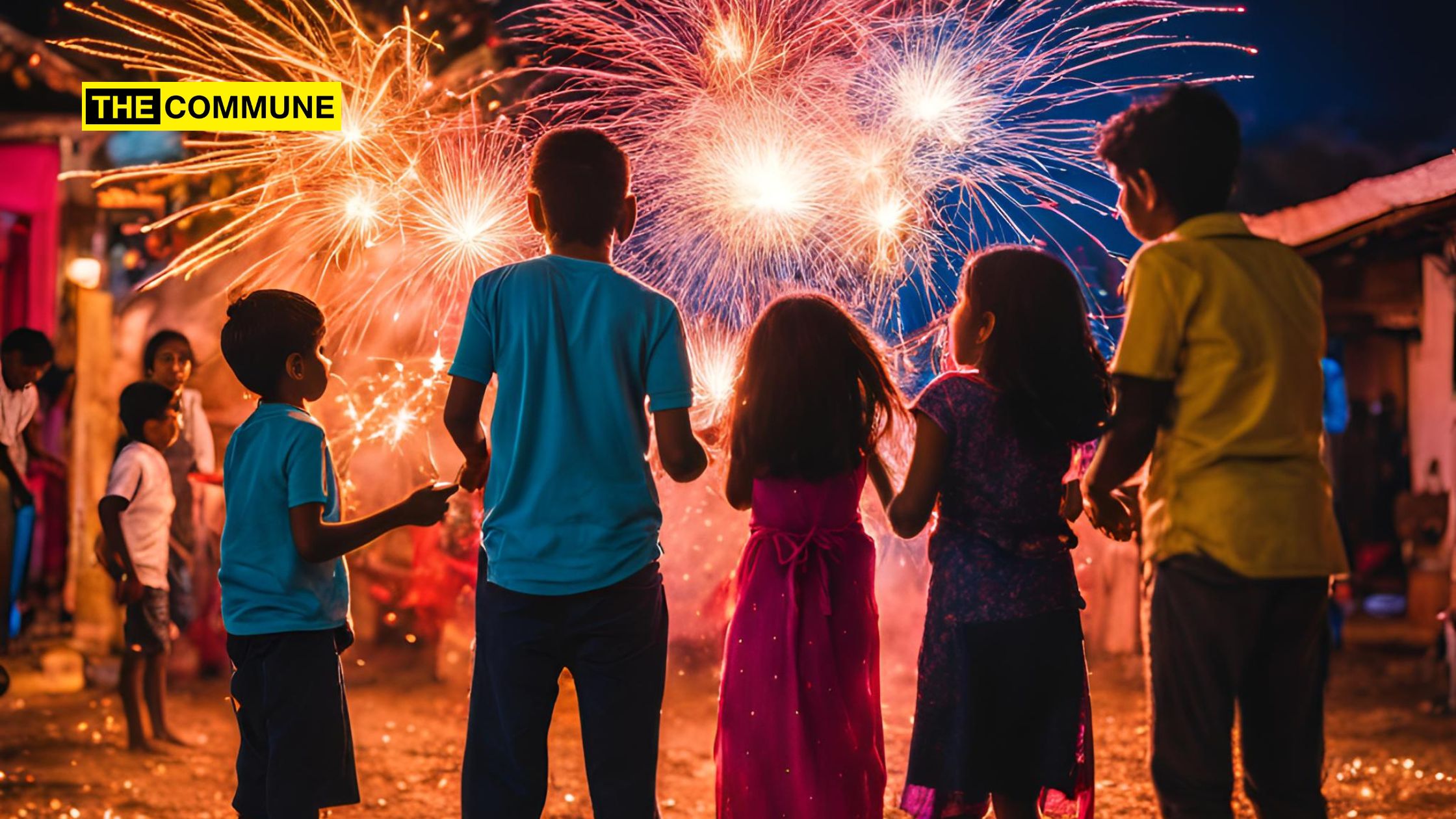
The Supreme Court has said that it is not inclined to impose a complete ban on firecrackers in Delhi-NCR, warning the authorities that continued failure to enforce existing restrictions could compel it to take a harsher stand, as reported in Verdictum.
A Bench comprising Justice M.M. Sundresh and Justice P.B. Varale stressed that merely passing orders would serve no purpose unless the enforcement mechanism was implemented on the ground. The Court observed that its orders would become a “mockery” if authorities failed to act against violations and directed the Union government to file an affidavit detailing the enforcement measures taken.
The Bench also suggested involving prominent public figures, including sportspersons, to create awareness about celebrating Diwali without causing pollution.
“Why can’t you use the services of prominent personalities to make the public awareness, like the sportsmen, or the public figure which are highly respected, from any walk of life?” the Bench asked.
Referring to cricketer Virat Kohli as an example, the Court said, “Like cricket celebrity, like Virat Kohli—somebody you can request him to make a statement: ‘Let us make this Diwali one that is enjoyable, let us enjoy the spirit of life.'”
The Court also made observations about the distinction between religious faith and practices associated with festivals.
“The difference with fire is when it’s part of the lamp, you worship. When it goes otherwise, you know, you can’t love it. So, what we are taking is a different standard—nothing wrong, we are not saying anything because, you know, all this practice can change. Faith is something, practice is something; practice is to give effect to the faith.”
The matter arose from a writ petition filed in 2015 on behalf of three infants seeking a blanket ban on the manufacture, sale and use of firecrackers in the National Capital Region, citing deteriorating air quality.
In 2018, the Supreme Court imposed restrictions on firecrackers containing barium salts and prohibited the manufacture, sale and use of joined firecrackers, commonly known as series crackers or laris, citing the air, noise and solid waste pollution caused by them.
During the latest hearing, the Bench questioned whether these restrictions were actually being enforced. It asked the Union government whether prohibited materials had been seized, whether manufacturers had changed the composition of their products and what action had been taken against violators.
The Court observed that traders often attempted to maximise sales because of the seasonal nature of the business, leading to the circulation of spurious products that required strict regulation.
The Bench said it was not inclined to impose a complete ban because such a decision could have a spiralling effect. However, it cautioned the authorities against forcing the Court to reconsider its position.
“Now by what’s happening is say right when we tell you, now we are armed with your order, pollution takes place. See, we also understand the sentiment of the public, say somebody who want to celebrate this occasion, it gives, it boosts their morale, you know, on a logical sense it will be, leave alone the religion. If you see on the logical sense, yes, it boosts your morale, it creates a positivity in a person. So, therefore we are not inclined to completely ban it, because you know it will again have a spiraling effect. But then, having said that, please don’t push us to take a very harsh stand on this matter.”
The Bench directed authorities to concentrate enforcement efforts on the two key days of the festival and suggested measures including issuing challans, cancelling licences and initiating prosecution against those violating the restrictions.
It also highlighted the impact of firecracker pollution on children, elderly persons, persons with disabilities, pregnant women, the sick, birds and animals.
Emphasising the need for actual enforcement, the Court said, “Did you seize the material? What did you actually do? See now, otherwise, there’s no point in passing orders and issuing all these conditions, unless on the ground you really give effect to it. It becomes near mockery then…see that’s something you have to file. Then only I will be able to appreciate and improve upon it. See unless, you know, see whatever the order passed, if the implementing mechanism is not put into operation, yes, it’s not going to have any effect at all.”
Additional Solicitor General Aishwarya Singh Bhati, appearing for the Union government, informed the Court that an enforcement mechanism was already in place but had not been presented before the Bench.
“The enforcement mechanism is there, but it was not placed before you,” she submitted.
Senior Advocate Gopal Shankaranarayanan, appearing for the applicants, pointed out that the Union government was not prepared to address the issue of barium-containing firecrackers during the hearing. He also referred to an affidavit indicating a 45 to 60 per cent reduction in emissions.
Bhati sought additional time on the barium issue, stating that internal consultations were incomplete. Justice Sundresh agreed to take up the issue the following week.
Shankaranarayanan further submitted that the Court’s earlier orders had been repeatedly violated and that contempt petitions had been filed. He referred to a CBI report which, according to his submissions, showed that manufacturers had violated the restrictions and stocked barium-containing firecrackers despite seven previous bans.
The Amicus Curiae also highlighted the health consequences of firecracker pollution, submitting that bursting firecrackers released large quantities of particulate matter and toxic gases that entered the lungs and bloodstream and affected other organs.
The Court was informed that residents of Delhi-NCR lost 4.74 years of life expectancy due to exposure to high levels of particulate matter. The submissions also referred to links between air pollution and cardiovascular diseases, cancer, strokes, congenital defects, low birth weight and foetal deaths.
The Amicus Curiae argued that a complete ban was necessary and that earlier relaxations had been granted only on a trial basis for a specified period. It submitted that the restrictions should not be reconsidered unless the Court was satisfied that pollution from green firecrackers had been reduced to the bare minimum.
The hearing also comes against the backdrop of earlier Supreme Court proceedings on firecracker restrictions. In October 2025, the Court permitted the sale and bursting of green firecrackers in Delhi-NCR after considering a joint request by the Central and Delhi governments.
In September 2023, the Court had rejected applications by firecracker manufacturers seeking permission to manufacture firecrackers using new formulations containing barium and additives, as well as joined firecrackers. It had also directed the Delhi Police not to issue temporary licences for the sale and storage of any kind of firecrackers, observing that it would be difficult to distinguish green firecrackers from non-green ones.
The Court had previously asked the Centre and regulatory authorities, including the Petroleum and Explosives Safety Organisation (PESO), to explain the steps taken to strengthen enforcement against the manufacture and sale of prohibited firecrackers.
In another recent hearing concerning air pollution in Delhi-NCR, a different Supreme Court Bench observed that public awareness and voluntary participation through a balanced, optional approach could be more effective than complete bans that faced practical implementation difficulties. It had also asked the Central Pollution Control Board to examine whether partial relaxation for certain categories of firecrackers could be considered, particularly with regard to noise.
Subscribe to our channels on WhatsApp, Telegram, Instagram and YouTube to get the best stories of the day delivered to you personally.