There was a time when a newspaper’s credibility was its greatest asset. A journalist was expected to chase facts, challenge power, question official narratives and, above all, tell readers the truth.
The Indian Express seems to have developed a rather different understanding of journalism.
Over the years, it has repeatedly demonstrated how facts can be arranged, headlines can be engineered, crucial context can be buried, and narratives can be constructed without necessarily telling readers the whole story. And when these episodes pile up, one can no longer dismiss every controversy as an isolated editorial lapse.
Consider the record.
In 2012, it published the sensational report about two Army units moving towards Delhi without informing the government, triggering speculation about a possible military-government confrontation.
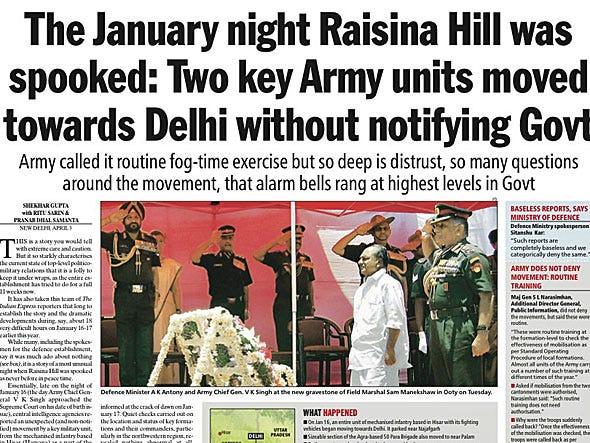
The Defence Ministry called the report baseless, while then Prime Minister Manmohan Singh described it as alarmist.
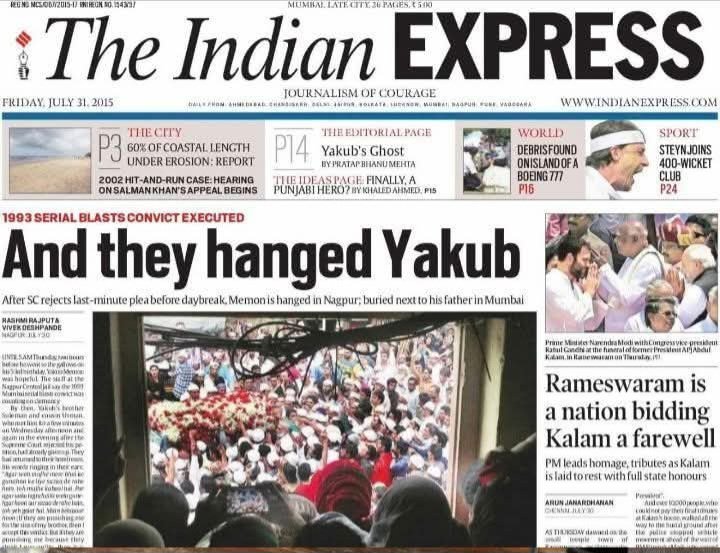
In 2015, following Yakub Memon’s execution in connection with the 1993 Mumbai serial blasts, it chose the headline “And they hanged Yakub Memon.”
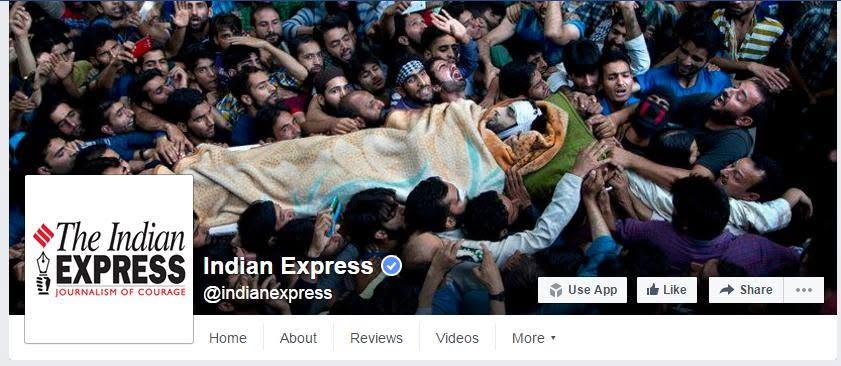
In 2016, its official Facebook cover featured an image associated with the funeral of Burhan Wani, the Hizbul Mujahideen commander.
Its coverage of Umar Khalid’s interim bail, the JNU disciplinary action against students accused of damaging university property, and the IIT Bombay Jain food controversy has also attracted criticism for foregrounding selective aspects of events while pushing other relevant details into the background.
Then came the Election Commission controversy. Its September 2026 report portrayed objections by two Election Commissioners as evidence of a serious institutional rift.
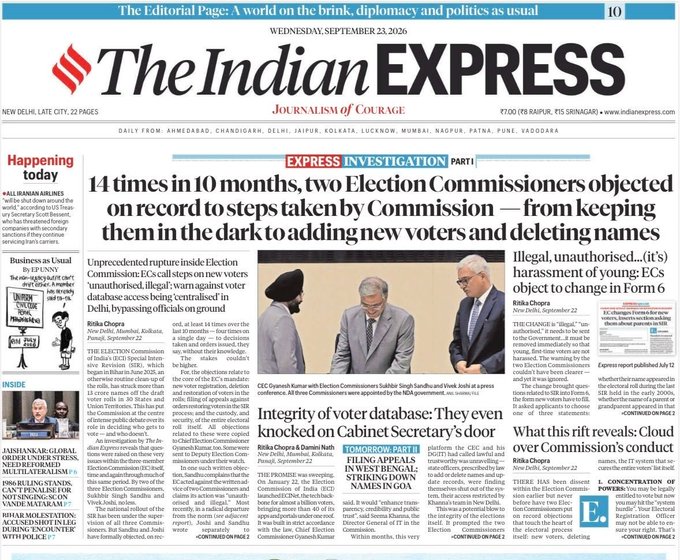
But in an affidavit filed before the Supreme Court on October 26, all three Election Commission members maintained that the SIR scheduling decisions were unanimous.
There have been other controversies too: presenting a six-month-old interview with Finance Minister Nirmala Sitharaman in the context of a new Budget, its disputed interpretation of the USAID $21-million voter-turnout allocation, and its reporting on government funding to organisations linked to George Soros.
These are not imaginary controversies. They are episodes that deserve scrutiny, corrections and answers.
We have listed twenty instances in a previous report. Twenty examples of how The Indian Express has twisted narratives, buried context and presented selective versions of events to its readers.
And these are not even isolated lapses that can be brushed aside as editorial mistakes. They expose a pattern of deliberate narrative-building through selective facts, distorted headlines and omitted context.
And the pattern has not stopped.
On 30 October 2026, the newspaper reported that the ₹3,200-crore Surat Diamond Bourse remained largely empty, prominently invoking Narendra Modi’s inauguration.
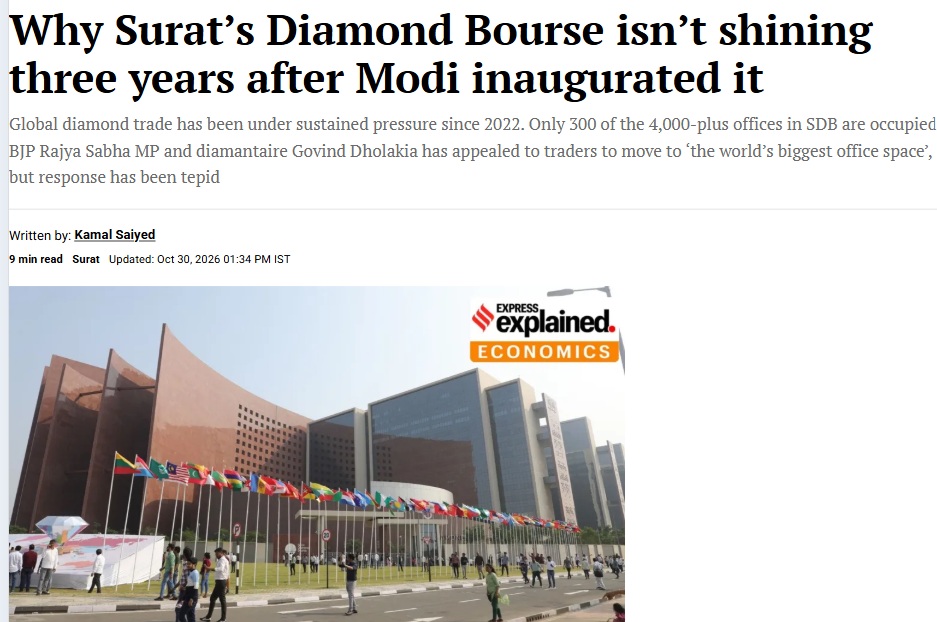
But the project was financed by the private diamond industry. That crucial distinction deserved far greater prominence. The global diamond industry’s downturn, the difficulties of shifting an established trading ecosystem from Mumbai and the project’s commercial challenges were all essential to understanding the story.
Why should readers have to dig through the report to discover the context that should have informed its headline?
This is the recurring problem. A technically accurate sentence can still create a misleading impression. A headline can be constructed around one fact while omitting another that fundamentally changes how readers understand the story. A sympathetic profile can overshadow serious allegations. An institutional disagreement can be presented in a way that suggests a crisis far greater than the available evidence establishes.
Journalism is not merely about whether individual sentences are technically true. It is also about whether the overall story gives readers an honest picture.
And that is precisely where the Indian Express needs to answer some uncomfortable questions.
The newspaper is perfectly entitled to question the Prime Minister, the government, the Election Commission, the courts or any institution in the country. That is the job of a free press. But a newspaper that demands accountability from everyone else cannot place itself above scrutiny.
If a newspaper expects readers to question government claims, readers must also be free to question its headlines. If it demands transparency from public institutions, it must demonstrate transparency in its own editorial relationships and corrections. If it exposes omissions by others, it cannot expect its own omissions to go unnoticed.
A prestigious masthead is not a licence to manipulate context. A legacy is not a substitute for credibility. And calling something investigative journalism does not automatically make it accurate.
The greatest danger to journalism is not criticism of the press. It is a press that begins to believe it is beyond criticism.
Indian journalism needs more fearless reporters, more rigorous investigations and more independent newsrooms. It does not need headlines that do the thinking for readers, selective context that nudges them towards predetermined conclusions, or editorial framing that repeatedly leaves important questions unanswered.
The Indian Express must decide whether it wants to be remembered for the facts it uncovers or the narratives it constructs.
Because when readers can no longer distinguish between reporting and narrative-building, it is not merely one newspaper’s credibility that suffers.
It is Indian journalism itself.
It is time to save Indian journalism From The Indian Express.
Subscribe to our channels on WhatsApp, Telegram, Instagram and YouTube to get the best stories of the day delivered to you personally.