
The Indian Express published a report on 30 October 2026, highlighting how the ₹3,200-crore Surat Diamond Bourse, inaugurated by Prime Minister Narendra Modi in December 2023, remains largely underoccupied. Of its 4,200 offices, only around 300 are operational.
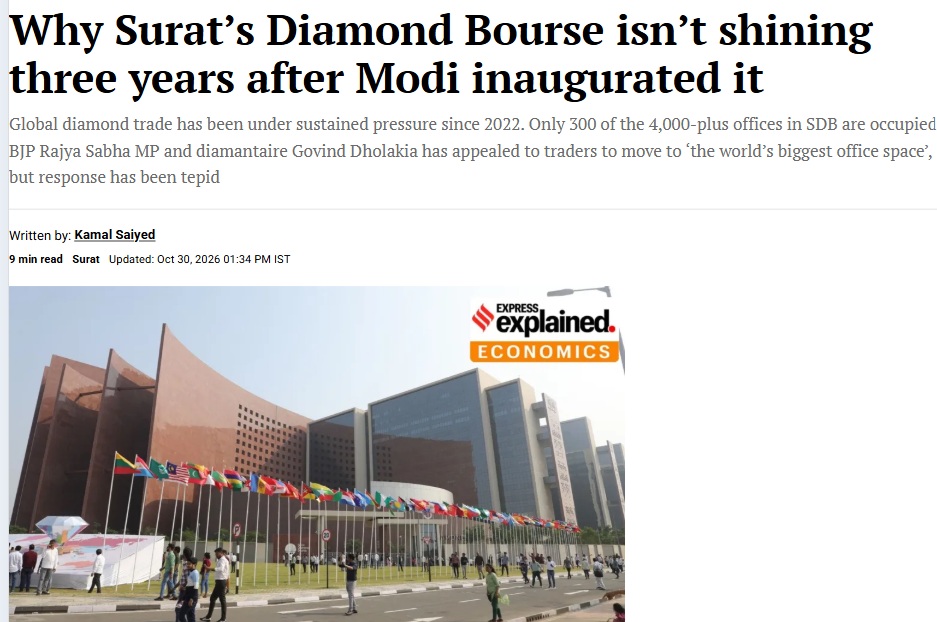
The report repeatedly invokes Modi’s inauguration and his promise of making Surat a global diamond-trading hub. But it leaves out an important distinction: the ₹3,200-crore bourse was financed by the private diamond industry, not built using ₹3,200 crore of taxpayer money.
The project was developed by SDB Diamond Bourse, a private, not-for-profit Section 8 company formed by members of the diamond industry. Diamond traders and manufacturers funded the project and purchased its office spaces. The land itself was purchased from the Gujarat government.
The report also fails to adequately distinguish between the government’s role in developing DREAM City and the industry’s investment in the bourse.
There is another important part of the story. The bourse was intended to shift diamond trading from Mumbai’s Bharat Diamond Bourse to Surat, India’s diamond-cutting and polishing hub. But Mumbai already had an established ecosystem of international buyers, brokers and financial services.
In fact, Kiran Gems, the first major company to move to Surat in November 2023, returned to Mumbai barely six weeks later.
The global diamond industry has also been facing a prolonged downturn, with natural diamond prices falling sharply, competition from lab-grown diamonds increasing, and demand from China weakening.
Even the Indian Express report acknowledges these challenges. Yet its headline and opening prominently centre Modi’s inauguration.
The bourse’s poor occupancy is a concern. But shouldn’t a report examining its performance also explain who financed it, why businesses have not shifted and what the global industry is going through?
When a privately financed industry project struggles, presenting it primarily through the Prime Minister’s inauguration without giving equal prominence to its funding and commercial realities is not journalism, it is bias.
Subscribe to our channels on WhatsApp, Telegram, Instagram and YouTube to get the best stories of the day delivered to you personally.