A café in Kerala’s Fort Kochi found itself at the centre of a controversy after vlogger Amrit Singh Darren posted a video questioning the display of an artwork featuring Pakistan’s founder Muhammad Ali Jinnah alongside Mahatma Gandhi, as well as the café’s beef dishes.
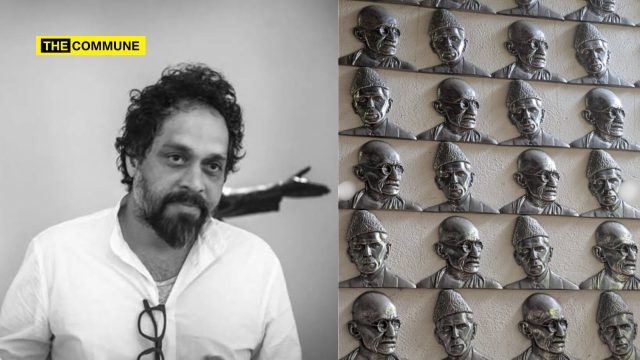
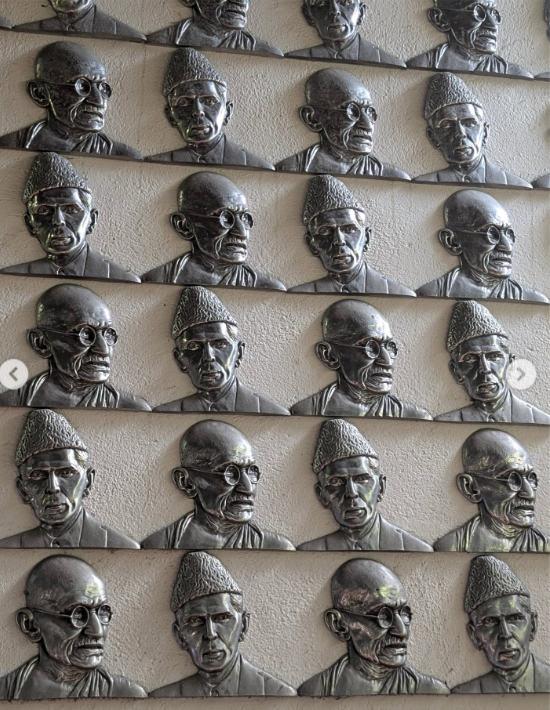
The installation at Kashi Art Café, titled Blood Brothers: Two Fathers from Gujarat, was created by Riyas Komu, a prominent contemporary artist and co-founder of the Kochi-Muziris Biennale, an international exhibition of contemporary art.
Darren’s video triggered a backlash in Kerala. Kochi City Police registered a case against him under Sections 353(2) and 192 of the Bharatiya Nyaya Sanhita (BNS), which deal with promoting enmity between groups and acts intended to provoke rioting.
Kerala Chief Minister V.D. Satheesan also condemned the video, calling it unacceptable and saying that the law would take its course.
However, there is more to the story than the Jinnah artwork. Its creator, Riyas Komu, has faced sexual misconduct allegations, while the Kochi-Muziris Biennale, with which he was associated, has faced questions over public funding, financial transparency, unpaid contractors and the treatment of artists.
Who Is Riyas Komu, the Artist Behind the Jinnah-Gandhi Installation?
Riyas Komu is a Kerala-born contemporary artist who co-founded the Kochi-Muziris Biennale along with artist Bose Krishnamachari, as reported in OpIndia.
The installation that triggered the latest controversy is titled Blood Brothers: Two Fathers from Gujarat. Created in 2008, it places metallic representations of Gandhi and Jinnah alongside each other.
The artwork had reportedly been displayed at Kashi Art Café since at least 2025. However, according to the café’s gallery management, it had been removed at least three months before the controversy erupted and was replaced as part of the gallery’s regular rotation of artworks.
The gallery’s general manager, Jude Vibin, said the artwork was removed in consultation with the artist and that works by artists from Greece and Sri Lanka were currently being displayed.
There is also a detail about the café’s name that has been overlooked in the controversy. Despite the association of Kashi with the Hindu holy city of Varanasi, the café’s name comes from a Japanese word associated with confectionery and sweets. Established in 1997 in a Dutch-era heritage building, the café has long displayed works by contemporary artists.
#MeToo Allegations Against Riyas Komu
Komu stepped down from all management positions at the Kochi Biennale Foundation in October 2018 after sexual misconduct allegations against him surfaced during the #MeToo movement.
The allegations were published through an anonymous Instagram account called Scene and Herd. The woman who made the allegations was an art professional who said she had travelled to Kochi in 2015 to discuss a project with Komu.
According to her account, Komu accompanied her to her hotel room, pushed her against a wall, forcibly kissed and groped her. She alleged that she was subjected to sexual misconduct again during her stay in Kochi.
Describing the alleged incident, she wrote, “He began kissing me and feeling me up while I struggled to even process what the hell was going on. I was so petrified that I just let it happen. It stopped just as abruptly as it had started. And then he left. It didn’t stop there. I was violated again by him during my stay in Kochi.”
Komu issued an apology in response to the allegations, saying that he was deeply upset that the incident had been understood and presented in that manner. He also said he was open to a conversation with the woman.
The Kochi Biennale Foundation announced that it had a zero-tolerance policy towards harassment and constituted an Internal Complaints Committee to examine the allegations. Komu stepped down from all management positions pending the inquiry.
In March 2019, the Foundation’s board accepted the committee’s recommendation to drop the inquiry because no formal complaint had been forthcoming despite several weeks of efforts to pursue the matter.
The absence of a formal complaint was the stated reason for closing the inquiry; it was not an adjudication of the allegations.
Financial Irregularities and Unpaid Contractors at the Kochi-Muziris Biennale
The Kochi-Muziris Biennale has also faced allegations of financial mismanagement and lack of transparency, particularly over the use of public funds and payments to contractors and artists.
In June 2015, a Comptroller and Auditor General (CAG) report flagged the Kochi Biennale Foundation for what it described as unjustified expenditure of ₹38.03 lakh from government grants. The amount had reportedly been spent on renovating and maintaining the Foundation’s Mumbai office, an expense the CAG said was unrelated to organising the Biennale.
The government had released an initial grant of ₹5 crore in December 2010, followed by an additional grant of ₹4 crore in September 2011.
The Biennale subsequently faced allegations of unpaid bills. In 2019, a contractor issued a legal notice over alleged non-payment for structural work carried out at exhibition venues. The contractor claimed that ₹77.6 lakh remained unpaid.
The Foundation, however, disputed the contractor’s final bill, describing it as exorbitant, and said the matter had been referred to an independent government-appointed arbitrator.
In December 2022, artists also raised questions over the Foundation’s finances. A group of artists alleged that Indian artists were being charged between ₹1 lakh and ₹2 lakh to exhibit their works, even as the Foundation received substantial government grants and private sponsorships.
The group questioned the need for such charges and demanded greater accountability in the use of public funds.
Kochi Biennale Foundation president Bose Krishnamachari rejected the allegations, saying that the memorandum raising them was being circulated with the intention of tarnishing the Biennale’s image.
These allegations and disputes have repeatedly brought the Foundation’s financial management under scrutiny.
Political Patronage and Public Money
The Kochi-Muziris Biennale has received substantial financial support from successive governments in Kerala, both under the Left Democratic Front (LDF) and the Congress-led United Democratic Front (UDF).
The first edition received ₹5 crore in initial government funding in December 2010, followed by an additional ₹4 crore grant in 2011. The state also extended financial support to subsequent editions.
For the 2014 edition, the government provided further assistance, while the 2016-17 edition received a budgetary allocation of ₹7.5 crore. The state also acquired land for a permanent Biennale venue and approved an additional working fund for the Foundation.
More recently, the Pinarayi Vijayan-led LDF government announced a grant of ₹7.5 crore for the sixth edition of the Biennale, which opened in December 2025 and concluded in March 2026.
The public funding has continued despite the questions raised over the Foundation’s expenditure, unpaid contractor bills and allegations that Indian artists were being charged to exhibit their works.
Subscribe to our channels on WhatsApp, Telegram, Instagram and YouTube to get the best stories of the day delivered to you personally.