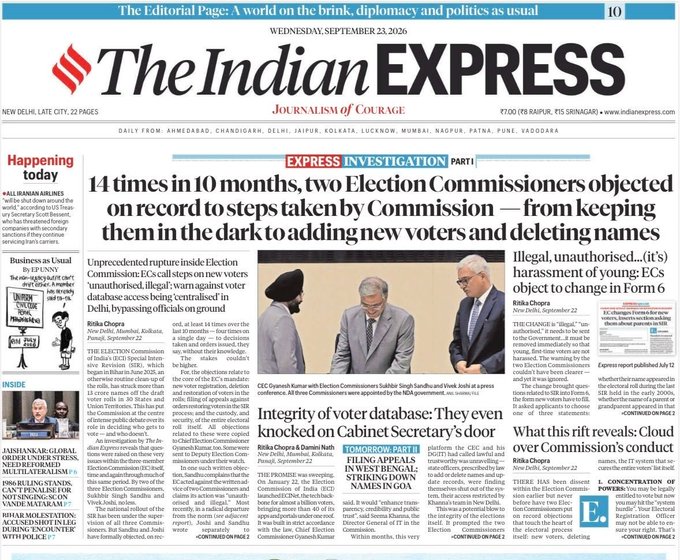
In September 2026, The Indian Express journalist Ritika Chopra published a report alleging an unprecedented rift within the Election Commission of India, claiming two Election Commissioners had formally objected to CEC Gyanesh Kumar at least 14 times. The alleged exposé accused the CEC of sidelining his colleagues over voter roll revisions and other key decisions. But when the ECI filed a 27-page affidavit before the Supreme Court, all three commissioners including the two allegedly sidelined signed the document defending the Commission’s decisions as unanimous. The affidavit challenged the report’s central narrative, raising questions about how The Indian Express framed internal deliberations as an institutional crisis.
The Indian Express has repeatedly positioned itself as a watchdog of power. But its own record of controversial headlines, disputed reporting, editorial interventions and associations with organisations operating in India’s foreign-funding ecosystem raises questions about its editorial judgement, consistency and the narratives it chooses to amplify.
From the newspaper’s 2012 report about Army movements towards Delhi, to its 2015 headline following Yakub Memon’s execution, its 2016 use of a photograph of Burhan Wani as a Facebook cover image, and its more recent coverage of the Election Commission of India (ECI), these episodes deserve to be examined together.
The issue is not that a newspaper should be prohibited from questioning the government. It should be free to do so. The question is whether its reporting consistently applies the same standards of scrutiny to every political actor, whether disputed claims receive adequate context, and whether its headlines fairly represent the facts.
The ECI Controversy: ‘14 Objections’ Versus ‘Unanimous Decisions’
The latest controversy concerns the newspaper’s investigation into the functioning of the Election Commission of India.
In September 2026, The Indian Express reported that Election Commissioners Sukhbir Singh Sandhu and Vivek Joshi had objected on record at least 14 times over 10 months to decisions and processes associated with Chief Election Commissioner Gyanesh Kumar. The report raised questions about the rollout of the Special Intensive Revision (SIR), changes involving Form 6, the handling of voter-roll data and whether important decisions were being made without adequate consultation.
The ECI subsequently acknowledged the existence of the commissioners’ notes but described them as part of the decision-making process.
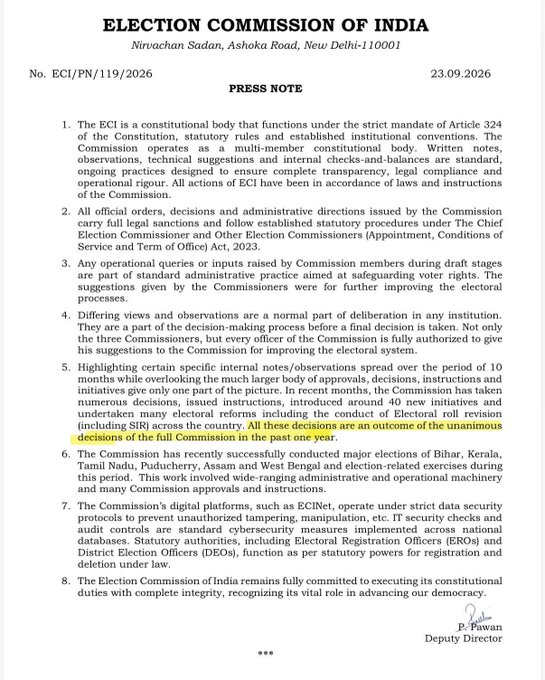
In its October 26 affidavit before the Supreme Court, the Commission maintained that its SIR scheduling orders had been taken unanimously. It also said that an internal work-allocation order that prompted objections from the two commissioners had never been implemented.
The affidavit therefore complicates the picture presented by the investigation. It does not establish that the 14 objections never existed, but it does challenge the implication that disagreement necessarily meant the Commission’s SIR decisions lacked unanimity.
The Supreme Court subsequently gave the petitioners time to file a rejoinder, with the matter deferred until after the Diwali break.
The larger question is whether the newspaper’s reporting adequately distinguishes internal administrative disagreements from substantive dissent over decisions affecting millions of voters. The ECI’s response does not settle every question raised by the investigation, but neither can the existence of internal objections alone establish every allegation made about the Commission’s functioning.
#2 Omidyar Network, Soros and IE Thinc: A Documented Association
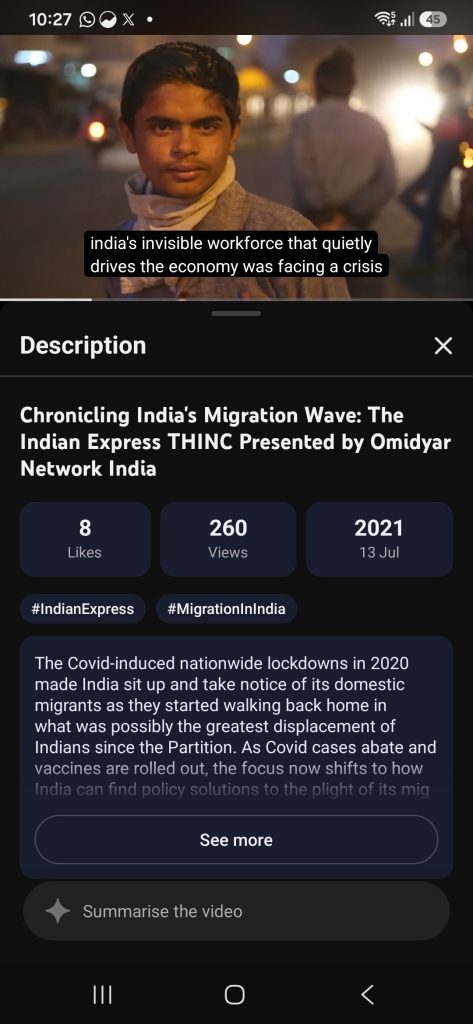
Another relationship worth examining is the partnership between The Indian Express and Omidyar Network India through the newspaper’s IE Thinc events.
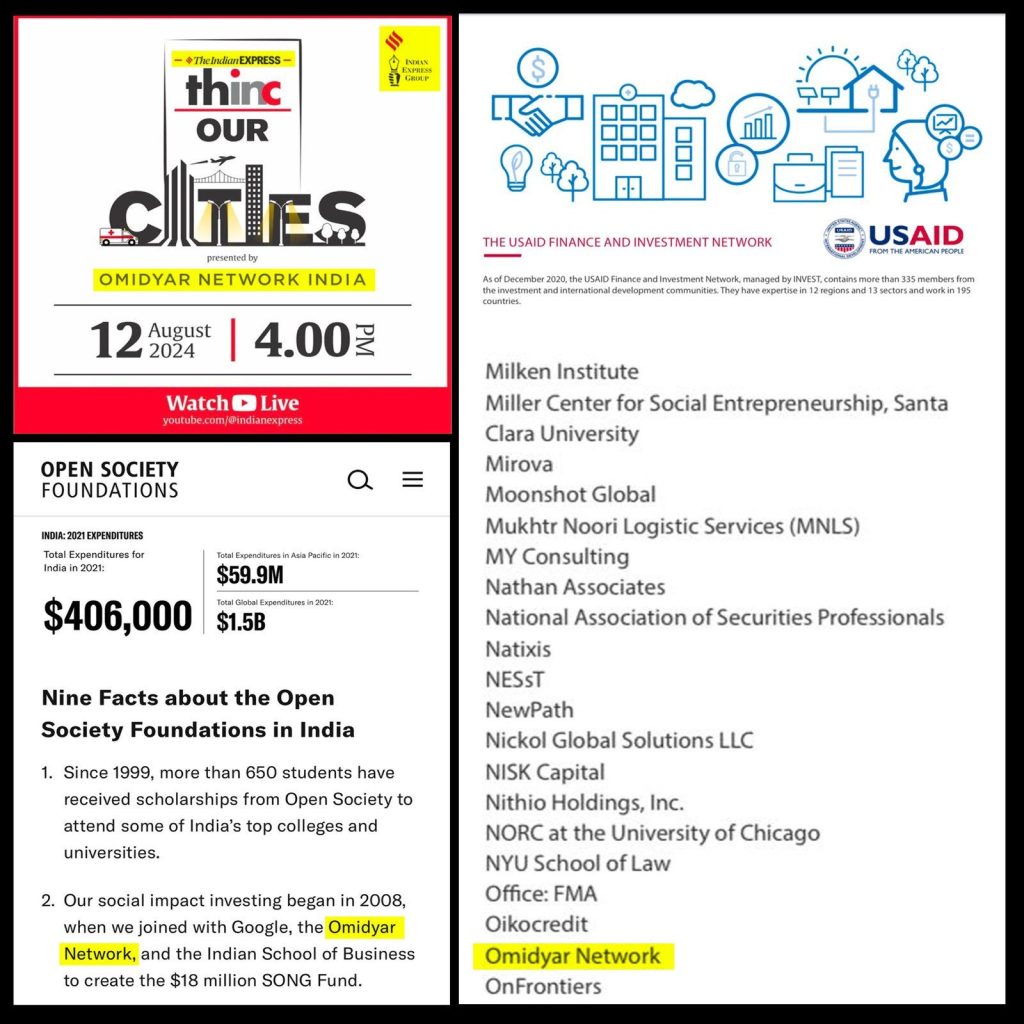
The newspaper itself has described IE Thinc editions as being held in partnership or collaboration with Omidyar Network India. For example, its 2024 urban-development series explicitly acknowledged the partnership.
Omidyar’s broader philanthropic and investment network also has a documented connection to George Soros’s ecosystem.
The Open Society Foundations has stated that the Soros Economic Development Fund, Omidyar Network, Google.org and the Indian School of Business jointly created the SONG Fund. Its published account describes an initial fund of approximately $18 million, while the Soros Economic Development Fund’s investment listing describes the fund as having been established in 2008.
These are documented institutional relationships, not inventions. But they need to be described accurately: a partnership between the newspaper and Omidyar, and Omidyar’s separate financial collaboration with the Soros-linked fund, do not by themselves establish that Soros or Omidyar directed the newspaper’s editorial coverage.
The legitimate question is one of transparency. When a newspaper partners with an organisation that operates in the same philanthropic ecosystem as other politically consequential institutions, readers should be able to understand the nature of that relationship and evaluate potential conflicts of interest.
Omidyar’s exit from India and the FCRA question
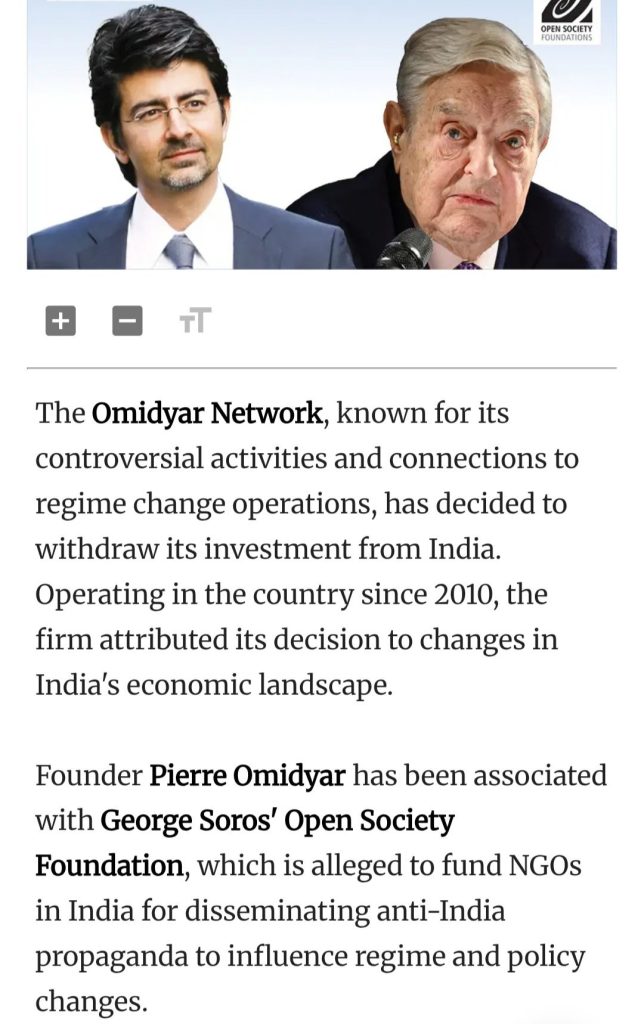
In December 2023, Omidyar Network India announced that it would stop making new investments and transition out of the Indian market by the end of 2024.
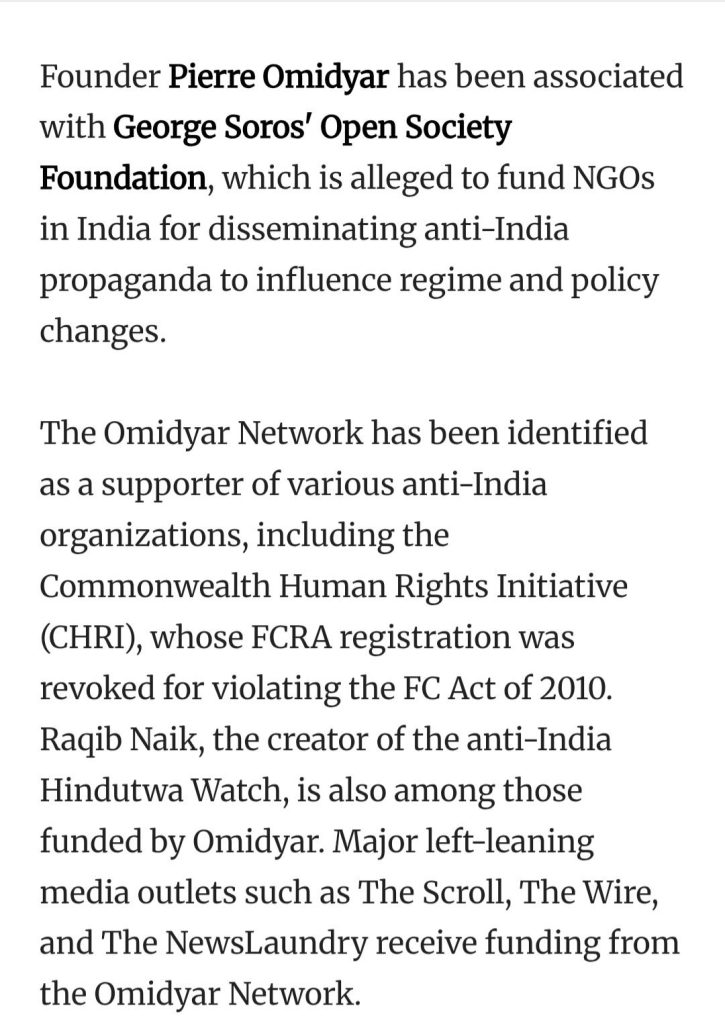
The organisation attributed the decision to changes in the economic landscape and said it had achieved its primary objective of catalysing impact investment. The Economic Times, however, reported that some people associated with its portfolio believed FCRA-related scrutiny and grant issues might have contributed to the decision.
The Open Society Foundations has also publicly stated that Indian government restrictions on foreign funding had constrained its grant-making activities in India since 2016.
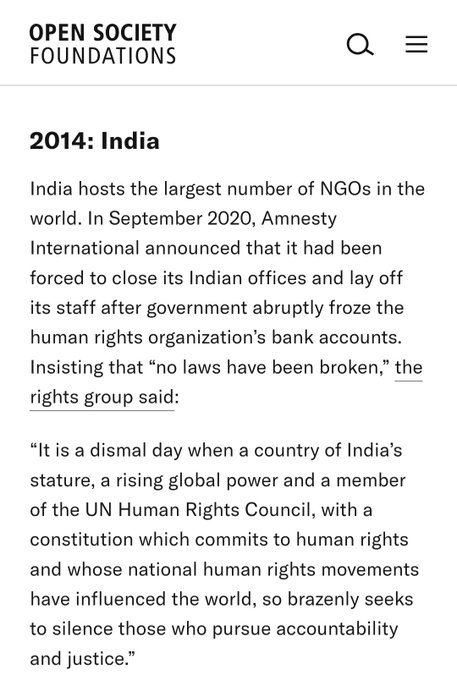
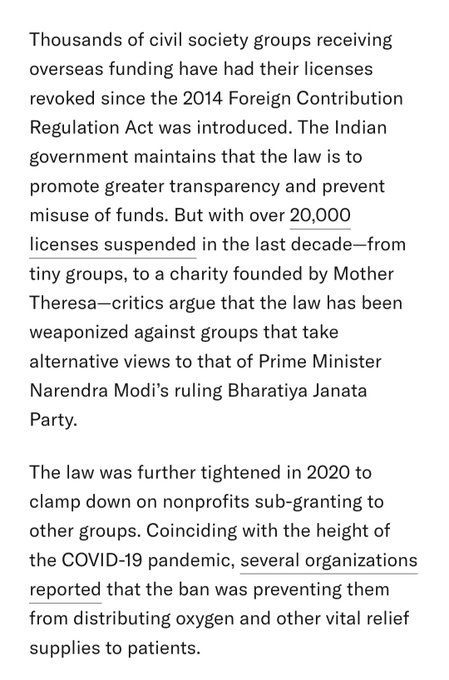
These developments provide context for the broader debate over foreign funding, philanthropy and civil society. They do not, on their own, prove that The Indian Express acts on behalf of any foreign organisation.
#3 FCRA: The Newspaper’s Editorial Position
In July 2026, The Indian Express criticised tighter FCRA provisions as a troubling expansion of executive control that could shrink civic space. In August, it published Congress MP Shashi Tharoor’s argument that the proposed FCRA amendments were about “control, not transparency.”
The Indian Express
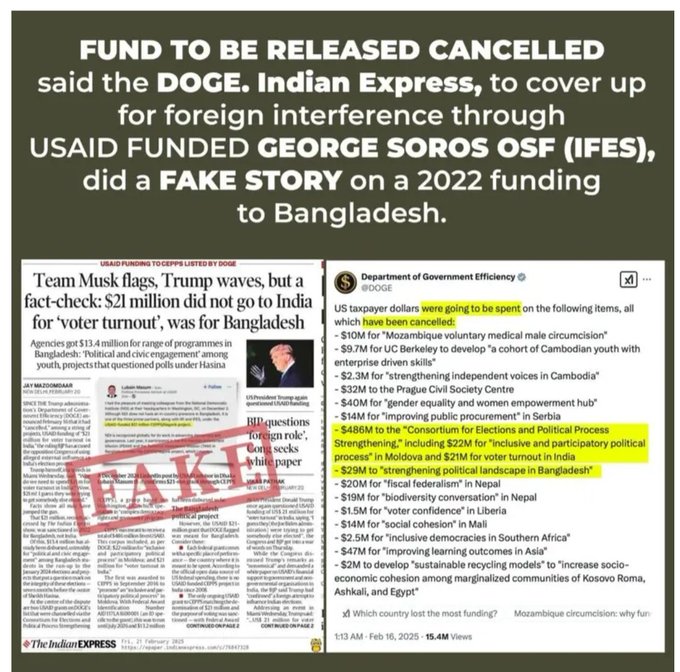
The newspaper is entitled to oppose legislation. But its position is relevant because the FCRA debate is also central to the regulatory disputes surrounding foreign-funded organisations, including Omidyar Network India.
The question for readers is whether the newspaper consistently examines the accountability and transparency of foreign-funded institutions with the same intensity that it applies to government regulation of those institutions.
#4 “And They Hanged Yakub”: A Headline That Drew Fierce Criticism
Following the execution of Yakub Memon, convicted in connection with the 1993 Mumbai serial bomb blasts, The Indian Express published a piece titled “And they hanged Yakub Memon.”
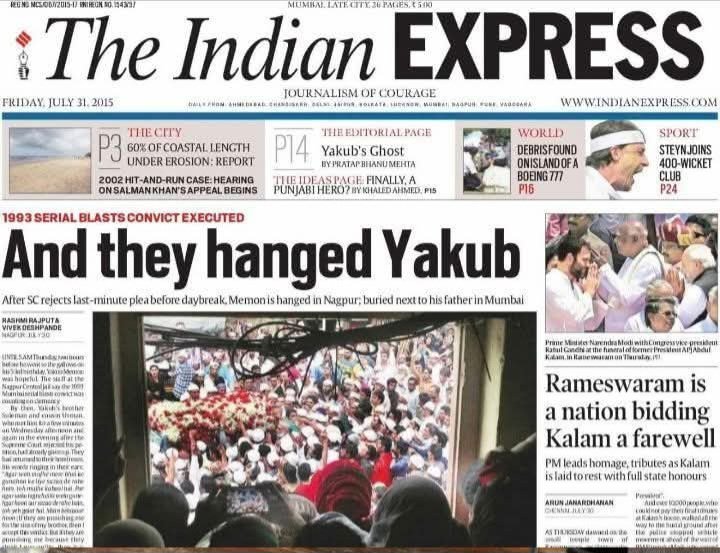
The headline’s wording sounded mournful, as though the newspaper were lamenting the execution of a man convicted in a terrorist bombing case that killed 257 people.
When the subject is a convicted terrorist, the headline inevitably shapes how readers perceive the event.
#5 The 2012 Army Movement Story: “Two Key Army Units Moved Towards Delhi”
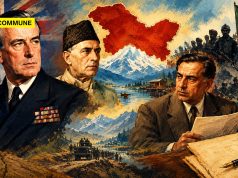
In April 2012, The Indian Express published a front-page investigation titled “The January night Raisina Hill was spooked: Two key Army units moved towards Delhi without notifying Govt.”
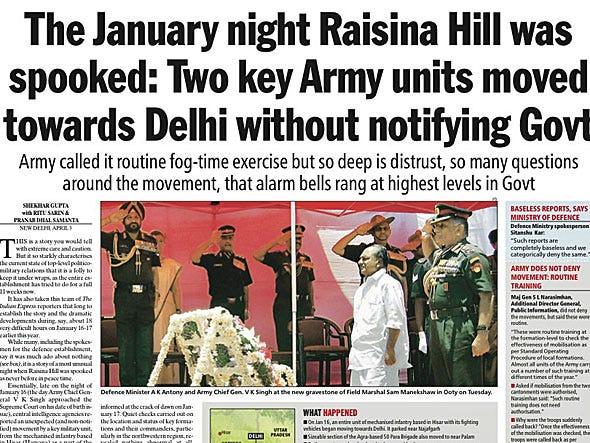
The report described the movement of two Army formations towards Delhi on the night of January 16–17, 2012, when then Army Chief General V.K. Singh was pursuing a dispute over his date of birth in the Supreme Court. The timing and circumstances prompted speculation about tensions between the military and the government.
The Defence Ministry called the report “baseless”, while then Prime Minister Manmohan Singh described it as “alarmist”. General V.K. Singh said the movements were routine exercises and denied that they were intended to pressure the government.
The newspaper claimed that it had relied on credible sources and that questions about the movements remained unanswered.
#6 Burhan Wani Funeral Image On Its Facebook Cover
In July 2016, The Indian Express faced criticism on social media over its Facebook cover image, which critics said showed the funeral of Burhan Wani, the Hizbul Mujahideen commander killed by security forces.
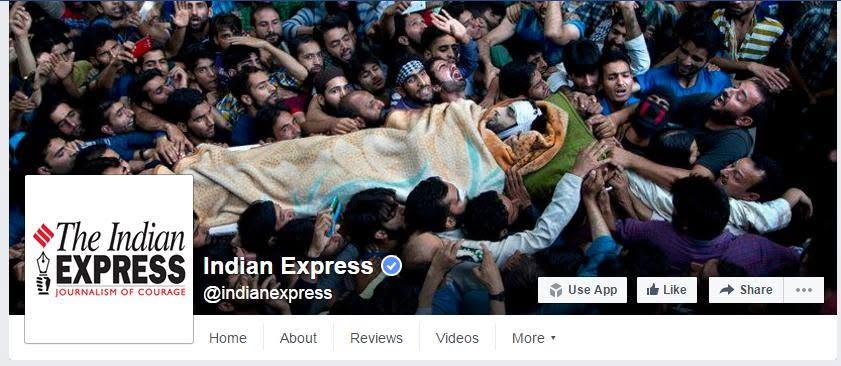
The image on the cover of the official social media page of a national newspaper seemed to want to represent a militant whose death triggered widespread unrest in Kashmir.
#7 JNU: Vandals Presented As Victims
In February 2026, The Indian Express reported on the rustication of five JNU research scholars, including former JNUSU president Nitish Kumar, over the alleged destruction of facial-recognition gates at the university’s Dr B.R. Ambedkar Central Library. However, its coverage foregrounded the students’ punishment while downplaying the alleged destruction of equipment worth approximately ₹20 lakh. By focusing on the consequences faced by the students without adequately highlighting the damage that led to the disciplinary action, the newspaper presented an incomplete picture of the controversy.
#8 Umar Khalid: Humanizing A Delhi Riots Terror Accused
In an article titled “When Umar Khalid came home”, The Indian Express covered Umar Khalid during his interim bail period.
The profile of Umar Khalid foregrounded personal and family details while giving insufficient weight to the serious allegations against him in connection with the 2020 Delhi riots, which killed 53 people and injured more than 200.
By centering the accused’s personal story over the allegations and legal proceedings, the piece risked shaping public perception through a sympathetic portrait while underplaying the gravity of the case.
#9 IIT Bombay: Student Objections To Portrayal Of Controversial Campus Speakers
In November 2023, students at IIT Bombay published an open letter criticising what they regarded as the romanticisation of terrorism and divisive politics on campus.
The controversy followed reporting by The Indian Express about the cancellation of a talk by academic Achin Vanaik. The students also objected to what they saw as inadequate scrutiny of a controversial speech by theatre artist Sudhanva Deshpande, who sympathised with terrorism.
The students’ objection was not simply that the newspaper covered a campus dispute. It was that, in their view, the coverage did not adequately address the substance of the controversy surrounding the speakers and their statements.
10. IIT Bombay’s Jain food controversy: Whose concerns were Foregrounded?
Another controversy concerned a dispute involving Jain students and a humanities student at IIT Bombay.
The Indian Express’s report on a student being fined over an incident involving a non-vegetarian spoon and food meant for strictly vegetarian Jain students framed the controversy around the fear experienced by non-vegetarian students. In doing so, it gave insufficient weight to the alleged provocation of Jain students and the violation of their dietary boundaries. The coverage turned a specific campus dispute into a broader narrative about the victimisation of non-vegetarian students, while downplaying the incident that triggered the controversy.
#11 Christianity as an “Indian tradition”: An Opinion Piece’s Incorrect Historical Claim
On 25 December 2025, The Indian Express published an opinion piece by Savio Fernandes, an Auxiliary Bishop of the Archdiocese of Bombay, arguing that Christianity should not be treated merely as a colonial legacy and discussing the tradition associated with St Thomas’s arrival in India.
The Indian Express presented the tradition that St Thomas, one of Jesus Christ’s apostles, arrived on the Malabar Coast in the first century AD and established a Christian presence in India as established history, without adequately distinguishing religious tradition from independently verified historical evidence. While the tradition holds deep significance for sections of India’s Christian community, its historical basis remains debated. By presenting a contested account without clearly acknowledging these distinctions, the newspaper blurred the line between religious belief and established historical fact.
#12 Mahakumbh: An Ppinion Piece Critical of Hindu Religious Mobilisation
The Indian Express published an opinion piece by Savita Jha Khan on the Mahakumbh that was criticised for portraying the massive Hindu religious gathering through a hostile lens. Rather than focusing on specific administrative or political concerns, the piece was accused of viewing large-scale Hindu religious mobilisation itself with suspicion, framing the participation of millions of devotees as a cause for concern.
#13 Tamil Nadu’s Two-Language Policy: Publishing the DMK’s Case
The Indian Express published an argument by Tamil Nadu Finance Minister P. Thiaga Rajan (PTR) defending the state’s two-language policy. The piece relied on selective historical claims and failed to adequately address how restricting the school curriculum to two languages could limit students’ opportunities to learn additional languages. It also left unchallenged the assumption that the policy was inherently equitable, presenting the government’s defence without sufficiently examining its claims against evidence on educational access and opportunity.
#14 The USAID $21 Million Controversy: What was the Money Meant For?
The Indian Express claimed that the widely discussed $21 million USAID allocation for voter-turnout work in India was actually meant for a Bangladesh programme, initially called Amar Vote Amar and later renamed Nagorik. This explanation was challenged over its interpretation of official records and public statements distinguishing funding associated with India from funding for Bangladesh. By attributing the entire $21 million figure to the Bangladesh programme, the newspaper was accused of misrepresenting the funding trail and obscuring questions about USAID-funded voter participation activities linked to India.
#15 Lied That Govt Was Funding Soros-Linked Organizations
The Indian Express faced criticism over a report on government funding and organisations linked to George Soros. Its headline allegedly created the impression that the Indian government was directly funding Soros-linked organisations, without adequately clarifying the funding arrangements, the agencies involved and the actual recipients. By blurring the distinction between the source of funds, the implementing agency and the beneficiary, the report risked misleading readers about who was funding whom.
16. The $21 Million Voter-Turnout Story
The Indian Express, Alt News co-founder Mohammed Zubair and journalist Rajdeep Sardesai were accused of spreading a misleading narrative about the $21 million USAID allocation for voter-turnout activities. Their account centred on the claim that the money was intended for a Bangladesh programme, allegedly sidestepping separate claims about voter-turnout funding linked to India. The controversy raised questions about whether the funding story was accurately represented and whether the distinction between the India-linked allocation and the Bangladesh programme was adequately explained.
17. The Nirmala Sitharaman Interview: An Old Interview Presented As New
The Indian Express published remarks from a six-month-old interview with Union Finance Minister Nirmala Sitharaman in the context of the Union Budget, creating the impression that her comments were recent. The newspaper later issued a correction, but faced criticism for not issuing a prominent apology. By presenting old remarks in the context of a new budget announcement, the paper misled readers about when the comments were made and their relevance to the current event.
18. Haryana’s “Stolen Election” Allegations: When the newspaper’s own reporting challenged Rahul Gandhi
In November 2025, the newspaper published an on-ground investigation into Rahul Gandhi’s claims of widespread voter fraud in the Haryana Assembly elections. Its report found that the key examples cited by Gandhi did not stand up to scrutiny.
This matters because the newspaper’s own reporting challenged a prominent opposition leader’s allegations about electoral integrity.
The Indian Express Cannot Be Blindly Trusted
The Indian Express expects readers to trust its reporting, especially when it makes serious allegations against the government. But that trust cannot rest on reputation alone. Across these episodes, questions have repeatedly arisen over headlines, missing context, disputed claims and corrections. Each case must be judged on its evidence, but the cumulative record raises a larger concern about the newspaper’s editorial judgement and consistency. When allegations are presented as facts, old remarks appear new, or critical context is sidelined, readers are left with a distorted picture. A newspaper demanding accountability from others must meet the same standard itself. Trust must be earned through accuracy, transparency and accountability—not assumed because of a prestigious masthead.
This article is based on an X thread by Rishi Kalia.
Subscribe to our channels on WhatsApp, Telegram, Instagram and YouTube to get the best stories of the day delivered to you personally.