Former Supreme Court judge Justice Abhay S. Oka delivered a lecture on judicial accountability on 27 October 2026. Oka, who retired in May 2025, has delivered several consequential judgments involving UAPA accused, corruption cases and high-profile political figures. Since retirement, he has also made headlines for his remarks on religious practices, firecrackers, temple idol immersions and pollution, questioning whether religious sentiment can justify practices that harm the environment.
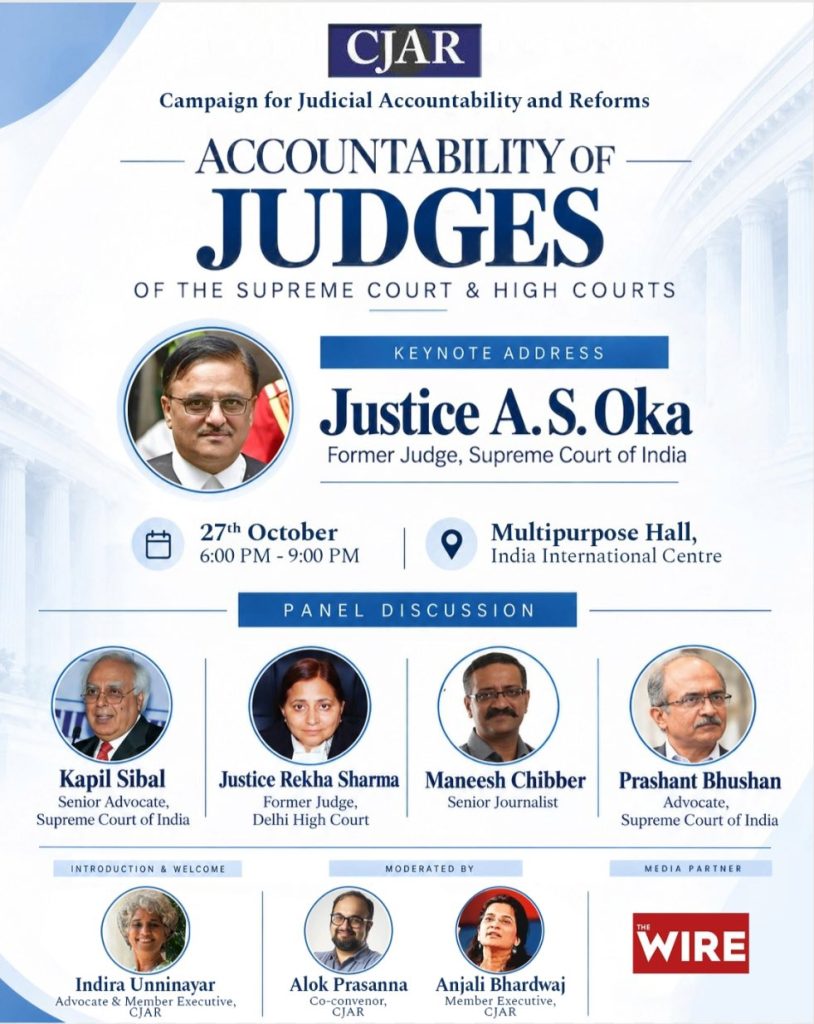
Oka retired from the Supreme Court on 24 May 2025, after serving as a judge of the court from August 2021. Before that, he served as Chief Justice of the Karnataka High Court and as a judge of the Bombay High Court.
Former Supreme Court judge Justice Abhay S. Oka’s judicial record includes bail for accused in terror-related investigations, relief for politicians and officials facing serious criminal allegations, and the quashing of criminal proceedings in high-profile cases. From UAPA cases involving alleged Maoist links and the banned Popular Front of India (PFI) to the cash-for-jobs case involving former Tamil Nadu minister V. Senthil Balaji, Oka has been part of several consequential rulings that allowed accused persons to walk out of custody or escape prosecution.
These decisions were delivered on grounds including the interpretation of anti-terror laws, the evidentiary requirements for criminal prosecution and the constitutional right to a speedy trial. But the cases themselves involved grave allegations, ranging from alleged terror-related conspiracies to corruption and post-poll violence.
UAPA Cases: Bail For Accused In Terror-Related Investigations
Thwaha Fasal and Allan Shuaib
In Thwaha Fasal v. Union of India (2021), a Supreme Court Bench comprising Justices Abhay S. Oka and Ajay Rastogi dealt with appeals concerning the bail granted to Thwaha Fasal and Allan Shuaib, who were arrested in a case investigated by the National Investigation Agency (NIA) over alleged Maoist links.
The Court restored Fasal’s bail and dismissed the NIA’s appeal against the bail granted to Shuaib. Justice Oka authored the judgment.
The Court held that mere association with a terrorist organisation was not sufficient to attract Sections 38 and 39 of the UAPA unless the association was accompanied by an intention to further the organisation’s activities. It also examined the statutory restrictions on bail under Section 43D(5).
Ashim Kumar Haranath
Oka also sat on the Supreme Court Bench that granted bail to UAPA accused Ashim Kumar Haranath in 2021.
Javed Ahmad Hajam
In Javed Ahmad Hajam v. State of Maharashtra (2024), Justice Oka authored a judgment concerning a college professor from Kashmir who faced a case under Section 153A of the Indian Penal Code over WhatsApp posts.
The posts included a message wishing people pro Pakistan and anti-India messages which included happy Independence Day on 14 August, Pakistan’s Independence Day, as well as criticism of the abrogation of Article 370.
The Supreme Court set aside the criminal proceedings, holding that the messages, read in context, did not establish the offence of promoting enmity between groups. The judgment emphasised that expressing a viewpoint, even one that may be unpopular, does not automatically amount to a criminal offence.
Jalaluddin Khan and Athar Parwez
Oka was also part of the Supreme Court proceedings that resulted in bail for Jalaluddin Khan and Athar Parwez, accused in the Patna Popular Front of India (PFI) case.
The prosecution alleged links to the banned organisation and activities connected to a plan titled India 2047: Towards Rule of Islamic India. The case involved allegations of conspiracy, recruitment and the organisation’s activities.
The bail proceedings examined whether the material cited by the prosecution established the statutory grounds required to deny bail under the UAPA.
Corruption Cases: Demand For Bribe Must Be Proved
K. Shanthamma v. State of Telangana
In K. Shanthamma v. State of Telangana (2022), Justice Oka authored a judgment setting aside the conviction of a Commercial Tax Officer under the Prevention of Corruption Act, 1988.
The prosecution alleged that the officer had demanded a bribe. Tainted currency notes were recovered in the case, but the Supreme Court found that the demand had not been reliably established.
The Court held that proof of demand was essential to establishing the offence under Section 7 of the Prevention of Corruption Act. It set aside the convictions upheld by the lower courts and acquitted Shanthamma.
Soundarajan v. State
In Soundarajan v. State (2023), the Supreme Court again considered the evidentiary requirements for establishing a corruption offence.
The case concerned allegations of illegal gratification and the prosecution’s ability to prove the essential elements of the offence. The Court applied the principle that the prosecution must establish the necessary legal ingredients of bribery rather than rely on the recovery of money alone.
Anil Tuteja And The Chhattisgarh Liquor Scam
In April 2024, the Supreme Court quashed an Enforcement Directorate prosecution complaint against retired IAS officer Anil Tuteja in proceedings connected to the alleged Chhattisgarh liquor scam.
The case concerned the legal foundation required for proceedings under the Prevention of Money Laundering Act (PMLA). The Court held that the absence of a legally sustainable scheduled offence undermined the basis for the money-laundering proceedings in question.
Political Cases: Senthil Balaji And Sheikh Sufiyan
V. Senthil Balaji
In September 2024, a Supreme Court Bench comprising Justices Abhay S. Oka and Augustine George Masih granted bail to former Tamil Nadu minister V. Senthil Balaji, who had been arrested by the Enforcement Directorate in a money-laundering case linked to the alleged cash-for-jobs scam.
Balaji had spent more than a year in custody. The Court considered the delay in the commencement of the trial and the volume of material involved in the proceedings.
The judgment emphasised that the right to a speedy trial forms part of Article 21 and that prolonged incarceration cannot be justified indefinitely when the trial is unlikely to conclude within a reasonable period.
Sheikh Sufiyan
Oka was also part of the Supreme Court proceedings in which Sheikh Sufiyan, the election agent of West Bengal Chief Minister Mamata Banerjee during the 2021 Nandigram election, received anticipatory bail in a case connected to post-poll violence.
The case concerned allegations investigated by the Central Bureau of Investigation. The bail proceedings involved the assessment of the material connecting Sufiyan to the alleged offences.
Abdul Sathar
Another case involving Oka concerned Abdul Sathar, a former Kerala state-level PFI leader accused in the conspiracy case relating to the 2022 murder of RSS worker Sreenivasan in Palakkad.
The former PFI leader was accused in the conspiracy case relating to the September 2022 murder of RSS worker Sreenivasan in Palakkad. The NIA alleged that Sathar had recruited cadres and organised arms training during his tenure as PFI general secretary; it also cited a photograph of the victim found on his phone. The Supreme Court granted him bail in May 2025, noting that no direct role in the murder had been attributed to him.
After Retirement: Remarks On Firecrackers And Religious Practices
Since retiring, Oka has continued to make public interventions on constitutional duties and environmental protection. In a speech he even gave gyan about Hindu religious celebrations that cause air, water or noise pollution.
In October 2025, while delivering a lecture titled Clean Air, Climate Justice and We – Together for a Sustainable Future, organised by the Supreme Court Bar Association, he questioned whether bursting firecrackers could be treated as an essential religious practice protected by Article 25 of the Constitution.
He asked, “How is there joy and happiness by bursting crackers which cause irritation to the old and infirm and to birds and animals?”
He argued that the right to practise religion cannot automatically extend to activities that harm other people, animals or the environment. He also pointed to pollution caused by idol immersions and the use of loudspeakers during festivals across religious communities.
Oka further criticised the tendency to justify environmental damage in the name of religion, arguing that all communities have a responsibility to protect nature.
His remarks came shortly after the Supreme Court, through a Bench he headed, had relaxed the restrictions on firecrackers in Delhi-NCR and permitted the use of green crackers under specified conditions. In his public lecture, he said he would not discuss the cases he had adjudicated, but nevertheless addressed the broader constitutional question of whether pollution-causing practices deserved protection as religious observances.
“No Religion Encourages Destruction Of The Environment”
In April 2026, during a lecture in Chennai titled Environment – Rights or Duties Under the Constitution, Oka again argued that environmental protection was inseparable from constitutional responsibility.
He criticised the pollution of rivers, lakes and seas in the name of religious activities, including the immersion of idols and mass bathing in rivers. He also referred to the environmental effects of pouring large quantities of milk into water bodies and called for greater scientific temper.
“No religion encourages destruction of the environment,” he said.
Oka argued that environmental degradation disproportionately affects poorer communities, which depend on rivers and lakes for drinking water and other essential needs. He linked environmental protection to social justice and the constitutional duty of citizens to preserve the natural environment.
He also called for scientific reasoning to inform public practices, maintaining that environmental reform did not require people to abandon their religious beliefs.
Conclusion
Oka’s record spans cases involving alleged Maoist links, the PFI, corruption, money laundering and political violence. In several high-profile matters, the accused received bail, had criminal proceedings quashed or saw convictions overturned. These included UAPA accused in terror-related investigations, former Tamil Nadu minister V. Senthil Balaji in the cash-for-jobs money-laundering case, and officials facing prosecution in corruption-related matters.
The same judge who delivered or participated in these rulings has, after retirement, spoken forcefully about constitutional duties, environmental protection and the limits of religious practices. His record therefore raises questions not just about judicial accountability as an abstract principle, but about how courts balance individual liberty, the prosecution of serious alleged crimes and public confidence in the justice system.
Subscribe to our channels on WhatsApp, Telegram, Instagram and YouTube to get the best stories of the day delivered to you personally.