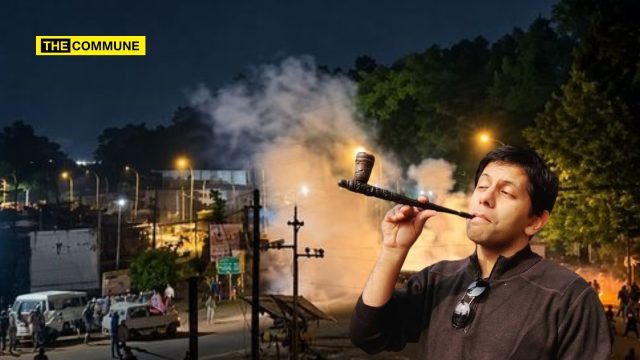
YouTuber Akash Banerjee has portrayed the violence during protests against the proposed Siang Upper Multipurpose Project in Arunachal Pradesh as a battle for survival, described the confrontation as a fight to the last breath, and seemingly warned the government that its actions are igniting a “fire of rebellion” that nobody will be able to extinguish.
In a video titled “Why Is Arunachal Protesting Against The Siang Dam? | ‘Shield’ Against China Or A Ticking Time Bomb?”, Banerjee discusses the protests against the proposed 11,200 MW dam, which has triggered opposition among sections of the indigenous Adi community over concerns about displacement, ancestral land and environmental risks.
However, his repeated characterisation of the confrontation goes beyond explaining the protesters’ grievances. He describes the unrest as an existential struggle against the government, presents resistance as inevitable, and uses language that risks legitimising further confrontation.
Banerjee first starts by describing the escalation of the protests, including the breaking of barricades, the storming of government offices and the burning of police vehicles.
Then he goes to portray as if nothing like this ever happened before. “This is no ordinary riot or disturbance taking place here,” he says. “Here, people are fighting a battle to save their existence—to prevent their civilization from being wiped out.”
The description comes immediately after his account of protesters setting police vehicles on fire following the use of tear gas and batons by the police. Rather than clearly distinguishing the protesters’ grievances from the acts of violence, Banerjee places the violence within the framework of a struggle for survival.
While narrating the burning of police vehicles during the Arunachal Pradesh protests, Banerjee says the vehicles were set ablaze in response to police action. He then declares that this is “no ordinary riot” but a “final battle” to save the people’s existence and prevent their civilisation from being wiped out. Rather than condemning the arson, he places it within a narrative of existential struggle, framing the escalating confrontation as a fight for survival.
Govt should really look into incitement of violence happening on Youtube
Just hear Akash Banerjee!
Almost directly inciting people to burn buildings & police stations in Arunachal
He calls it final war by people to save themselves!
That too so near to China border? https://t.co/C3WTNgXgYG
— Abhishek (@AbhishBanerj) October 28, 2026
Then he escalates the rhetoric further, declaring that the people of the Northeast do not know how to bow down and that force will not work against them.
“When it comes to land, existence, and identity—it does not matter who holds the gun,” he says.
He follows this with another categorical declaration: “Whether it is the government or the army—instead of giving in, the people will fight to the very last breath.”
The language he uses makes one feel as if the confrontation is a fight in which neither government authority nor the use of force will make the protesters retreat. In a video discussing actual incidents of arson, stone-pelting and clashes with police, such a description can only incite further violence.
The most explicit warning comes towards the end of the video. Banerjee says the government cannot suppress ordinary people by deploying police and taking legal action against those raising their voices.
“When you try to trample on the age-old rights of border populations like this, you are not strengthening the nation’s security,” he says. “Instead, you are igniting a fire of rebellion—which no one will be able to extinguish later.”
He then invokes Manipur, which has experienced prolonged ethnic violence, and suggests that the same pattern is now unfolding in Arunachal Pradesh.
Banerjee again describes the situation in terms of violence and state responsibility, referring to the deaths of four people during protests in Leh before alleging that the same violence is being repeated in Arunachal Pradesh.
Throughout the video, Banerjee repeatedly portrays the government as an adversary of the indigenous population, describes the dam project as a threat to an entire tribal civilisation, and depicts resistance as a fight for freedom and survival.
A prominent YouTuber like Akash Banerjee is discussing an already volatile situation and is not merely reporting the protesters’ anger but using rhetoric to escalate the issue.
Subscribe to our channels on WhatsApp, Telegram, Instagram and YouTube to get the best stories of the day delivered to you personally.