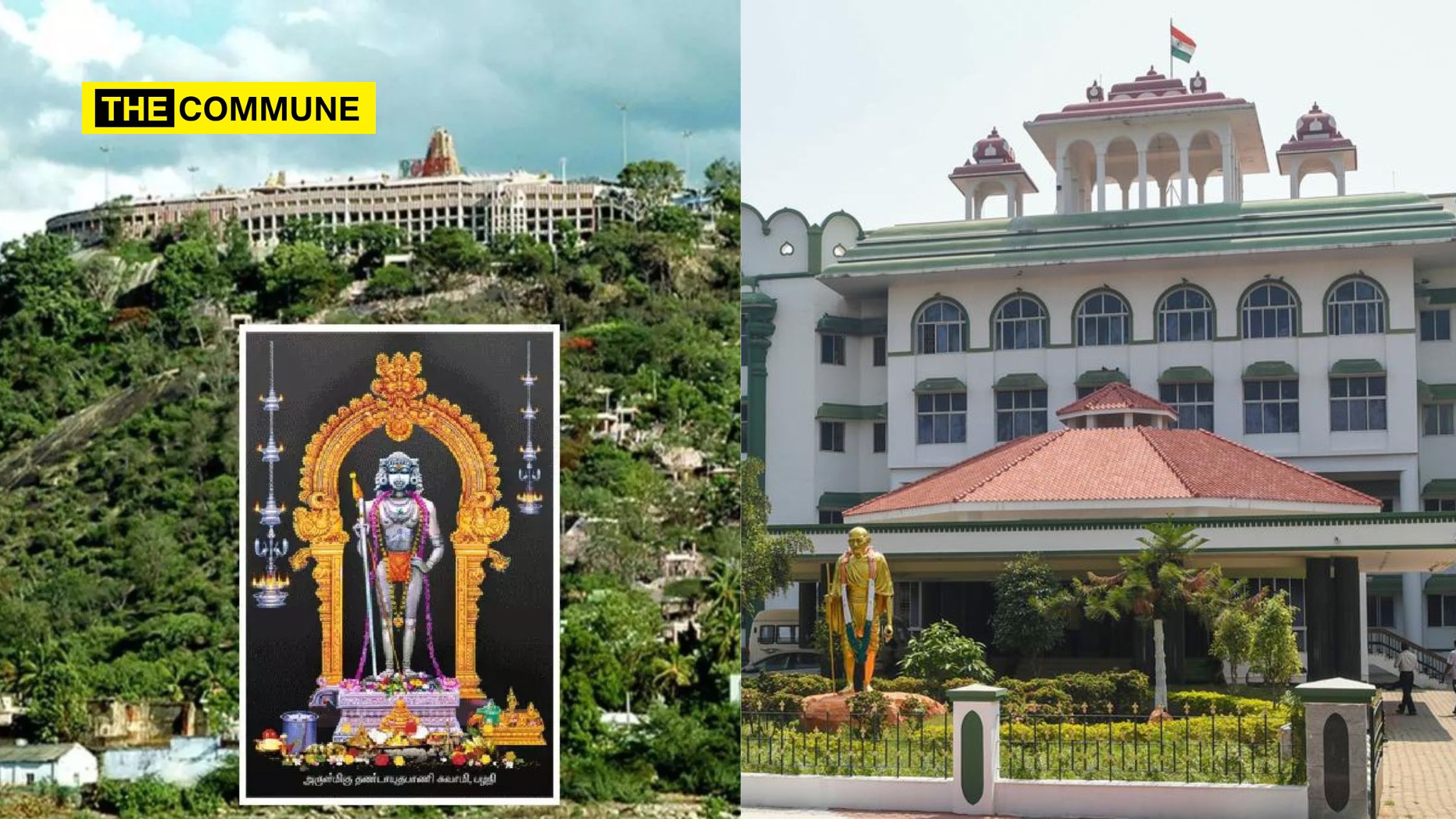
The Madurai Bench of the Madras High Court has ruled that non-Hindus who do not sign an undertaking affirming their reverence for the deity concerned cannot be permitted to cross the flag-pole in Agamic temples in Tamil Nadu. The Court further held that non-Hindus who display their religious symbols and do not affirm their reverence for the deity cannot be permitted to enter the temple premises, as reported in Verdictum.
A Division Bench comprising Justice G.R. Swaminathan and Justice P. Murugan delivered the ruling on 23 October 2026, in a petition filed by Thangam Venkatesh seeking enforcement of statutory provisions governing temple entry and the protection of customary practices in Hindu temples.
The Bench held that the undertaking must be submitted in the format prescribed by the temple concerned. It also emphasised that temple customs and traditions cannot be compromised for political appeasement or public display.
The Court observed, “Not only Chamchagiri but also optics matters in a democracy. We know of one political leader, who is a fundamentalist subscribing to a non-Hindu faith. But he would make it a point to visit the temple and also prominently display the religious mark on his forehead. This was to play to the gallery. The vote value of such a display, is obvious.”
It further stated, “We hold that usages and customs of temple cannot kneel down before such display of Chamchagiri and optics.”
Constitution Takes Precedence Over Caste-Based Restrictions
The Bench made a distinction between restrictions imposed on non-Hindus and historical restrictions that prevented certain classes of Hindus from entering parts of temples.
The Court noted that Agamic injunctions had historically restricted certain Hindu communities from crossing the flag-pole. However, it held that such restrictions could no longer be enforced against Hindus because constitutional protections take precedence over regressive theological injunctions.
The Bench observed, “We decided to go back to the fundamentals. Can it be said that the presence of certain persons in the vicinity of the deity can be said to cause pollution or defilement? Agamas have definite and clear injunctions in this regard. Certain classes of Hindus were not even permitted to cross the flag-pole. But such Agamic injunctions can no longer pass muster. Constitution ranks paramount and such regressive theological injunctions have to necessarily give way. But we hasten to add that those injunctions will hold good in respect of non-Hindus who do not sign the undertaking.”
The Court clarified that the ruling was strictly confined to Agamic temples.
Court Cites Earlier Judgments On Temple Entry
The Bench relied on earlier judicial decisions, including Kalyan Dass v. State of Tamil Nadu (1972) and D. Senthilkumar v. Government of Tamil Nadu (2024), which dealt with the entry of non-Hindus into Hindu temples and the role of temple customs.
In the 2024 judgment, Justice S. Srimathy had directed temple authorities to display notices stating that non-Hindus were not allowed beyond the Kodimaram, or flag-pole, and to obtain an undertaking from non-Hindus who sought to visit a particular deity, affirming their faith in the deity and willingness to follow Hindu religious practices and temple customs.
The present Bench also referred to earlier decisions, including Gopala Moopanar v. Dharmakarta Subramaniya Iyer, Sankaralinga Nadan v. Raja Rajeswara Dorai, Venkataramana Devaru v. State of Mysore and Seshammal v. State of Tamil Nadu.
Drawing on these precedents, the Court held that trustees have a duty to preserve established temple customs and usages. It observed that the presence of persons who violate applicable temple traditions could compromise the sanctity of the shrine.
The Bench also referred to Sections 10, 24(3) and 24(4) of the Tamil Nadu Hindu Religious and Charitable Endowments Act, 1959. Section 24(4), in particular, states that nothing in Section 24 authorises a non-Hindu to enter the premises or places referred to in that provision.
Court Cites Instances Of Temple Entry By Political Figures
The Bench referred to recent instances involving public figures entering temples without submitting the required undertaking.
It noted that Badrudeen Mustafa, an MLA representing Madurai Central, had entered the Meenakshi Amman Temple after his election and claimed that he had a right to inspect the facilities provided there. The Court also referred to a Christian minister who had entered the Tiruchendur temple without submitting the required undertaking.
In contrast, the Bench cited Tamil Nadu Chief Minister Joseph Vijay, whom it described as Christian by faith, as an example of an inclusive approach after he signed an undertaking before worshipping Goddess Meenakshi.
The Court observed that the undertaking did not require a person to convert to Hinduism, but merely to affirm reverence for the deity concerned.
The Bench also referred to a video circulating on social media that allegedly showed persons wearing skull caps pushing their way into the Thiruvannamalai Arunachaleswarar Temple despite protests from devotees. It criticised the temple staff for remaining passive spectators.
Petition Allowed
The petitioner, Thangam Venkatesh, had approached the Court seeking directions to the Hindu Religious and Charitable Endowments Department to investigate alleged violations of the Tamil Nadu Temple Entry Authorisation Act, 1947, and enforce relevant provisions of the HR&CE Act, 1959.
The Additional Advocate General, P.V. Balasubramanian, submitted that the procedures prescribed under the relevant laws and rules were being followed and would continue to be followed.
Allowing the petition, the Bench held that the petitioner was entitled to insist that trustees of Agamic temples enforce the applicable restrictions on entry by non-Hindus who had not signed the prescribed undertaking.
The Court concluded that non-Hindus who display their religious markers and do not affirm reverence for the deity concerned cannot be permitted even to enter the temple premises. It directed that the undertaking must follow the format prescribed by the institution concerned.
Subscribe to our channels on WhatsApp, Telegram, Instagram and YouTube to get the best stories of the day delivered to you personally.