“The first Jammu & Kashmir war did not begin with accession. It began with the attempt to prevent accession. That distinction matters.”
Few episodes in modern Indian history have generated more heat and less clarity than the issue of Jammu & Kashmir. The arguments are familiar. The facts are not. The princely state created by Maharaja Gulab Singh under the Treaty of Amritsar in 1846 survived a century of imperial rule before confronting the upheaval of Partition. Like every other princely state in British India, Jammu & Kashmir was left to determine its constitutional future in 1947. That decision unfolded amid mounting political turmoil, pressure from both new Dominions and, in October, a full-fledged invasion under the garb of tribal raids launched from Pakistan’s territory.
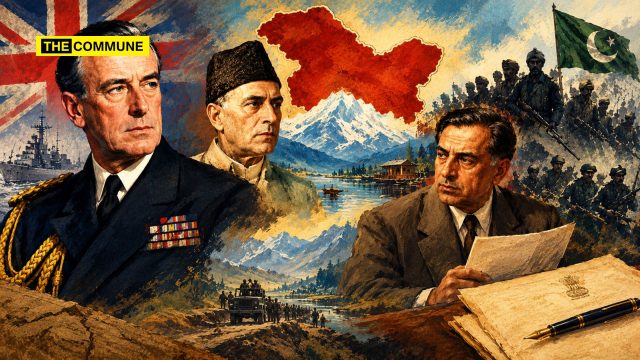
Faced with a crisis, Maharaja Hari Singh signed the Instrument of Accession to India on 26 October 1947, and Governor-General Lord Mountbatten accepted it the following day. Yet the road to accession, invasion and war was shaped by individuals whose influence is often overlooked. Pandit Ramachandra Kak sought to delay a choice he believed premature. Major O.S. Kalkat, who discovered details of the invasion plans before they were executed. At the same time, most of modern history treats Mountbatten as some messiah sent by the Crown, a great friend of India, etc. His duplicity and his dubious past as the Supreme Commander of South East Asia are conveniently ignored. Their stories illuminate a neglected truth.
Mountbatten – The Bearer of A Familiar Parting Gift.
When Lord Mountbatten came to India as its last British Viceroy, he had a well-known history. Ironically, our leaders chose to overlook Mountbatten’s dubious history. Clement Attlee appointed Mountbatten as Viceroy of India on 10 February 1947, with the task of overseeing the transfer of power and Britain’s withdrawal from India. We know that he was the Viceroy and Governor-General of India from 21 February – 15 August 1947, when India was partitioned, and that he continued as the Governor-General of India until June 1948.
As Supreme Commander, South East Asia, he enabled Indonesia’s return to Portugal and the Netherlands. Not just that: as Britain withdrew from Indonesia, he split the country into several parts, leaving it in chaos. When Britain retook Singapore after World War II, one of the first things Mountbatten did was to raze the INA War Memorial in Esplanade Park. Mahatma Gandhi, during his visit to Madras in 1946, met a group of Indonesian Sailors. In this meeting, he was apprised of Mountbatten’s role in sabotaging Indonesia’s independence.
When Mountbatten visited Kashmir in June 1947, the objective was to get a decision from the Maharaja. During this visit, he met with Pandit Ramachandra Kak, who asked him point-blank which side he advised Kashmir to accede to. Mountbatten, while not replying directly, stated, “That is entirely for you to decide. You must consider your geographical position, your political situation and the composition of your population and then decide.” Under his neutral mask, Mountbatten was trying to nudge Kashmir and its rulers over to the other side. Ironically, Gen. Frank Messervy, the first Commander-in-Chief of the Pakistani Army, is known to have lamented to his friends and close quarters that Mountbatten had moved over to the side of the “Hindoos.”
So clearly, Mountbatten came to India with expertise in breaking up countries and leaving them in chaos. I don’t think it would be wrong to say that the British establishment dropped him in India as the Viceroy to do what he did best: split and leave things simmering. It is sad to note that despite knowing who Mountbatten was, Gandhi, Nehru and the Indian National Congress did nothing to stop his appointment. It is puzzling that they were always uncritical and also let him continue in the post-independence role of Governor-General, which cost India dearly when Nehru, obedient to Mountbatten, agreed to stop the military offensive and to take the Kashmir issue to the United Nations. Nehru, who, according to Gandhi, could interpret India’s mind to the outside world as no one else could, failed miserably at the UN, leaving parts of the region occupied to date.
Pandit Ramachandra Kak: The Man who Wanted to Wait
No figure in the Kashmir story is more misunderstood than Pandit Ramachandra Kak. An archaeologist by training and Prime Minister of Jammu and Kashmir during its most perilous years, Kak found himself confronting a question that would define the state’s future: should Kashmir join India, join Pakistan or attempt to remain independent? Convinced that an immediate decision would expose the state to political upheaval and external pressure, he urged Maharaja Hari Singh to postpone accession and preserve Kashmir’s autonomy for as long as possible. In the fevered atmosphere of 1947, neutrality was a bold wager.
He was also a man whose guts Nehru hated. In 1946, when Jawaharlal Nehru attempted to enter Kashmir to support Sheikh Abdullah, who was imprisoned during the Quit Kashmir movement, the state government, led by Prime Minister Pandit Kak, prohibited his entry. It detained him after he defied the order. For perhaps the only time in his political career, Nehru found himself blocked by a provincial administrator who refused to yield to Congress pressure. Nehru did everything he could to uproot Pandit Kak, including enlisting Mahatma Gandhi’s support, and he eventually succeeded. In August 1947, Pandit Kak was dismissed from service, arrested and prosecuted by Maharaja Hari Singh.
Pandit Kak’s dismissal can be termed a decapitation of the state administration. The Chief Secretary, the Chief of Army, the IG Police, the Director of Civil Supplies, the Chief Engineer and many other important officers were replaced in the aftermath. The people who replaced them were all from the Maharaja’s close circle, with little or no experience. There were people of dubious reputation too, who found their way into the new establishment. The result was that there was no leadership, no one to take responsibility, take action and run the government. Janak Singh, who replaced Pandit Kak as the Prime Minister, was brought out of retirement to take responsibility at a very crucial juncture. It is said that, while he was a good man, he was neither physically nor mentally able to bear the gravity of the situation.
Pandit Ramachandra Kak wondered, “If the Jews could get back Israel after 2000 years of exile, why should it be considered extraordinary if India wanted to retain Kashmir, which was already in its possession?”
Major Onkar Singh Kalkat: The Unheeded Warning
Bannu, a district in the North Western Frontier of India, had an army brigade based there. Brigadier C. P. Murray was the Commander of the Bannu Brigade. On August 19, 1947, Brig. Murray was away, at Mir Ali Mirali, another frontier settlement. His 2IC, or Second-in-Command, was a Sikh officer named Major Onkar Singh Kalkat. Maj. Kalkat was on his way out, waiting to hand over charge to a Pakistani officer from the Frontier Force Regiment and make his way to the newly redrawn India. On August 20, as he waited for his brigade commander to return so he could hand over charge and leave for India, a letter arrived from General Frank Messervy, the Commander-in-Chief of the Pakistani Army. This letter had gone to all brigade headquarters in North West Pakistan.
Being the 2IC and as was practice, he opened the letter. Titled “Operation Gulmarg – The Plan for the Invasion and Capture of Kashmir,” it clearly sketched out a plan of action with the day of commencement of operations marked as 20 October 1947. Maj. Kalkat called Brig. Murray and discussed the content. On his return, Brig. Murray realised that Maj. Kalkat’s life would be in danger should anyone learn that he knew the contents of the letter from the headquarters. He ordered Maj. Kalkat to act normally as he waited to hand over charge to his Pakistani successor on 5 September 1947. In the interim, Maj. Kalkat managed to send his wife and infant son back to safety in India. Brig. Mian Hayauddin, who was to take over as the brigade commander from Brig. Murray learned of the departure of Maj. Kalkat’s family to India and discreetly placed him under house arrest.
While this situation developed, a Pakistani clerk who overheard a conversation between Brig. Murray and Maj. Kalkat, upon learning about some letter, alerted the Pakistani Intelligence establishment. Just in time, Maj. Kalkat escaped house arrest and boarded a train to Mari Indus, a major junction from where Hindus and Sikhs escaping the carnage were leaving for India. Maj. Kalkat, upon reaching Mari Indus, reported to the Army Service Corps depot and said that he planned to return to India now that he had handed over charge. The duty officer at Bannu Brigade that morning had discovered that Maj. Kalkat had escaped house arrest and also caught wind that he was at the Army Service Corps depot at Mari Indus. A message was sent to the British officer who was in charge of the depot to hand over Maj. Kalkat to the Pakistanis. Thankfully for Maj. Kalkat, the kind officer provided him supplies and his service weapons, and concealed him in a goods train, enabling him to reach Amritsar.
Maj. Kalkat finally arrived at Delhi on 18 October 1947. He met Maj. Gen. Kulwant Singh, who was the commander of the Jammu and Kashmir Division and Maj. Gen. Pran Nath Thapar (later the fourth Chief of Army Staff, who resigned after the Indo-China war of 1962), who was the Director of Military Operations and Intelligence. The two Generals were unconvinced with the narrative of Maj. Kalkat, but because he had put it on record, they had to take him for an interview with Sardar Baldev Singh, who was the Defence Minister. Baldev Singh was sceptical too and asked the Army Intelligence Directorate to verify the account. The directorate, which was mostly British, didn’t take any action to either verify the input or conduct any further investigation into it.
It is a travesty that the Army Intelligence chose to ignore this important piece of information, which, had they taken it seriously and in conjunction with the other information they were receiving, could have helped avert the invasion. On 15 October 1947, a group of Hindu and Sikh refugees from Pakistan met the Prime Minister of Jammu & Kashmir, Justice Mehr Chand Mahajan (later the third Chief Justice of India) and apprised him of the heavy presence of tribal Afghans and Kabailis around Abbottabad and Man Shera. They also told him about the rumours that they were waiting to invade Kashmir. On 18 October 1947, the British officers, bureaucrats and their families who were holidaying in the Kashmir valley were given emergency evacuation orders. The next day, on 19 October, Pakistani army buses evacuated them from Kashmir. The Indian side had all this information but took no further action.
It can therefore be summarised that the British were complicit with the Pakistanis. At the same time, the Indian establishment decided to bury its head deep in the sand by believing in the British officers and bureaucrats who were running the show on the Indian side.
As Thiruvalluvar says:
ஒற்றினான் ஒற்றிப் பொருள்தெரியா மன்னவன்
கொற்றங் கொளக்கிடந்தது இல் (Kural 583)
Behold the prince that learneth not the happenings about him by means of scouts and spies: conquests are not for him.
Today, on the positive side, the historical wrongs that were committed are being set right one by one. The abrogation of Article 370 on 5 August 2019, which revoked the special status of Jammu and Kashmir, is a firm step in the right direction. Now we await the day the persecuted Kashmiri Pandit community get back their rightful place in the state and when the occupied parts of our land are reclaimed.
Raja Baradwaj is a marketing communications professional who works with a leading technology multinational company. He is an avid reader, history buff, cricket player, writer, and Sanskrit and Dharma Sastra student.
Subscribe to our channels on WhatsApp, Telegram, Instagram and YouTube to get the best stories of the day delivered to you personally.