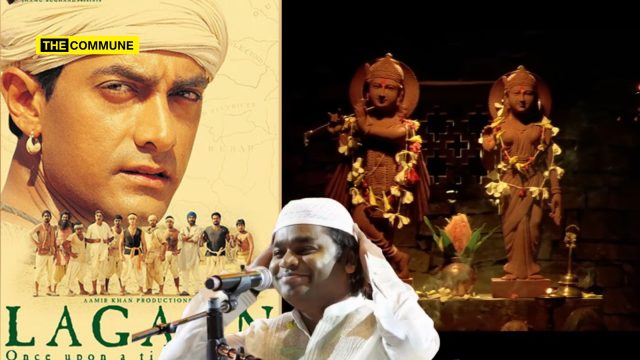
The long-running claim that “O Paalanhaare” from Lagaan is a Hindu devotional bhajan is contradicted by the song’s own creators – AR Rahman and Javed Akhtar – both Muslims.
During a Spotify podcast marking 25 years of Lagaan, director Ashutosh Gowariker, lyricist Javed Akhtar, actor-producer Aamir Khan and music director AR Rahman discussed the making of the film’s iconic soundtrack. Their conversation about “O Paalanhaare” makes one thing particularly clear: the song was conceived as a universal prayer rather than a specifically Hindu devotional song.
The distinction matters because the song is often cited by AR Rahman’s fans as evidence of his contribution to Hindu devotional music, particularly whenever criticism of his remarks on religion resurfaces. Yet the explanation offered by Rahman and Akhtar themselves points in a different direction.
In Lagaan, the song accompanies villagers praying for divine intervention before their decisive cricket match against the British. The film’s visuals explicitly portray their worship through imagery associated with Shri Krishna. But the lyrics themselves carefully avoid directly invoking Krishna or any other named deity.
The song repeatedly uses words such as “Paalanhaare”, “Prabhu”, “Bhagwan”, “Swami” and “Nirgun” – terms that are presented as broad references to the divine rather than an invocation of a particular Hindu deity.
Javed Akhtar himself explained this during the podcast.
“The fact is, the song contains no religious word. “Palanhare” is not a religious term; it isn’t tied to any specific faith—anyone, from any religion in the world, can use it—nor is “Nirgun.” Now, there was some hesitation or apprehension regarding the word “Nirgun.” “Nirgun” implies an absence of attributes—so how can one describe the Supreme Being as “Nirgun”? It isn’t my word; it is Kabir’s. Kabir used “Nirgun” frequently and offered a brilliant explanation: he argued that by attributing a specific quality to God, you are limiting Him; the quality itself imposes a limit, even if it is meant as praise. Do not ascribe specific attributes to Him—hence, “Nirgun.”
Akhtar’s explanation leaves little room for describing the lyrics as an explicitly Hindu prayer. His emphasis was precisely on the absence of words identifying a particular religious tradition.
Rahman went even further when discussing the reaction the song received.
“The most praises I received for this song was from Muslim people and Christian people —and I don’t know why, but it surpassed the boundaries of religion.”
That observation is significant. Rahman did not describe the song as being embraced primarily because listeners recognised it as a Hindu devotional. Instead, he highlighted appreciation from Muslims and Christians and attributed it to the song having “surpassed the boundaries of religion.”
Akhtar’s explanation provides the answer to why.
The song’s language was deliberately universal. “Palanhare”, he said, could be used by anyone, regardless of religion. Even “Nirgun” was explained through the teachings of Kabir, whose devotional tradition itself challenged rigid religious categorisation.
The musical composition also deliberately reinforces that universality.
Asked about the song, Akhtar said, “I have written perhaps more than a thousand songs—that’s for sure—but sometimes, when people ask me to name a song I found challenging to write, I always mention “O Paalanhaare.” You see, try doing one thing: remove the lyrics and listen to the melody on instruments. Play this tune to an Eskimo, a Masai, a tribal person, someone from Manhattan, someone from Moscow—anyone, anywhere—and ask them, “What do you think this tune is saying?” Invariably—I can guarantee this—if they have a musical ear, they will say it is a tune of devotion. The melody speaks for itself; in fact, the melody actually intimidated me because it was so pure and so real—it didn’t sound man-made.”
Akhtar’s point was therefore not that the melody was specifically Hindu. His argument was that the musical language communicated devotion across cultures, independent of the identity of the deity.
This makes Ashutosh Gowariker’s role particularly important. The film’s visual storytelling supplied the explicitly Hindu context that the lyrics themselves avoided. The villagers are shown praying to Krishna, making the song appear to audiences as a Krishna bhajan even though the words do not name Krishna.
In other words, the visuals did the religious heavy lifting that the lyrics deliberately did not.
The distinction is also evident in the way Rahman described his musical objective for the Lagaan album.
“When a highly cinematic movie like this comes along, my intention was to make the score timeless. Whether it actually becomes timeless or not is another matter, but fortunately, this one did. It’s just great. So, “timeless” implies using timeless singers; we have a timeless poet involved. I said, “We need Lata-ji and Asha-ji,” and the response was, “Yes, we should use them.”
ARR says Muslims and Christians praised O Palanhare (implied – more than Hindus). This makes sense – Muslims and Christians didn’t consider it to be a Hindu religious song, they saw it for what it was – a secular song of worship. Lyricist Javed Akhtar himself says it’s not a… https://t.co/QEg49cifsd pic.twitter.com/VMS8JE9FwI
— Param Arunachalam (@taparam) June 14, 2026
The song’s devotional character, therefore, was never dependent on explicitly naming Krishna. Its emotional and musical construction was intended to make the prayer accessible beyond one religious identity.
That makes the repeated presentation of “O Paalanhaare” as proof of a specifically Hindu devotional commitment particularly misleading.
The film shows Krishna. The song does not name Krishna.
The film presents villagers praying within a Hindu setting. The lyricist explicitly says the words can be used by “anyone, from any religion in the world.”
And Rahman himself says the song’s appeal came from the fact that it “surpassed the boundaries of religion.”
The contrast is clear: Lagaan visually presents “O Paalanhaare” as a prayer to Shri Krishna, but the song itself was deliberately stripped of any explicitly Hindu invocation. The villagers are shown praying to Krishna, while the lyrics use generic terms for God and, according to Javed Akhtar himself, are framed as words that “anyone, from any religion in the world” can use. The song was therefore made to look Hindu on screen while being presented in its lyrics as a universal, secular prayer.
For those who invoke “O Paalanhaare” as a defence of Rahman’s engagement with Hindu devotional music, the creators’ own explanation is worth revisiting. For Muslims like Javed Akhtar and AR Rahman, this was the perfect way to get what they wanted – sound seemingly Hindu while it is not. This is the exact same way how AR Rahman’s religious belief made lyricist Vaali change the song lyrics of the film New from ‘Deivam Amma’ to ‘Devathai Amma’.
Subscribe to our channels on WhatsApp, Telegram, Instagram and YouTube to get the best stories of the day delivered to you personally.