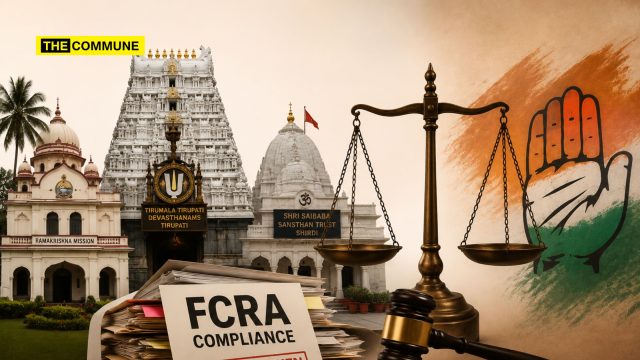
On Wednesday, 12 August 2026, the Foreign Contribution (Regulation) Amendment Bill went to a Joint Parliamentary Committee. Congress, the Samajwadi Party and others turned the Lok Sabha into a protest ground. Congress’s K C Venugopal stood up and demanded the government withdraw the Bill altogether – not amend it, not send it for review, withdraw it. Akhilesh Yadav went further, saying the Modi government has never brought a single bill that wasn’t anti-minority.
The government made a simple point: foreign money cannot enter India without rules. That’s it. That is not a communal statement. It is common sense. Yet somehow, asking who sends money to Indian organisations, how much, and where it goes has become “proof” of targeting minorities.
There’s one problem with that story. FCRA did not start with Modi, nor is the FCRA ‘targeting’ minorities.
Congress Built This Law
The original FCRA came in 1976, under Indira Gandhi’s Congress government. The BJP didn’t even exist then, it was formed in 1980, four years later. So, Congress cannot blame the BJP for a law the BJP had no hand in creating.
Congress didn’t stop there. Rajiv Gandhi’s government tightened the law in 1984, adding more oversight of foreign-funded groups.
Then, in 2010, Manmohan Singh’s Congress-led government scrapped the old law completely and replaced it with a brand new one – the FCRA, 2010. This version added five-year renewal cycles and stricter reporting rules.
So, the current FCRA framework is mostly a Congress creation, built and rebuilt three times by three different Congress Prime Ministers.
The Modi government’s 2020 changes fit the same pattern: foreign funds now have to come through one designated SBI account, NGOs can no longer pass money to each other, and administrative spending was capped at 20% instead of 50%. Stricter, yes. But it’s the same direction Congress was already moving in for decades.
So, when Congress acts like foreign-funding rules just appeared out of nowhere under Modi, the question writes itself: did nobody tell them who was Prime Minister in 1976, 1984 and 2010?
If FCRA Targets Minorities, Why Did It Hit Hindu Trusts Too?
The story being sold to the public is that FCRA mainly ‘targets’ Christian and Muslim groups. This could not be further from the truth.
In 2016, the government cancelled FCRA licences of over 11,000 NGOs that missed their renewal deadline. That list wasn’t a list of Christian organisations. It included the Ramakrishna Mission.
It gets clearer. The Tirumala Tirupati Devasthanams, the body that runs India’s richest and most famous Hindu temple, got fined ₹3 crore for FCRA violations linked to foreign money collected through the temple’s donation box. Shirdi’s Shri Saibaba Sansthan Trust had its foreign-donation licence not renewed too, before later getting it back.
Add to that the Sri Sathya Sai Central Trust, Maharishi Ayurveda Pratishthan, Hindu Mission Hospital, Sri Durga Educational Development Welfare Society, Ohm Sakthi Educational Trust, Sathyalok Charitable Trust, and Sathvidya Sthanam Trust. All caught in the same net.
FCRA doesn’t check what god an organisation prays to. It checks whether the paperwork is in order. That’s the whole point of it.
The Opposition’s Trick: Dodge the Question
Nobody is saying the new Bill should pass without a real debate. That’s exactly why it’s gone to a Joint Parliamentary Committee; so MPs, lawyers and stakeholders can go through it, clause by clause.
But instead of pointing to an actual clause and explaining what’s wrong with it, the ‘argument’ has been reduced to a slogan: FCRA equals minorities, FCRA regulation equals BJP, so FCRA regulation must be anti-minority.
When minister Kiren Rijiju asked the Opposition to name one clause in the Bill that discriminates against minorities, nobody could. If the Bill really is discriminatory, show the clause. Don’t just shout “minority” and walk away from the question.
Foreign Money Isn’t a Religious Issue
India doesn’t ban foreign contributions. It regulates them. That’s normal everywhere. Foreign money can fund good work – hospitals, schools, disaster relief. It can also be misused. The only fair question is: who’s sending the money, how much, where does it go, and is the law being followed? That question should not be controversial. It only becomes controversial when accountability itself becomes the enemy.
There’s also a real, separate debate about foreign money being used to fund illegal religious conversion. Where there’s evidence of that, it should be investigated properly, under the law. But that’s a reason to enforce the law better — not a reason to call the entire law communal. And religious identity should never work as a shield against financial scrutiny. If an organisation’s books are clean, the books will show it.
The Hypocrisy Is Hard to Miss
The Opposition is free to oppose the Bill, challenge its provisions and demand safeguards. But calling FCRA inherently anti-minority becomes difficult to sustain when the same framework has scrutinised Hindu institutions from Tirupati and Shirdi to the Ramakrishna Mission.
Congress itself created the law, strengthened it and replaced it. The Modi government tightened it further. What has changed is not the basic principle that foreign money needs oversight, but the political reaction when that oversight affects organisations connected to a key vote bank.
FCRA does not ask which God an organisation worships. It asks whether the rules governing foreign money have been followed. If Hindu institutions can face that scrutiny without the entire system being labelled anti-Hindu, why should scrutiny of minority-linked organisations automatically be called anti-minority?
The debate should be about the law and its provisions — not about turning compliance into a shield for votebank politics.
Subscribe to our channels on WhatsApp, Telegram, Instagram and YouTube to get the best stories of the day delivered to you personally.