Fresh community-wise data from Tamil Nadu’s medical admissions has added another layer to the debate over the state’s reservation system, with the detailed figures showing substantial representation of several individual communities among MBBS seats allotted under the 92.5% admission pool.
The latest data, obtained through RTI and issued by the Directorate of Medical Education and Research, provides a sub-caste-wise breakup of MBBS admissions for the 2025-26 and 2024-25 academic sessions. The figures cover 92.5% of the MBBS admissions, with the government-school students’ separate 7.5% quota not included in this dataset.
Tamil Nadu’s current medical admission framework provides 31% for Open Competition, 30% for Backward Classes, 20% for Most Backward Classes and Denotified Communities, 18% for Scheduled Castes and 1% for Scheduled Tribes. Importantly, candidates belonging to BC, BCM, MBC, DNC, SC, SCA and ST categories are also eligible to compete for Open Competition seats on merit.
The earlier RTI data had already highlighted the unusually small number of candidates classified as OC in the community-wise government medical admission figures.
In 2025-26, 4,268 candidates allotted seats in government medical colleges included 1,929 BC candidates, 214 BCM candidates, 1,219 MBC/DNC candidates, 687 SC candidates, 125 SCA candidates and 42 ST candidates. Only 52 candidates were classified as OC.
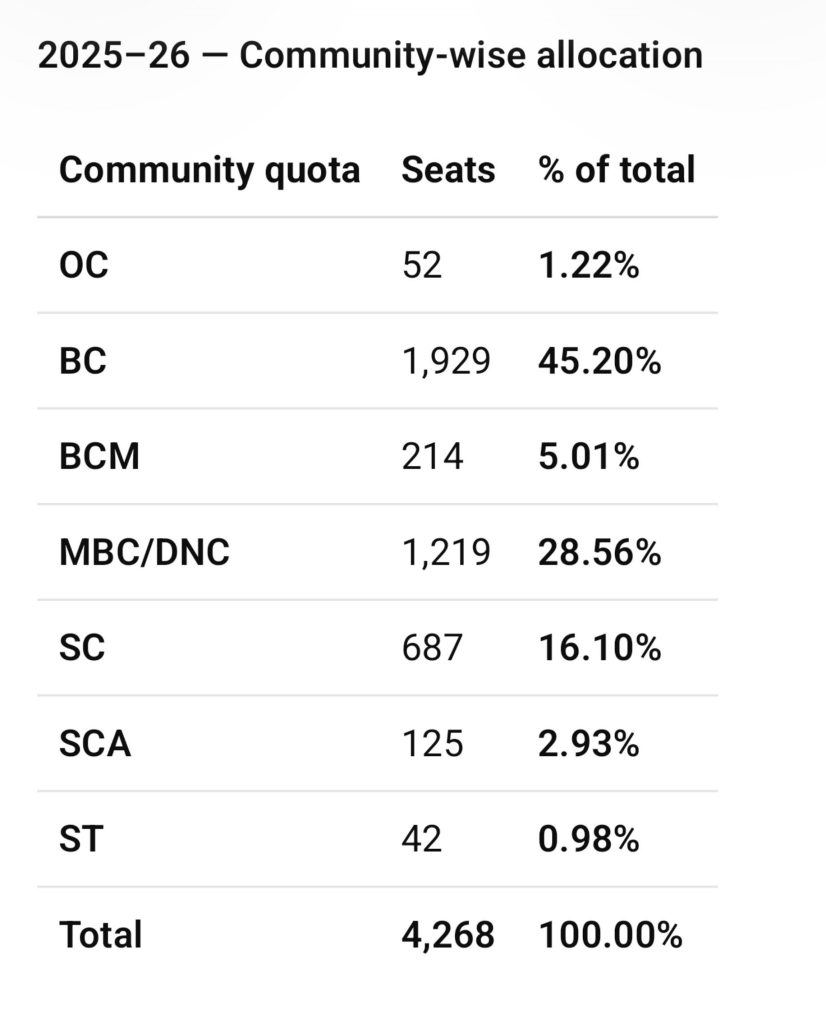
In 2024-25, the corresponding number of OC candidates was 89 out of 4,281 allotted seats.
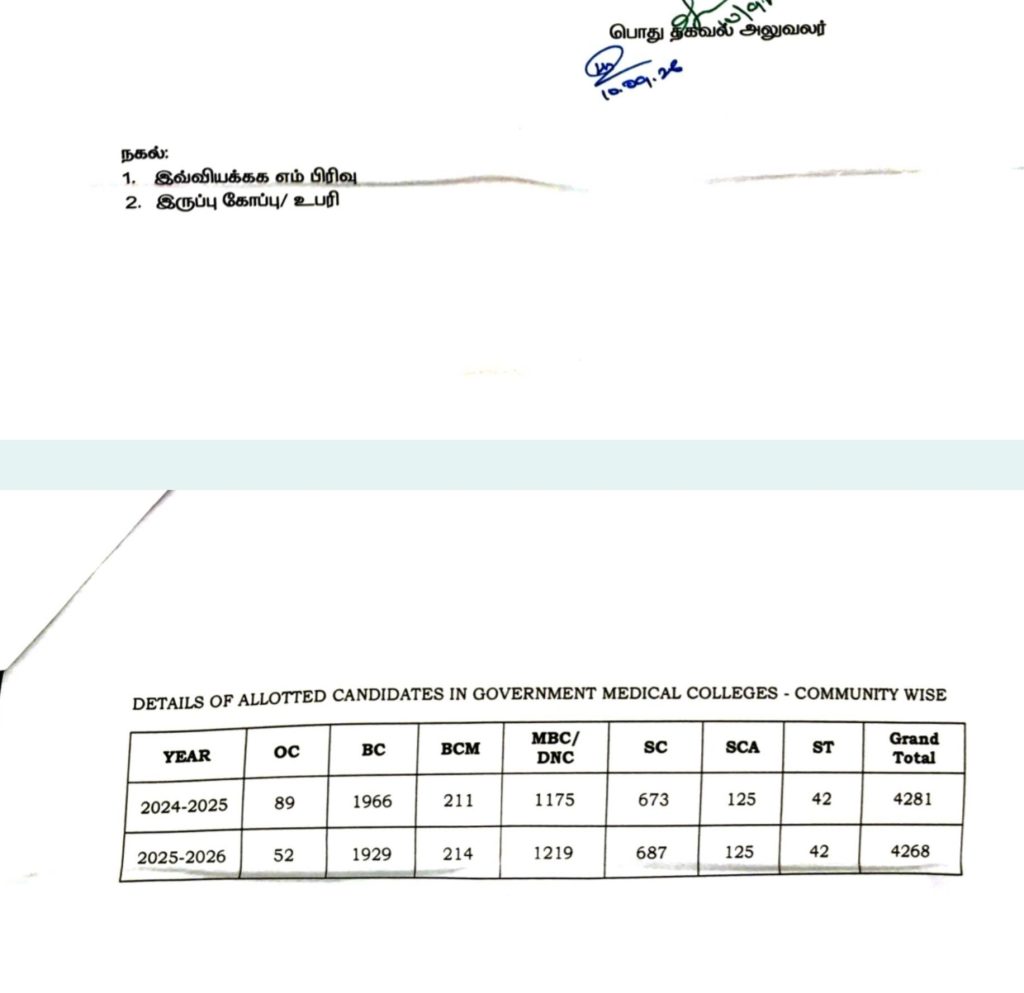
The latest sub-caste-wise data provides a much more granular picture of where the seats went.
Vanniyar, Kongu Vellalar Groups Feature Prominently
The 2025-26 sub-caste-wise document records a total of 7,073 MBBS allotments in the 92.5% admission pool.
The list contains hundreds of individual community and sub-community entries. Among the larger numbers listed are Arunthathiyar, Adi-Dravida, Devendrakulavelalar, Nadar, Yadhava, Kongu Vellalar and various Vanniyar-associated communities.
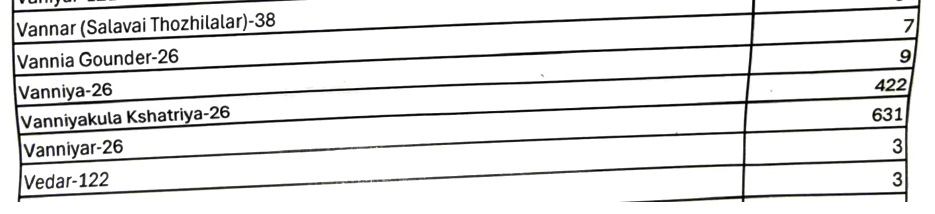
The Vanniyar grouping appears under multiple entries, including Vanniya, Vannia Gounder, Vanniyakula Kshatriya and Vanniyar. The document also separately lists communities such as Padayachi and Agnikula Kshatriya.
This is significant because the Ambashankar Commission grouped Vanniyar, Vanniya, Vannia Gounder, Gounder or Kander, Padayachi, Palli and Agnikula Kshatriya under the Vanniakula Kshatriya classification.
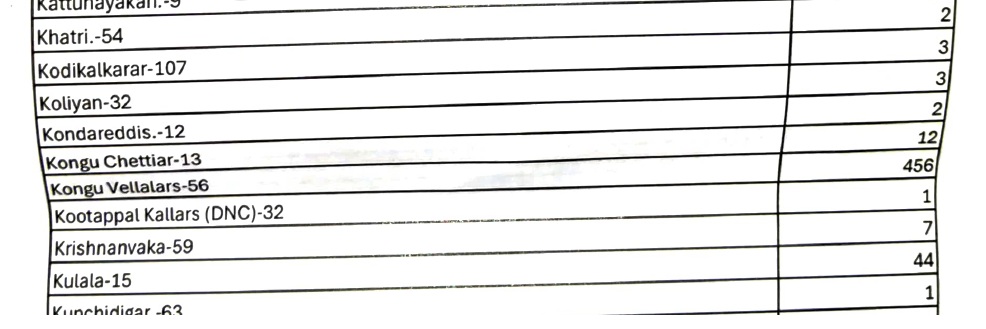
The same official classification framework also groups several sub-communities under Kongu Vellalars, including Vellala Gounder, Nattu Gounder, Narambukkatti Gounder, Tirumudi Vellalar, Thondu Vellalar, Pala Gounder, Gounder, Anuppa Vellala Gounder, Kurumba Gounder, Padaithalai Gounder, Chendalai Gounder, Pavalankatti Vellala Gounder and others.
Based on these groupings, an analysis of the RTI figures has stated that Vanniyar-associated communities account for around 16% of the 2025-26 MBBS allotments, while Kongu Vellalar-associated communities account for around 7%.
2024-25 Data Shows Similar Pattern
The 2024-25 sub-caste-wise data also contains 6,693 MBBS allotments in the 92.5% pool and shows substantial numbers across a wide range of communities.
Among the entries are 567 Vanniyar, 401 Vanniyakula Kshatriya as listed in the supplied data. Kongu Vellalars are listed separately, along with several associated communities.
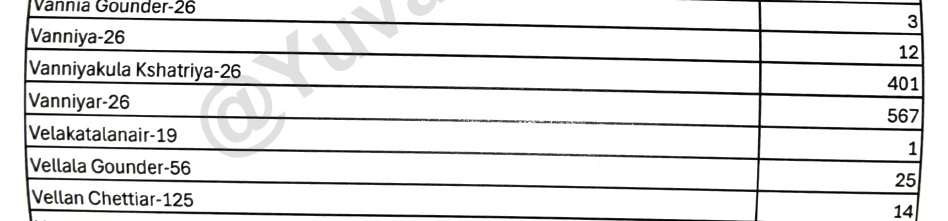
Other notable entries include 300 Nadar candidates, 179 Yadhava candidates.



The data also illustrates the sheer fragmentation of Tamil Nadu’s community classification system.
What Does Open Competition Actually Mean?
The figures have renewed a key question surrounding Tamil Nadu’s reservation model: what does the 31% Open Competition category represent in practice?
The state’s medical admission prospectus makes clear that Open Competition is not a category reserved exclusively for candidates outside the BC, MBC, SC or ST classifications. Candidates from reserved communities can also secure Open Competition seats if they qualify on merit.
Therefore, a candidate belonging to a reserved community securing an Open Competition seat does not mean that the candidate has taken away a reserved-category seat. The distinction is important when interpreting the RTI data.
At the same time, the very low number of candidates recorded as OC in the earlier government-medical-college dataset has raised questions about how many seats are ultimately being accessed by candidates who do not belong to any of the reserved communities.
Adding to this!
Lemme present the other shocking facts! With RTI data on caste wise splitup of medical seat admission
Refer the link for the data:https://t.co/NonQGJ9utU
Based on last available backward commission (Ambhashankar) data
Vanniyar(all sub castes aaded up)… https://t.co/eg4W1QJKzr
— Yuvaraj Ramalingam (@YuvarajPollachi) September 25, 2026
Creamy Layer and Economic Criteria
The latest data has also raised questions over whether economic criteria should play a larger role within Tamil Nadu’s reservation framework.
Say for example, there is a student from an economically disadvantaged household within a relatively larger BC community. He would still be competing against a student from the same community who comes from a considerably more affluent family.
This is particularly relevant to communities such as Kongu Vellalars and Vanniyars, where a community-wide reservation system may not distinguish between economically weaker families and relatively affluent families within the same community.
The issue is not necessarily a straightforward argument for removing these communities from the reservation framework. Rather, it raises the question of whether the benefits should be more tightly targeted towards economically and socially disadvantaged members within communities that have achieved greater representation in higher education.
Smaller Communities Raise Another Question
The sub-caste-wise data also highlights another issue: representation is far from uniform even within the broad BC, MBC and SC categories.
While some communities account for hundreds of admissions, several others appear only in single digits or low double digits.
That has prompted questions over whether a broad reservation structure based primarily on large community categories adequately reaches smaller communities that may remain educationally disadvantaged despite being included within the same larger reservation group.
The Ambashankar Commission remains an important historical reference point in this debate. Its classification grouped numerous communities under the BC and MBC categories, including the broader Vanniakula Kshatriya grouping and Kongu Vellalar grouping.
Subscribe to our channels on WhatsApp, Telegram, Instagram and YouTube to get the best stories of the day delivered to you personally.