Congress leader Sonia Gandhi’s memoir Belonging: A Journey of Love has recently hit the stands. With it, the memoir brings plenty of controversy and a look into how Sonia Gandhi thinks-about Hindus, about India among other political things.
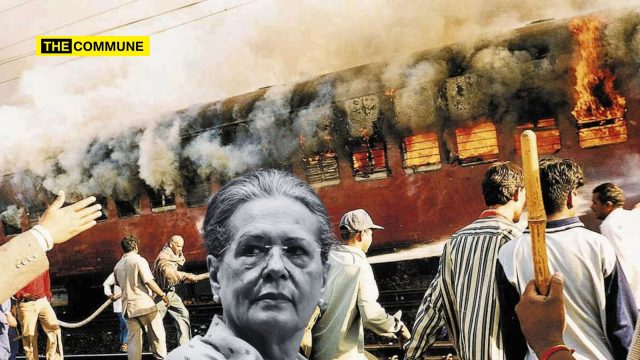
In her account of the 2002 Godhra train burning, Sonia Gandhi’s description of the incident whitewashes and contradicts the findings of the official Commission of Inquiry and subsequent criminal proceedings.
In the book, recalling the 2002 Gujarat riots, she writes that the violence was triggered when “four coaches of the Sabarmati Express were set on fire and fifty-nine pilgrims died”. She further states that “the cause of the fire remains disputed”, before describing the subsequent violence across Gujarat and noting that its victims were overwhelmingly Muslims.
Sonia Gandhi on the Hindu massacre at Godhra:
Sonia Gandhi claims that four coaches were set on fire.
• In reality, only one coach, S-6, carrying Hindu kar sevaks, was set on fire.
Sonia Gandhi claims that the cause of the fire remains disputed.
• The Nanavati Commission concluded that it was a pre-planned attack.
UP elections are just four months away, and Gujarat goes to polls next year.
Sonia Gandhi has given enough ammunition to PM Modi.
— Facts (@BefittingFacts) November 10, 2026
However, the official record identifies a specific coach — S-6 — as the site of the Godhra train burning. On 27 February 2002, 59 Hindu kar sevaks returning from Ayodhya were killed after the coach was set on fire by a mob at Godhra railway station.
The Nanavati-Mehta Commission, which investigated the incident, concluded that the burning of coach S-6 was a pre-planned conspiracy and not an accidental fire. It found that a mob attacked the train and deliberately set the coach on fire, resulting in the deaths of the passengers.
Gandhi’s description of four coaches being set on fire, rather than the specific S-6 coach, is therefore inconsistent with the findings of the Commission, thereby allowing us to draw the conclusion that she was whitewashing the crimes of the Islamists.
The findings were not merely confined to the Commission’s report. In its June 2022 judgment in the Zakia Jafri case, the Supreme Court referred to the Godhra train burning as an act committed by a group of persons who were subsequently identified, tried and convicted for setting coach S-6 on fire. The Court noted that the trial had resulted in the conviction of 32 persons, with the Gujarat High Court having dealt with the confirmation appeals.
Gandhi’s assertion that the cause of the fire remains disputed overlooks the findings of the criminal investigation and judicial proceedings.
The Nanavati-Mehta Commission’s 2008 report concluded that the fire was deliberately started by throwing petrol into coach S-6. It described the attack as a pre-planned conspiracy involving a mob that had gathered near the railway tracks.
There had been a contrary finding by the U.C. Banerjee Committee, constituted by the Railway Ministry, which described the fire as accidental. However, the Gujarat High Court ruled that the committee’s constitution was illegal and quashed its proceedings in October 2006. Its findings therefore could not be treated as an equally valid judicial determination of the incident.
The Supreme Court’s subsequent reference to the convictions and the identification of S-6 as the coach set on fire further establishes the distinction between a historical controversy and the outcome of criminal proceedings.
In her memoir, Gandhi devotes considerable attention to the suffering of Muslims during the violence that followed the Godhra incident. She recalls visiting relief camps in Ahmedabad as part of an all-party parliamentary delegation and describes the trauma of survivors.
She also accuses sections of the BJP, RSS and Bajrang Dal of fuelling the violence and criticises the administration under then Chief Minister Narendra Modi for failing to respond adequately.
However, her account gives comparatively little attention to the 59 Hindu pilgrims who were burnt alive in the train attack that preceded the riots.
The distinction between the Godhra train burning and the subsequent anti-Muslim violence is essential to understanding the events of 2002. The victims of the train attack and the victims of the subsequent communal violence must both be acknowledged without conflating the two incidents or minimising either.
Subscribe to our channels on WhatsApp, Telegram, Instagram and YouTube to get the best stories of the day delivered to you personally.