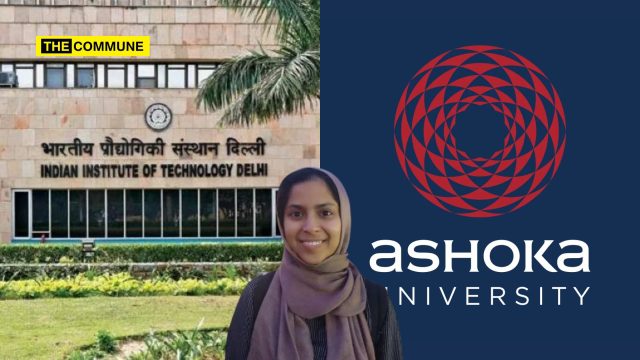
A lecture challenging the judicial Essential Religious Practices (ERP) test in India’s hijab controversy, scheduled at Ashoka University on November 11, has brought the academic work of Sania Ismailee, an Assistant Professor at BML Munjal University’s School of Law, into focus.
Her PhD was funded by IIT Delhi. Basically tax payers funded her stipend to defend Hijab for women. Defund humanities immediately in IITs. https://t.co/zqzWOKwS7p
— Gems of Indian Academia (@GemsofAcademia) November 10, 2026
Ismailee is scheduled to deliver a talk titled ‘Why the Essential Religious Practices (ERP) Test Is the Wrong Answer to the Indian Headscarf Case’ at Ashoka University’s Philosophy Department colloquium, organised under its Harish and Bina Shah School of Humanities.
The event examines the Karnataka hijab controversy, in which the Karnataka High Court declined to recognise the wearing of the hijab as an Essential Religious Practice warranting constitutional protection. Ismailee’s proposed alternative, described as the Sincerity and Disproportionate Burden (SDB) test, argues that religious symbols should be accommodated when they represent sincerely held beliefs and restrictions disproportionately burden those beliefs.
The talk has drawn attention to her doctoral research at the publicly funded Indian Institute of Technology Delhi (IIT Delhi), where she received an Institute Fellowship between 2017 and 2021.
What Did Taxpayers Fund?
According to IIT Delhi’s Institutional Repository, Ismailee’s doctoral dissertation was titled Secularism and Gender Justice: Philosophical Perspectives on the Uniform Civil Code.
The research examined academic arguments surrounding the Uniform Civil Code (UCC), secularism, gender justice and family laws in India. It was not a doctoral thesis dedicated to defending the hijab or opposing restrictions on religious headwear.
Her profile at BML Munjal University confirms that she was an Institute Fellow and Teaching Assistant at IIT Delhi between 2017 and 2021. She also received a Fulbright-Nehru Doctoral Research Fellowship at Columbia University and a Commonwealth Split-Site Fellowship at the University of Oxford.
IIT Delhi’s fellowship system provides monthly financial support to full-time doctoral researchers across disciplines, including Humanities and Social Sciences. The institute’s published financial assistance framework describes these fellowships as being linked to research progress and performance.
Her subsequent academic work has included writing on the Karnataka hijab controversy, including an examination of Muslim women’s religious practices and gender justice.
Do IITs Need Humanities?
The controversy raises a larger question about the role of humanities departments within India’s premier technical institutions. Why should taxpayer-funded IITs, established primarily to advance science, engineering and technological innovation, divert institutional resources to departments that increasingly become centres of ideological activism and political contestation?
Several such departments have strayed from their academic mandate, with faculty activities, research themes and campus events frequently reflecting ideological preoccupations rather than contributing to India’s technological priorities. With dedicated universities and institutions already catering to humanities and social sciences, there is a case for reviewing whether these departments need to exist within the IIT system at all. Public money allocated to IITs should primarily serve the purpose for which these institutions were established: building technological capabilities, advancing scientific research and producing innovations that strengthen the country.
Subscribe to our channels on WhatsApp, Telegram, Instagram and YouTube to get the best stories of the day delivered to you personally.