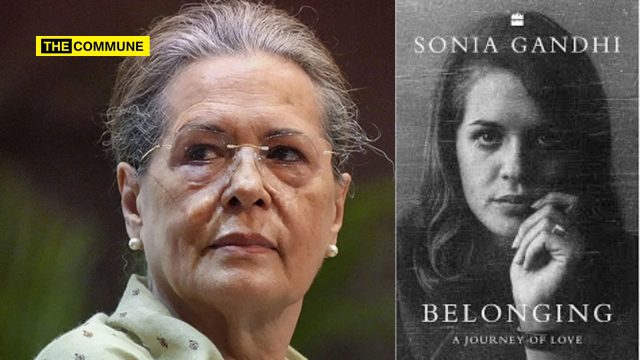
Sonia Gandhi’s memoir, Belonging: A Journey of Love, has come under fire over a string of factual errors, including getting the RSS’s founding year, Ahmed Patel’s death, Gujarat’s capital and the 1984 Commonwealth summit wrong. The book has also whitewashed the role of Islamists in the Godhra train burning, the 1984 anti-Sikh massacre and the abrogation of Article 370 in Kashmir. Several readers have flagged these discrepancies since its release, raising questions about the accuracy of the historical and political claims made in the memoir.
The controversy has also raised questions about the book’s editorial and fact-checking process, particularly given that it is being presented as a first-hand account of Sonia Gandhi’s personal and political journey.
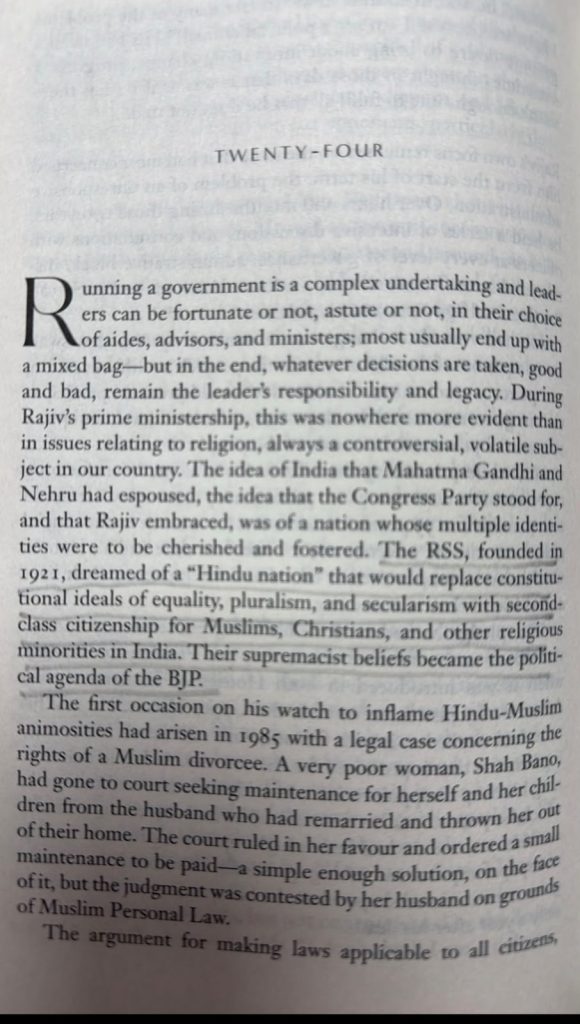
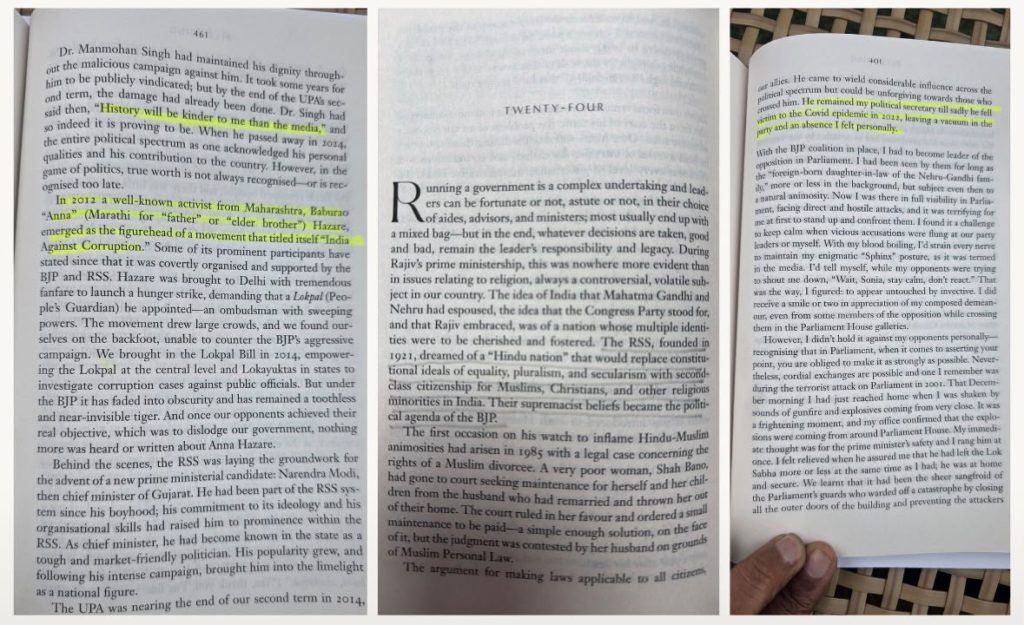
Among the errors identified is the memoir’s claim that the Rashtriya Swayamsevak Sangh (RSS) was founded in 1921. The organisation was actually founded on 27 September 1925, in Nagpur by Dr Keshav Baliram Hedgewar.
The book also places the emergence of Anna Hazare as the face of the India Against Corruption movement in 2012. The movement had gained national prominence in 2011, when Hazare began his indefinite hunger strike at Delhi’s Jantar Mantar on April 5 that year.
Another glaring error concerns veteran Congress leader Ahmed Patel, Sonia Gandhi’s long-time political secretary. The memoir states that Patel died in 2022 after contracting COVID-19. He actually died on 25 November 2020.
The geographical errors are equally striking. While recounting her visit to Gujarat during the 2002 riots, Sonia Gandhi refers to Ahmedabad as the state capital. Gujarat’s capital is Gandhinagar, not Ahmedabad.
Gujarat’s capital is Ahmedabad~ Sonia Gandhi
No wonder Congress didn’t win Gujarat since Sonia Gandhi took over. https://t.co/zbcdw5BbZn
— Ankur Singh (@AnkurSingh) November 10, 2026
Another error concerns Rahul Gandhi’s parliamentary record. The memoir describes him as a four-time MP, whereas he has been elected to the Lok Sabha five times—in 2004, 2009, 2014, 2019 and 2024.
Rahul Gandhi was elected in 2004, 2009, 2014, 2019, 2014 he is 5 time member. @SoniaGandhi please fire the person who wrote this for you https://t.co/18DVHjpyH9
— Shiva Mudgil (@shivamudgil) November 10, 2026
What is perplexing is the use of the word ‘Islamist terrorists’ when she explains the 26/11 terror attack. It is highly likely that this was done ‘inadvertently’ by the ghost writer as it was Congress which was ready to peddle the Hindu terror narrative after the terror attack.
“Islamist Terrorist”
Sonia Gandhi is the first Indian political leader to use the term “Islamist terrorist” (p. 435).
Correct me if I am wrong.
West has long been comfortable using this term and associating Islam with terrorism. In India, politicians avoid it. https://t.co/tRXogmKFqU
— Dilip Mandal (@Profdilipmandal) November 11, 2026
Godhra And The 1984 Anti-Sikh Massacre
The memoir’s account of the Godhra train burning has also attracted criticism. Sonia Gandhi writes that four coaches of the Sabarmati Express were set on fire, killing 59 Hindu kar sevaks returning from Ayodhya. However, judicial records identify coach S-6 as the coach that was set ablaze, killing 59 passengers. The Supreme Court, in its 2022 judgment, also referred specifically to the burning of coach S-6.
Gandhi further writes that the cause of the fire remains disputed. The Godhra case, however, underwent a criminal investigation and trial, with convictions upheld by the Gujarat High Court. The Supreme Court has also referred to those convictions in its judgment.
Her account of the 1984 anti-Sikh massacre has triggered another major controversy. Sonia writes that Army Chief General A S Vaidya received orders on the night of Indira Gandhi’s assassination on 31 October 1984 but allegedly chose not to deploy nearby Army units because they included Sikh soldiers. Instead, troops were reportedly ordered from Dehradun, delaying their arrival in affected areas until November 2.
Sonia Gandhi’s book gets the 1984 timeline wrong too.
In her book she claims Gen. Vaidya got orders on the night of 31 October but chose not to use nearby units because they had Sikh soldiers, delaying deployment till 2 November.
Misra Commission recorded that ~6,000 troops were already in Delhi by the morning of 1 November. The delay was the civil administration’s. Had they been deployed, the Commission said, at least 2,000 Sikh lives could have been saved.
Rajiv’s own “when a big tree falls, the earth shakes” remark is still on record. The book tries to give the family a clean chit. The official record does not.
— Sandiip Gandotra (@sandiipgandotra) November 10, 2026
Senior advocate and BJP leader H S Phoolka has challenged this version, citing the Justice Ranganath Misra Commission’s findings. He pointed out that around 6,000 Army personnel were already available in Delhi by October 31 and the morning of November 1. The Commission had observed that deploying 5,000 soldiers on the streets on the morning of November 1 could have prevented the deaths of at least 2,000 people.
The Commission had also attributed the delay in requisitioning the Army to the Delhi administration, specifically the Lieutenant Governor and Police Commissioner. Phoolka has accused Sonia Gandhi of shifting responsibility away from the administration and attempting to give Rajiv Gandhi and the Gandhi family a clean chit.
The controversy is particularly significant given Rajiv Gandhi’s infamous remark following the massacre: “When a big tree falls, the earth shakes.” The memoir recounts his appeals for peace and efforts to help Sikh colleagues, but its account of the Army’s deployment has now been questioned against the findings of official inquiries.
Political Judgements And A One-Sided Reading Of Events
Beyond the factual discrepancies, the memoir offers a revealing account of Sonia Gandhi’s political outlook.
Describing the Balakot air strikes, she writes that the government’s retaliatory action against a terrorist camp in Pakistan caused the election campaign to be overwhelmed by patriotic fervour. The passage frames the national response to the air strikes primarily through its electoral consequences.
Sonia Gandhi describing the Balakot Air strikes.
“When the government launched a retaliatory air strike on a terrorist camp in Pakistan, the mood of the election came to be overwhelmed by patriotic fervour.”
She doesn’t understand India. Not one bit.
— Tushar Gupta (@Tushar15) November 10, 2026
She also describes the abrogation of Article 370 on August 5, 2019, as the worst thing to have happened to Kashmir, despite acknowledging the violence and killings that had preceded it, including the persecution of Kashmiri Pandits.
To Sonia Gandhi, the worst thing ever to happen to Kashmir was the revocation of Article 370. She mentions the violence against Kashmiri Pandits and the killings that happened over the years, but somehow, to her, the worst date for Kashmir is August 5, 2019. Makes no sense.
— Tushar Gupta (@Tushar15) November 11, 2026
On the BJP, Gandhi claims that the Congress and its allies had pushed their opponents back sufficiently to weaken them considerably. The BJP won 240 seats in the 2024 Lok Sabha elections. However, the Congress itself has not crossed the 240-seat mark since its 1984 Lok Sabha landslide, when it won 404 seats.
Sonia Gandhi claims that they had ‘pushed back our opponents (BJP) enough to weaken them considerably’.
Yes, the BJP was reduced to 240, but why does the Congress forget they last crossed 240 in 1984?
— Tushar Gupta (@Tushar15) November 10, 2026
Gandhi also writes that Prime Minister Narendra Modi’s idea of India is vastly different from hers. The statement offers an insight into the ideological divide she sees between herself and the Prime Minister.
Sonia Gandhi makes one honest remark in her book about Prime Minister Narendra Modi. She says his idea of this country is vastly different from mine. Honest. Which explains why Modi launched welfare programmes, starting with toilets and tap water. She never saw the need, perhaps?
— Tushar Gupta (@Tushar15) November 10, 2026
A 35% Discount On Blinkit
Adding another talking point, the 544-page memoir, carrying a printed price of Rs 1,299, was listed on Blinkit for Rs 849 — a discount of approximately 35%. The listing also offered delivery in as little as eight minutes in parts of Delhi.
Sonia Gandhi’s book being sold at a massive 35% discount on Blinkit. I don’t think it’s a lack of sales, more like a deliberate attempt at making it a bestseller. All the signs of a highly coordinated PR campaign. https://t.co/9CjYQYHfLO
— Abhijit Iyer-Mitra (@Iyervval) November 10, 2026
For a memoir that revisits the political history of modern India and offers the author’s version of events involving the Congress and the Gandhi family, the errors already identified raise questions about the rigour with which its historical details were checked. The debate is no longer confined to Sonia Gandhi’s recollections; it has extended to whether the book’s account of the past stands up to the public and official record.
Subscribe to our channels on WhatsApp, Telegram, Instagram and YouTube to get the best stories of the day delivered to you personally.