Leftist propaganda outlet The News Minute’s Editor-in-Chief Dhanya Rajendran has been trying very hard; she has been trying very hard to appear as the champion of journalism and accountability.
On 23 September 2026, reacting to a post by Times of India journalist Bharti Jain about reports of alleged differences within the Election Commission of India, Rajendran wrote: “It is time to ask for accountability. And we must refrain from accepting vague source based information as real news. Ask the govt to come and explain ON RECORD.”
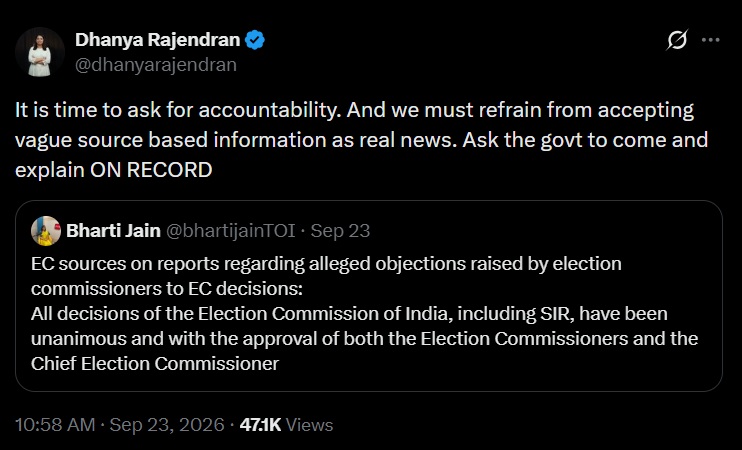
The statement came shortly after Rajendran had also attacked journalists who reported the Election Commission’s response to an Indian Express investigation by Ritika Chopra. Defending Chopra, Rajendran wrote: “Shame on all those journalists, especially the senior ones who will put out stories today on how the ECI has denied the story by @RitikaChopra__. You could not do the work she did, at least stop being govt’s puppet for a day. Instead ask for accountability. Millions suffering.”
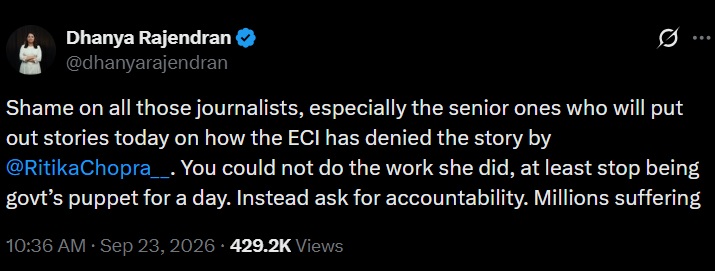
But Rajendran’s own demand raises a simple question: Did The News Minute follow the same standard while reporting on the Dharmasthala controversy?
When TNM Ran With The ‘Masked Man’
The Dharmasthala mass-burial allegations began after CN Chinnayya, a former sanitation worker, appeared before the authorities and claimed that he had buried bodies of rape and murder victims at multiple locations around Dharmasthala.
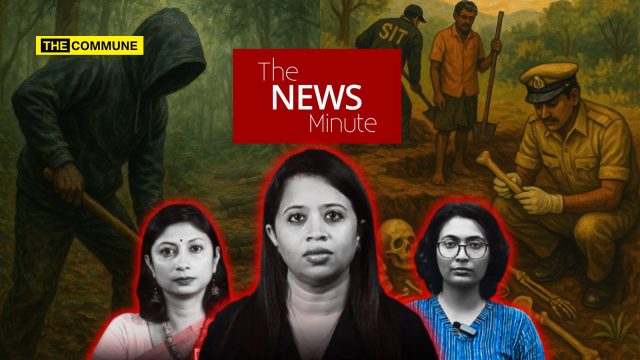
The News Minute extensively covered the allegations, beginning in July 2025. Its coverage included ground reports, interviews, videos, explainers and podcast discussions, with Dhanya Rajendran herself participating in South Central podcast episodes.
We had previously documented how TNM repeatedly amplified the masked man’s allegations while linking them to older cases and presenting the alleged mass-burial narrative as a major mystery before the claims had been established. Its coverage questioned the conduct of local authorities and repeatedly connected the new allegations with older unsolved cases.
The fundamental problem was straightforward: a sensational allegation was being made by one man, yet the allegation was treated as the starting point for an enormous narrative about a Hindu pilgrimage centre.
The questions that should have been asked at the outset were obvious: where were the missing-person complaints corresponding to hundreds of alleged victims, how could such large-scale burials have gone unnoticed, and what evidence independently corroborated the masked man’s claims?
Instead, the allegations alone were extensively covered by media by making it sensational and adding fake news.
The Skull That Changed The Case
One of the most dramatic pieces of alleged evidence was a skull that Chinnayya produced.
He had claimed that the skull was connected to the alleged mass-burial story. The SIT subsequently investigated the circumstances surrounding its production and Chinnayya’s claims.
The investigation took a very different turn.
The SIT’s preliminary report submitted to the Belthangady court in December 2025 described the mass-burial allegations as a fabricated conspiracy and named six accused in connection with alleged fabrication and perjury. The report said Chinnayya had been pressured and coached and that investigators had recovered evidence including electronic data, bank transaction trails and video material.
The subsequent investigation also found that the skull Chinnayya had presented was not that of a woman, as had been alleged. Forensic examination identified it as belonging to a 32-year-old man.
In July 2026, the SIT submitted its 7,005-page final report to the court. The report followed an earlier preliminary report that had alleged perjury and criminal offences against six people, including Chinnayya and others associated with the allegations.
DNA testing also subsequently identified three skeletal remains recovered during the SIT investigation as belonging to three men: U.B. Aiyappa, Adishesha Narayana and Krishnappa.
Chinnayya’s Later Confession
The controversy did not end there.
In a later petition before the Karnataka High Court, Chinnayya alleged that he had been pressured and threatened into making statements against the Dharmasthala administration. He alleged that money was offered to him, that threats were made against his family, and that he was coached on what to say.
He further alleged that a skull was placed in his hands and that he was instructed on how to present his claims. These are allegations made by Chinnayya in his petition and are separate from the SIT’s findings.
The SIT’s investigation, meanwhile, has already resulted in a court-facing record alleging fabrication, perjury and a conspiracy surrounding the original claims.
So Where Is The Accountability Now?
Rajendran is now demanding accountability from the government and insisting that journalists must not treat vague, source-based claims as established fact.
But where was that standard when The News Minute extensively amplified the Dharmasthala allegations?
A masked former sanitation worker made extraordinary claims about mass burials at a major Hindu pilgrimage centre. Instead of limiting its coverage to reporting what the man had alleged and waiting for independent verification, TNM built an extensive narrative around those claims.
The subsequent SIT investigation dramatically altered the picture. Its preliminary findings described the alleged mass-burial case as a fabricated conspiracy, while later investigation and forensic findings further undermined key claims surrounding the case.
Yet Rajendran is now lecturing other journalists about demanding evidence and insisting that the government explain itself “ON RECORD.”
So where is that accountability now?
Has Rajendran acknowledged TNM’s coverage? Has she explained why such extraordinary allegations were repeatedly amplified before they were independently established? Has she apologised to the people and institution whose reputation was dragged into the controversy?
If journalists must demand accountability from governments, they must also be prepared to answer for their own reporting when the facts change.
The question is simple: Rajendran wants accountability from everyone else. Where is the accountability for her own outlet?
Subscribe to our channels on WhatsApp, Telegram, Instagram and YouTube to get the best stories of the day delivered to you personally.