Home Blog Page 285

Dravidianist Feminist V Geetha’s Selective Outrage And Circular Banality In The News Minute’s Echo Chamber Where Anti-Hindutva Becomes Anti-Logic
A recent episode of The News Minute’s “South Central” podcast, which positioned itself as a nuanced discussion on Hindutva, instead revealed a deep-seated bias and a troubling reliance on stereotypes from its panelists. The conversation, featuring academic V Geeta and ‘journalists’ Dhanya Rajendran, Anisha Sheth, and Sudipto Mondal, was less an analysis and more an exhibition of the very intellectual laziness and prejudice they claim to oppose.

For the section on RSS marches in Karnataka, the main guest Geeta was invited to spew her form of venom at Hindus and the RSS.

Selective Outrage: The Authoritarian Blind Spot

Geeta correctly identifies that fascism has two aspects: an authoritarian state apparatus and an ideology that builds consensus. She brilliantly uses the example of J Jayalalithaa’s rule in Tamil Nadu to illustrate an authoritarian state without the Hindutva ideology, citing the muzzling of the media and the crippling of democratic institutions. She says, “But Tamil Nadu has seen the reign of J Jayalalithaa. And we must not forget those years. Those years were the most authoritarian years in the history of Tamil Nadu. The different segments of time that she served as Chief Minister of the state. You’ll see how she systematically crippled all democratic institutions, including the media. I still remember the time KP Sunil of The Week was in the eye of a storm for having written something very critical about her. Then the government hit back, and over a period of time, Sunil found himself landing a job in Jaya TV. So, I mean, it’s a very interesting sort of approach that she had, not very dissimilar to what we see happening around us today.”

She further adds, “And I mean, I can quote so many things at point: every feature that you see that is part of the way the government at the centre functions today in muzzling speeches, cracking down on dissent, in defining what is legitimate and what is not. All of this has been precedence in Jayalalithaa-ruled Tamil Nadu, in NTR-ruled Andhra Pradesh, and Telangana in the past. Why I’m saying this is, fascism need not always be aligned with an ideology; it has two aspects, right? Hindutva has two aspects: one is an authoritarian state apparatus which goes all the way down and is seen as a good thing by sections of the population. And then an ideology which wants to draw more and more people into this consensus.”

This critical lens mysteriously vanishes when discussing the current DMK government under M.K. Stalin. She says, “Now in Tamil Nadu, you may not have the ideology, but you have the constituents of an authoritarian state, which has been put in place by Jayalalithaa during her several years in power in the state. And I don’t think that the DMK has rolled back those measures fully. And in some ways, they’ve layered them with a veneer of democratic practice, in some instances, they’ve sort of not worked with those constituents. I mean, their attitude toward the media is still relatively more open than in most parts of the country, but the fact is that you have these authoritarian resources at hand.” 

She finds Stalin’s government “more open to the media” but her mouth is glued shut when people are arrested in Tamil Nadu for exercising freedom of speech! Where is her critique of the Stalin government’s treatment of netizens who get arrested for speaking against DMK? There have been multiple instances of police complaints and arrests of journalists and social media users for posts critical of the government. The recent example being the arrest of a septuagenarian YouTuber for a critical video regarding the recent Karur stampede or the filing of cases against journalists for their reporting.

Where is her condemnation of the state’s overreach in silencing dissent? By her own definition, the “authoritarian state apparatus” is alive and well in Tamil Nadu. Yet, she offers the DMK a free pass, merely saying they have layered Jayalalithaa’s measures with “a veneer of democratic practice.” This is a staggering failure to apply her own analytical framework consistently. If she condemns authoritarianism under the BJP and JJ, her silence on the DMK is a politically motivated omission.

The “Saffronization” Bogeyman Vs. The “Dravidian” Sanctity

Geeta expresses shock at the “saffronization” of Pondicherry University and private schools, framing it as an RSS infiltration. She describes the “Brahmanical Hindu ways” of elite Chennai schools as a problem.

Herein we see the Hypocrisy and logical fallacy of this so-called “academic”. What is the fundamental difference between “saffronization” and the long-standing “Dravidianization” of Tamil Nadu’s institutions?

For decades, Tamil Nadu’s government machinery, textbooks, and public discourse have been steeped in Dravidian ideology. If promoting a particular political and social ideology in educational spaces is wrong, then both are culpable. To label one as “infiltration” and the other as a “sense of place” is a classic case of partisan framing.

She claims the RSS’s script is “50 years old” and “banal.” Is the Dravidian movement’s script, which constantly recycles anti-Brahmin, anti-North Indian, and anti-Hindi rhetoric, any fresher or more nuanced? Both movements rely on historical grievances and identity politics. To mock one for its repetitive nature while giving the other a pass is intellectually dishonest.

The False Equivalence And The Lathi Anecdote

The discussion on the RSS’s use of the lathi (staff) is revealing. Geeta dismisses the idea of comparing an RSS march to a religious event but fails to provide a coherent reason why a lathi in a shakha is inherently more threatening than other symbols.

The lathi has been a traditional Indian staff used for centuries as a walking aid, in martial arts like Silambam, and by ascetics. To singularly assign it a malevolent, “weaponized” meaning only in the context of the RSS is a deliberate misrepresentation.
By this logic, should the swords carried in religious processions during festivals like Muharram also be uniformly banned from public spaces? If not, the focus on the RSS’s lathi is not about the object itself, but about the organization wielding it.

The “Circular Banality” Critique That Boomerangs

Geeta’s most potent point is her analysis of Hindutva’s “circular banality” – its reliance on endless repetition of the same themes (Love Jihad, Temple freeing) because it cannot admit historical change.

It is her own hypocrisy that undermines her entire argument. Does the Dravidian political space not suffer from the same ailment? How many elections have been fought and won on the same, tired tropes of “Hindi imposition,” “Brahminical domination,” and “protecting Tamil pride”? The Dravidian model’s political script is just as repetitive and reliant on stoking historical and social divisions.

When Geeta says, “We’re stuck in the circular banality more than them,” she accidentally stumbles upon the truth. The “secular-left” opposition, of which she is a part, has failed to create a new, forward-looking language. It remains trapped in a reactive mode, forever defining itself in opposition to Hindutva and thus, as she correctly fears, “fighting the battle on their terms.”

To be a truly critical public intellectual, one must be an equal-opportunity critic. V Geeta’s analysis fails this test. Her scholarship is weaponized against one side of the political spectrum while providing intellectual cover for the other. It was yet another episode of the four people making ‘banal’ comments inside their echo chamber.

Subscribe to our channels on WhatsAppTelegram, Instagram and YouTube to get the best stories of the day delivered to you personally. 
Thirumavalavan Car Hitting Motorist Case: CCTV Shows VCK Goons Chasing Lawyer And Attacking Him Inside Bar Council Premises

"They Beat Him Since He Stared Angrily": VCK MP Thirumavalavan Justifies His Goons Thrashing Motorist In Two-Wheeler Dashing Case

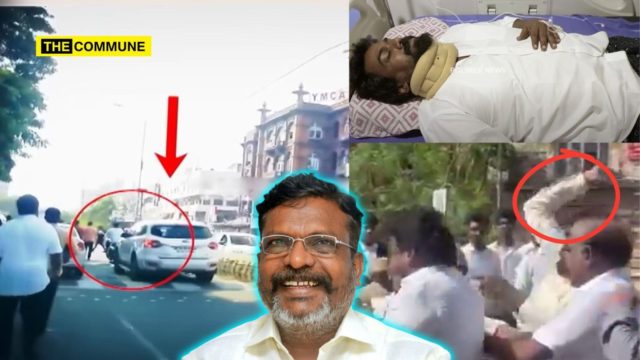
Recently released CCTV footage by Polimer News has thrown light on a dramatic incident that unfolded at the Chennai Bar Council, following a car collision reportedly involving politician Thirumavalavan and members of the VCK (Viduthalai Chiruthaigal Katchi) party.

The video begins outside the Bar Council building, where a group of men, identified as VCK members, are seen in white shirts and traditional attire, chasing lawyer Rajeev Gandhi. They enter the premises in a hurry and pursue him through the corridors, creating an atmosphere of tension and panic. The footage continues inside a room filled with desks and chairs where the confrontation leads to a brief scuffle.

The incident was reportedly sparked by a car crash involving Thirumavalavan and lawyer Rajeev Gandhi. Following the accident, the situation escalated when VCK members, angered by the event, confronted the lawyer at the Bar Council. The released video highlights the moments from the exterior approach to the internal pursuit and ensuing altercation, providing a clear narrative of the sequence of events.

What Happened

The altercation took place when lawyer Rajiv Gandhi, who was riding his scooter near the High Court premises, came into contact with Thirumavalavan’s car. Video footage from the scene shows a group of VCK members surrounding and attacking the lawyer after the collision.

Rajiv Gandhi later filed a complaint alleging that he was assaulted by VCK cadres at the instigation of Thirumavalavan. His scooter was also damaged during the scuffle.

Rajiv Gandhi was admitted to a private hospital for treatment. His family has alleged that since the night of the incident, the lawyer has received over 500 threatening phone calls, and his personal phone number was circulated online by VCK supporters who allegedly encouraged further harassment.

Following public outrage, Thirumavalavan released a video claiming that the incident was an attempt to provoke him. According to his account, the lawyer deliberately tried to block his car and instigate a confrontation.

However, the lawyer’s brother refuted this version, stating that the available footage clearly shows Thirumavalavan’s vehicle hitting Rajiv Gandhi’s scooter. He said Rajiv merely approached the car to question the driver about the collision when he was attacked by VCK men.

Despite video evidence showing the VCK vehicle hitting the scooter, Thirumavalavan maintains that the episode was orchestrated to provoke him. The VCK chief alleged a “planned conspiracy” behind the episode, blaming members of the Rashtriya Swayamsevak Sangh (RSS) and the Bharatiya Janata Party (BJP) for orchestrating it.

He justified his party cadre thrashing the motorist saying “He got beaten up because he stared and not because they knew which caste he belonged to. Are you so arrogant and self-conceited? So they beat him up because he arrogantly stared. They gave him 4 knocks, did not even beat him up well. (crowd cheers). That man pretends to have fainted and has chest pain. What a drama.”

Subscribe to our channels on WhatsAppTelegram, Instagram and YouTube to get the best stories of the day delivered to you personally. 
Drug Case Accused Islamist-Dravidianist Filmmaker Ameer Sultan Mocks Kantara’s Success?

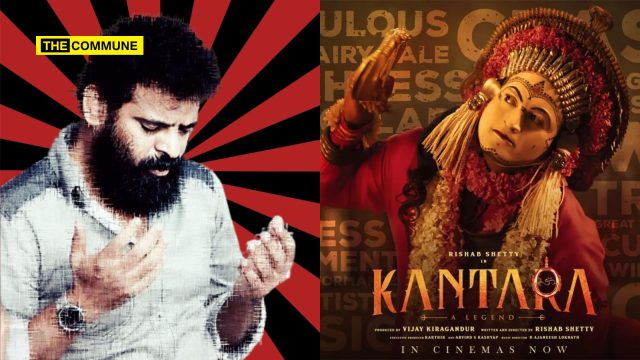
In a provocative speech at the Bison Success Meet, director Ameer Sultan—currently under investigation over drug trafficking allegations linked to the Jaffer Sadiq case—sparked controversy for his pointed remarks on religious and supernatural cinema, seemingly mocking films like Kantara.

During his address, Ameer Sultan challenged journalists who questioned the social impact of director Mari Selvaraj’s hard-hitting films. He scoffed at critics who accused such works of creating divisions in society, calling the notion absurd. Ameer pointed out society’s double standards: while movies about invisible gods and non-existent ghosts (alluding to spiritual blockbusters like Kantara) are celebrated, films about caste—the harsh, visible reality that torments millions—face backlash.

“Nobody has seen god, but if you make a film about it, people celebrate. Ghosts don’t even exist, but humans are worse than ghosts. Ghosts flee in daylight, afraid of humans,” he quipped. Ameer questioned why movies confronting real-life pain and caste injustice should be suppressed, while fantastical narratives receive the public’s adulation.

Given how Kantara became a cultural phenomenon for its rooted portrayal of bhakti, Bhoota Kola, and the spiritual connection between man and nature, Ameer’s comment was viewed as a typical Dravidianist swipe — mocking India’s indigenous belief systems while glorifying divisive identity politics.

This is what Ameer Sultan spoke at the Bison Success Meet: “These journalists are asking Mari one question repeated – Why are you making these kind of films? They say that you’re trying to create problems within in society. I saw how ridiculous such questions were. A God who is invisible, and a ghost that never exists – many films are coming about them and is achieving victory. Nobody has seen god. But if you take a film about it, people are celebrating. Ghost, it doesn’t even exist. I think man is worse than a ghost. That’s why you see that these ghosts come at night. Because during the day it is afraid of humans. Films are being made on these. But the caste that we see in front of our eyes, its ill effects, pain and torture, and someone saying that such films should not be taken is what I feel absurd.”

Who Is Ameer?

Ameer Sultan, a Tamil filmmaker known for his Islamist-Dravidianist leanings, has faced growing scrutiny over his close ties with Jaffer Sadiq, a former DMK NRI Wing official accused of running an international drug-trafficking network. Dubbed Sadiq’s “bestie,” Ameer was named in an ED chargesheet alleging money laundering through films and was summoned by the NCB in April 2024 in connection with the smuggling of pseudoephedrine worth ₹2,000 crore. In October 2024, a special court summoned both Ameer and Sadiq as part of the ongoing money-laundering case. More recently, Ameer was accused of participating in a coordinated smear campaign against Justice G. R. Swaminathan, aligning with the DMK’s broader ideological ecosystem.

At a forum hosted by the Dravidianist YouTube channel “The Debate,” filmmaker Ameer attacked Sanatana Dharma and Brahmins, claiming as a Muslim he stood outside the caste system. He accused “Aryans” of creating caste, linked honor killings to Hindu epics, and praised DMK as Tamil Nadu’s positive force. His comments included sweeping generalizations, targeting practices like Vinayagar Chaturthi as dominated by “intermediate castes” while alleging Brahmins remain aloof. He also quoted EV Ramasamy Naicker (hailed as ‘Periyar’ by his followers) saying “Islam is the best medicine to eliminate racial discrimination.”

Subscribe to our channels on WhatsAppTelegram, Instagram and YouTube to get the best stories of the day delivered to you personally.
What The Washington Post Hit Job Article Against Adani, LIC And Modi Deliberately Hid To Peddle Propaganda

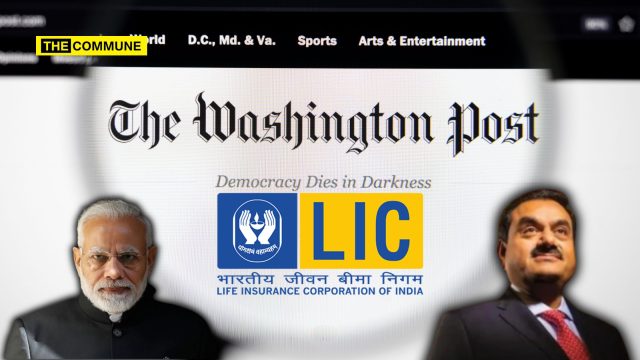
On October 24, 2025, The Washington Post dropped its report, “India’s $3.9 billion plan to help Modi’s mogul ally after U.S. charges,” and what followed was a storm of headlines and political outrage—chiefly a chorus from the Congress party. But look beyond the dramatic prose and you’ll see a narrative fueled more by conjecture and innuendo than fact. The reality: this “exposé” is not the triumph of investigative journalism it claims to be, but a textbook case of selective storytelling and agenda-driven framing.

The Anatomy of a Manufactured Scandal

The Post alleges a secret government push, orchestrating a ₹33,000 crore ($3.9 billion) LIC bailout for the Adani Group—a storyline built on anonymous sources, never-before-seen “internal documents,” and hearsay. But here’s the rub: According to clear, repeated statements from LIC and senior government officials, no such scheme exists. LIC’s investments are guided by merit, rigorous risk assessment, and policyholder safety—not political diktat or backroom dealings. LIC officials and their own corporate governance rules (the LIC Act, SEBI and IRDAI regulations) all enshrine independence—the kind that withstands both market shocks and media trial.

Former LIC Chairman Siddhartha Mohanty wasn’t subtle when he called the Washington Post’s story a “misleading narrative,” grounded in ignorance, not evidence. The Post’s refusal to seek direct comment from LIC or Adani betrays its preference for drama over diligence.

LIC’s Real Story: Scale, Prudence, and Professionalism

Let’s check the numbers. LIC’s equity holdings are India’s backbone, not Adani’s lifeline. From ₹2.55 lakh crore in 2013-14 to ₹13.01 lakh crore in 2024-25, LIC’s portfolio has ballooned in both diversity and dynamism. Its record profit—₹48,151 crore in FY 2024-25, an 18% jump—stands testimony to professional stewardship.

Here’s what the Washington Post won’t tell you:

LIC’s annual investment outlay exceeds ₹5.5 lakh crore, yet its stake in Adani? A mere 4.5% of its total equity, under 2% of Adani’s debt. The supposed “bailout”—a ₹5,000 crore bond subscription in May 2025—was a routine, AAA-rated corporate investment with yields above government securities. By fixating on Adani, The Post hopes you’ll overlook the seventy giants in LIC’s true portfolio.

Adani Group: Global Trust, Not Political Patronage

After the Hindenburg saga, Adani faced a barrage of probes—SEBI cleared the group of any systemic wrongdoing. Since then, global capital has poured in: a $1 billion QIP oversubscribed by titans like Goldman Sachs, Nomura; BlackRock, Apollo and international banks happily taking up Adani debt. That’s hardly the behaviour of a market pariah. LIC has seen profits, not losses, on Adani investments. Claims of a multibillion-dollar hit are pure fiction.

Congress: Dancing To Foreign Agenda

The timing of all this outrage? Impeccable. With Indian markets soaring and Adani surmounting legal battles, Congress seized The Post’s narrative, pushing slogans and panic, painting prudent investing as corruption—from the masters of middlemen and cut-deals. The hypocrisy is staggering: Congress built a legacy of policy-for-payout, yet now pontificates about financial integrity.

Who’s At Risk? Not India’s Savers

Does LIC endanger its 14 crore policyholders? Fact: Its ₹50 lakh crore asset base is fortress-strong, with consistent dividends and record profits. Adani is a fraction of a fraction; the real danger comes from manufactured agitation—spooking investors, risking genuine losses, and eroding trust for political sport.

A Call for Accountability in Journalism

The Washington Post must do better. Verify with LIC and Adani, reveal your sources, retract what cannot be proved. Transparency is the oxygen of credibility; speculation is poison. This “scoop” isn’t reporting—it’s market sabotage disguised as journalism, amplified by Congress’s political ambitions.

Final Verdict: India’s Market is Built on Merit, Not Manufactured Scandal

LIC’s stewardship, Adani’s resilience, and India’s economic boom are real—The Post’s narrative is not. Sensationalism may drive clicks, but the facts drive India’s growth. It’s time global media and partisan politicians learned the difference. The country’s savers deserve no less.

Subscribe to our channels on WhatsAppTelegram, Instagram and YouTube to get the best stories of the day delivered to you personally.

Muslim-Born Atheists Targeted By Islamist Extremists From 2013 To 2025

On 14 October 2025, poet and lyricist Javed Akhtar, who openly identifies as an atheist, condemned the warm reception extended to Taliban Foreign Minister Amir Khan Muttaqi in India. Akhtar expressed that he “hangs his head in shame” over the welcome given by Deoband to “the representative of the world’s worst terrorist group.” His remarks sparked online abuse and protests from Islamist groups.

From 2013 to 2025, Muslim-born individuals who publicly identified as atheists or criticized religious fundamentalism have faced severe persecution, including lethal attacks, torture, and relentless threats from Islamist extremists. This report documents 11 such incidents across Bangladesh, Pakistan, and India, highlighting a dangerous climate for freethinkers and secular activists.

Bangladesh Targets 84 Atheist Bloggers

In 2013, a coalition of Islamist groups in Bangladesh, including Hefazat-e-Islam and Anjuman Al-Bayyinat, compiled a list of 84 “atheist bloggers.” The groups accused those named of “insulting Islam” and “promoting atheism” and formally submitted the list to the Bangladeshi government during that year’s Shahbagh movement. They demanded that the individuals be arrested and prosecuted under existing blasphemy laws, highlighting the threats faced by secular voices in the country.

Countries Punishing Apostasy And Atheism With Death

As of 2025, approximately 13 countries, including Afghanistan, Iran, Saudi Arabia, Pakistan, Qatar, Yemen, Brunei, Maldives, Mauritania, Somalia, Sudan, the United Arab Emirates, and certain regions of Malaysia and Nigeria, retain the death penalty for apostasy. These laws, derived from strict interpretations of Islamic Sharia, criminalize leaving Islam or openly declaring atheism. Individuals accused of apostasy or “insulting Islam” face severe penalties, including capital punishment, underscoring the global risks for those rejecting or criticizing the faith.

#1 Nazimuddin Samad Hacked To Death

On 6 April 2016, 28-year-old law student Nazimuddin Samad was hacked and shot dead by unidentified attackers in Dhaka, Bangladesh. An outspoken atheist, Samad used Facebook to promote secularism and criticize radical Islam. He was also a supporter of the ruling Awami League and had been active in movements seeking justice for war crimes. His murder was part of a series of violent attacks on secular activists and bloggers in the country, highlighting the extreme risks faced by those challenging religious orthodoxy.

#2 Washiqur Rahman Brutally Murdered

On 30 March 2015, atheist blogger Washiqur Rahman, 27, was brutally hacked to death with meat cleavers near his home in Dhaka. Writing under the pseudonym “Ugly Duckling,” Rahman was known for his satirical Facebook posts criticizing religious fundamentalism and irrational beliefs. The attack occurred in broad daylight on a busy street. Two assailants, who were madrasa students, were caught at the scene and subsequently confessed to police that they targeted Rahman specifically because of his writings against Islam.

#3 Ahmed Rajib Haider Killed By Assailants

On 15 February 2013, blogger and architect Ahmed Rajib Haider was attacked and killed by machete-wielding assailants near his home in Dhaka. A prominent activist in the Shahbag movement, Haider wrote critically about Islamist extremism. His murder sparked large-scale protests and was blamed on militant groups like the Ansarullah Bangla Team. In 2016, two students were sentenced to death for his killing, a case that became a stark symbol of the violent backlash against secular voices in Bangladesh.

#4 Asif Mohiuddin Survives Stabbing

On 14 January 2013, atheist blogger Asif Mohiuddin was stabbed multiple times in the neck and back by three unidentified men as he left his office in Dhaka’s Uttara district. Mohiuddin, known for his blog “Almighty only in name, but important in reality,” was an outspoken critic of religion and an advocate for secularism and free speech. He survived after undergoing emergency surgery. Prior to the attack, he had faced police harassment and arrest for his online activism, reflecting the multi-faceted threats faced by dissenting voices.

#5 Mashal Khan Lynched On Campus

On 13 April 2017, 23-year-old journalism student Mashal Khan was lynched by a mob of fellow students and outsiders on his university campus in Mardan, Pakistan. Khan, who described himself as a humanist and atheist, was accused of blasphemy. The attackers beat him severely, shot him, and threw his body from a second-floor balcony while chanting religious slogans. In 2018, an anti-terrorism court convicted 31 people, with one sentenced to death and others receiving life imprisonment for the brutal murder.

#6 Ayaz Nizami Tortured In Confinement

In March 2017, Pakistani atheist blogger Ayaz Nizami (real name Abdul Waheed) was arrested by Pakistan’s Federal Investigation Agency (FIA) in Islamabad for allegedly spreading “blasphemous content” online. A member of the Council of Ex-Muslims of Britain, Nizami was an advocate for secularism and human rights. He was held in solitary confinement and reportedly tortured during interrogation. His case, brought under blasphemy and anti-terror laws, remains unresolved with little transparency regarding his legal status or health, highlighting the use of state apparatus to target critics.

#7 H. Farook Murdered In Coimbatore

On 16 March 2017, 31-year-old computer engineer H. Farook was hacked to death with knives and sickles in Coimbatore, India, by six self-radicalised men. The murder was motivated by his outspoken atheist posts on social media, where he administered a rationalist WhatsApp group and shared material critical of religion, including a viral image of his son holding a “No God” placard. Associated with the Dravidar Viduthalai Kazhagam, Farook’s killing sparked national outrage and highlighted the threats faced by rationalists in India.

#8 Javed Akhtar Faces Ongoing Threats

From 2022 to 2025, renowned Indian lyricist Javed Akhtar, a self-declared atheist, faced repeated online abuse, fatwa-style warnings, and boycott calls from Islamist clerics and groups. The threats escalated on 14 October 2025, after he condemned the warm reception given to a Taliban minister in India. Clerics in Bareilly and Hyderabad labelled him an apostate for equating Islamist and Hindu extremism. Despite the intimidation, Akhtar has continued to be an outspoken secular voice, though he remains a target of sustained trolling and verbal attacks from religious hardliners.

#9 Tarek Fatah Targeted During Lectures

Between 2016 and 2017, Muslim-born Canadian journalist and declared atheist Tarek Fatah faced repeated threats and mob intimidation during his public talks in India. In 2017, his lecture at Lucknow University was disrupted by protesters who called him “anti-Islam.” Fatah, known for his anti-clerical views, frequently received death threats from Indian and Pakistani extremist social media accounts.

#10 Taslima Nasrin Attacked And Exiled

In multiple incidents from 2007 to 2023, Bangladeshi-origin writer Taslima Nasrin faced severe persecution from Islamist extremists in India. This included physical assaults, such as an attack by members of the All India Majlis-e-Ittehadul Muslimeen (AIMIM) during a 2008 book launch in Hyderabad, and large mob protests in Kolkata demanding her deportation. Nasrin, an outspoken critic of religious fundamentalism, has lived in exile under continued threat, her case epitomizing the long-term dangers and pressures faced by atheist writers from Islamist hardliners.

#11 Salman Rushdie Banned and Threatened

From 2012 to 2023, Mumbai-born author Salman Rushdie, who identifies as secular, faced recurring protests and bans in India. In 2012, his participation in the Jaipur Literature Festival was cancelled after threats from Islamist groups over his novel The Satanic Verses. Indian clerics repeatedly led calls to restrict his appearances, citing blasphemy allegations. The global threat was starkly illustrated by the 2022 knife attack on Rushdie in New York for which the assailant was sentenced to 25 years in prison.

Subscribe to our channels on Telegram, Instagram and YouTube to get the best stories of the day delivered to you personally.
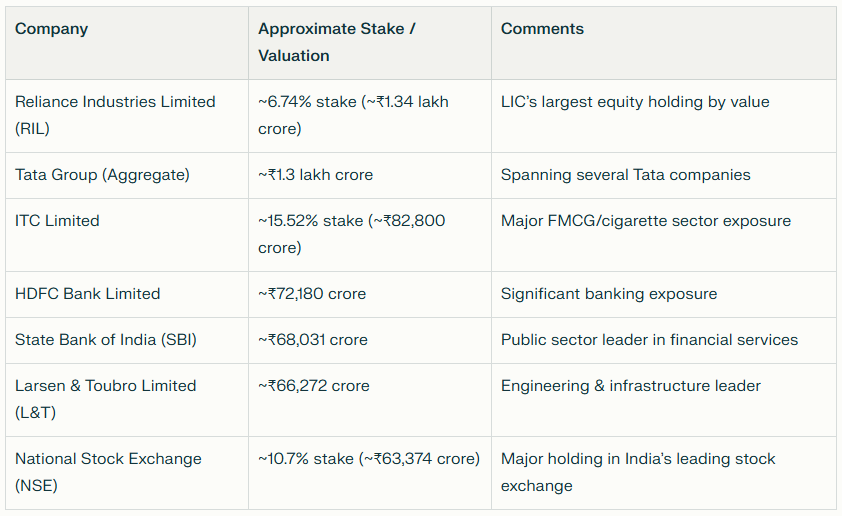
Rahul Gandhi To Meet TVK Chief Vijay Amidst Smoke Emerging IN DMK-Congress Alliance: Reports

congress dmk tvk

Tamil Nadu’s political landscape is entering a volatile and transformative phase as speculations mount over a potential meeting between Rahul Gandhi and Thalapathy Vijay Chandrasekhar, the actor-turned-politician leading the Tamilaga Vettri Kazhagam (TVK). The anticipated interaction comes amid visible strains between the Congress and the Dravida Munnetra Kazhagam (DMK), signaling possible recalibrations ahead of the 2026 Tamil Nadu Assembly elections.​

Rahul Gandhi’s Outreach To Vijay

In late September 2025, Rahul Gandhi’s call to Vijay after the Karur stampede sparked speculation about deeper political intentions. Although Congress leaders publicly described the gesture as humanitarian, the context and timing — following Gandhi’s call to CM M.K. Stalin — raised eyebrows across political circles. Vijay, whose party is widely regarded as a growing political force, remained silent after the exchange, fueling theories of back-channel interest between TVK and Congress.​

Leaders within the state Congress have voiced growing dissatisfaction with their limited influence under the DMK-led alliance, which dominates the ruling Secular Progressive Front. Some have called for more equal power-sharing, with demands reportedly extending up to 50% of assembly seats and a stake in government formation.​

Given Vijay’s considerable fan base in Kerala, Congress insiders believe that bringing him on board could boost the party’s prospects of returning to power in the state.

Cracks In The DMK-Congress Alliance

Recent developments in Tamil Nadu politics have revealed growing friction between the DMK and Congress, two long-standing allies within the Secular Progressive Alliance. Several visible cracks have emerged over the past months, pointing to deeper structural tensions in their partnership ahead of the 2026 Assembly elections.​

Seat-Sharing Demands And Power-Sharing Rift

One major source of strain has been the Congress’s push for a significantly larger seat share in the upcoming election. In the 2021 polls, the party contested 25 seats and won 18, but its leaders argue this underrepresents their strength. AICC in-charge Girish Chodankar announced preparations to contest in 125 constituencies, forming over 21,000 village committees to expand the Congress base. During a Tirunelveli meeting, Chodankar is reported to have floated a “fifty-fifty” power-sharing demand, calling for 117 Assembly seats and a stake in governance if the coalition wins.​

Supporting voices within the party include S. Rajeshkumar, who demanded the formation of a coalition government instead of DMK’s unilateral rule, and former TNCC chief K.S. Alagiri, who echoed the call for “a rightful share in power”. These statements have been publicly leveraged by opposition leaders like Edappadi K. Palaniswami (AIADMK) to portray the alliance as fractured.​

Jothimani And Karur Defection Controversy

Congress MP Jothimani openly clashed with DMK minister V. Senthil Balaji after a Congress district office-bearer in Karur defected to the DMK, calling the move “unethical” and accusing DMK leadership of political poaching. This incident followed a July 2025 dispute when Congress MLAs, including Rajeshkumar, criticized DMK MP Tiruchi Siva for remarks perceived as disrespectful toward former CM K. Kamaraj, forcing Chief Minister M.K. Stalin to personally intervene. These repeated flare-ups have heightened mistrust between grassroots cadres of both parties.​

Selvaperunthagai’s Chembarambakkam Dam Row

Another flashpoint occurred in October 2025 when TNCC president K. Selvaperunthagai expressed anger over being excluded from the Chembarambakkam reservoir water release event in his constituency, Sriperumbudur. He alleged caste bias within the Water Resources Department (WRD) and accused officials of sidelining elected representatives from Congress. His televised remarks criticizing bureaucrats for lack of communication triggered official backlash; the TNSEA engineers’ association demanded a police complaint against him for “disrespectful conduct”. The controversy, though localized, highlighted growing alienation between Congress leaders and the DMK-led state administration.​

Political One-Upmanship and Assertion

In recent weeks, Congress leaders have struck an increasingly assertive tone. Manickam Tagore, a senior MP, warned that only those who “give due respect to Congress” would receive Congress’s backing for chief ministership, implicitly nudging DMK toward greater accommodation. The ongoing media discourse now revolves around whether Congress intends to renegotiate terms with DMK or explore new alliances, possibly with Vijay’s Tamilaga Vettri Kazhagam (TVK), to expand its southern footprint.​

In recent weeks, Congress leaders have struck an increasingly assertive tone. Manickam Tagore, a senior MP, warned that only those who “give due respect to Congress” would receive Congress’s backing for chief ministership, implicitly nudging DMK toward greater accommodation.

AIADMK chief Edappadi K. Palaniswami has seized upon these rifts, predicting that the partnership “is going to get deserted” before 2026.​

Congress insiders acknowledge these tensions but insist that while their alliance with DMK remains intact, the party cannot “close channels of communication” with new political entrants like Vijay. This dual-track strategy reflects Congress’s ambition to strengthen its base independently while maintaining leverage over its senior ally.​

Vijay’s Political Positioning And TVK’s Rise

Vijay’s TVK has evolved rapidly since its inception, gathering momentum with mass mobilization campaigns, a strong youth base, and populist rhetoric against both DMK and AIADMK. In September 2025, TVK officially declared Vijay as its chief ministerial candidate, signaling a clear intent to challenge DMK supremacy. Vijay has condemned both major Dravidian parties, accusing the DMK of “underground dealings” with the BJP and branding both as “ideological enemies”. His message — a fusion of anti-establishment politics and Dravidian cultural pride — resonates with younger and first-time voters disillusioned by traditional power blocs.​​

The Broader Political Equation

The speculation around a Rahul-Vijay meeting cannot be isolated from the larger realignments in Tamil Nadu politics. With AIADMK battling internal divisions and the BJP attempting indirect influence through regional outreach, a Congress–TVK alignment — even a limited one — could shift the axis of competition away from a pure DMK vs. rest binary. Observers note that such a move, if it materializes, would give Congress both negotiating power with DMK and a contingency link to a rising force with immense popular appeal.​

Recent developments indicate that even AIADMK leaders have floated the idea of understanding with Vijay’s TVK as a “need of the hour,” further proving the magnetic pull of Vijay’s expanding political relevance.​

What Lies Ahead

As Tamil Nadu approaches the 2026 elections, the state’s political ecosystem is entering a phase of flux unseen since the early Dravidian movement era. The Rahul Gandhi-Vijay engagement, even if informal, signals that national parties recognize TVK’s voter appeal and strategic potential. Whether this evolves into a tactical alliance or remains a gesture of outreach, one thing is certain — Vijay Chandrasekhar has moved from the periphery of Tamil Nadu politics to its centre stage, compelling both allies and opponents to rethink their electoral arithmetic.

Subscribe to our channels on WhatsAppTelegram, Instagram and YouTube to get the best stories of the day delivered to you personally.

Mahagathbandhan Has Handed Bihar On A Silver Platter To NDA 

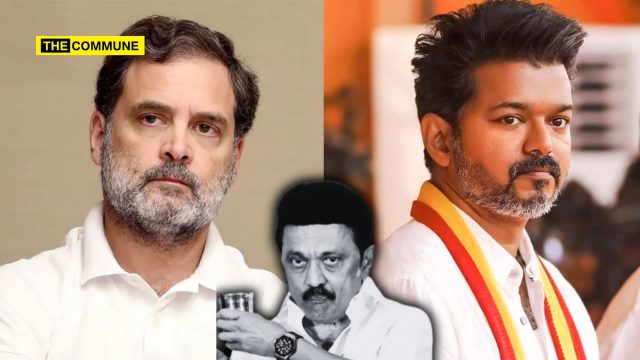
The Bihar Assembly elections are on the verge of commencing, with campaigns actively underway from all involved parties since the announcement of the election dates. The Mahagathbandhan, led by the RJD, appears to have squandered a significant opportunity to displace the ruling NDA. The RJD’s chosen candidate for Chief Minister, Tejaswi Yadav, has unfortunately been largely eclipsed by his coalition partner, Rahul Gandhi.

Since the onset of campaigning in Bihar, Congress has seemingly prioritized the promotion of Rahul over Tejaswi, effectively diminishing the presence of latter. Promoting Rahul Gandhi in the Bihar elections, where Congress has struggled to gain traction since the rise of Mandal politics, is a serious miscalculation. Whether this strategy is intentional or amounts to political self-sabotage remains subject to interpretation.

If the Mahagathbandhan truly had a chance against the formidable NDA, it was solely when Tejaswi Yadav was their primary representative. There is no lack of a list of failures during the incumbent Nitish Kumar regime; however, Rahul Gandhi is preoccupied with trivial matters such as SIR and Vote Chori, which has hindered Tejaswi’s campaign from gaining momentum while Rahul remained at the center of attention. 

The Congress party also enlisted the support of its alliance partners from Tamil Nadu and Telangana. M K Stalin and Revanth Reddy were actively campaigning in Bihar alongside leaders from Congress and RJD. This approach lacks any sense or logic, especially considering that Stalin has publicly criticized migrant laborers in Tamil Nadu. Furthermore, this strategy does not resonate with the average Bihari at all, and it is likely to backfire.

RJD has failed to take advantage of the shortcomings of the Nitish Kumar-led NDA. Their campaign appeared to be disorganized, resembling random shots fired in various directions. The topics of SIR and ‘vote chori’ do not constitute significant electoral issues in Bihar. It does not require extensive time or effort to confirm this fact. Even a brief discussion in various locations would clearly demonstrate this.

RJD participated in the Congress campaign regarding SIR, which attempted to elevate a trivial matter into a serious concern. Instead, they ought to have concentrated on genuine issues such as migration, the scarcity of employment opportunities in Bihar, and the recently deteriorating law and order situation in the state. Elevating a fabricated ‘vote chori’ to a primary issue effectively provides an easy victory to the NDA.

RJD has frequently depended on its core voter base – the crucial MY (Muslim Yadav) equation, with Muslims making up around 16% and Yadavs 14% of the state’s population. RJD’s excessive dependence on MY polarization serves as a clandestine advantage for the ruling NDA & it cleverly highlights the rogue elements within this combination, instilling a fear of a return to Lalu 2.0, which effectively counteracts the polarization among other communities that are opposed to the idea of RJD regaining power. 

Tejaswi Yadav has made significant efforts to unify these votes en bloc. However, this is not the 1990s, and Tejaswi is not Lalu Yadav, who could easily gather support from the backward classes cutting across the castes. Furthermore, the Modi-led BJP is executing OBC politics more effectively than any other political party; even a brief examination of their key office bearers confirms this. Therefore, Tejaswi’s efforts to consolidate his voter base are likely to lead to a counter-polarization, where the non-Yadav OBCs, a substantial portion of SCs, and the General category would align with the NDA.

The achievements of Nitish’s leadership in the NDA are noteworthy, if not remarkable. The initiatives in infrastructure development, such as roadways, metro systems, and connectivity projects like the Patna Mokama Aunta-Simaria bridge, illustrate the persistent efforts of the state government. According to UNDP data, Bihar, which has the highest Multidimensional Poverty Index (MPI) value in the National Family Health Survey-4 (NFHS-4) conducted in 2015-16, experienced the most rapid decline in MPI value in absolute terms. The MPI value decreased from 0.265 in NFHS-4 (2015-16) to 0.160 in NFHS-5 (2019-21). During this same timeframe, the percentage of multidimensionally poor individuals fell from 51.89% to 33.76%. Additionally, its Infant Mortality Rate (IMR) is lower than the national average. Although there is still much work to be accomplished, the state is gradually overcoming longstanding stereotypes.

The NDA government’s announcement of a domicile policy that allocates 35% of government jobs to women has been positively received by the women voters of Bihar. Previously, these voters have shown considerable trust in the NDA Government. Furthermore, the introduction of various women-centric welfare initiatives, such as the ‘Mukhyamantri Mahila Rozgar Yojana’ and the ‘Mukhyamantri Kanya Suraksha Yojana’, along with programs aimed at disadvantaged groups like the Chief Minister Divyangjan Empowerment Scheme (Sambal) and the Parwarish Yojana for orphans, resonates strongly with the electorate.

Another party, Jan Suraj, founded by Prashant Kishore, is generating considerable media attention in the Bihar elections. Upon closer objective examination, its electoral impact appears to be insignificant. Since Jaganath Mishra, there has not been an upper caste Chief Minister in Bihar. The upper castes have primarily allied with the RJD in the past and subsequently with the BJP in the state. The late Raghuvansh Prasad Singh of the RJD was a prominent Rajput leader, and its current state president, Jagdanand Singh, continues to be a significant figure. Jan Suraj seems to have garnered a faction of disgruntled upper castes who are seeking their electoral relevance; they perceive an opportunity within Prashant Kishore’s organization. However, their overall numbers are not substantial (approximately 15%), and a considerable portion remains loyal to the BJP. Jan Suraj may secure 5-10 seats, largely contingent on candidate selection. Nevertheless, Prashant Kishore’s choice to refrain from contesting elections after promoting the narrative of alternative politics does not instil much confidence.

The victory of the NDA is clearly evident. The Mahagathbandhan attempted to raise issues that do not resonate with the average Bihari. The genuine concerns have been overshadowed, and the electoral prospects of the RJD have been adversely affected by its coalition partners in Bihar.

Kanishk Shekhar, is a columnist and also teaches students preparing for Civil Services Exam.

Subscribe to our channels on WhatsAppTelegram, Instagram and YouTube to get the best stories of the day delivered to you personally.
DMK’s Political Communications Firm PEN Spent Around ₹1.5 Crores On Digital Ads From Jan-Oct 2025

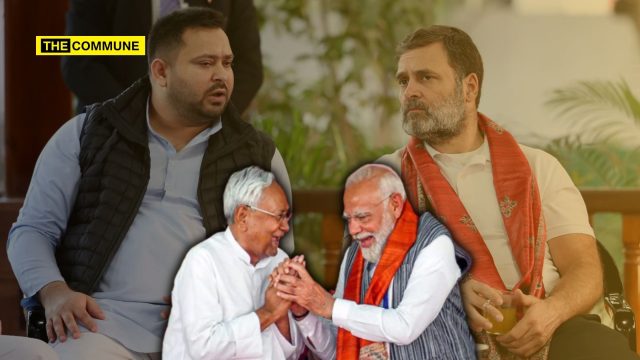
In 2024, The Commune had reported that DMK spent over ₹10 crore in social media ads Via PEN (Populus Empowerment Network) indirectly owned by MK Stalin’s son-in-law Sabareesan.

Populus Empowerment Network Private Limited (PEN) is a Chennai‑based company incorporated in 2022. It is the in-house agency of DMK handling digital and social media campaigns. While official filings list its directors as Manikandan Vasudevan and Prabhakaran Sekar V. Sabareesan (son‑in‑law of CM M.K. Stalin) is said to exercise indirect control over the company.

PEN has managed multiple political and promotional campaigns, including on platforms like Google and Meta.

In April 2024, the then Tamil Nadu BJP president K. Annamalai, contesting his first Lok Sabha election in 2024, intensified his attack on the ruling DMK and Chief Minister M.K. Stalin’s family during his campaign. Accusing the DMK of large-scale misuse of public funds, Annamalai claimed the party spent ₹7.39 crore on social media advertisements through a company called Populous Empowerment Network Pvt. Ltd., allegedly owned by Stalin’s son-in-law, V. Sabareesan, who holds a 99% share. He described this as an example of “crony capitalism,” saying the chief minister’s family was “looting state funds over and over again.”

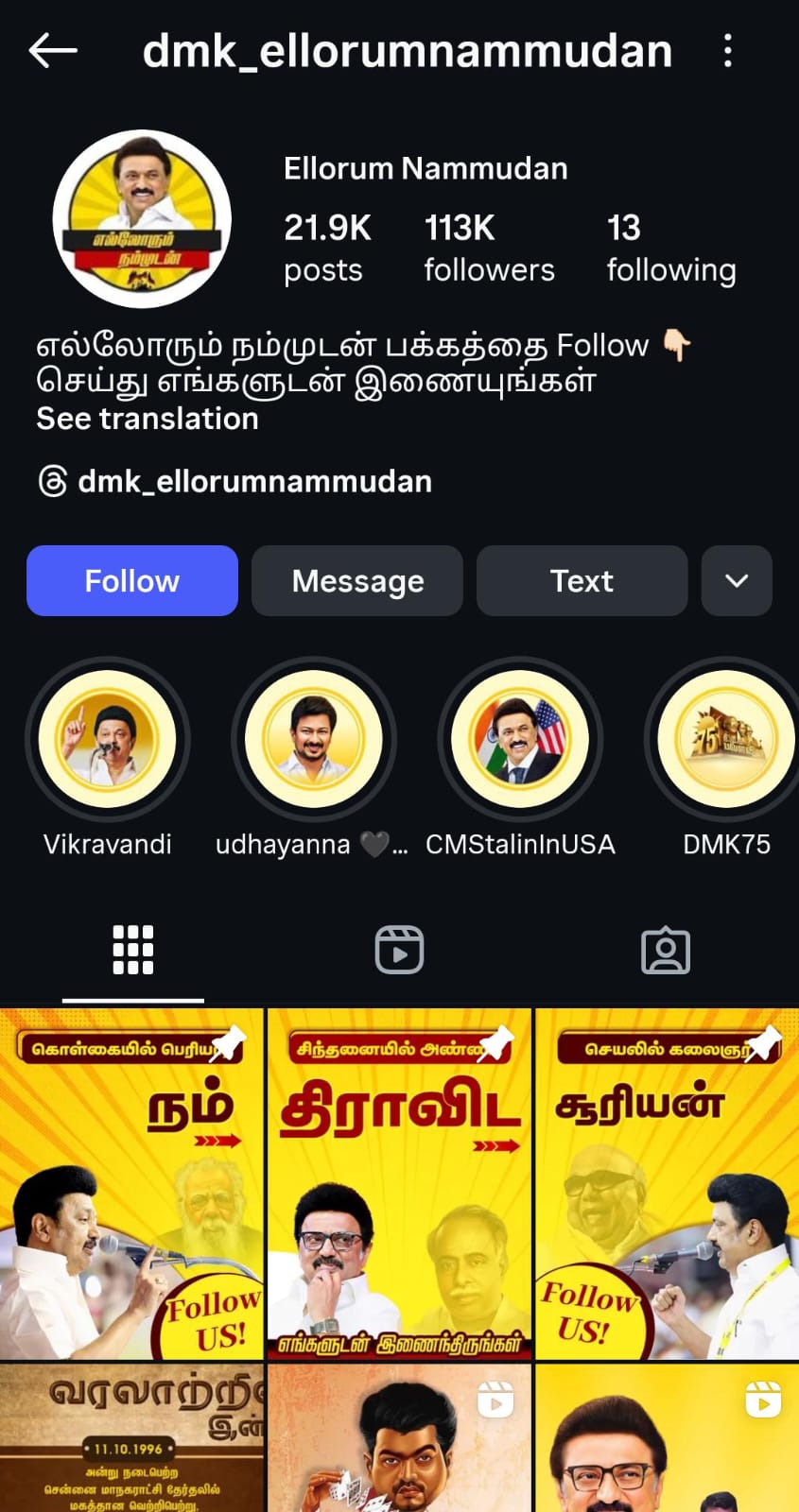
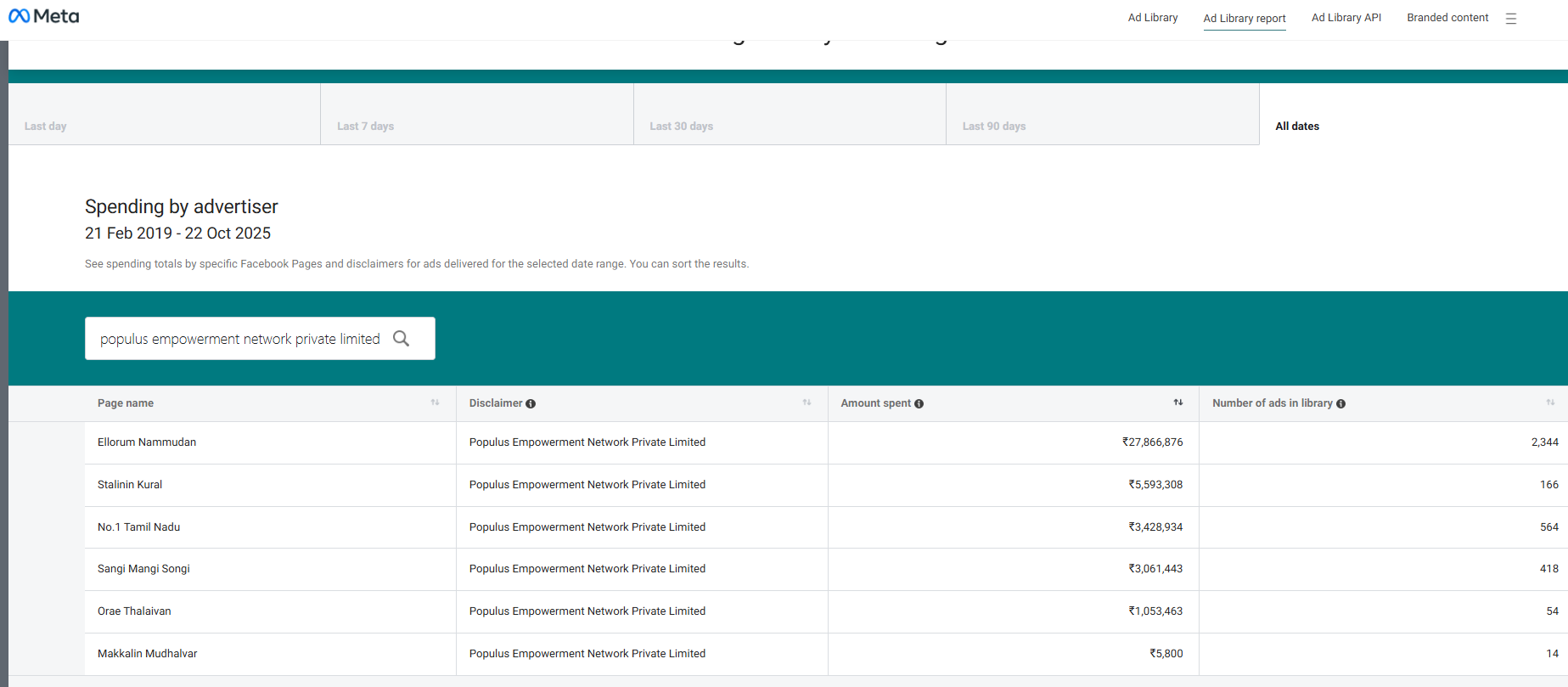
Annamalai’s allegations refer to paid advertisements run on Meta platforms (Facebook and Instagram) under pages such as Ellorum Nammudan and Stalinin Kural, both managed by Populous Empowerment Network (PEN). The campaigns, launched around March 2024, promoted DMK content, including videos, songs, and anti-Modi messages. According to publicly available Meta Ad Library data, these pages collectively spent over ₹1.2 crore on Meta ads, with some individual ads costing up to ₹2 lakh each.

Reports also indicated that PEN spent an additional ₹9.25 crore on Google Ads. The company was earlier associated with developing the “Makkalin Mudhalvar” app and game designed to promote the DMK’s “Dravidian Model of governance.” Annamalai accused the DMK of misusing state resources for political propaganda while claiming that Modi’s “guarantees” would end such nepotism, separatist rhetoric, and family rule in Tamil Nadu.

Cut to 2025, the ad spends are back in scrutiny. Let’s analyse the social media adverts and how much was spent for each of these ads.

Time Frame For Analysis: January 2025 – October 2025

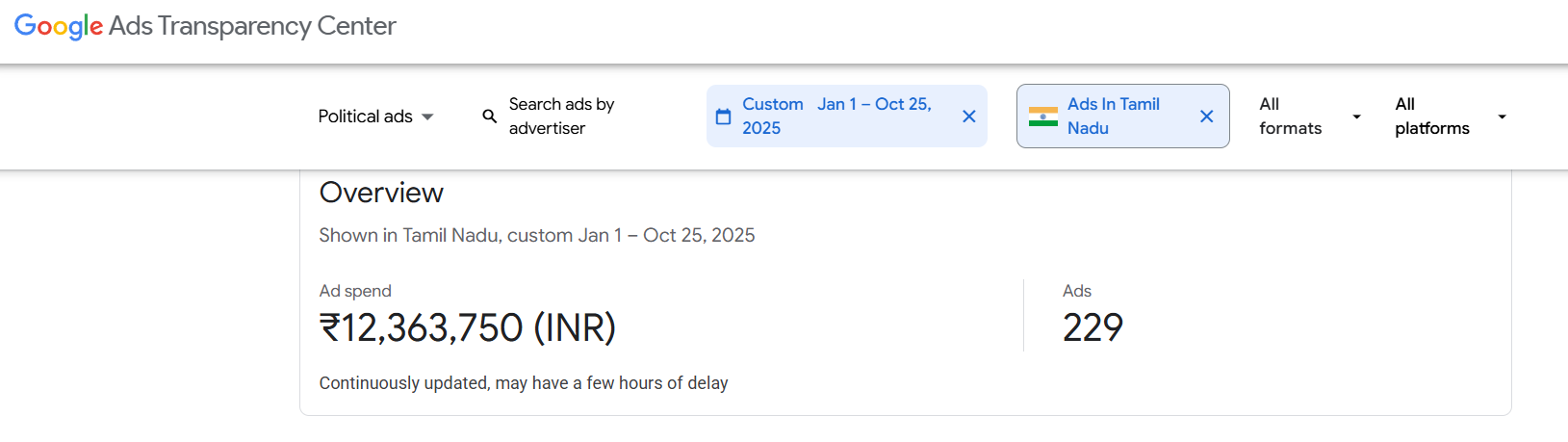
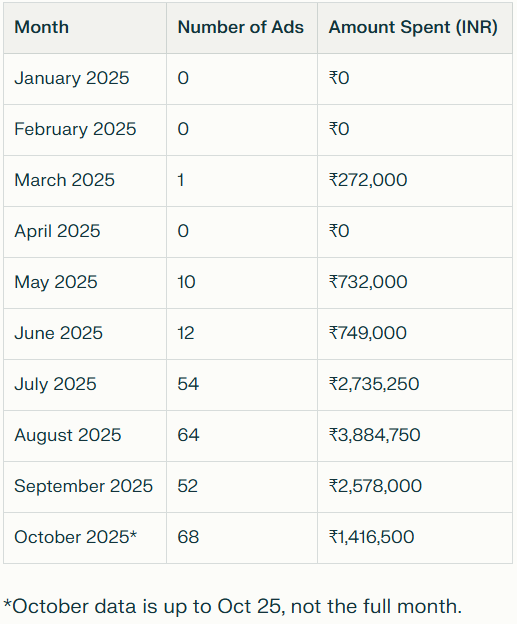
Since January 2025, a total of ₹1.24 crores have been spent on 229 Google Ads.

Let’s deep dive into some of the recent spends.

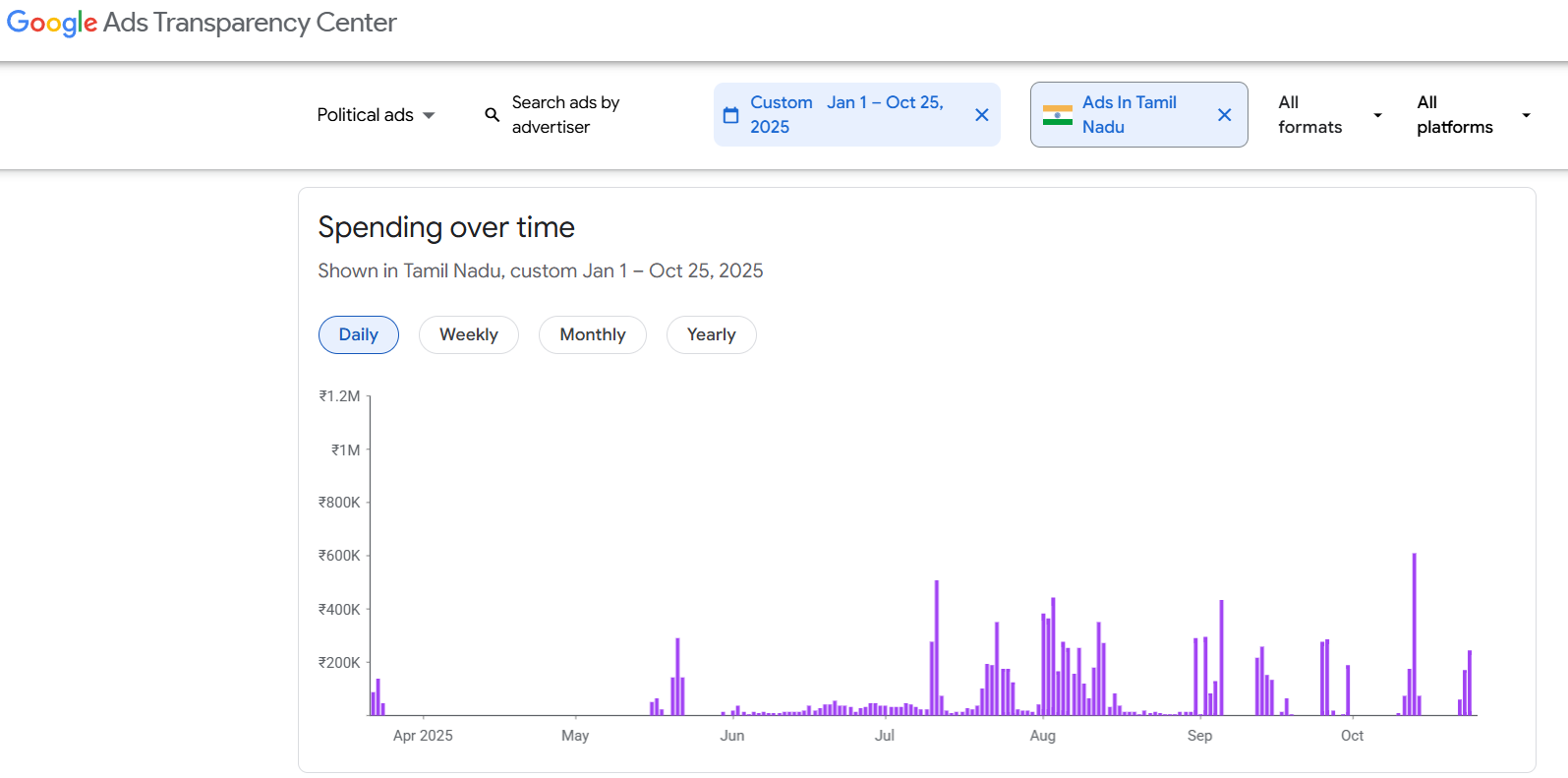
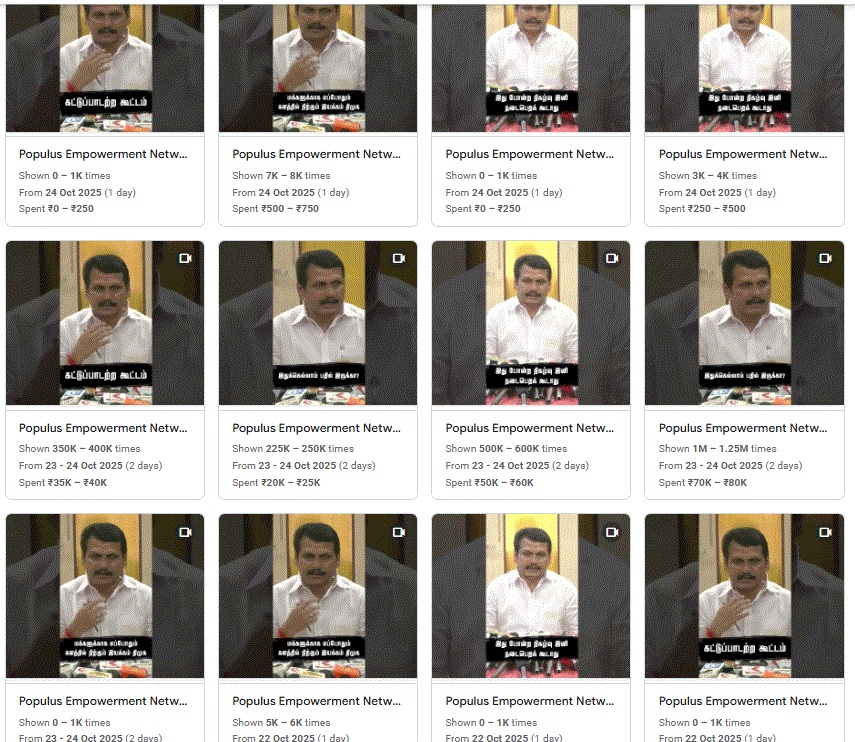
The highest-spending days were concentrated in late October 2025 (Oct 22–25), with some days seeing spend up to ₹150,000 and dozens of ads launched, typically in bursts.

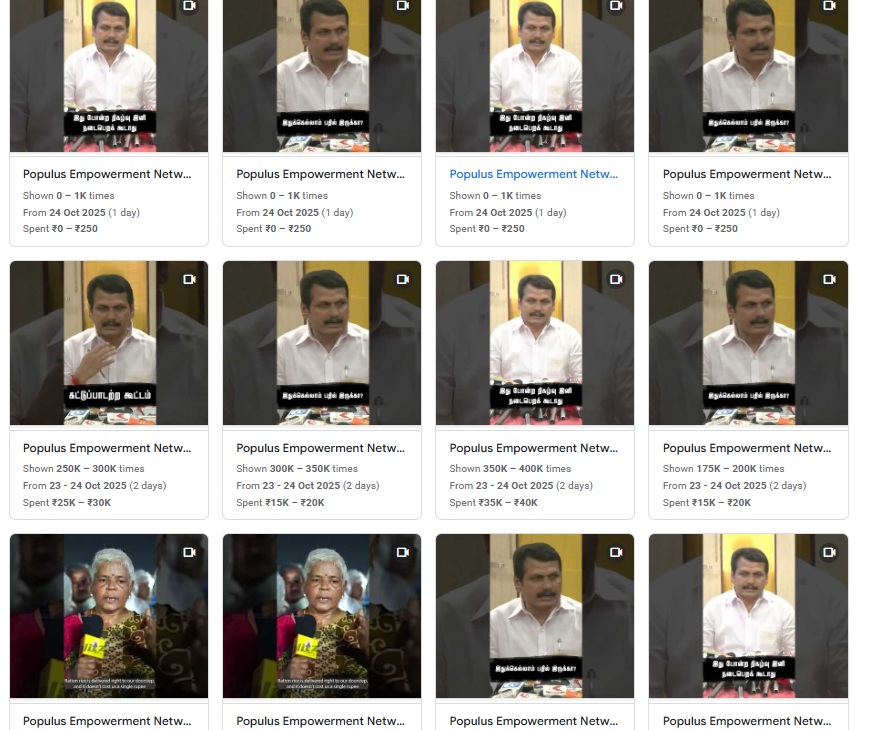
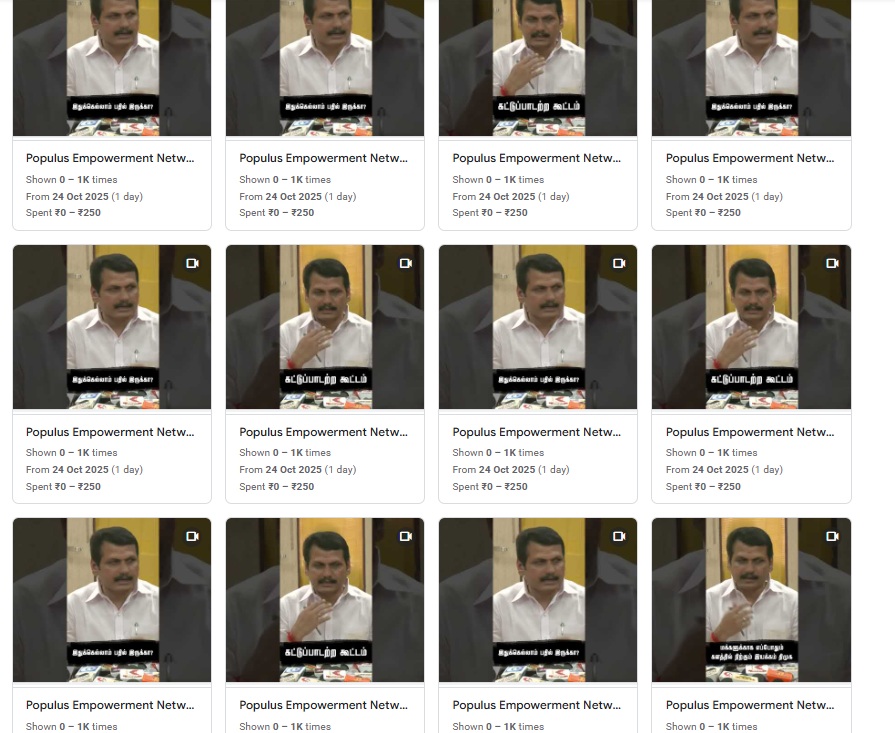
Between October 22nd and 24th, 2025, PEN poured ₹125K–₹150K into a single campaign, publishing rapidly pushing it out to an estimated 2–2.25 million viewers.

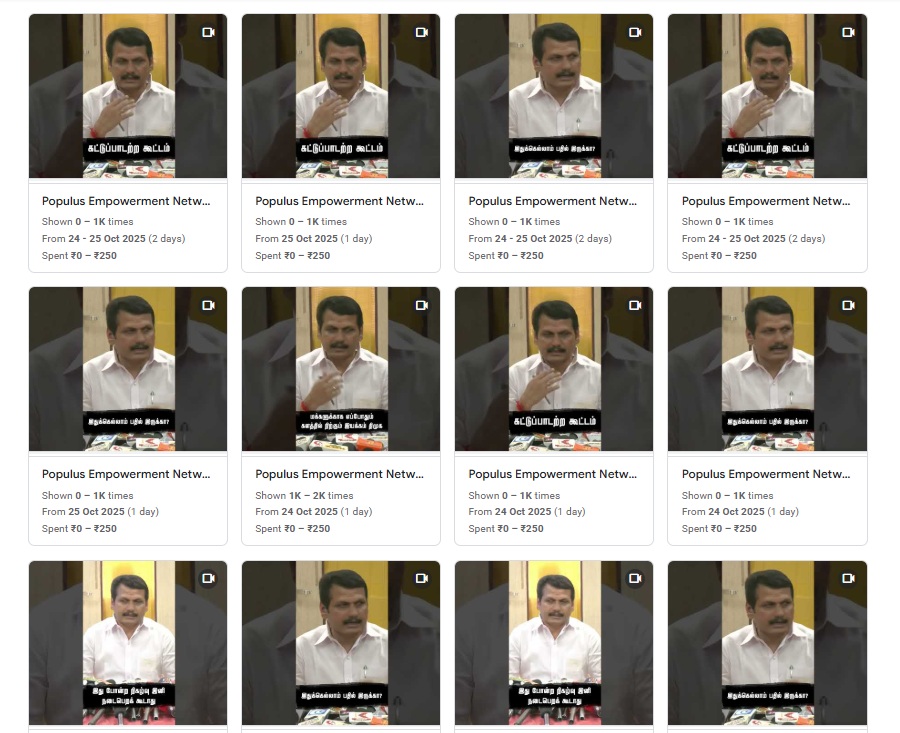
Ads were shown just about former DMK minister Senthil Balaji who has come to be identified as ₹10 Balaji because of the allegations of scam in TASMAC popularized by Vijay during the Karur Stampede Tragedy.


The average spend per ad by Populus Empowerment Network Private Limited during January 1, 2025 to October 25, 2025 is approximately ₹47,385 per ad.

As you can see, there has been a massive increase in the amount spent since July 2025 as the news cycle was majorly against the DMK government – from sanitation workers protest to Karur Stampede.

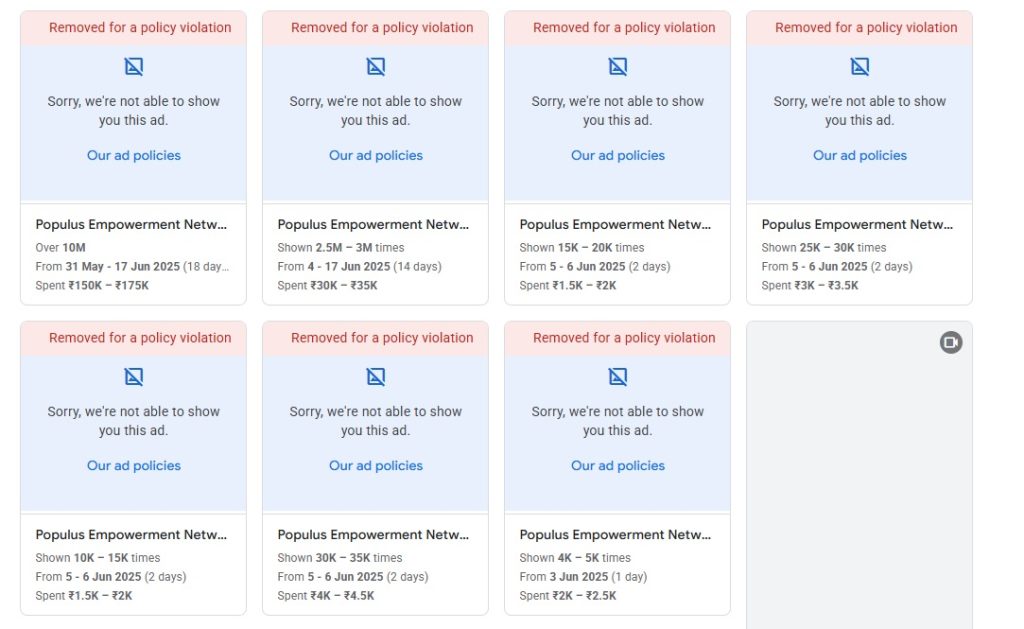
Out of the 80 visible ads reviewed, 24 were removed by Google for policy violations, resulting in an approximate removal rate of 30%.

The amount spent on these removed ads was around ₹34.35 lakhs.

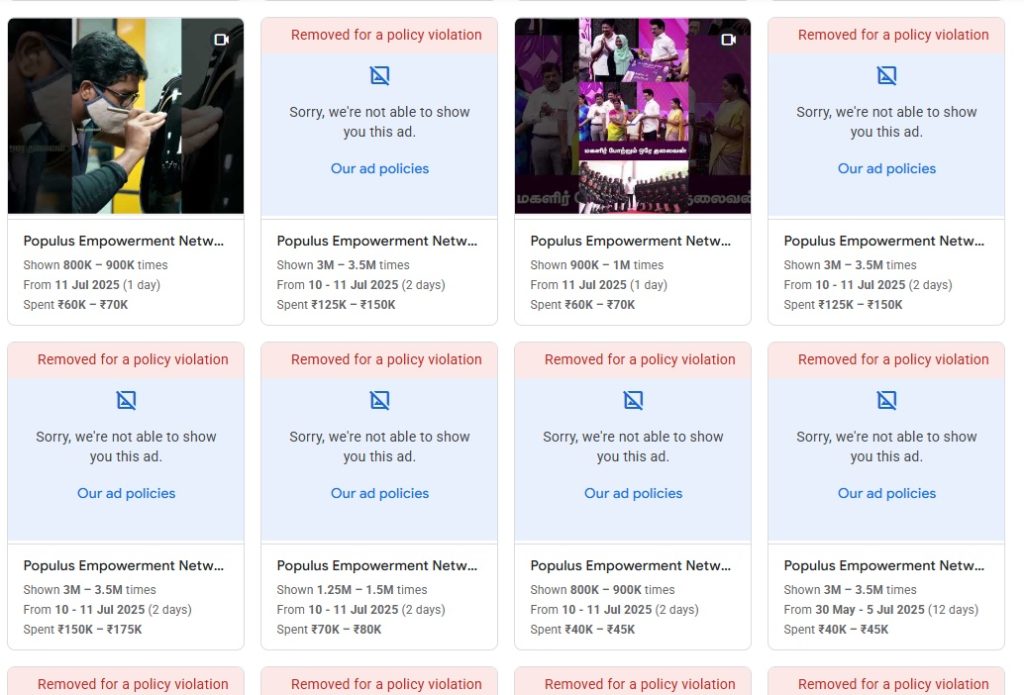
Ads in June 2025


Ads in July 2025

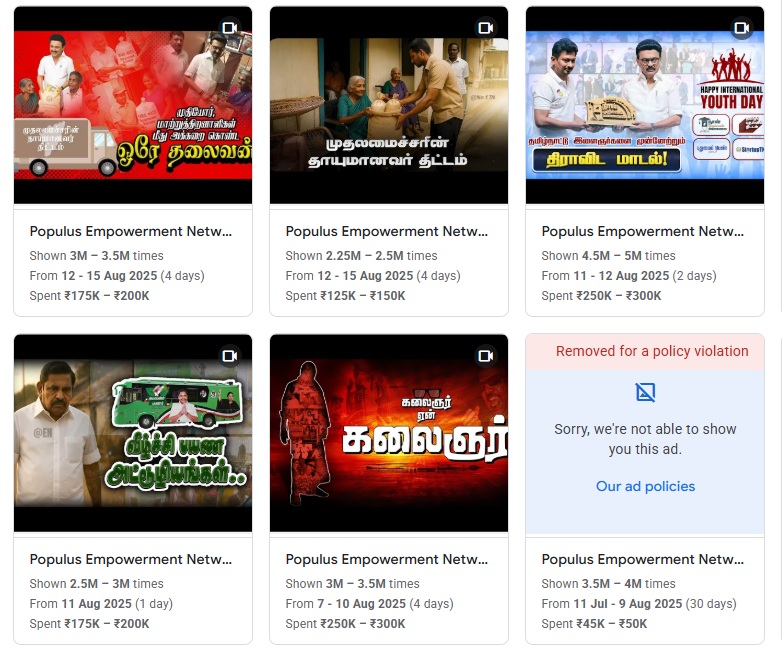
The top spending ads ranged from ₹2.5-4.5 Lakhs each, with most high-budget campaigns running for extended periods (30-64 days). Notably, several of the highest-spending ads were removed, including:

  • June-August campaign: ₹4.25 Lakhs
  • June-July campaign: ₹3.25 Lakhs
  • September campaign: ₹2.75 Lakhs
August 2025 ads
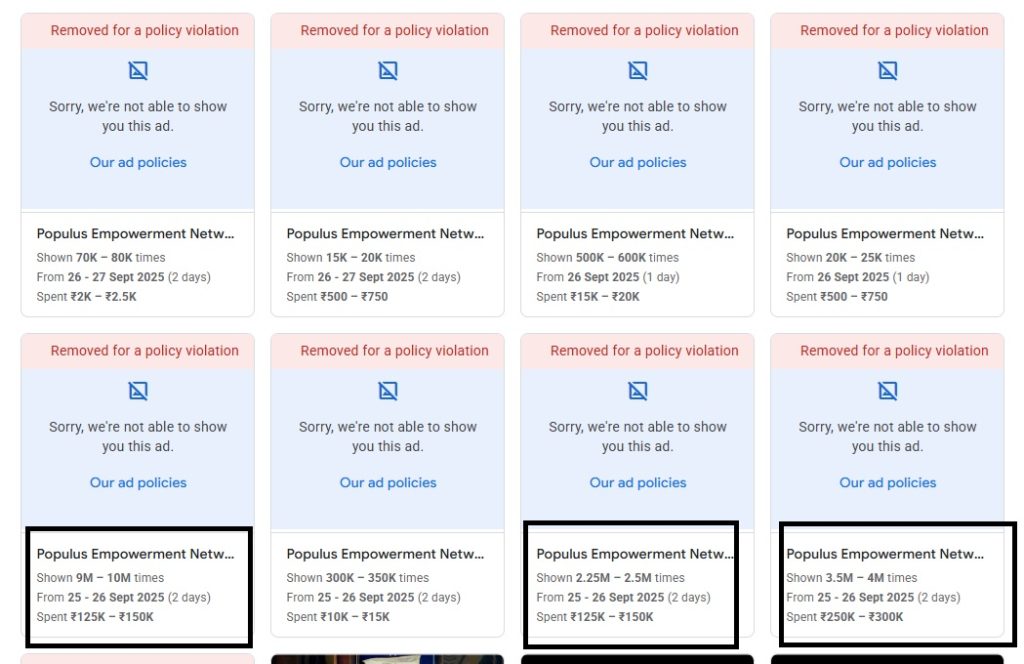
Ads in September 2025
Removed Ads in September 2025 and their views

This is just in Google. Let’s take a look at how much money DMK has splurged in Meta (Facebook and Instagram).

Meta Spend Of DMK

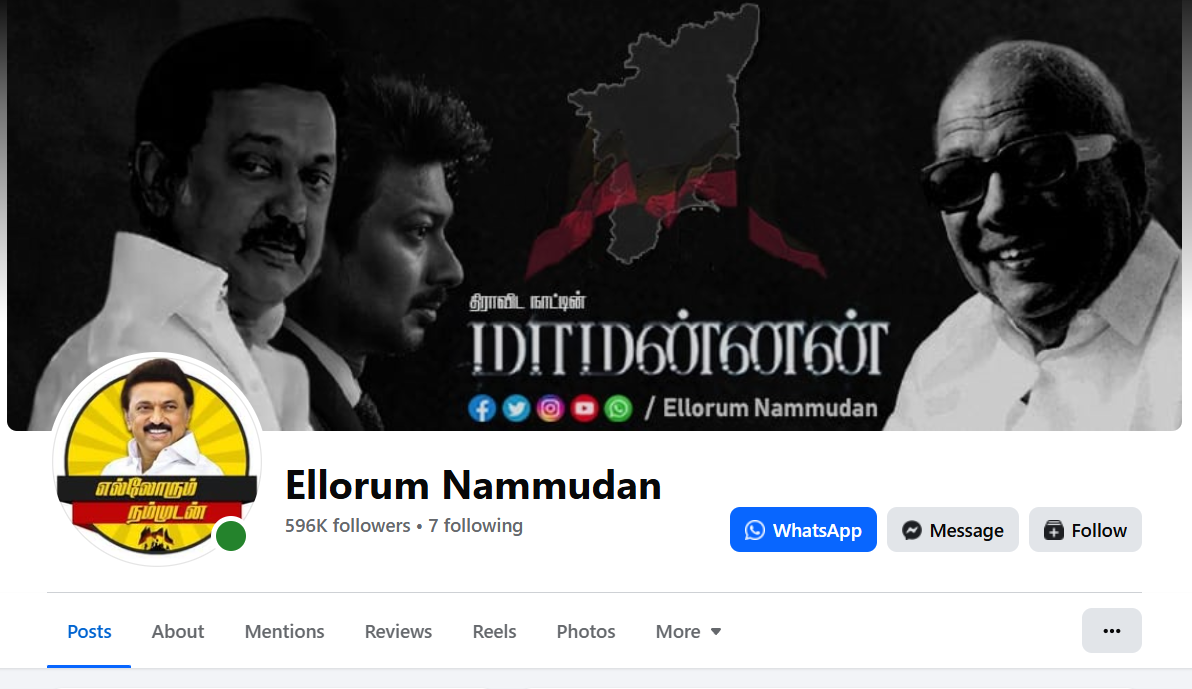
PEN runs DMK propaganda pages called Ellorum Nammudan in Facebook (596K followers as on Oct 25, 2025) and dmk_ellorumnammudan in Instagram (113K followers as on Oct 25, 2025).

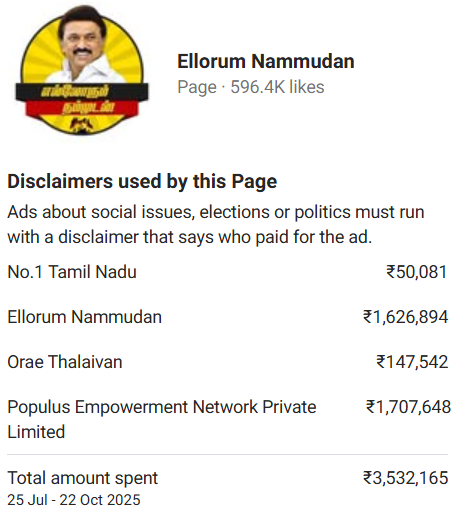
According to Meta’s Ad Library, ₹3,532,165 was spent from 25 July 2025 – 22 October 2025.

Most of its spending has gone towards ads in Instagram.

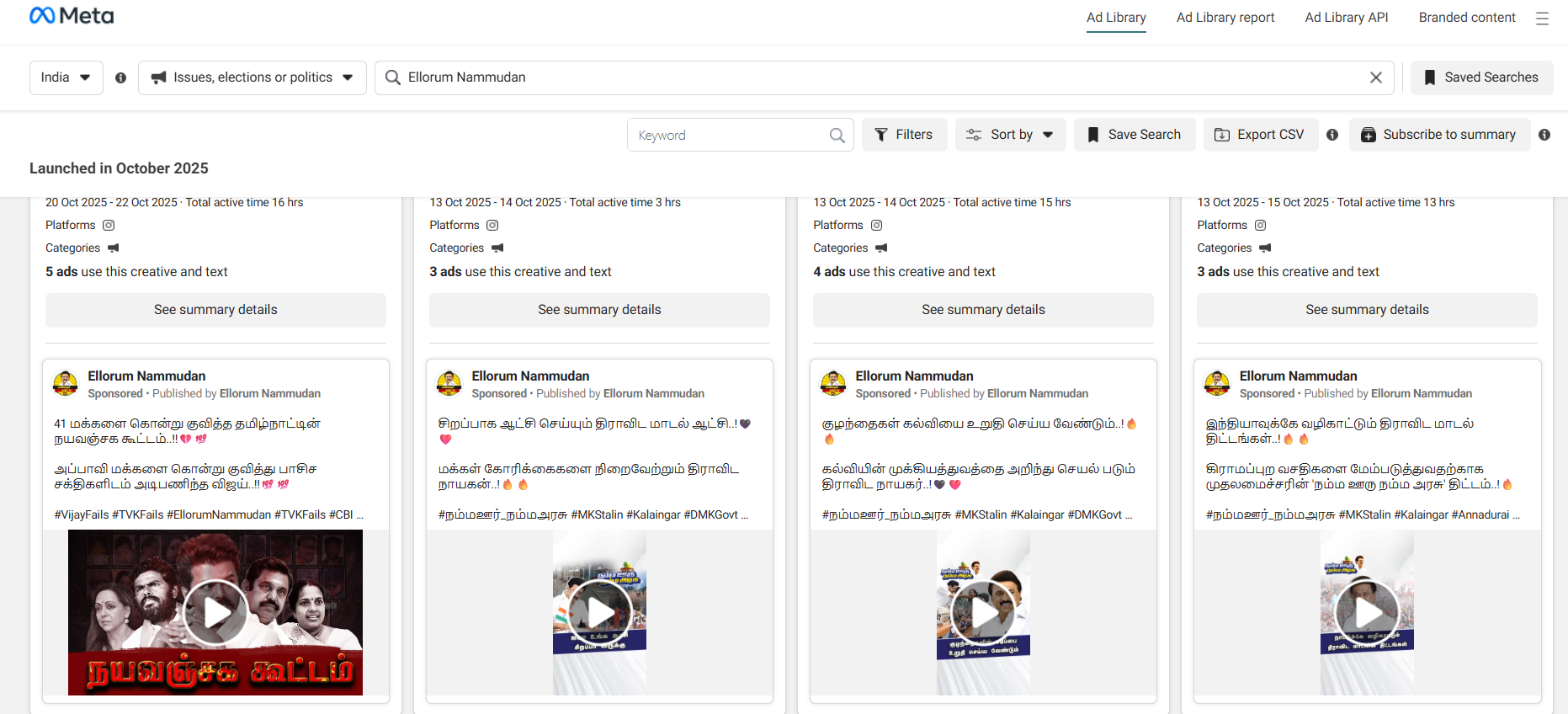
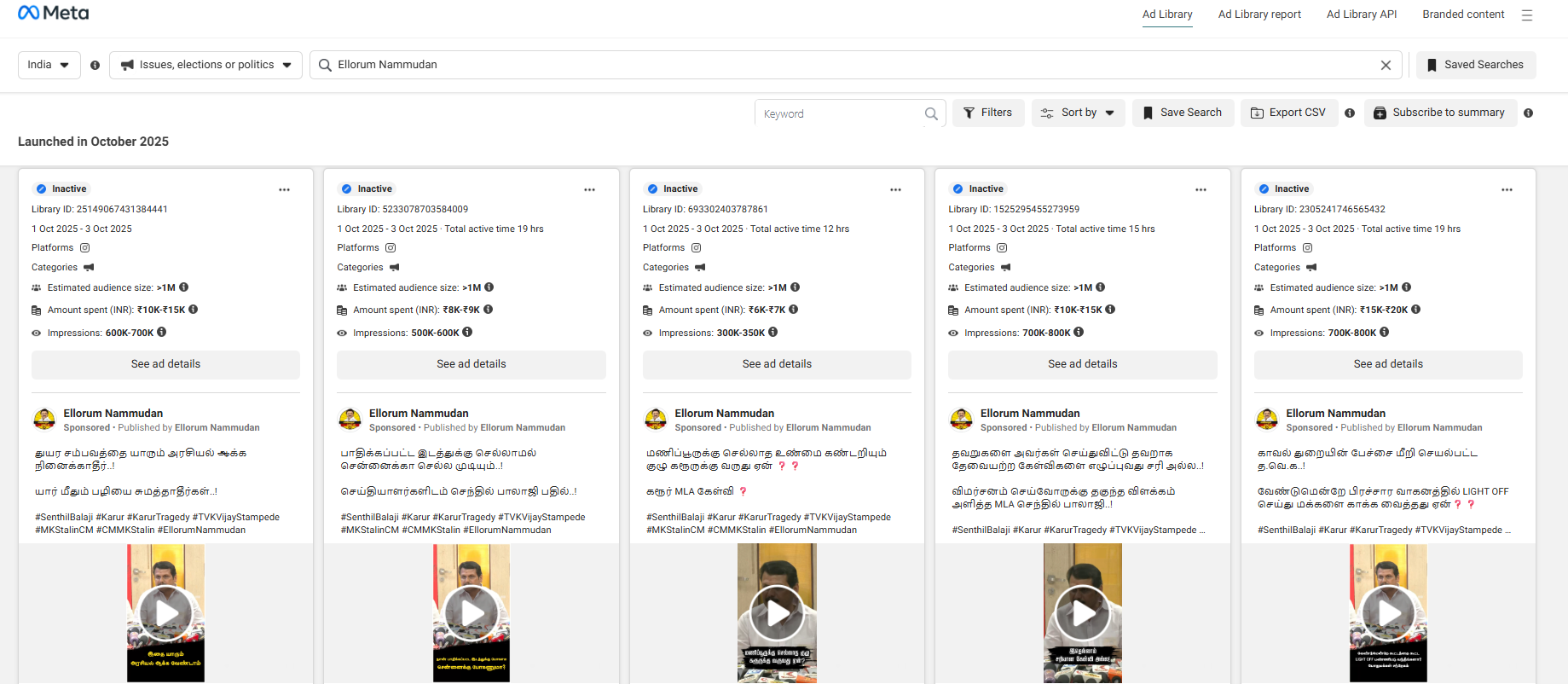
And like in Google, a lot of money has been splurged on bytes of Senthil Balaji’s press conference in light of Karur Stampede.

From January 2025 to October 2025, a total of 1054 ads have been been placed through Meta.

In total, PEN has spent ₹4.1 crore for ads through Meta.

Subscribe to our channels on WhatsAppTelegram, Instagram and YouTube to get the best stories of the day delivered to you personally.
Paid Or Organic? Mapping 36 Protests In 30 Days Of September-October 2025

From 11 September to 12 October 2025, India witnessed 36 notable protests and demonstrations across multiple states. Issues ranged from student activism, Dalit rights, and the Chief Justice of India shoe incident to Waqf Amendment Bill opposition and Palestine solidarity. Political parties, student organizations, and community groups were actively involved, with participation varying from a few dozen to hundreds of thousands. Analysts note a mix of local grievances and nationally orchestrated movements, often aligned with political or radical networks, reflecting a trend of coordinated, high-visibility protests in urban and rural India alike.

#1 NSUI Demands Leaders’ Release – 12 October 2025

In Jaipur, Rajasthan, the National Students’ Union of India (NSUI) staged a protest involving 400-500 people. They were demanding the release of their state president, Vinod Jakhar, and other Congress student leaders. These individuals had been arrested for allegedly attacking an event organized by the Rashtriya Swayamsevak Sangh (RSS), framing their protest around the detention of their members.

#2 Youth Congress Mourns Singer’s Death – 11 October 2025

The Youth Congress organized large-scale protests across Assam, including in Nalbari and Nagaon, with an estimated 8,000-10,000 participants.

The demonstrations, featuring torchlight processions and bike rallies, were held to demand answers following the mysterious death of renowned Assamese singer Zubeen Garg, reflecting public outrage and demand for a transparent investigation.

#3 Haryana Congress Protests IPS Suicide – 11 October 2025

The Haryana Pradesh Congress Committee, under President Rao Narendra Singh, ordered state-wide protests in all districts. The protests were triggered by the suicide of IPS officer Puran Kumar. The Congress party framed the issue as a case of Dalit oppression, aiming to highlight alleged systemic injustices within the state administration.

#4 AAP Protests CJI Shoe Incident – 11-12 October 2025

The Aam Aadmi Party (AAP) held protests at multiple locations in Delhi, including Patel Nagar, with 400-500 participants. The party seized upon the incident where a shoe was thrown at Chief Justice of India (CJI) B.R. Gavai, using it as a central issue to mobilize supporters and critique the prevailing political atmosphere.

#5 Congress Links CJI Incident & IPS Suicide – 11 October 2025

The Indian National Congress (INC) called for nationwide protests, strategically linking the shoe-throwing incident at the CJI with the suicide of IPS officer Puran Kumar. Led by leaders like Rajendra Pal Gautam in Delhi and Ajay Rai in Lucknow, the party consistently framed both events as emblematic of Dalit oppression.

#6 AIMPLB, AIMIM Oppose Waqf Act – 10 October 2025

The All India Muslim Personal Law Board (AIMPLB), with AIMIM chief Asaduddin Owaisi in attendance, organized a protest at Jantar Mantar in Delhi. The demonstration, involving 200-300 people, was directed against the recently passed Waqf Amendment Act, which the groups argue adversely affects Muslim community properties and rights.

#7 SFI’s Pro-Palestine Stir at Delhi University – 09 October 2025

The left-leaning Students Federation of India (SFI) held a pro-Palestine protest at Delhi University. The gathering of 100-150 students reportedly led to clashes with other students. Delhi Police intervened, detaining eight individuals involved in the unrest.

#8 AAP Rallies for Farmers in Gujarat – 10 October 2025

Aam Aadmi Party leader Rajubhai Karpada led a massive protest of 8,000-10,000 people outside the Agricultural Produce Market Committee (APMC) in Botad, Gujarat. The demonstration was organized in the name of farmers, addressing longstanding issues related to agricultural marketing and farmers’ welfare in the state.

#9 Left Parties Rally for Palestine – 09 October 2025

A coalition of united left parties staged a demonstration at Jantar Mantar in Delhi. The protest, which saw participation from 1,000-2,000 individuals, was held to express solidarity with Palestine and to condemn the ongoing conflict in Gaza.

#10 Congress’s Nationwide Dalit Atrocity Protests – 11 October 2025

The Congress party announced plans to hold protests at all district headquarters across the country. The coordinated action was focused on the attack on the CJI and the suicide of IPS officer Y. Puran Kumar, both of which the party labeled as severe instances of Dalit atrocities, demanding government accountability.

#11 Assam Tea Tribes Demand ST Status – 08 October 2025

In a massive show of strength, six tea-tribe communities of Assam, led by ATTSA and AASAA, gathered in Tinsukia. An estimated 2-3 lakh people protested at the Hukan Pukhuri playground, demanding Scheduled Tribe (ST) status, land ownership rights, and increases in wages for plantation workers.

#12 Prayagraj Demo for Sonam Wangchuk – 08 October 2025

A demonstration was held in Prayagraj, Uttar Pradesh, under the leadership of Dr. Ashish Mittal. The protest, involving 40-50 people, demanded the release of Ladakh activist Sonam Wangchuk. The demonstration included individuals with controversial backgrounds, such as a main accused in the 2020 Prayagraj riots.

#13 NSUI’s Rae Bareli Murder Protests – 08 October 2025

The NSUI staged protests in multiple cities, including Delhi, focusing on the murder of a youth in Rae Bareli. The organization framed the killing, which resulted from a fight between two groups, as a Dalit issue. However, the turnout at each location was reported to be low, with only 20-25 participants.

#14 IYC, NSUI Protest Attack on CJI – 08 October 2025

The Indian Youth Congress (IYC) and NSUI continued their protests against the attack on the CJI. Demonstrations were held in cities like Patna, Kurukshetra, and Gurugram, with 100-200 workers participating. In Patna, the protest was staged in front of the Ambedkar statue at the High Court.

#15 CPI(M), DMK Show Support for Gaza – 08 October 2025

In a significant show of political force, the CPI(M) held a pro-Gaza demonstration in Chennai, Tamil Nadu. The event was attended by Chief Minister M.K. Stalin and 5,000-7,000 supporters. Stalin called for India to provide humanitarian aid to Palestine and urged the central government to help end the war.

#16 Mumbai Prepares for Palestine Protest – 10 October 2025

Preparations were underway for a major protest in support of Palestine at Mumbai’s Azad Maidan. Appeals for participation were issued by several prominent leaders, including Samajwadi Party’s Abu Azmi, indicating a planned large-scale gathering to express solidarity with the people of Gaza.

#17 Hyderabad Sees Pro-Palestine Rally – 07 October 2025

A protest in support of Palestine was held at Dharna Chowk in Hyderabad. Organized by IPSP and BDS groups, the event saw participation from 500-700 people. The protest reportedly turned tense, with some participants clashing with the police deployed to manage the gathering.

#18 Small Pro-Palestine Protest in Patna – 06 October 2025

A relatively small protest in support of Palestine was held in Patna, Bihar. Organized by IPSP and BDS, the demonstration saw a modest turnout of only 20-25 individuals, highlighting the varying scales of such activism across different cities.

#19 Malappuram Readies for Palestine Rally – 10 October 2025

In Malappuram, the Solidarity Youth Movement announced preparations for a major protest in support of Palestine. The planned demonstration was part of a coordinated effort seen across the country on the same date, focusing on the ongoing conflict in Gaza.

#20 AAP’s UP-Wide Protest on CJI Incident – 10 October 2025

The Aam Aadmi Party announced its plan to stage protests in every district of Uttar Pradesh. The party aimed to mobilize its workers around the incident involving the shoe being thrown at the Chief Justice of India, seeking to capitalize on the event for political mobilization.

#21 AAP Surrounds Lawyer’s House – 07 October 2025

In a targeted protest in Delhi, 50-100 AAP workers surrounded the house of a 72-year-old lawyer allegedly connected to the CJI shoe-throwing incident. The party accused the individual of insulting the Dalit community and the Constitution, alleging he had an “RSS mentality.”

#22 Chhattisgarh Protests Coal Block Allocation – 06 October 2025

In Raigarh, Chhattisgarh, the Hasdeo Aranya Bachao Sangharsh Samiti led a protest of 800-1,000 people. The demonstration was against the allocation of the Gare Palma 1 coal block to Jindal Company, highlighting ongoing environmental and displacement concerns in the forest region.

#23 NSUI Leads Nursing Students in Bhopal – 07 October 2025

The NSUI led a protest of 800-1,000 nursing students in Bhopal, Madhya Pradesh. The students were demonstrating after 13 nursing colleges in the city were derecognized, jeopardizing their education and futures, and demanding immediate government intervention.

#24 Nurses Protest for Reforms in Jaipur – 07 October 2025

Young nurses gathered at the Martyr’s Memorial in Jaipur, Rajasthan, under the leadership of NSUI. The protest, involving 800-1,000 participants, demanded an end to the contract system in the state’s medical department and permanent recruitment of nursing officers through written examinations.

#25 NSUI’s Pan-India Rae Bareli Protests – 07 October 2025

The NSUI organized protests across all states of India, linking the murder of a youth named Hariom in a Rae Bareli group fight to Dalit issues. The scale was nationwide, though turnout varied significantly from one location to another.

#26 Hyderabad’s Gaza Solidarity Protest – 05 October 2025

As part of nationwide protests, a demonstration in support of Gaza was held at Dharna Chowk in Hyderabad. Organized by BDS India, the event saw 500-600 participants, mirroring similar rallies in other major Indian cities like Delhi, Mumbai, and Kolkata.

#27 “I Love Mohammad” Protest at MANUU – 05 October 2025

At Maulana Azad National Urdu University (MANUU) in Hyderabad, Muslim students held a protest of 100-150 people under the “I Love Mohammad” campaign. Participants were seen raising slogans in support of the campaign, reflecting religious sentiment on campus.

#28 Christian Community Protests in Simdega – 05 October 2025

Members of the Christian community in Simdega staged a protest, with 1,000-2,000 people participating. The demonstration was against recent attacks on a church and Christian religious leader in the area, demanding protection and justice from the authorities.

#29 Congress’s Haryana Goodwill Tour – 06 October 2025

The Congress party launched a major “goodwill tour” across Haryana, involving 5,000-6,000 supporters. However, the event was marred by internal conflict, as senior Congress leaders themselves raised questions about the tour led by former MP Brijendra Singh.

#30 Major Palestine Rally at Jantar Mantar – 05 October 2025

BDS India and the Indian People in Solidarity with Palestine (IPSP) held a major protest at Jantar Mantar in Delhi. The event attracted 1,000-2,000 people, forming a significant part of the coordinated nationwide expressions of support for Palestine.

#31 BVM Sit-In at Jantar Mantar – 05 October 2025

The Bharatiya Vidyarthi Morcha, an affiliate of BAMCEF, staged a sit-in protest at Jantar Mantar, Delhi. The gathering of 2,000-3,000 people was part of a pre-announced nationwide rally titled “Save Schools! Save Education!!” focused on educational reforms.

#32 Sparse Protest for Sonam Wangchuk – 05 October 2025

Left-leaning student organizations like AISA called for a protest at Jantar Mantar demanding the release of Sonam Wangchuk. However, the event saw a very poor turnout, with reports indicating only 10-15 people gathered for the demonstration.

#33 Jaipur Candle March for Wangchuk – 28 September 2025

A candle march was organized at Patrika Gate in Jaipur in support of Sonam Wangchuk. The peaceful demonstration aimed to draw public attention to the activist’s arrest and the ongoing issues in Ladakh that he has been championing.

#34 ‘I Love Mohammad’ Unrest in Bihar – 27 September 2025

During a visit by Union Minister Amit Shah to Bihar, unrest erupted in Jogbani over the “I Love Mohammad” campaign. Reports indicated that a mob forcibly closed shops owned by Hindus, leading to tensions and protests in the area surrounding the high-profile visit.

#35 Pro-Palestine Film Screening in Patna – 22 September 2025

At Patna College, the Indian People in Solidarity with Palestine (IPSP) and Disha Student Organisation screened the Palestinian short film ‘Al Hadiya’ (The Present). The event, attended by 100-150 students, was used as a tool to generate support and awareness for the Palestinian cause.

#36 Old Assam Protest Video Recirculates – 11 September 2025

An old video from a protest in Assam on 10-11 September began recirculating on social media. The video showed the Matak tribe demanding their inclusion in the Sixth Schedule of the Constitution, with 5,000-10,000 participants, but was being shared as a recent event.

Subscribe to our channels on Telegram, Instagram and YouTube to get the best stories of the day delivered to you personally.
Dravidian Model: 71-Year-Old YouTuber Arrested By Stalin Govt For Social Media Post Languishes In Jail For More Than 20 Days

madras high court dmk stalin varadharajan karur stampede

The bail petition of retired police officer and YouTuber R. Varadharajan, aged 71, has been adjourned to Monday by the Madras High Court, extending his incarceration beyond 20 days. He was arrested by the Chennai South Cyber Crime Police on 7 October 2025, for allegedly posting defamatory content against Justice N Senthilkumar of the Madras High Court.

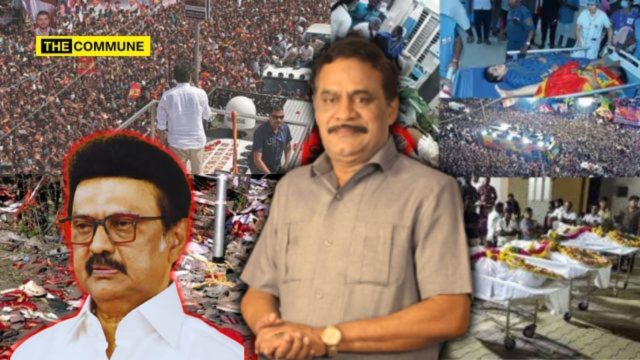
The arrest has drawn sharp criticism from sections of the opposition and political observers, who have described it as an example of vindictive politics under the ruling Dravida Munnetra Kazhagam (DMK) government. Varadharajan, a former police officer and founder of the political outfit Nethaji Makkal Katchi, regularly uploads political commentary on his YouTube channel, Nethaji TV.

According to police sources, the action was taken in response to a video where Varadharajan questioned the neutrality of Justice Senthilkumar, alleging proximity to the DMK and criticizing the judge’s remarks on actor-politician Vijay and his party, Tamilaga Vettri Kazhagam (TVK).

The controversy stems from the Karur stampede of September 27, which claimed 41 lives during Vijay’s first major political rally in Velusamypuram. The venue, designed for a few thousand people, saw an estimated 30,000 attendees, leading to a deadly crush.

During one of the hearings, the judge made personal remarks about Vijay’s leadership and the TVK’s organizational capacity — observations that sparked widespread debate on social media.

In the ensuing online discourse, several users, including Varadharajan, reacted critically to the judge’s statements. Police alleged that Varadharajan’s post crossed into defamatory and inflammatory territory, prompting his arrest under provisions related to cybercrime and public order.

The Tamil Nadu Police have maintained that the arrest is part of a broader effort to curb misinformation and hate campaigns following the Karur tragedy. Other online commentators, including YouTubers Felix Gerald and Maridhas, were also subjected to police action. While Gerald’s remand was rejected by the court and Maridhas was released after questioning, Varadharajan remains in judicial custody.

His bail petition, heard earlier this week, was adjourned after the prosecution sought additional time to obtain instructions, drawing criticism from activists who called the move a deliberate delay tactic.

Legal commentators have raised concerns about the chilling effect on free speech, noting that Varadharajan’s prolonged detention over a social media post underscores a tightening environment for dissent under the Dravidian Model government.

Thiru Varadharajan avl’s bail petition has been adjourned to Monday in the Honbl Madras HC . As usual the prosecution wanted time to get instructions . This is a clear case of vindictive politics by the ruling government keeping a septuagenarian locked for more than 20 days for… pic.twitter.com/bJVKDjvmr0

Subscribe to our channels on WhatsAppTelegram, Instagram and YouTube to get the best stories of the day delivered to you personally.