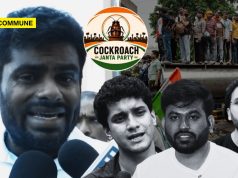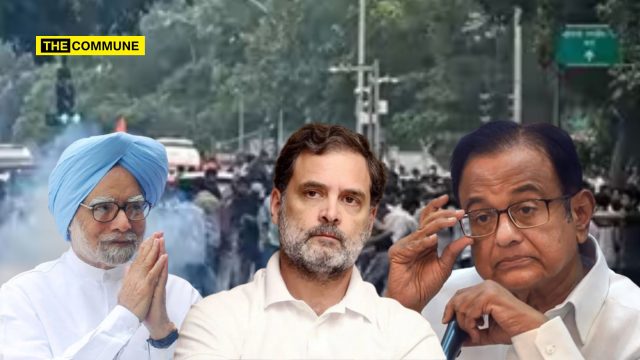
Congress scion Rahul Gandhi on Tuesday (21 July 2026) demanded that Prime Minister Narendra Modi apologise to students over the police action during the Cockroach Janata Party (CJP)-led protests in Delhi and resign along with Union Home Minister Amit Shah.
Addressing the media in the Parliament House complex, Rahul Gandhi said he had met Lok Sabha Speaker Om Birla along with Opposition MPs to seek a discussion on the issue of students in Parliament.
“He [Birla] said he will have to ask the government. So, the Speaker is telling us that to debate in Parliament he has to take permission from the government.”
Referring to the police action against protesters, Rahul Gandhi said, “The issue is of students and the way people are being beaten up, this is completely ‘unIndian’. Modi ji has not even apologised for what has happened yesterday.”
Claiming that the protests were centred around the education and examination system, he said, “The whole country knows that the education system and the testing system is broken and has ceased to exist.”
He further alleged that the examination system had been hollowed out and defended the students’ agitation.
“The testing system has been hollowed out by termites and that is what the students are stating. There is nothing wrong with that. We have been having presentation after presentation on it. Why is the PM silent? What is the reason? He should apologise to the students and stop this nonsense of police people thrashing students.”
While responding to questions on the Opposition’s demand for the resignation of Union Education Minister Dharmendra Pradhan, Rahul Gandhi said the responsibility lay higher up the chain of command.
“Absolutely, he should resign but Dharmendra Pradhan has not beaten up these students, but the home minister (Amit Shah) has, he should resign and the Home Minister reports to the PM, he should resign.”
Rahul Gandhi’s Contrasting Stand During Anna Hazare’s 2011 Agitation
Rahul Gandhi’s remarks in support of the student protests stand in sharp contrast to the position he took during the UPA government’s confrontation with Anna Hazare’s anti-corruption movement in 2011.
On 25 August 2011, as Anna Hazare continued his indefinite hunger strike demanding the Jan Lokpal Bill, Rahul Gandhi warned Parliament that compelling lawmakers through a fast posed a threat to parliamentary democracy.
While acknowledging the anti-corruption sentiment behind the movement, Rahul Gandhi rejected the method adopted by Hazare.
He told Parliament, “A process divorced from the machinery of an elected government that seeks to undo the checks and balances created to protect the supremacy of Parliament, of this House, sets a dangerous precedent for our democracy.”
He further cautioned that accepting such methods could have far-reaching consequences beyond the issue of corruption.
“Today the proposed law is against corruption. Tomorrow the target may be something less universally heralded. It may attack the plurality of our society and our democracy.”
View this post on Instagram
Rahul Gandhi described the hunger strike as a “tactical incursion” that undermined India’s constitutional architecture by attempting to pressure Parliament into accepting legislation outside the established democratic process.
UPA Government Defended Parliamentary Supremacy
Rahul Gandhi’s views were echoed by the UPA government led by Prime Minister Manmohan Singh, with senior ministers repeatedly asserting that legislation could not be dictated through public agitations or hunger strikes.
On 17 August 2011, then Union Home Minister P. Chidambaram, while responding to a debate in the Lok Sabha, stressed that lawmaking was the exclusive domain of Parliament.
To underline his argument, Chidambaram quoted India’s first Prime Minister Jawaharlal Nehru from a speech delivered in August 1960, “We have a Parliament in which we try to explain our respective points of view to each other and come to decisions. Should we close down Parliament and put a lock on it and undertake hunger strikes to come to decisions? This would only mean that whoever was able to undertake the longest hunger strike would win and get his demand accepted. It is neither democracy nor anything else, it is an utterly wrong path.”
View this post on Instagram
Former Prime Minister Manmohan Singh also maintained that public policy could not be shaped through hunger strikes.
On 16 August 2011, he stated that, “Hunger strikes by campaigners would not help to tackle corruption.”
He argued that institutional reforms had to emerge through constitutional and parliamentary mechanisms rather than through pressure tactics.
Addressing Parliament during the Anna Hazare agitation, Singh also warned against allowing disruptive protests to derail national governance.
He observed that India was a rapidly rising economy and cautioned, “There are many forces that would not like to see India realise its true place in the comity of nations. We must not play into their hands.”
View this post on Instagram
Subscribe to our channels on WhatsApp, Telegram, Instagram and YouTube to get the best stories of the day delivered to you personally.