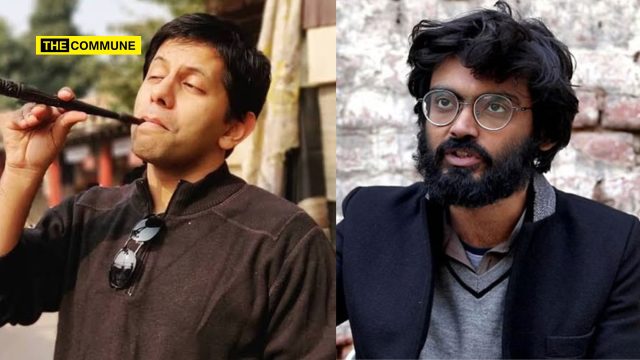
Pro-Congress YouTuber Akash Banerjee, who runs the channel The DeshBhakt, has targeted ThePrint’s pseudonymous columnist Ibn Khaldun Bharati after the writer published an opinion piece examining Sharjeel Imam’s ideological positions.
Instead of addressing the arguments in the article, Banerjee questioned the writer’s identity, insinuated that ThePrint founder Shekhar Gupta could be operating behind the pseudonym, and accused the publication of promoting RSS talking points.
The piece, titled “Sharjeel Imam’s Islamist manifesto will be forgotten. The silence of liberals will not,” was published on 17 October 2026. 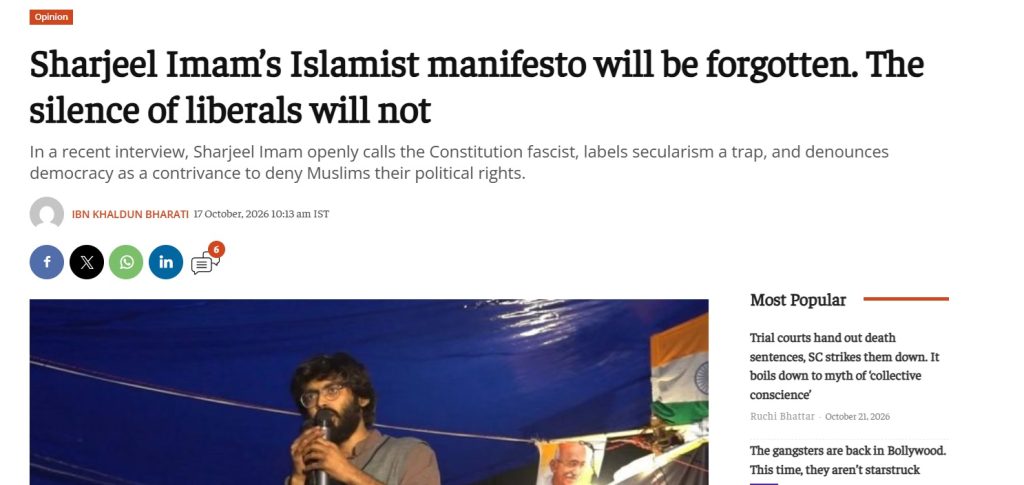
It examined Imam’s recent interview with The Quint, in which he reportedly described the Constitution as fascist, characterised secularism as a trap and questioned the idea of Indian national identity.
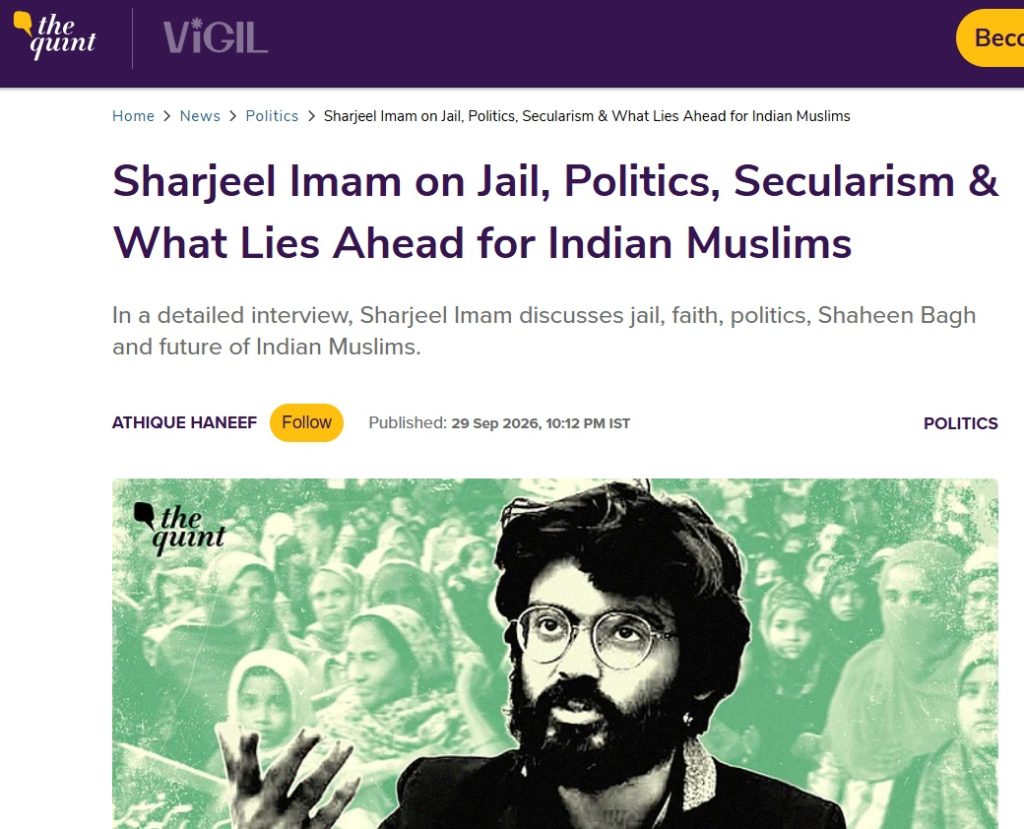
Imam, who has been in jail since January 2020 in connection with cases related to the anti-CAA protests and the Delhi riots, has also articulated controversial positions on nationalism, Muslim political identity and the legacy of Partition.
ThePrint columnist Ibn Khaldun Bharati argued that these positions exposed a contradiction within sections of the Left-liberal establishment: their opposition to Hindutva, alongside their reluctance to confront ideological positions that challenge secularism and Indian national identity.
Akash Banerjee Questions The Writer’s Identity
Reacting to the article, Banerjee took to X to question whether Shekhar Gupta was using the pseudonym Ibn Khaldun Bharati.
Drawing a comparison with Benjamin Franklin’s historical use of pseudonyms, Banerjee suggested that Gupta might be using an anonymous identity to publish controversial arguments, generate outrage and attract traffic.
He wrote that the columnist’s apparent purpose was to advance “RSS talking points” in polished English. He also pointed to the X account associated with Ibn Khaldun Bharati, claiming that it had existed since 2022 but had posted links to articles published in ThePrint.
Banerjee then directly challenged Gupta, writing, “Shekhar Ji please come out of the closet now …. there is a huge audience that would love the Brown Shirt version of you. Or do bring this student / employee – Ibn Khaldun Bharati into the open :)”
🚨 Does @ShekharGupta channalise his inner Godse though the pseudonym of @IbnKhaldunIndic?
🚨 Benjamin Franklin is often referred to as one of the foremost of the American Founding Fathers, the man who’s liberal ideas helped draft the historical US Declaration of Independence
🚨 But Benjamin had a less glorious side too… he was an absolute master of media manipulation, using alter egos & fake letters to build his printing empire, attack competitors and entertain the public.
🚨 For all his ‘liberal’ ideas, Franklin knew that scandal, controversy and humour drove newspaper circulation. So he crafted highly detailed fictional personas (complete with intricate backstories) to safely comment on controversial issues, poke fun at others & sabotage his business rivals.
🚨 Shekhar Gupta seems have been inspired to try something similar with the creation of Ibn Khaldun Bharati – a faceless/anonymous ‘student of Islam who looks at Islamic history from an Indian perspective’ (except that the Bharati’s only raison d’etre seems to be furthering RSS talking points – dressed in good English)
🚨 Also of particular interest is Bharati’s twitter account – that has been in existence since 2022 – but has tweeted nothing but links to articles written for @ThePrintIndia – talk about a dedicated columnist!! 🙂
🚨 The Print used to have some great reportage and an editorial line that used to money-balance – but now writing under a pseudonym to generate controversy / outrage / traffic is just sad.
🚨 Shekhar Ji please come out of the closet now …. there is a huge audience that would love the Brown Shirt version of you. Or do bring this student / employee – Ibn Khaldun Bharati into the open 🙂— The DeshBhakt 🇮🇳 Akash Banerjee (@TheDeshBhakt) October 20, 2026
The post was an attack on the columnist’s anonymity and alleged ideological affiliations.
ThePrint has previously stated that it knows the identity of the writer and permits the use of the pseudonym. That does not establish that Gupta himself is the author.
What About The Arguments On Sharjeel Imam?
The more significant question is what Banerjee’s response does not address.
ThePrint article examined Imam’s rejection of the Indian nation-state framework, his criticism of secularism and his conception of Muslim political identity. It also discussed his interpretation of Partition and his arguments about the relationship between religious identity and political power.
The columnist argued that Imam’s position went beyond demands for minority rights and instead envisaged a separate political status for Muslims within India. The article compared aspects of this argument with earlier ideas associated with the Muslim League and Jamaat-e-Islami.
But Banerjee’s post did not engage with any of these arguments. Instead, it shifted the focus to the identity of the person making them and accused ThePrint of advancing an RSS agenda.
Questioning an author’s identity is not the same as rebutting the author’s arguments. Even if the use of a pseudonym warrants scrutiny, it does not by itself invalidate the claims made in an article.
A Defence Of Imam By Attacking His Critic
Banerjee’s reaction effectively amounts to an indirect justification of Sharjeel Imam’s controversial ideological positions. Rather than challenge Imam’s reported remarks about the Constitution, secularism, nationalism and Partition, Banerjee launched an attack on the journalist who exposed them, questioning the writer’s identity and accusing ThePrint of pushing RSS talking points.
If Banerjee disagreed with Imam’s views, why was he more outraged by an article criticising them than by the views themselves? Instead of rebutting the arguments presented in the article, he chose to discredit the author and shift the debate towards alleged ideological motives.
By directing his attack at the messenger rather than confronting the message, Banerjee ended up deflecting scrutiny from Imam’s reported statements. His post does not explicitly endorse every position attributed to Imam, but his response effectively shields those positions from substantive criticism while attacking the person who brought them into focus.
Subscribe to our channels on WhatsApp, Telegram, Instagram and YouTube to get the best stories of the day delivered to you personally.