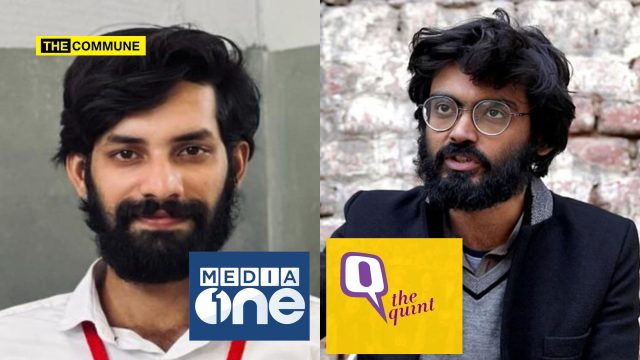
Leftist rag The Quint has rolled out the red carpet for terror accused Sharjeel Imam.
On 29 September 2026, The Quint published a lengthy interview with Sharjeel Imam conducted by Jamaat-e-Islami Hind owned MediaOne channel’s journalist Athique Haneef.
Haneef does not just give Sharjeel Imam a platform. He gives him plenty of space to explain away his political record, his role in Shaheen Bagh and his ongoing legal case without asking the tough questions that should have followed.
Instead of questioning Imam about his controversial speeches, his role in the Delhi riots conspiracy case, his views on the Constitution and his calls for religious and political mobilisation, the interview sanitises everything and allows him to portray himself as a persecuted “political prisoner”, an ignored figure of Shaheen Bagh and a victim of an allegedly “Islamophobic” state.
In the end, it reads less like a tough interview and more like a long opportunity for Sharjeel Imam to tell his side of the story with very little challenge from the interviewer.
Whitewashing Right From The Start
The headline itself presented Imam’s worldview prominently: “The Secular Consensus is a Trap for Indian Muslims.”
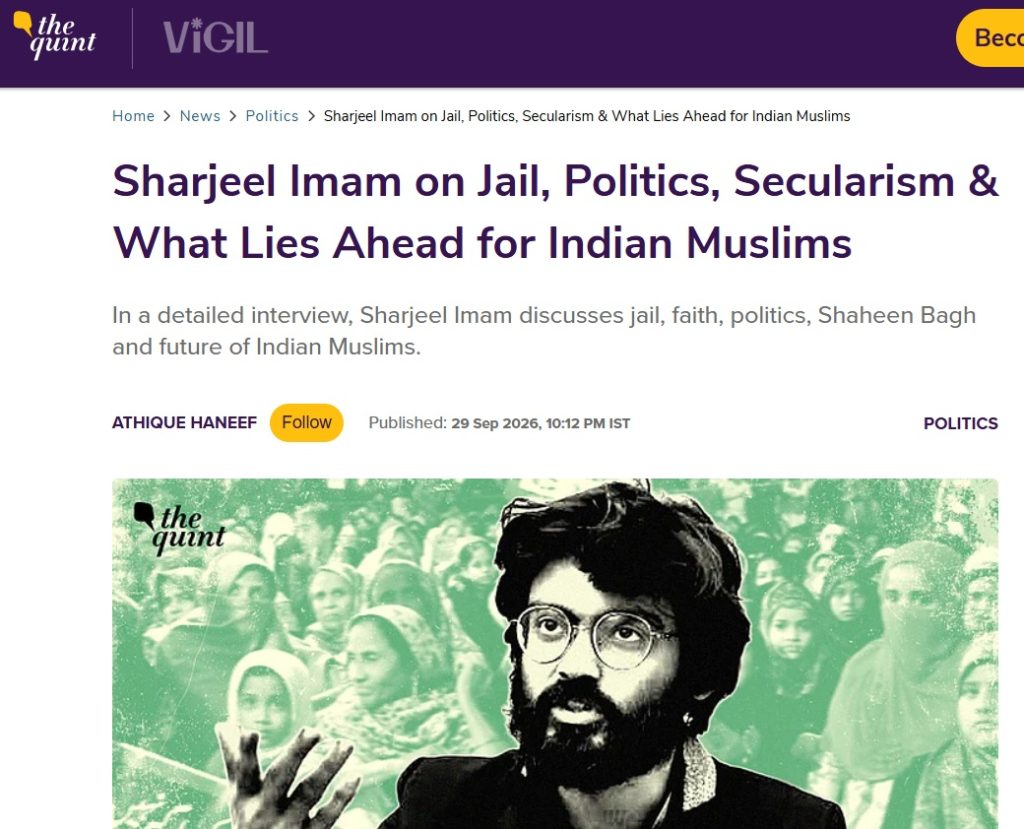
The article begins with an editorial declaration that is difficult to miss: “We are able to provide a platform to political prisoners like Sharjeel Imam and Umar Khalid because of our editorial independence.”

That is not simply an introduction to an interview. It is a characterisation of Imam’s status.
Imam is an accused in the larger conspiracy case relating to the 2020 Northeast Delhi riots. In January 2026, the Supreme Court declined to grant him bail. The Court’s judgment records that he is an accused in FIR 59/2020, that the chargesheet invokes provisions of the IPC, UAPA, Arms Act and other laws, and that the prosecution alleges a larger conspiracy behind the violence.
The Delhi High Court again rejected his bail plea on 30 September 2026. The court recorded that Imam and Umar Khalid were prima facie attributed a central role and were alleged to be ideological drivers of the conspiracy, with the prosecution case concerning speeches, meetings, digital communications and alleged strategic deliberations.
Calling him a “political prisoner” in the publication’s own voice moves beyond describing his legal status as an undertrial and adopts a contested political interpretation of his imprisonment.
“Without Trial” – But What About the Case Against Him?
Haneef’s first question asks Imam how faith sustains him after spending “over 5 years in jail without trial”.
This wording reduces a complicated criminal proceeding to a simple narrative of a person being imprisoned without judicial process.
The Supreme Court’s judgment records the chargesheet, the extensive charges against the accused and the prosecution’s case concerning the alleged conspiracy.
The interview’s premise is established before the questioning even begins.
Then Comes Imam’s Extraordinary Constitutional Claim
Imam tells The Quint, “the Constitution is noble, so noble that no one should complain, while the truth is that it has enshrined centralisation, denied Muslim representation (by mandating only territorial constituencies with joint electorates), and prohibited Muslim and Christian reservation in branches of states…”
He then says, “The Secular framework is devoid of any real understanding of history and is particularly Islamophobic and parochial.”
And he goes further, “In short, both Secular and Hindutva frameworks share the same core ideas — myth of uniformity, centralisation and denial of sharing of power.”
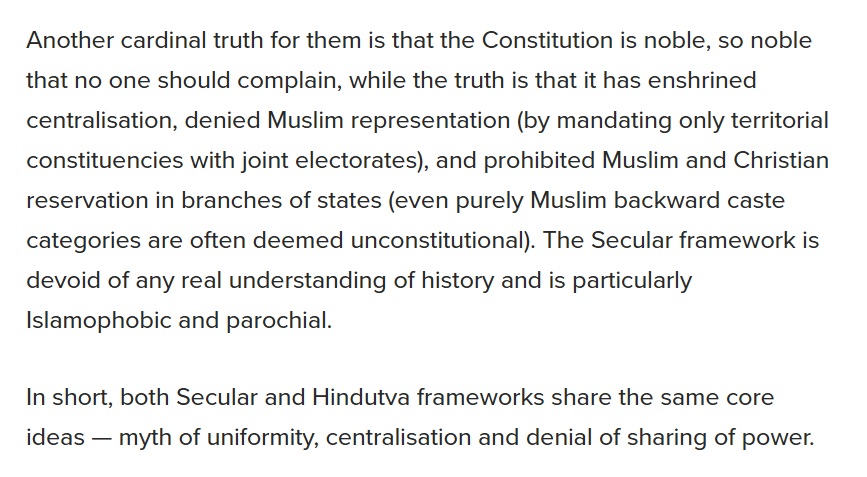
These are sweeping political and historical claims.
Yet Haneef does not ask Imam to substantiate them.
There is no serious follow-up on what precisely he means by the Constitution “denying Muslim representation”, no examination of his claim about reservations, and no challenge to the assertion that India’s secular constitutional framework is inherently “Islamophobic”.
Instead, the claims are allowed to stand as the intellectual premises of the conversation.
The Interview Allows Imam to Rewrite Shaheen Bagh Story
Another particularly important section concerns Shaheen Bagh.
Imam claims that his role has been erased by progressive circles and describes himself as a founding figure in the movement.
Haneef asks why “mainstream progressive circles” supposedly abandoned him and why his role was erased.
The question doesn’t primarily ask whether Imam’s account of his role is accurate. It assumes a narrative of erasure and invites him to explain why it happened.
The courts have found that Imam played a consequential role. None of that is discussed. The entire focus is on whitewashing the crimes.
The January 2026 judicial record notes allegations that Imam delivered speeches calling for disruptive “chakka jams” and that the prosecution linked these speeches to the establishment of Shaheen Bagh and subsequent protest sites.
The September 2025 Delhi High Court record similarly describes the prosecution’s allegation that Imam promoted disruption of essential services through chakka jams and records allegations concerning meetings and mobilisation.
An interview that wants to seriously examine Imam’s role should put these allegations to him directly.
Instead, the conversation spends considerable space on the claim that progressives erased his contribution.
The “Fascists” Claim is Simply Allowed to Pass
Imam says, “I take pride in the fact that I am among those chosen by the fascists to be incarcerated.”
That is an extraordinary political characterisation.
Who exactly are the “fascists”? What does he mean by the term? What evidence supports the characterisation?
Does he consider India’s constitutional institutions, courts and criminal justice system to be part of a fascist state?
The interviewer does not press him on any of these questions. The term simply becomes part of the interview’s narrative vocabulary.
Imam’s Political Programme is Treated as Intellectual Reflection
The most revealing portion comes towards the end.
Imam says, “we have to, in partnership with the young aalims of this country, develop this rationalist, empathetic and emancipatory discourse of our religion; focus our gaze back to the Qur’an and the tawatur sunnat of the Prophet, and work out the meaning of Tawhid for our age and generation as we fight against both ancient and modern idols of oppression.”
He then says, “So, refining our religious and political ideas, explaining them to our masses, building organisation; electoral strength and agitational capacity — I wish to be able to play a part in all or any of these…”
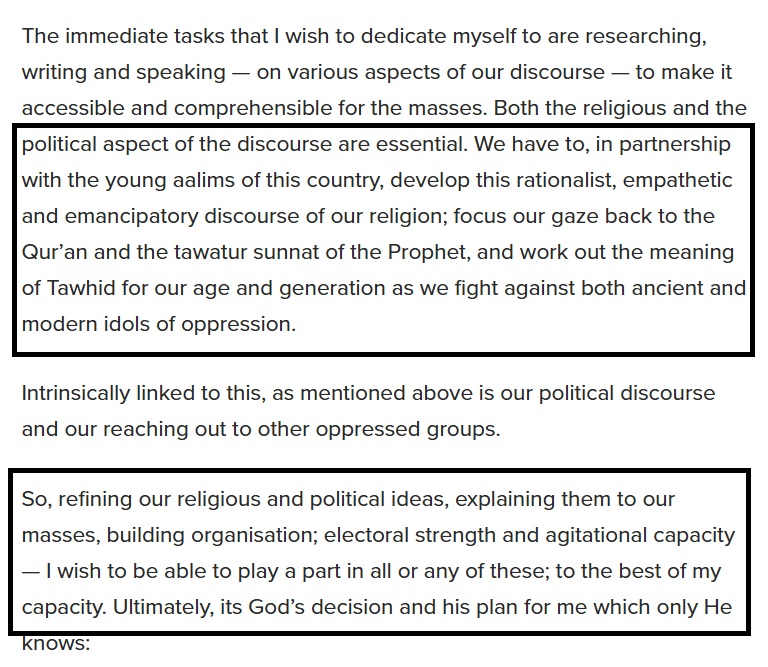
This is not simply a discussion about prison conditions. Imam is articulating a political project involving religious mobilisation, community organisation, electoral strength and “agitational capacity”.
That is newsworthy in itself.
Yet the interviewer does not ask what such an organisation would look like, what political objectives it would pursue, what relationship it would have with existing Muslim organisations, or what he means by “agitational capacity”.
The reader is essentially given Imam’s political manifesto without the adversarial questioning one would expect when interviewing a controversial political actor.
The Jinnah and Partition argument deserved scrutiny
Imam also presents a highly revisionist interpretation of Partition and Congress’s role.
He argues that, “the Brahminical forces in Congress, along with capitalist cliques wanted a centralised India … and hence rejected Muslim League’s demand for decentralisation and partitioned the country”
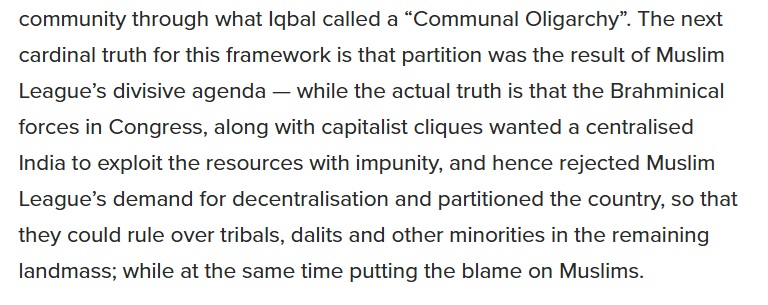
That is an enormous lie he is peddling there.
A journalist interviewing someone making such a claim could ask him to identify the evidence, distinguish between Congress’s documented positions and his interpretation, and address the extensive historical scholarship on the Muslim League, Congress, constitutional negotiations and Partition.
Instead, the claim becomes another building block in Imam’s larger narrative.
The Gaza Language is Similarly Presented Without Context
Imam describes Israel as, “a racist settler colonial state” and refers to “a genocide”.
He then says, “faith is the most important weapon in the hands of those resisting.”
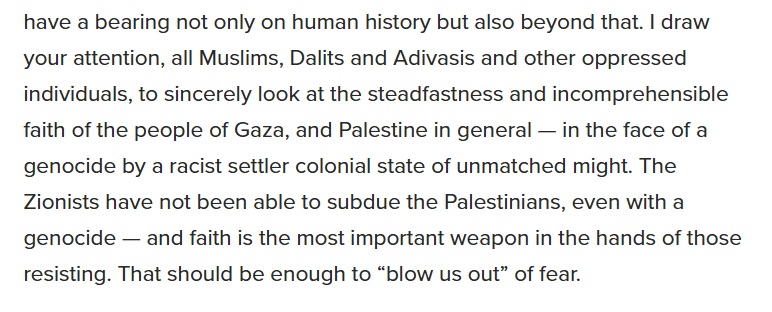
These are typical propaganda playbook statements.
A journalist can certainly allow a political interviewee to use them. But if the stated objective is rigorous journalism, the interviewer should identify them as Imam’s characterisations and probe what he means by them.
Instead, they are simply incorporated into the interview.
The “Political Prisoner” Narrative
The Quint has previously used similar language about Imam.
A separate August 2026 Quint article written by Imam’s brother was titled “The Grief We Cannot Perform” and explicitly described Sharjeel as a “political prisoner”, while arguing that public memory should focus on “resistance” rather than suffering.
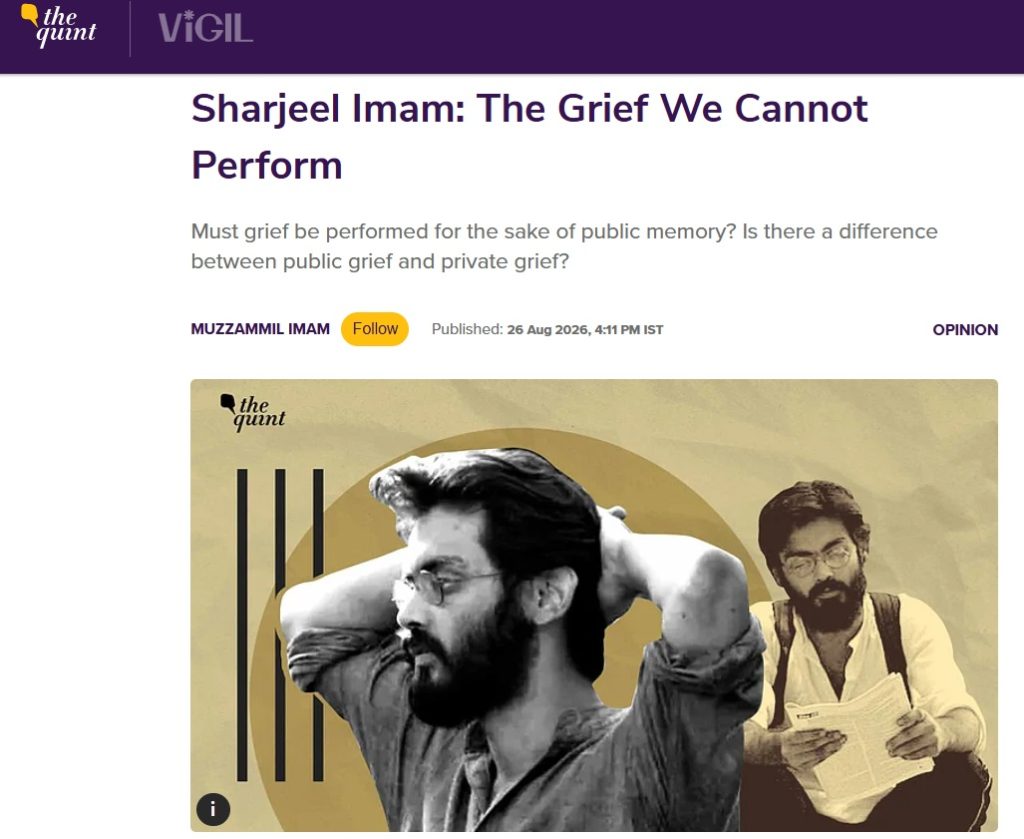
The present interview therefore does not exist in isolation. It is a broader propaganda in which Imam is repeatedly presented as persecuted by the state through imprisonment, that he is an icon of resistence.
Who is Asking the Questions Matters Too
The journalist Athique Haneef’s own professional background is important for readers to evaluate the interview.
His public LinkedIn profile identifies MediaOne TV as an employer and lists MediaOne publications among his professional work. MediaOne TV is operated by Madhyamam Broadcasting Ltd.
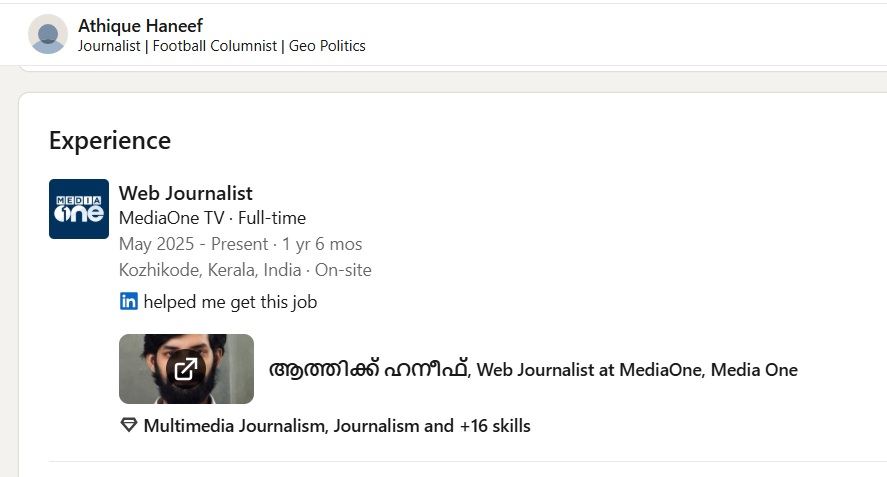
MediaOne’s institutional background is a problem. It is said to be owned by Jamaat-e-Islami Hind. They have previously peddled lies about the RSS and propaganda about Hinduism and Hindutva. Even recently, the same channel peddled conspiracy theories about the flydubai attempted hijack incident and went on to frame it as a crash in Saudi Arabia while identifying only the Indian pilot.
This makes Haneef and the intent of the interview itself evident that it was done to focus heavily on Muslim political mobilisation.
And Who Owns The Quint?
The Quint says on its own “About Us” page that Quint Digital Limited owns the publication and identifies Raghav Bahl and Ritu Kapur as its promoters.
There is also a documented financial relationship between Bahl’s Quintillion Media and The News Minute. In 2015, Quintillion Media invested an undisclosed amount in The News Minute, with Ritu Kapur joining the board of TNM’s parent company. That corporate relationship is a matter of record.
We know how The News Minute whitewashes Muslim perpetrators of crime and makes it seem as if the accused is always a Hindu.
What is Missing is Ultimately More Revealing Than What is Present
The interview could have asked Imam:
Why does he advocate “chakka jam” and what limits does he place on disruptive protest?
Does he accept any responsibility for the consequences of the mobilisation he helped organise?
What exactly does he mean by calling the Indian secular framework “Islamophobic”?
What constitutional model does he want instead?
Does he support religiously organised political mobilisation?
What does “agitational capacity” mean?
Does he believe Islamic political principles should influence state policy?
What evidence supports his interpretation of Congress and Partition?
Does he accept the distinction between an accused political activist and a person legally established to be a political prisoner?
Those questions would not require the interviewer to endorse the prosecution’s case.
They would simply require him to challenge his interviewee.
Instead, the interview functions as a vehicle through which Imam gets to explain why his critics misunderstood him, why progressives abandoned him, why his role was erased, why the Constitution is problematic for Muslims, why the secular consensus is a trap, and why he believes religious and political mobilisation should be strengthened.
The Quint’s interviewer gave Sharjeel Imam an unusually sympathetic, largely unchallenged platform to sanitise his crimes and rewrite his political identity — from an accused in a serious UAPA case into a “political prisoner”, from someone who instigated secession into an erased founder of Shaheen Bagh, and from a defendant facing prosecution allegations into a dissident intellectual whose critics supposedly failed to understand him.
This interview exposes both MediaOne, its journalist, and The Quint revealing where their loyalties lie. Clearly, not with India and the Indian state.
Subscribe to our channels on WhatsApp, Telegram, Instagram and YouTube to get the best stories of the day delivered to you personally.