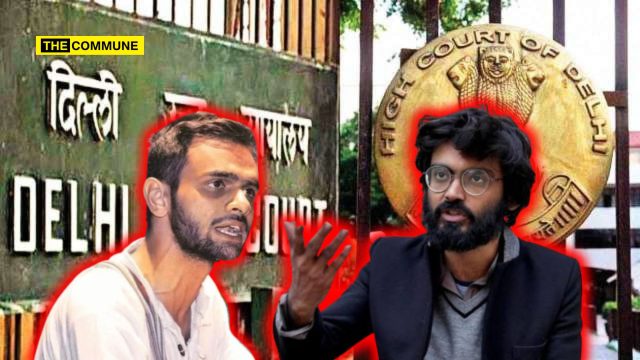
The Delhi High Court on Wednesday, 30 September 2026, dismissed the appeals filed by former JNU scholar Umar Khalid and Sharjeel Imam challenging the rejection of their bail pleas in the larger conspiracy case relating to the 2020 North-East Delhi riots, as reported in LawChakra.
A Division Bench comprising Justice Prathiba M. Singh and Justice Dinesh Bhatt held that it was bound by the Supreme Court’s 5 January 2026 judgment in Gulfisha Fatima v. State, which had laid down specific conditions under which Khalid and Imam could renew their pleas for bail.
The case arises from FIR No. 59 of 2020, investigated by the Special Cell of the Delhi Police, which invokes provisions of the Indian Penal Code as well as the Unlawful Activities (Prevention) Act, 1967.
High Court Says Supreme Court Conditions Cannot Be Modified
In Gulfisha Fatima, the Supreme Court had granted bail to five co-accused but denied bail to Khalid and Imam. The Court permitted the two to renew their bail pleas upon either the completion of the examination of the protected witnesses relied upon by the prosecution or the expiry of one year from January 5, 2026, whichever was earlier.
The Delhi High Court held that it could not modify those conditions.
The Bench observed, “This court is bound by judicial discipline.”
The High Court noted that the Supreme Court had considered Khalid and Imam separately from the other accused while deciding their bail pleas. The Supreme Court had also granted them liberty to renew their applications subject to the conditions specified in its judgment.
During the hearing, the High Court had asked counsel for the two accused whether they were willing to wait until the first week of January 2027 to press their appeals. The counsel made it clear that they wanted the appeals to be decided and did not wish to wait.
The High Court therefore proceeded to consider the grounds raised in support of their fresh bail pleas.
Three Changed Circumstances Cited For Bail
The fresh bail applications relied on three developments.
First, the applicants pointed to subsequent Supreme Court proceedings in which the reasoning concerning prolonged incarceration and delay in UAPA trials had come under scrutiny.
Second, they relied on the grant of interim bail to co-accused Tasleem Ahmed and Khalid Saifi on grounds relating to delay in the trial.
Third, they argued that a further period of incarceration had elapsed since the Supreme Court’s Gulfisha Fatima judgment.
The High Court, however, held that these developments did not allow it to override or modify the specific conditions imposed by the Supreme Court in respect of Khalid and Imam.
The Bench also rejected the plea of parity with Tasleem Ahmed and Khalid Saifi, observing that the roles attributed to those accused were different from the roles attributed to Khalid and Imam.
The Court accordingly held that the two could not seek bail merely by relying on the interim bail granted to the co-accused.
Supreme Court Reference To Larger Bench
The applicants had also relied upon subsequent proceedings before the Supreme Court concerning the interpretation of prolonged incarceration and delay in UAPA cases.
The issue arose after a Supreme Court Bench led by Justice B.V. Nagarathna expressed reservations regarding the approach adopted in Gulfisha Fatima, particularly in light of the three-judge Bench judgment in Union of India v. K.A. Najeeb (2021), which recognised that prolonged delay in trial can be relevant to the question of bail even in UAPA cases.
In May 2026, the Bench led by Justice Aravind Kumar, which had decided Gulfisha Fatima, referred the perceived conflict concerning the interpretation of K.A. Najeeb to a larger Bench.
The Delhi High Court nevertheless held that the subsequent developments did not empower it to alter the specific conditions imposed by the Supreme Court on Khalid and Imam.
High Court Dismisses Appeals
After considering the submissions, the Delhi High Court concluded that it could not find fault with the trial court’s decision to reject the bail pleas in view of the Supreme Court’s directions.
The Bench held, “In view of the above discussion and the overall facts of the case, specifically the conditions imposed qua the appellants in Gulfisha case, this Court cannot find fault with the decision of the trial court. Accordingly, the appeals are dismissed.”
The appeals were consequently dismissed.
The High Court was hearing appeals under Section 21 of the National Investigation Agency Act against the 4 July 2026 order of the trial court rejecting Khalid’s third bail plea and Imam’s bail plea. The trial court had held that it was bound by the Supreme Court’s earlier decision refusing bail to the two.
Background Of The Case
The proceedings relate to FIR No. 59 of 2020 concerning the alleged larger conspiracy behind the communal violence that broke out in North-East Delhi in February 2020. The FIR was registered by the Delhi Police Special Cell and invokes offences under the IPC and UAPA.
The Supreme Court’s January 2026 judgment in Gulfisha Fatima granted bail to five co-accused while refusing bail to Khalid and Imam, with liberty to renew their pleas upon fulfilment of the conditions specified by the Court.
The Delhi High Court’s September 30 decision has now left the trial court’s rejection of their regular bail pleas undisturbed.
Subscribe to our channels on WhatsApp, Telegram, Instagram and YouTube to get the best stories of the day delivered to you personally.