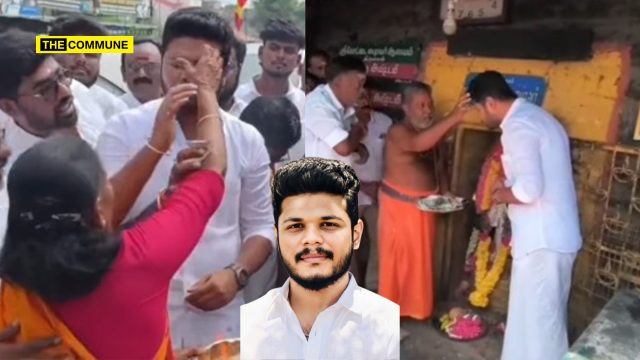
TVK Minister for Labour Welfare and Skill Development, Dr. J. Muhammad Parvez, visited the Bhairavar Temple in Thirumayam and offered prayers days after attracting criticism for preventing a woman from applying a tilak on his forehead during a public event in Pudukkottai.
Parvez had recently attended the inauguration of a buttermilk distribution camp organised by the Dawah wing in Pudukkottai district. During the event, women welcomed him with traditional aarathi and attempted to apply a tilak on his forehead.
However, the Minister stopped the woman from placing the tilak, with videos of the incident quickly spreading on social media. The visuals triggered criticism from several quarters, with critics accusing him of rejecting a customary Hindu form of welcome.
Amid the controversy, Parvez on Tuesday, 16 June 2026 visited the Bhairavar Temple, also known locally as the Thirumayam Kavalar Kovil, in Pudukkottai district.
During the visit, the Minister offered prayers, performed rituals, broke a coconut before the deity and received a tilak on his forehead. Photographs of Parvez worshipping at the temple and wearing the tilak were subsequently released and circulated on social media.
The temple visit comes shortly after the criticism surrounding the Pudukkottai incident, leading many observers to view it as a response to the backlash generated by his earlier refusal to accept the traditional tilak.
Subscribe to our channels on WhatsApp, Telegram,Instagram and YouTube to get the best stories of the day delivered to you personally.
A woman from Kerala was allegedly sexually harassed by a man who was standing at the Tiruppur bus stand, claiming to take her and get her a job, police said.
The victim was rescued, a case was registered, and the police are investigating the incident.
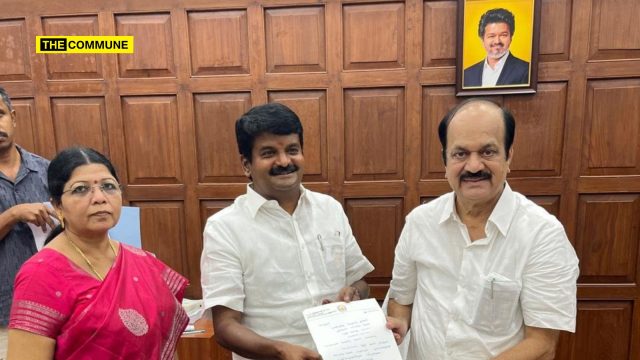
In another setback for the AIADMK, former Health Minister and Viralimalai MLA Dr. C. Vijayabaskar resigned from the Tamil Nadu Legislative Assembly on Tuesday, 16 June 2026, as reported in The Hindu.
Dr. Vijayabaskar submitted his resignation letter to Tamil Nadu Legislative Assembly Speaker JCD Prabhakar at the Secretariat in Chennai. The Speaker later confirmed that he had accepted the resignation of the AIADMK leader.
Tamil Nadu: AIADMK MLA and Former Tamil Nadu Minister Dr C Vijayabaskar has resigned from his membership in the Tamil Nadu Legislative Assembly.
The resignation marks the latest development in the continuing exodus of AIADMK legislators following the 2026 Assembly elections and further weakens the party’s position in the Assembly.
Dr. Vijayabaskar is the fifth AIADMK MLA to resign from the Assembly within weeks of the elections. Earlier, Maduranthakam MLA Maragatham Kumaravel, Perundurai MLA S. Jayakumar, Dharapuram MLA P. Sathyabama and Ambasamudram MLA Esakki Subaya resigned from their Assembly seats and subsequently joined the ruling Tamilaga Vettri Kazhagam (TVK).
A senior AIADMK leader with decades of association with the party, Vijayabaskar has been linked to the organisation since his college days. He served as Tamil Nadu’s Health Minister between 2013 and 2021 under the governments headed by former Chief Ministers J. Jayalalithaa, O. Panneerselvam and Edappadi K. Palaniswami.
His electoral career spans more than two decades. Vijayabaskar was first elected to the Tamil Nadu Legislative Assembly from Pudukkottai in 2001. He later represented Viralimalai and won the constituency in the 2011, 2016, 2021 and 2026 Assembly elections.
The resignation comes amid growing turmoil within the AIADMK after a group of legislators openly defied the party leadership during the confidence vote held for the TVK government led by Chief Minister C. Joseph Vijay.
Vijayabaskar was among the 25 rebel AIADMK MLAs who voted in favour of the TVK government during the trust vote in the Assembly on May 13, despite directions issued by the party whip to oppose the motion.
The rebellion triggered a major political crisis within the AIADMK and fuelled speculation that several legislators were preparing to align themselves with the ruling TVK.
With Vijayabaskar’s resignation, the number of AIADMK MLAs quitting the Assembly after the elections has now risen to five, intensifying concerns over the party’s ability to maintain its legislative strength in the face of growing defections.
While Vijayabaskar has not yet publicly announced his future political course, his resignation is expected to further strengthen speculation about a possible shift towards the ruling camp, following the path taken by several other former AIADMK legislators who have already crossed over to the TVK.
Subscribe to our channels on WhatsApp, Telegram,Instagram and YouTube to get the best stories of the day delivered to you personally.
A growing trend within sections of America’s Christian conservative movement is drawing attention after several women publicly expressed support for giving up their own voting rights in favour of a “one household, one vote” system led by male heads of families, as reported in OpIndia.
The debate gained renewed attention following discussions at the recent Turning Point USA (TPUSA) Women’s Leadership Summit in San Antonio, Texas, where a number of Christian conservative women reportedly argued that women should voluntarily surrender their voting rights in pursuit of what they described as a more Christian society.
The event was led by Erika Kirk, widow of conservative activist Charlie Kirk, and featured discussions reflecting broader debates within the American Christian Right over gender roles, family structures and political participation.
According to a report by CBC, one of the most prominent voices advocating the position was conservative influencer Savanna Stone, who has nearly half a million followers on Instagram and is widely associated with the “trad wife” movement that promotes traditional gender roles.
CBC reported that Stone argued against women’s voting rights and supported a one-household-one-vote model. She reportedly claimed that women tend to vote for more liberal candidates and that relinquishing their voting rights would help create a more conservative and Christian America. Stone also reportedly argued that wives should vote the same way as their husbands.
CBC reported that Stone was not alone in expressing such views.
The broadcaster quoted Brooke Foxworthy, a stay-at-home mother, as saying that she would be comfortable with her husband voting on behalf of the household.
According to CBC, Foxworthy stated that if her husband was the head of the household, she considered herself the “neck” and believed they worked together cohesively. She reportedly said she would be comfortable if her daughter also lost the right to vote because she expected her to eventually marry a “biblical man” whose political values would align with hers.
CBC also quoted a 19-year-old nursing student from San Diego who reportedly said that although she personally would want to cast her vote, she believed eliminating women’s voting rights could actually benefit women.
Another participant, Alexus DeGraaf, reportedly told CBC that as a Christian woman she viewed herself and her husband as “one flesh.” According to the report, DeGraaf said she voted the same way as her husband and would therefore be comfortable surrendering her own voting rights because she believed he would represent her interests adequately.
The controversy has revived scrutiny of similar arguments advanced by Christian nationalist figures and organisations in recent years.
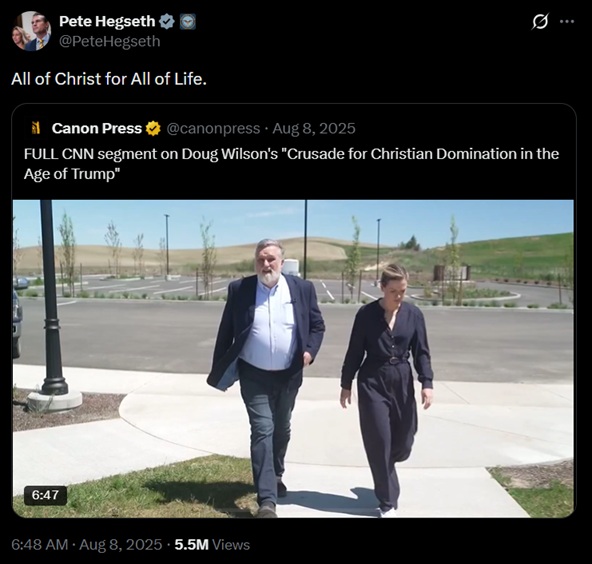
In 2025, US Defence Secretary Pete Hegseth faced criticism after reposting an interview featuring Christian nationalist pastor Doug Wilson and members of Wilson’s church discussing why they believed women should not vote.
Wilson, founder of Christ Church, has long been associated with Christian nationalist ideas. According to reports, several members of the church have publicly supported restricting women’s participation in political decision-making.
A 2025 report by Politico quoted Jared Longshore, a minister associated with Wilson’s church, as expressing support for a household-based voting model.
Longshore reportedly argued that scripture established a hierarchy in which husbands served as the head of the household while wives occupied a subordinate position. He was quoted as saying that although he was not actively campaigning to repeal the 19th Amendment, which granted women the right to vote in the United States, he would support such a move if asked.
Longshore reportedly stated that America effectively operated under a one-vote-per-household model before the women’s suffrage movement and argued that such a system would be beneficial.
Following criticism, Hegseth responded through a spokesperson, who stated that he was a proud member of the church and appreciated many of Longshore’s writings. Critics interpreted the response as a tacit endorsement of the broader ideological positions associated with the church.
The debate has also prompted renewed discussion about traditional Christian teachings on gender roles.
It is noteworthy that in Christian nationalism several Biblical passages have historically been interpreted as establishing male authority over women.
Among the verses frequently cited are 1 Corinthians 11:3–9, which states that “the head of the woman is man” and that woman was created for man; 1 Timothy 2:11–15, which instructs women not to assume authority over men; and Ephesians 5:22–24, which calls upon wives to submit to their husbands.
For those supporting traditional doctrines, such passages describe complementary roles within marriage rather than political disenfranchisement. It is noteworthy that these interpretations have historically been used to justify restricting women’s participation in public life.
The emergence of women publicly advocating the surrender of their own voting rights has generated significant discussion online, however, the reaction from prominent conservative women and Republican leaders has been comparatively muted.
Democratic activist Sara McGee was among those who publicly criticised the trend. She reportedly suggested that women who genuinely believed they should not vote were free to voluntarily abstain from elections rather than advocating the removal of voting rights for others.
If MAGA women believe that women shouldn’t have the right to vote, then they should go ahead and live their truth now and stop voting. pic.twitter.com/9TrbYP9vH5
— Sara McGee for Texas HD 132 (@SaraForTexLege) June 13, 2026
The controversy has also reignited debate over the influence of Christian nationalism within American politics.
Data from the Public Religion Research Institute (PRRI) indicates that Christian nationalist ideas enjoy significant support among sections of the American electorate.
According to PRRI’s 2024 findings, approximately 29% of Americans either identified as adherents of Christian nationalism or expressed sympathy towards its core ideas.
The study also found a strong correlation between Christian nationalist beliefs and political affiliation.
PRRI reported that among Republicans, 21% qualified as Christian nationalist adherents and 33% as sympathisers. By contrast, the majority of Democrats and independents fell into categories that were sceptical of or opposed to Christian nationalism.
According to the organisation, Republicans were roughly four times more likely than Democrats or independents to qualify as adherents of Christian nationalism, but for Christian.
The controversy reveals an uncomfortable reality: Christian nationalism is not merely a movement seeking greater public visibility for religion, but one that increasingly challenges core democratic norms when they conflict with its interpretation of Biblical authority. Calls to roll back women’s political participation are not aberrations but flow naturally from doctrines that place men above women in both family and society.
That such views are now being voiced openly at major conservative gatherings and defended by women themselves suggests that ideas once considered politically toxic are steadily entering mainstream right-wing discourse. The debate is therefore not simply about voting rights; it is about the growing acceptance of a religious-political ideology that seeks to subordinate individual rights to a rigid, male-dominated vision of social order.
Subscribe to our channels on WhatsApp, Telegram,Instagram and YouTube to get the best stories of the day delivered to you personally.
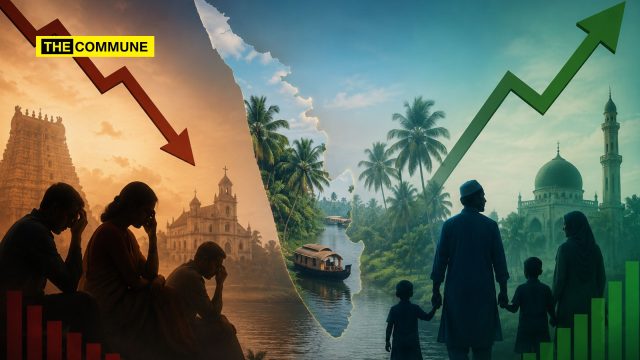
A decadal analysis of official demographic data has revealed that Kerala’s Hindu and Christian communities are now recording more deaths than births annually, resulting in a negative Natural Growth Rate (NGR), while the state’s overall population growth remains positive due to the Muslim community continuing to record higher births than deaths, as reported in The New Indian Express.
The findings are based on birth and death data published in the Kerala government’s annual Vital Statistics Reports between 2014 and 2023 by the Department of Economics and Statistics.
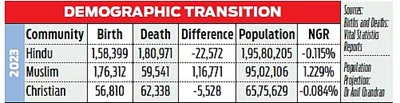
According to the latest available figures for 2023, Kerala’s overall Natural Growth Rate, calculated as births minus deaths per 100 population, stood at 0.249%. However, the Hindu community recorded an NGR of -0.115%, while the Christian community recorded -0.084%.
Demographers note that a negative natural growth rate indicates that a community is no longer replacing its population through births alone, with deaths outnumbering births over a given period.
The data showed that 2023 was the second consecutive year in which Hindus recorded a negative natural growth rate. The Hindu NGR first entered negative territory in 2022 at -0.080% before declining further to -0.115% in 2023.
The Christian community has been in negative territory for a longer period. Christians first recorded a negative natural growth rate in 2021 at -0.095%, and the figure stood at -0.084% in 2023.
Commenting on the trend, Dr. Anil Chandran S., Assistant Professor in the Department of Demography at the University of Kerala, reportedly said that Hindu and Christian communities were leading Kerala’s broader demographic transition towards a negative natural growth rate.
He stated that population decline within these communities had begun among upper-class sections several decades ago and had gradually expanded to wider sections of society.
Dr. Chandran further observed that projections suggested Kerala’s overall natural growth rate could turn negative by 2041.
According to him, as Kerala increasingly becomes an ageing society, the communities that entered negative natural growth territory earlier would likely experience the consequences of demographic decline before others.
While the Muslim community continued to record a positive natural growth rate, the data also showed a steady decline over the past decade.
The Muslim community’s NGR reportedly fell by around 35% between 2014 and 2023, declining from 1.898% to 1.229%.
Dr. Chandran noted that the Muslim community was also following a similar demographic trajectory, though at a slower pace. He reportedly stated that both the birth rate and natural growth rate among Muslims were declining and predicted that the community could also eventually register negative growth within two decades of Kerala’s overall natural growth rate turning negative.
The birth and death figures over the decade illustrate the demographic shift across all three major religious communities in the state.
Among Hindus, births declined from 2,31,031 in 2014 to 1,58,399 in 2023, representing a fall of nearly 31%. During the same period, deaths increased from 1,50,159 to 1,80,971.
Among Christians, births fell by approximately 32%, declining from 83,616 in 2014 to 56,810 in 2023. Meanwhile, deaths increased by 24%, rising from 50,095 to 62,338.
The Muslim community also recorded a decline in births, though at a slower rate. Births fell by 19.3%, from 2,18,437 in 2014 to 1,76,312 in 2023. Deaths increased by 28.1% during the same period, rising from 46,468 to 59,541.
Image Source: TNIE
Despite the decline in birth rates and increase in deaths, Muslim births continue to substantially outnumber deaths, allowing the community to maintain a positive natural growth rate and keeping Kerala’s overall natural growth rate above zero.
The data highlights Kerala’s ongoing demographic transition, characterised by falling fertility rates, rising life expectancy, population ageing and slowing population growth across all major communities, with Hindus and Christians already entering a phase where annual deaths exceed births.
Subscribe to our channels on WhatsApp, Telegram,Instagram and YouTube to get the best stories of the day delivered to you personally.
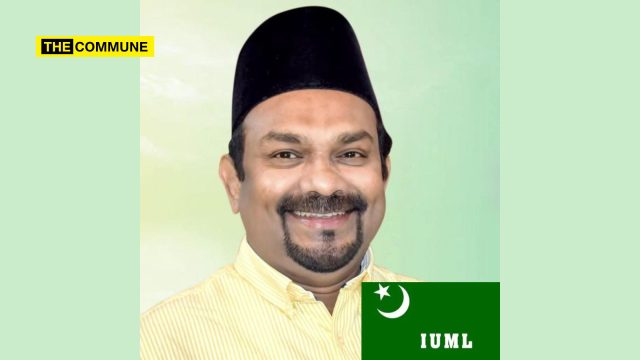
The Indian Union Muslim League (IUML) has claimed that Chief Minister Vijay has assured the party that its long-pending demand to increase the reservation quota for Muslims in Tamil Nadu from 3.5% to 5% would be examined and appropriate action taken after a detailed study.
Speaking to reporters, IUML National General Secretary K. M. Shahjahan said the party had recently raised the issue with the Chief Minister and received a positive response.
“The Indian Union Muslim League has been continuously raising its voice demanding that the 3.5% reservation given to Muslims during the Kalaignar government be increased to 5%. Ten days ago, we placed this demand before the Honourable Chief Minister. He has assured us that he will conduct a proper study and take the necessary steps. We firmly believe that in the coming days, it will certainly be increased,” Shahjahan said.
வெளிப்படையாக மத அரசியல் செய்வது கடும் கண்டனத்திற்குரியது!
தமிழகத்தில் 3.5% ஆக உள்ள இஸ்லாமியர்களுக்கான உள் இடஒதுக்கீட்டை 5% ஆக உயர்த்த வேண்டுமென சிறுபான்மை நலத்துறை அமைச்சர் திரு. ஷாஜகான் அவர்கள் வைத்துள்ள கோரிக்கை, ஒரு தலைபட்சமான மத அரசியல். பிற்படுத்தப்பட்ட இந்துக்களின்… pic.twitter.com/ewIskV3fab
According to Shahjahan, the demand was formally placed before the Chief Minister around ten days ago. He said the government had indicated that the proposal would be studied before a decision is taken.
Muslims in Tamil Nadu currently receive a 3.5% internal reservation carved out of the 30% Backward Classes (BC) quota. The sub-quota was introduced during the tenure of former Chief Minister M. Karunanidhi.
The IUML has long argued that the existing allocation should be enhanced to better reflect the community’s educational and socio-economic requirements.
The renewed demand comes at a time when debates surrounding reservation policies and internal quota allocations continue to generate political discussion in the state.
An increase in the Muslim sub-quota from 3.5% to 5% would have implications for the overall distribution of seats and opportunities within the Hindu Backward Classes category. Since the Muslim quota is carved out of the existing 30% BC reservation pool, increasing it to 5% would reduce the share available to other non-Muslim BC communities from 26.5% to 25%.
The Tamil Nadu government has not yet made any official announcement regarding a revision of the Muslim reservation quota. However, the IUML’s statement has fuelled speculation that the issue may be under active consideration by the state government.
Subscribe to our channels on WhatsApp, Telegram,Instagram and YouTube to get the best stories of the day delivered to you personally.
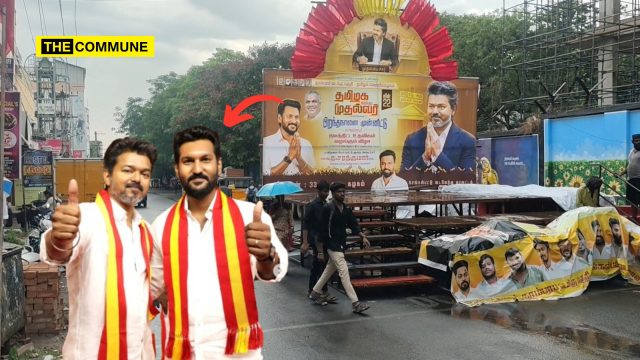
Just days after Chief Minister Vijay and senior Tamilaga Vettri Kazhagam (TVK) leaders reiterated a strict ban on banners, cut-outs and public displays that inconvenience citizens, a birthday celebration event linked to Vijay’s upcoming birthday has triggered controversy in Tambaram.
A stage erected by allegedly encroaching upon a public road in the MEPZ area of Tambaram and posters put up ahead of Vijay’s birthday celebrations have drawn attention, particularly because the event was attended by Tambaram TVK MLA and Minister for Human Resources Management and Ex-Servicemen Welfare, D. Sarathkumar (also known as Ghilli Sarath).
The development comes in contrast to the position repeatedly articulated by Vijay since assuming office as Chief Minister.
Soon after taking charge, Vijay sought to distance his party from Tamil Nadu’s long-standing political culture of giant banners, cut-outs and public celebrations that often obstruct roads and inconvenience the public. The Chief Minister directed party workers not to erect banners, hoardings or similar displays for birthdays, family functions or political events in public spaces, roadsides or crowded locations.
The party leadership warned that strict disciplinary action would be taken against anyone violating the directive and stressed that no celebration should create inconvenience for the general public or disrupt traffic.
The issue carries particular sensitivity because banner culture has been repeatedly criticised by the Madras High Court following the death of Subashri in 2019. The young woman lost her life after a political banner fell onto the road, causing a fatal accident while she was riding a two-wheeler. Since then, courts have repeatedly cautioned political parties against erecting banners and structures that endanger public safety.
Against this backdrop, TVK General Secretary and Rural Development and Water Resources Minister N. Anand recently reiterated the party’s position during a meeting of TVK MLAs, district secretaries and office-bearers at the party headquarters in Panaiyur.
Reviewing arrangements for Chief Minister Vijay’s birthday celebrations scheduled for June 22, Anand instructed party functionaries to completely avoid banner and cut-out culture and instead focus on welfare activities such as annadhanam, medical camps and assistance programmes for the poor.
He reminded party cadres that Vijay had explicitly directed members not to cause any inconvenience to the public during birthday celebrations.
He also acknowledged that banners continued to appear at some party events despite repeated instructions and warned cadres against violating the directive.
However, even as the party leadership was reiterating these instructions, posters celebrating Vijay’s upcoming birthday appeared in the MEPZ area of Tambaram. Additionally, a stage was reportedly erected by occupying a portion of the roadway for a birthday-related event attended by Minister and Tambaram MLA Ghilli Sharath.
Subscribe to our channels on WhatsApp, Telegram,Instagram and YouTube to get the best stories of the day delivered to you personally.
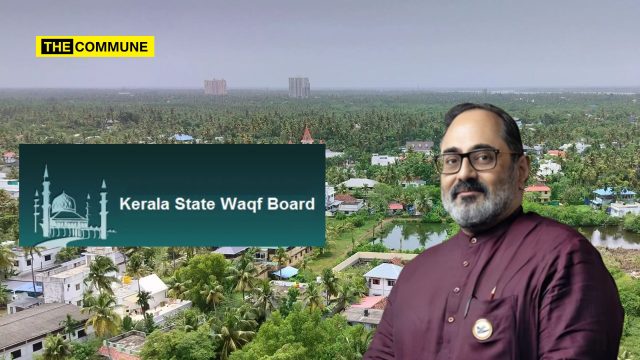
The Central Government has issued a notice to the Kerala Waqf Board seeking an explanation for the inclusion of the disputed Munambam land in the UMEED portal, the Centre’s centralised digital registry of waqf properties.
As reported in The New Indian Express, the Union Government directed the Kerala Waqf Board to respond within five days regarding the registration of approximately 404 acres of disputed land in Munambam, located in Ernakulam district. The notice was issued following complaints received by the Centre over the entry of the land into the digital registry.
The disputed land was reportedly uploaded to the UMEED portal last month using the Kerala Waqf Board’s special powers, triggering objections from local residents and stakeholders involved in the long-running ownership dispute.
The development comes shortly after BJP leader and Nemom MLA Rajeev Chandrasekhar raised the issue with the Union Government and sought intervention in the matter.
Reacting to the Centre’s action, Rajeev Chandrasekhar welcomed the notice and credited the Union Government for acting swiftly on his request.
“Munambam will not become another Waqf land grab,” Chandrasekhar said in a statement.
He thanked Prime Minister Narendra Modi and Union Minority Affairs Minister Kiren Rijiju for intervening in the matter and taking prompt action against what he described as an illegal move by the Kerala Waqf Board.
According to Chandrasekhar, the Kerala Waqf Board’s unilateral registration of the 404 acres of land on the UMEED portal was contrary to the law.
“The Kerala Waqf Board’s unilateral registration of 404 acres in Munambam on the UMEED portal is entirely illegal, since the law vests that authority only with the Mutawalli,” he said.
Stating that the Centre’s notice followed his intervention, Chandrasekhar asserted that no one should assume that a “weak Congress-led government in Kerala” provided a licence to violate the rule of law or disregard the rights of ordinary citizens.
He further stated that the BJP-led NDA would continue to stand with the families of Munambam and defend their property rights and livelihoods.
“The BJP/NDA will continue to stand firmly with the families of Munambam and protect their property rights and livelihoods,” he said.
Chandrasekhar also declared that the party would oppose what he termed “illegal Waqf land grabs” not only in Munambam but elsewhere in Kerala as well.
“We will not allow illegal Waqf land grabs to succeed – whether in Munambam, Taliparamba, or anywhere else in Kerala,” he added.
Munambam will not become another Waqf land grab.
Thank you, PM @narendramodi ji and Union Minister @KirenRijiju ji, for acting swiftly on my request.
The Kerala Waqf Board’s unilateral registration of 404 acres in Munambam on the UMEED portal is entirely illegal, since the law… pic.twitter.com/qGMxBFN0DU
— Rajeev Chandrasekhar 🇮🇳 (@RajeevRC_X) June 15, 2026
Responding to the Centre’s notice, Kerala Waqf Board Chairman K. S. Hamsa said that the Board would submit its response only after a meeting scheduled for June 16.
While media organisations reportedly attempted to contact Hamsa for further clarification, he was unavailable for detailed comments on the issue.
Sources indicate that the Kerala Waqf Board has sought legal opinion regarding the Centre’s notice and is expected to furnish its explanation shortly after the Board meeting.
Meanwhile, members of the Kerala Waqf Board’s Ernakulam division declined to comment on the matter.
The dispute over the Munambam land has remained a politically sensitive issue in Kerala, with residents and various organisations challenging the Waqf Board’s claims over the property. The Centre’s latest intervention is expected to intensify scrutiny of the land registration process and the legal basis on which the disputed land was entered into the UMEED portal.
Subscribe to our channels on WhatsApp, Telegram,Instagram and YouTube to get the best stories of the day delivered to you personally.
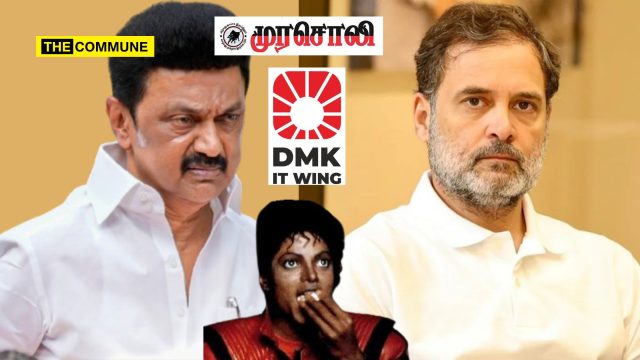
The DMK has launched a blistering two-pronged attack on Leader of Opposition Rahul Gandhi, accusing him of weakening opposition unity across the country while simultaneously mocking him for preaching coalition cohesion after allegedly undermining alliance partners in multiple states.
The attacks came from both the DMK’s official mouthpiece Murasoli and the party’s IT wing, reflecting the deepening rift between the DMK and the Congress following the dramatic political realignment in Tamil Nadu after the 2026 Assembly elections.
In a strongly-worded editorial published on Monday, 15 June 2026, Murasoli dismissed Rahul Gandhi’s recent appeal for opposition unity as a case of “belated enlightenment” and questioned his credibility in speaking about alliance cohesion.
“Rahul Gandhi is lecturing on unity. But who weakened that unity in various states?” the editorial asked, accusing the Congress leader of contributing to divisions within the I.N.D.I. bloc while now attempting to position himself as a champion of opposition solidarity.
The editorial alleged that the Congress had repeatedly employed “underhand tactics” to prevent I.N.D.I. bloc partners from coming to power in Assembly elections across several states, only to later seek their support during Lok Sabha elections. According to Murasoli, the Congress had consistently prioritised its own political interests at the expense of alliance partners, creating distrust and friction within the opposition coalition.
Referring to the recent I.N.D.I. bloc meeting, the DMK mouthpiece claimed that several constituent parties openly criticised the Congress and its leadership. It cited Samajwadi Party leader Akhilesh Yadav as describing the DMK and AAP’s decision to skip the meeting as a significant setback and calling for a serious review of the alliance’s future.
The editorial also referred to concerns reportedly expressed by RJD leader Tejashwi Yadav regarding the Congress’ functioning in Bihar and claimed that leaders from parties including the VCK and others had voiced grievances against the Congress during alliance discussions.
According to Murasoli, the growing dissatisfaction among I.N.D.I. bloc partners demonstrated that opposition parties were increasingly directing their criticism towards the Congress rather than the BJP.
The editorial devoted considerable attention to tensions between the Congress and Left parties in Kerala, citing Rahul Gandhi’s campaign remarks in which he accused the CPM-led government of maintaining a secret understanding with the BJP and demanded action against Kerala Chief Minister Pinarayi Vijayan.
According to the DMK mouthpiece, these attacks had drawn strong objections from Communist leaders, who questioned why a senior opposition leader was targeting fellow opposition parties instead of focusing on the BJP.
The editorial cited criticism reportedly voiced by Communist leaders during I.N.D.I. bloc discussions. It claimed that CPI General Secretary D. Raja had described Rahul Gandhi’s remarks as politically immature, while CPM leaders questioned the logic of an opposition leader demanding action against another opposition leader.
Using these examples, Murasoli argued that Rahul Gandhi’s political approach had repeatedly generated friction within the opposition alliance and weakened efforts to build a united front against the BJP.
The editorial further alleged that Congress had worked against the interests of I.N.D.I. bloc constituents even in states where regional parties were better positioned to challenge the BJP. It questioned how Congress could now speak about unity when several alliance partners had accused it of undermining their prospects of forming governments.
Drawing parallels with Tamil Nadu politics, Murasoli accused the Congress of betraying the DMK despite contesting and winning seats under the alliance banner. The editorial alleged that Congress had effectively “backstabbed” the DMK in Tamil Nadu following the April 23 Assembly election and claimed that the decision of Congress legislators to later join the TVK-led government was carried out with the knowledge and approval of the party’s central leadership.
The attack comes against the backdrop of a major political realignment in Tamil Nadu. The Congress, which secured five Assembly seats as part of the DMK-led alliance in the 2026 Assembly elections, subsequently exited the alliance and joined Chief Minister Joseph Vijay’s TVK-led government as a coalition partner, leaving the DMK heading a significantly weakened opposition front in the state.
Relations between the DMK and Congress have also deteriorated at the national level. The DMK recently boycotted an I.N.D.I. bloc meeting, stating that it would not participate in a meeting convened by the Congress, although it maintained that it would continue supporting issues raised by other opposition parties within the alliance framework.
Questioning Rahul Gandhi’s recent emphasis on opposition unity, Murasoli argued that his present position emerged only after Congress’ political calculations failed and alliance relationships had already been damaged.
The editorial also mocked Rahul Gandhi’s comparison of Congress accepting criticism to Lord Shiva consuming poison. Responding to the analogy, Murasoli asked who had created the “poison” within the I.N.D.I. bloc in the first place.
In one of its sharpest observations, the editorial stated: “The reason anti-Congress sentiment overshadowed anti-BJP sentiment at a meeting convened to oppose the BJP is Rahul’s immaturity and lack of integrity.”
In a parallel attack, the DMK’s IT wing also targeted Rahul Gandhi on social media. Referring to Congress’ decision to leave the DMK-led alliance after the elections, the party’s IT wing posted: “We carried the INC on our shoulders when they were fighting for their political survival, only for them to jump ship the second they saw a shiny new toy.”
The post concluded by describing Rahul Gandhi as “a massive joke.”
We carried the INC on our shoulders when they were fighting for their political survival, only for them to jump ship the second they saw a shiny new toy.
It just proves that the “brother” hasn’t grown up at all; he’s still a massive joke.
The Murasoli editorial ended on a similarly caustic note, asking who was responsible for “churning poison instead of nectar” within the I.N.D.I. bloc and suggesting that many of the alliance’s current troubles could be traced back to the Congress’ own actions.
The Congress is yet to issue an official response to the editorial. However, Congress sources rejected the allegations and maintained that the party had acted in accordance with the people’s mandate in Tamil Nadu.
“The Congress has respected the people’s mandate in Tamil Nadu,” a party source said, dismissing suggestions that the party had undermined either the DMK or the INDIA bloc.
Subscribe to our channels on WhatsApp, Telegram,Instagram and YouTube to get the best stories of the day delivered to you personally.
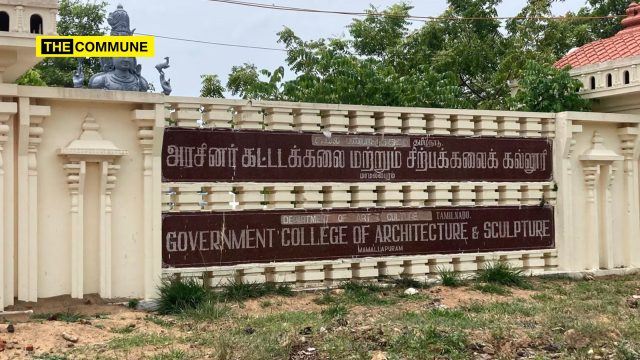
The Government College of Architecture and Sculpture in Mamallapuram, a premier institution dedicated to preserving Tamil Nadu’s traditional temple architecture and sculptural heritage, is facing serious challenges due to an acute shortage of teaching staff and inadequate infrastructure. Social activists and students have alleged that the institution is gradually deteriorating because of official neglect and a lack of understanding of its cultural importance, as reported in Dinamalar.
Established in 1957 and currently functioning under the Tamil Nadu Department of Art and Culture, the college was created to preserve and impart training in traditional architectural and sculptural practices that flourished during the Pallava period. The institution has earned recognition as Asia’s only college exclusively dedicated to traditional arts and heritage crafts.
The college offers four-year degree programmes in Traditional Architecture (B.Tech), Stone Sculpture, Stucco Sculpture, Metal Sculpture, Wood Sculpture, Traditional Painting and Fine Arts (BFA). Students who have completed Higher Secondary education are eligible for admission. At present, around 227 students are enrolled in various courses.
Despite growing interest among students in learning traditional arts and heritage crafts, faculty recruitment has remained stagnant for years. Several teaching and training positions that fell vacant following retirements have not been filled.
For the current academic year, the college has sanctioned intake capacity for 60 students across various disciplines, including Traditional Architecture, Stone Sculpture, Stucco Sculpture, Metal Sculpture, Wood Sculpture, and Painting.
According to college records, the institution has a total sanctioned strength of 67 posts, including principal, lecturers, instructors and administrative staff. However, more than 50 of these positions remain vacant. The situation is particularly severe in the teaching faculty, with only three lecturers and two instructors currently serving the entire institution.
The college has also been functioning without a permanent principal for more than a decade. Since the retirement of the last principal in 2015, the institution has been managed by an officer holding additional charge. To address the shortage, the administration has once again invited applications to appoint ten part-time teachers for the current academic year.
Students allege that nearly 90 percent of teaching positions remain vacant, severely affecting the quality of education. They claim that part-time faculty members are appointed every year but often leave midway, disrupting academic continuity and making it difficult to complete coursework and prepare for examinations.
அழிக்கப்படுகிறதா பாரம்பரிய சிற்ப கலை?
ஆசிய கண்டத்திலேயே கட்டடக்கலை மற்றும் சிற்பக் கலையை கற்பித்து தரப்படும் கல்லூரி தமிழகத்தில் மாமல்லபுரத்தில் அமைந்துள்ளது.
இவ்வளவு சிறப்பு மிக்க இந்த கல்லூரியில் 90 சதவீதத்திற்கும் மேல் பேராசிரியர்கள் மற்றும் அந்த கல்லூரிக்கு முதல்வரே இல்லை… pic.twitter.com/xH0yIkf0uL
Students have also raised concerns about poor infrastructure and inadequate basic facilities. They say several buildings on the campus have deteriorated, while drinking water and sanitation facilities remain insufficient. The campus itself is reportedly poorly maintained, with overgrown vegetation and neglected surroundings.
“Today, the only thing left is the pride of being Asia’s only traditional arts college. Nearly 90 percent of the teachers are absent. We are struggling to study properly. The institution functions only in name. The old buildings are dilapidated, and basic facilities are inadequate. Authorities should appoint teachers and improve infrastructure considering the college’s historical importance,” students said.
Social activists have echoed these concerns, pointing to the condition of the campus and buildings as evidence of official indifference. They argue that the institution, which plays a crucial role in preserving Tamil Nadu’s traditional architectural and sculptural heritage, deserves greater attention and investment.
Meanwhile, college authorities stated that they have repeatedly urged the government to fill vacant teaching and non-teaching posts. They added that proposals for new classroom buildings have already been prepared and construction work will begin once Coastal Regulation Zone (CRZ) clearance is obtained.
Subscribe to our channels on WhatsApp, Telegram,Instagram and YouTube to get the best stories of the day delivered to you personally.