Tamil Nadu Legislative Assembly Speaker and DMK candidate for Radhapuram, M. Appavu, has found himself at the centre of a fresh controversy after a remark made during a campaign rally in his constituency raised serious questions about the conduct expected of a constitutional authority seeking electoral votes.
Addressing the gathering, Appavu said, “I came asking for your vote. Oh women, are you ready to listen? They are trying to create confusion – you know who they are, and I know who they are.”
He went on to add, “Those who create confusion, listen quietly, if you want to cast your vote, cast it or else don’t – that is your personal choice. But no one has the right to tell me not to ask for votes or not to campaign.”
Appavu also defended his right to campaign, stating, “It is my right to ask the women.”
Referring to local civic concerns, he said: “Women are asking why Tamirabharani water is not being supplied. Water has to be brought from the river and added to the panchayat supply. Here there are 19 tanks… nine tanks…”
As Tamil Nadu heats up ahead of the 2026 Legislative Assembly elections, a viral drone video of pink-blossomed trees lining in Maduravoyal has sparked a political storm.
Chennai bloomed in baby pink this spring season with pink tabebuia trees, also called pink trumpet flowers. Visuals from Maduravoyal on Monday (April 13).
DMK supporters and party spokespersons, their IT wing handles took to social media to claim that the stunning floral canopy, likened to Japan’s iconic cherry blossoms, was proof of Chief Minister M.K. Stalin’s governance and a reason to vote for DMK.
#சிங்காரசென்னை
ஜப்பானைப் போல் சென்னையிலும்
அடையார் பெசன்ட் நகர் ஓஎம்ஆர் விப்ரோ மைக்ரோசாப்ட் அருகில் பல்லாவரம் நொளம்பூர் மற்றும் பல ரோடுகளில் கண்கவரும்
இளஞ்சிவப்பு செர்ரி பூக்கள்
The imagery was powerful, and it spread fast. There was just one problem: the trees were not planted by the DMK government.
Pink Trumpet Trees, Not Cherry Blossoms
The trees in question are Tabebuia rosea, or Pink Trumpet Trees – a Central American species that blooms brilliantly between December and April each year. While their delicate pink flowers draw inevitable comparisons to Japan’s sakura, botanists are clear that the two species are entirely unrelated. The trees thrive in tropical, high-heat, low-water conditions, making them a popular choice for urban beautification across Indian cities.
Central Government’s Role
Investigations reveal that a large number of these trees were planted along National Highways and expressways under schemes executed by the National Highways Authority of India (NHAI), a Central Government body, as part of a nationwide road-corridor greening and beautification programme. Thousands of Tabebuia saplings were planted across multiple states, including along the Chittoor-Thachur Expressway in Tamil Nadu.
In Mumbai, the same trees lining the Eastern Express Highway were planted by the Brihanmumbai Municipal Corporation and NHAI years ago. In Kochi, they were part of compensatory afforestation for the Kochi Metro project. In Bengaluru, they were part of a long-standing city greening initiative predating DMK’s current term.
In other words, the very same trees are blooming across multiple states under different governments – all as part of Central Government or civic agency-led programmes that have nothing to do with DMK.
The claim that Chief Minister Stalin “planted” these trees or that their bloom is a DMK achievement is misleading and factually inaccurate, at least with respect to the National Highway corridors prominently featured in the viral video.
What makes this claim even more unbelievable is that the same DMK government that has been pouring in money to clean up Cooum river is at it for the past so many decades, but the river is getting worse by the day. Had they put in even a little bit of effort, people would have even believed the lie that DMK government planted the alleged “Sakura” trees.
Yet again, the sticker that the Dravidianists tried to apply on a beautification step taken by the central government falls off in no time.
Senthilkumar, the DMK’s Assembly candidate from Palacode, has come under scrutiny following allegations that ₹8,000 coupons were distributed door-to-door in the constituency ahead of the April 23 polling date.
According to earlier reports, election flying squad officials seized 1,150 coupons, each valued at ₹8,000, along with 1,800 gift tokens during an operation in the constituency. A case was registered in connection with the incident.
This time, as alleged by ADMK spokesperson Kovai Sathyan, pictures of the Palacode candidate Senthilkumar have been circulating on social media where he is seen distributing the coupons to women.
The All India Anna Dravida Munnetra Kazhagam (AIADMK) has called it a serious violation of the Model Code of Conduct (MCC).
This centres on the nature and timing of the coupons, which are linked to the DMK’s manifesto promise of providing ₹8,000 under the “Illatharasi” scheme.
DMK candidate senthil, Palacode violates the model code of conduct.
Issuing rs 8000 coupons amounts to bribe for vote and it is a corrupt practice.
I urge the Election commission to initiate appropriate action and disqualify the candidate from contesting.@ECISVEEP… pic.twitter.com/iRGWPT5nRu
Kamala, the mother of YouTuber Savukku Shankar, passed away on 13 April 2026, reportedly due to age-related ailments and prolonged ill health.
As reported in Tamil Samayam, it is indicated that she had been under significant mental stress in recent years due to multiple cases and arrests involving her son. Despite this, she had actively pursued legal remedies challenging his detention and treatment.
Kamala had approached the Madras High Court on multiple occasions in connection with her son’s arrest and incarceration.
She had filed habeas corpus petitions challenging his detention under the Goondas Act. In addition, she raised allegations regarding custodial treatment, claiming that her son had been assaulted in prison and had not been provided adequate medical care.
In one of her recent petitions filed on 24 March 2026, she alleged that her son had been kept in solitary confinement. The court, however, dismissed the petition.
Earlier, in March 2025, when Shankar’s residence was reportedly attacked by a gang of unknown individuals, disguised as sanitation workers, unlawfully entered his home. They ransacked his home, terrorized his mother, and smeared filth across the rooms and dining table.
At the time of her passing, Savukku Shankar was in custody. He reportedly learned of his mother’s death while in prison.
He has since approached the court seeking interim bail or parole with police escort to attend her final rites.
The death comes shortly after Shankar’s latest arrest by the Greater Chennai Police.
Police sources said he was apprehended in Andhra Pradesh a few days ago after being traced to a lodge, where he was detained and subsequently brought to Chennai for remand.
The arrest was carried out on charges of violating bail conditions.
Background: Bail, Non-Compliance, and Fresh Action
Shankar had earlier been granted conditional bail by the Madras High Court for 12 weeks on medical grounds following his arrest in December in connection with extortion cases registered in Saidapet and Adambakkam, as reported in The New Indian Express.
The bail period ended on 25 March 2026, after which he was required to surrender at Puzhal prison. However, he allegedly failed to comply with this requirement.
Following a petition by the police citing violation of bail conditions, the court permitted his arrest if required for investigation. His subsequent arrest also followed a complaint from Puzhal prison authorities regarding non-compliance.
The earlier case relates to allegations that he extorted ₹94,000 from a film producer.
Following his arrest, Savukku Shankar has now been detained under the Goondas Act by the Greater Chennai Police. He had previously been detained under the same Act earlier in 2024.
His detention under the preventive law comes amid ongoing legal proceedings and investigations.
Subscribe to our channels on WhatsApp, Telegram,Instagram and YouTube to get the best stories of the day delivered to you personally.

Gift items allegedly meant for distribution to voters in the Manachanallur constituency have been seized from 18 goods vehicles in which they were reportedly stockpiled in a godown, triggering political controversy in the run-up to the Tamil Nadu Assembly elections.
A video circulating in connection with the incident shows individuals being questioned about the origin and intended distribution of the materials. In the video, a person being interrogated is heard stating that the items were linked to S. Kathiravan, the kidney trafficking accused, sitting DMK MLA from Manachanallur.
In the video, the individual identifies himself as working at the Dhanalakshmi college in Perambalur – this college incidentally belongs to the MLA’s father. When asked who had instructed him to distribute the items, he names the Manachanallur MLA.
He states that the materials were intended for distribution in Eechampatti village, where a specific quantity had been allocated. According to his account, a lorry had arrived near a temple, from which the goods were transported. He clarifies that while he did not personally load the items, he collected a portion, around 150 units, from what had been brought.
When questioned about distribution, he says the items were not to be distributed directly by him but by local ward-level party workers or booth agents.
On being asked again to identify the person behind the operation, he reiterates that it was the Manachanallur MLA.
A video of Manachanallur DMK MLA and sitting candidate S. Kathiravan calling a constituent a “fool” and telling him “you don’t need to vote for me” during an election campaign visit has gone viral on social media, drawing sharp criticism from opposition parties and the public ahead of the 2026 Tamil Nadu assembly elections.
The clip, recorded during Kathiravan’s campaign canvassing at the far end of his constituency, shows a constituent raising what appears to be a basic civic demand, reportedly related to the village’s water supply. Instead of engaging with the grievance, Kathiravan loses his composure entirely.
In the video, Kathiravan is heard saying: “Listen here, if a wedding has to happen, hey, listen to what I’m saying. The moment the wedding is over, by evening, when would this even happen? Do you understand?”
When the constituent persists, Kathiravan snaps, calling him “fool” twice in quick succession, loudly and in front of a gathered crowd. He then turns on the man directly: “What are you staring at? Look here, I’ve been talking so much, right? It’s the far end of the village, isn’t it? I’m the one who came all the way here. In connection with that, whatever you asked me, did YOU ever come looking for me even once? Answer what I asked you.”
He then dismisses the constituent altogether: “I can’t do all of this for you people. Let’s go, go, let’s go. You don’t need to vote for me. Is that enough?”
Who Is Kathiravan?
Kathiravan is no stranger to controversy. He is already fighting the 2026 election under the shadow of a kidney transplant racket linked to hospitals owned by his father, A. Srinivasan, founder of Dhanalakshmi Srinivasan Medical College in Perambalur. A government probe found evidence of illegal kidney transplants facilitated by brokers who targeted the poor, and the hospital’s transplant licence was subsequently suspended. Kathiravan has denied all allegations and has promised to release evidence clearing his name.
Political Fallout
BJP leader Annamalai shared the clip widely, stating that the DMK cannot give basic respect to the public even during election campaigning, and that the voters of Manachanallur would deliver a fitting reply. TVK-affiliated accounts also amplified the video, adding further pressure on the DMK camp in the constituency.
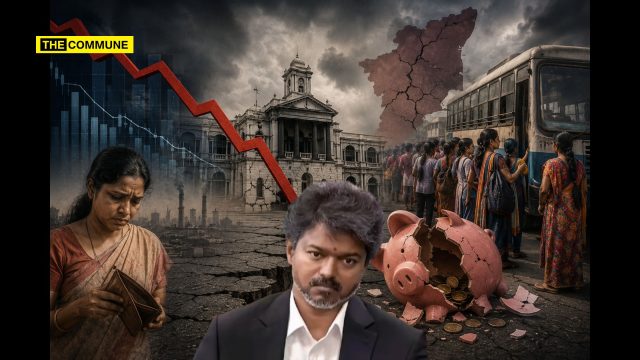
As Tamil Nadu heads into the 2026 Assembly elections, candidates of Tamilaga Vettri Kazhagam (TVK) are confronting an unusual and increasingly uncomfortable reality: they are campaigning without the physical presence of their party’s founder, C. Joseph Vijay.
Across constituencies, what should have been a star-driven campaign has instead turned into a patchwork of improvisations: cardboard cutouts, hired lookalikes, and now even AI-generated holograms – all attempting to fill the vacuum left by Vijay’s absence.
A Campaign of Substitutes
The reliance on substitutes has only deepened. In what is being described as a first in Indian electoral campaigning, TVK’s Kumbakonam candidate R. Vinoth deployed a life-size 3D AI hologram of Vijay at a rally on 12 April 2026.
The hologram developed using AI-generated visuals and audio, projected Vijay delivering a direct message to voters, urging them to support the party’s symbol and remain steadfast.
While technologically novel, the move has raised a more fundamental question: why is a party forced to simulate the presence of its leader in the middle of an election campaign?
From Star Power to Cardboard Campaigning
On 6 April 2026, TVK’s Tiruverumbur candidate Navalpattu S. Viji, also known as Vijayakumar, was seen taking out a roadshow in Tiruchi district – not with Vijay himself, but with a life-size cardboard cutout of the actor-politician.
A cardboard cut-out of #TamilagaVettriKazhagam (#TVK) chief and actor C. Joseph #Vijay was used by the party’s candidate for #Tiruverumbur constituency, Navalpattu S. Viji alias Vijayakumar, during his #election campaign in #Tiruchi district on Monday.
For a party contesting its first-ever Assembly election, such optics underline a deeper problem. TVK’s entire political proposition rests on Vijay’s personal appeal. When that central figure is missing, substitutes begin to look less like strategy and more like necessity.
Kolathur: High-Stakes Battle, Low Presence
The contrast is even starker in Kolathur, where TVK candidate V.S. Babu is up against M. K. Stalin – one of the most politically significant contests in the state.
In a constituency where every vote demands intense campaigning, TVK deployed a Vijay lookalike to accompany its candidate during canvassing.
நேந்து பொம்மைய வச்சு பிரச்சாரம் இன்னைக்கு லோ பட்ஜெட் விஜய் வச்சு பிரச்சாரம் 👌🔥 pic.twitter.com/66MiOZgxkK
The move drew ridicule rather than support, with critics pointing out that while established parties may use symbolic figures, they do so alongside strong organisational networks and active leadership.
TVK, by contrast, lacks both.
Repeated Absence, Repeated Cancellations
The issue is not merely one of limited appearances. Vijay has reportedly campaigned in fewer than ten constituencies across the state. More significantly, several of his scheduled campaign rallies, for which permissions had already been obtained, were cancelled.
Official explanations have cited scheduling constraints and security concerns. However, these justifications have drawn skepticism, particularly from party workers and candidates who are engaged in daily, on-the-ground campaigning.
For them, the expectation was clear: the leader whose entry into politics inspired their candidacy would stand beside them during the most critical phase of the election. That expectation has not been met.
Cadre Left to Fight Alone
On the ground, TVK candidates continue to canvass in peak summer conditions, relying largely on local networks and personal outreach. The absence of Vijay has effectively shifted the burden of campaigning entirely onto candidates who were, in many cases, banking on his presence to mobilise voters.
Unlike legacy parties such as AIADMK or DMK, which can fall back on decades of cadre strength and layered leadership, TVK remains heavily centralised around a single figure. Without that figure physically present, the campaign appears fragmented and inconsistent.
A Party Built on One Man – Missing in Action
TVK was launched on the strength of Vijay’s personal brand and mass appeal. But elections test more than popularity; they test organisational depth, leadership commitment, and the ability to translate charisma into votes.
Substituting a political leader with cardboard cutouts, lookalikes, and holograms signals more than innovation – it signals a disconnect.
At a time when candidates are seeking visibility, momentum, and direct voter engagement, the continued absence of the party’s central figure raises uncomfortable questions about leadership priorities.
The Optics of Absence
In electoral politics, presence matters. It signals commitment, builds trust, and energises cadre. Absence, particularly when repeated and unexplained, risks doing the opposite.
For TVK, the 2026 election was meant to be a debut powered by Vijay’s star appeal. Instead, it is increasingly being defined by his absence and the lengths to which the party must go to compensate for it.
Subscribe to our channels on WhatsApp, Telegram,Instagram and YouTube to get the best stories of the day delivered to you personally.
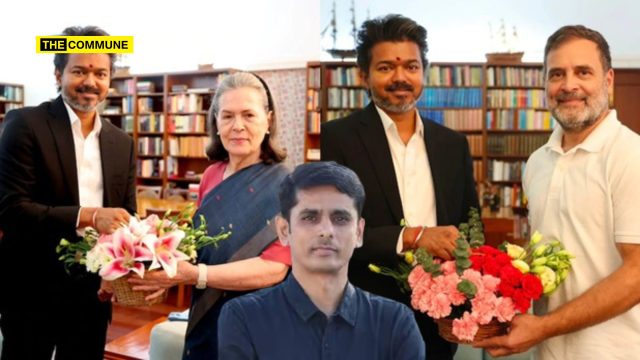
The investigation into the alleged harassment and religious coercion case at a Tata Consultancy Services (TCS) office in Nashik has escalated significantly, with the city police sharing a comprehensive report with central agencies including the Anti-Terrorism Squad (ATS), National Investigation Agency (NIA), and Intelligence Bureau (IB), as reported in News18.
The case, which began as a sexual harassment complaint, has expanded into a multi-agency probe amid allegations of pressure on employees to convert religion, consume beef, and participate in namaz. Investigators are now examining whether the incidents form part of a coordinated and organised network.
Nine FIRs Detail Pattern of Abuse and Coercion
The Special Investigation Team (SIT), led by ACP (Crime) Sandeep Mitke, is currently examining nine FIRs that describe repeated instances of harassment over several years.
According to the complaints, the alleged acts include inappropriate physical contact, stalking, sexually explicit remarks, derogatory comments about religion, and attempts to force women into religious practices. Several victims have also alleged that they were pressured to consume beef, perform namaz, and, in some cases, enter into physical relationships under false promises of marriage.
Sources indicate that the pattern of abuse was not random. Investigators are probing claims that groups within the organisation were used not merely for casual interaction but to identify and target women. Victims have alleged that internal discussions may have played a role in selecting individuals, and that a separate group was created around the first complainant, who was later allegedly sexually exploited.
Investigators believe that digital evidence, including WhatsApp communications, could point to a deliberate pattern linking harassment, sexual exploitation, and attempted religious conversion.
🚨 BREAKING: TCS conversion case escalates.
Nashik Police hands full report to NIA, ATS & IB with key SIT evidence.
Focus now on absconding Nida Khan, dubbed the “Lady Captain”
— The Analyzer (News Updates🗞️) (@Indian_Analyzer) April 13, 2026
Central Agencies Step In, Wider Network Under Scanner
The involvement of central agencies marks a significant escalation in the probe. The ATS, NIA, and IB have sought detailed inputs from the SIT, indicating that the case may have broader implications.
Agencies are examining multiple angles, including possible external funding, links to anti-national elements, and connections to banned organisations. Digital activity, financial transactions, international links, and social networks associated with the accused are all under scrutiny.
Teams from central agencies are expected to join the investigation on the ground and coordinate closely with local police.
Arrests Made, Key Accused Absconding
So far, seven individuals have been arrested in connection with the case, while one accused, identified as Nida Khan, remains absconding and is being actively traced. Investigators have referred to her as a key figure in the case.
Of the eight accused, six have been sent to judicial custody, one remains in police custody for interrogation, and Nida Khan is still absconding. The HR officer’s role drew particular focus, despite receiving repeated complaints from victims, she allegedly dismissed them saying “these types of things keep happening in an MNC,” and took no action.
In a significant development, the company’s Operations Manager, Ashwini Chenani, was arrested from Pune and has been remanded to police custody till April 13. Investigators have alleged that lapses in handling complaints allowed the situation to continue over an extended period.
A News18 reporter confronted the families of the accused on camera. Raza Memon’s mother, whose son is named in eight FIRs, flatly denied the allegations, insisting her son was innocent and being framed, saying she had full faith that justice would eventually clear his name. A second family member, speaking about another accused, described how the arrest unfolded: the young man had been on leave when he was summoned first to the office and then directly to the police station, with no prior visit to their home by police. The father maintained that his son was a well-behaved, devout young man who “walks with his head down going and coming back” and had never had any trouble with anyone in his years of employment — adding, pointedly, that he “offers namaz and minds his own business.”
During the course of the investigation, a person initially suspected to be linked to the accused has now been identified as a victim.
According to investigators, the individual stated during questioning that he had been coerced into changing his religion several years ago. His testimony is being treated as a key development, offering insights into the methods allegedly used, including psychological pressure and gradual behavioural influence.
Government Calls Case ‘Serious and Shameful’
The seriousness of the allegations has prompted a strong response from the Maharashtra government.
State minister Girish Mahajan, who visited Nashik, described the case as “extremely serious and shameful.” He stated that the allegations include harassment of women, pressure for religious conversion, coercion into participating in religious practices, and mental torture.
He also referred to claims that women were lured with job opportunities and subsequently subjected to such treatment. He said that if the allegations are proven, strict action would be taken against those involved.
Mahajan added that the Chief Minister has taken the matter seriously and has directed authorities to ensure a fair and thorough investigation. He also appealed to women to come forward without fear, assuring that their identities would be protected and that the government would extend full support.
Company Responds
Tata Consultancy Services (TCS) has issued a statement stating that it follows a strict zero-tolerance policy towards harassment or coercion in the workplace and prioritises employee safety.
Subscribe to our channels on WhatsApp, Telegram,Instagram and YouTube to get the best stories of the day delivered to you personally.
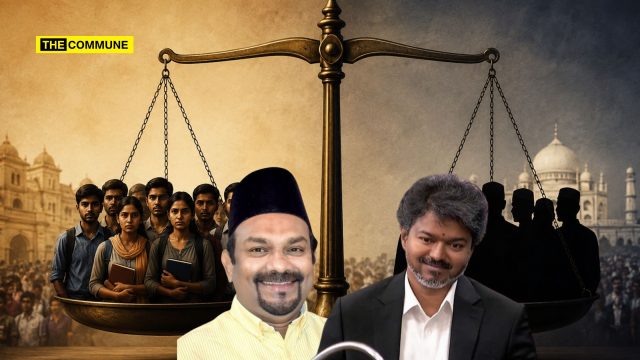
In what comes across as a below-the-belt act by a DMK minister, PTR Palanivel Thiagarajan, using a campaign rally podium, he publicly doxxed an anonymous X handle. This came about despite the handle simping for the ruling DMK government over the years.
What PTR Said at the Rally
At a campaign rally in Madurai, PTR delivered a combative speech targeting what he called “evil forces” spreading lies in his constituency. In the course of the speech, he named Sandhya Ravishank, Vinod Arulappan, Chennai Updates, Parthiban Kumar, AC Shanmugam and the ‘Cinema Sanghi’ director Sundar C – accusing all of them of coordinating to build a false political narrative for their own professional benefit.
Dear PTR,
As a journalist, I have been on the ground for four days in Madurai Central constituency and I am reflecting on what the people of your constituency are saying. I am not here to endorse any candidate contesting in Madurai Central. If people are satisfied with your… pic.twitter.com/6McsaGkXNm
By naming “Chennai Updates” alongside identified individuals in a public setting, PTR effectively unmasked the operator’s real identity to the rally crowd and, by extension, to anyone watching the speech online – the defining act of doxxing.
He framed the entire group as working to “portray the State Governor as some great man” and dismissed them as operating for their “next business venture.”
He even made a post naming the handle on his X account.
Till now, in politics, I have never addressed my comments at any individual contesting against me or our party in elections, be it 2016, 2019, 2021, 2022 or 2024.
Our approach has always been clear: who we are, what we do, and why people should vote for us.
Chennai Updates (@UpdatesChennai) is an anonymous account on the social media platform X, known for tracking civic issues in Chennai and also Madurai, and for regularly flagging governance lapses including those attributable to the DMK government. Despite its critical tone on specific issues, the handle had a history of broadly supporting the DMK and was not considered an adversarial or opposition-aligned account. It seems that the handle had not, by any public record, personally attacked PTR.
This is not the first time PTR has responded to unfavourable media coverage with public pushback rather than accountability. His response to Vinodh Arulappan’s ground report was a lecture on constitutional federalism that critics argued deflected rather than addressed the civic failures documented. The doxxing at the rally follows the same pattern targeting the messenger rather than engaging with the message.
PTR holds the IT portfolio in the Tamil Nadu government, making the act of doxxing a digital critic particularly pointed.
Subscribe to our channels on WhatsApp, Telegram,Instagram and YouTube to get the best stories of the day delivered to you personally.
When writing history, it is essential that the author undertakes deep research into the subject, or at the very least possesses a sound familiarity with the historical and cultural landscape. When someone relies heavily on secondary sources, especially questionable ones, the result is often a half-baked work in which the underlying agenda becomes all too obvious. The article in The Print is one such example.
Written in the backdrop of the ongoing court case, the article attempts to portray Lord Ayyappa as merely a “local forest deity” who was later appropriated by the usual target of such narratives – “the Brahmins.” What is unfortunate is that the larger background, religious context, and historical evolution of the worship are completely ignored in order to sustain this superficial argument. The author also resorts to the familiar wordplay often seen in Dravidianist discourse: if the names are different, then the deities must be different. This is the standard line used to construct a theory of exceptionalism claiming, for instance, that Murugan is different from Karthikeya, Durga is different from Kotravai, and so on.
The very opening paragraphs of the article are riddled with factual errors. One striking example is the claim: “In Tamil Nadu, he is known as Ayyanar, and is more of a village protector-god.” Really? The deity has been known since ancient times as Shasta, and is worshipped under various names such as Ayyanar and Ayyappan. At its core, this is the worship of Shasta in different forms.
The name Shasta appears in Tamil sources from an early period, including Sangam literature. In fact, several Tamil poets bore names such as Saattan, which is the Tamil form associated with Shasta. To reduce Shasta merely to a “village protector-god” is therefore historically inaccurate. Shasta has been worshipped not only in village shrines, but also in major and urban temples. It is true that, over time, this form of worship became especially prominent in rural settings, but that does not define either its origin or its full historical character. The name itself is traditionally explained as “one who knows the many Shastras,” as noted by Adiyarkkunallar in his commentary on the Silappadikaram.
Definition of Shasta in Silappadhikaram commentary
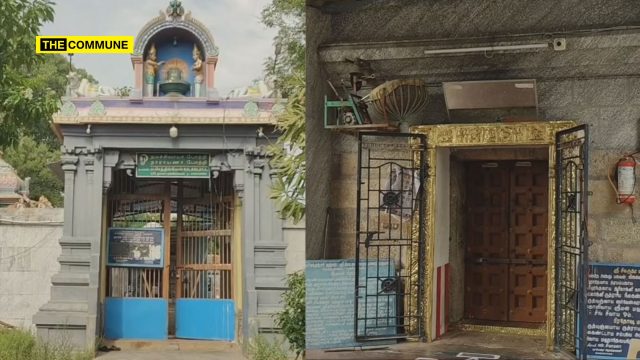
The famous Kanchipuram Kamakshi Amman Temple also has a shrine for Shasta, and tradition holds that Karikala Chola worshipped there before embarking on his northern expedition. A well-known verse refers to this association.
Further, many Pallava temples had shrines dedicated to Shasta. Endowments made to Shasta temples were known as “Aiyan Bhogam,” and the administrators of such temples were called “Sattan Ganathar.” These details are attested in numerous inscriptions of the Pallavas, Cholas, and Pandyas. One such example is an inscription of Parthivendra Varman at the Uthiramerur Maha Shasta Temple. Significantly, the inscription uses both Ayyan and Shasta to refer to the same deity, clearly showing that these names were understood as referring to one and the same divine tradition.
“Ayyan Mahashasta” says Parthivendravarman Inscription at Uttiramerur
Similarly, there is another inscription of Rajaraja I at Ukkal, dated to 1002 CE, which records grants made to the Mahashasta temple. It also notes that the transaction was registered in the presence of the Sattan Ganathar, the administrators of the temple.
All this clearly establishes that Ayyanar/Shasta worship was not confined to village settings. Let us now turn to some of the other claims made in the article. It states: “Kalittokai, a compendium of early Tamil poems, mentions that Ayyan was revered by peasant chieftains called the Ay.”
This is again misleading. The Ay chieftains ruled parts of south Kerala from the Sangam age onward and cannot simply be reduced to “peasant chieftains.” They traced their lineage to the Yadavas said to have migrated from the north. They were also patrons of Vedic learning, Veda patasalas, and temples, as inscriptions such as the Parthivasekarapuram Copper Plates make clear. Therefore, even in the case of the Ay rulers, Ayyanar was not some marginal or folk deity detached from the Vedic framework; he was very much understood within that broader religious tradition.
Another line in the article claims that “the epic Silappadikaram mentions a hunter god known as Chattan and Ayyanar.” This is precisely the problem with writing from secondary sources without even undertaking basic primary verification.
Silappadikaram refers to Pashanda Sattan, who is described as one who knew the ninety-six shastras, hence the name, as noted earlier. Silappadhikaram mentions that Shasta was born as a Brahmin and did all the rituals for his parents.
The text also states that there was a kottam, a temple for him, at Poompuhar, the great Chola port city. Where, then, does this “hunter god” interpretation come from? It is a reading imposed on the text rather than one grounded in it.
The article makes yet another factual blunder : “Ayyanar, on the other hand, is rarely mentioned in temple inscriptions in Tamil Nadu, as he had become a god of ‘lower’ castes, such as potters.” This is simply incorrect. The Kanyakumari inscription of Rajaraja I clearly refers to Shasta as a Vedic deity, without any ambiguity, and presents him as a deity worshipped within the mainstream religious fold. The inscriptional record does not support the simplistic caste-based reduction that the article attempts to impose.
A blatant falsehood appears in the article’s claim that there is “a 13th century inscription from Srirangam attesting that a ‘Shudra-Devata’, probably Ayyanar, was installed by a Brahmin priest ‘to control erosion of the temple grounds and to prevent the interference of shudra elements by the river’.” The inscription is available in detail, and nowhere does it use the term “Shudra-Devata.”
What it actually records is that, because the river repeatedly breached its banks, the Jeeyar performed the pratishtha of Shasta along with a yantra. That is all. This is precisely the level of “scholarship” on which the article is built: a meaning is invented and then passed off as epigraphic fact.
At one point, however, the author almost stumbles into reality by admitting: “Despite the divergence, Ayyanar and Ayyappa continued to influence each other. They share iconographic links.” In truth, Shasta, Ayyanar, and Ayyappan belong to the same deity tradition, with the same essential iconographic features. One would hardly find their vigrahas, right from the Pallava period onward, without the yajnopavita. As with many deities in Sanatana Dharma, the same god appears in different forms in different places according to local sthala puranas and devotional traditions.
Take Murugan as an example. At Palani, he is worshipped as Dandayudhapani; at Tiruchendur, as the divine warrior; at Tirupparankundram, in the context of his marriage to Deivayanai; and in many other temples, together with Valli and Deivayanai. In some places he is in a seated posture; in others, he stands. None of this means that the deity is different. The form varies; the deity does not.
The same applies to Ayyanar/Ayyappan. He is worshipped in different forms in different temples. In many places, Ayyanar appears with his consorts Poorna and Pushkala. At Sabarimala, however, Ayyappan is worshipped as a brahmachari. Tradition associates this form with the later history of the region, including the movement of the Pandya line into Pandalam during the Chola–Pandya conflicts, and the belief that Ayyappan manifested there in that form. Accordingly, the temple came to worship him as a brahmachari, in keeping with that local sacred tradition. Yet, in the same Kerala, at places such as Aryankavu, the deity is worshipped together with Poorna and Pushkala. For anyone familiar with Sanatana Dharma, such variation is neither unusual nor contradictory; it is entirely natural within a living and layered sacred tradition.
There is therefore no justification for branding Ayyappa as merely a “tribal deity” simply because one form of Shasta is worshipped in a forest shrine. Ayyappa has, from the earliest period, been worshipped by people across social sections, and it is precisely this wide and unifying appeal that has made the temple a recurring target of controversy. The fact that the temple stands as a living symbol of Hindu unity is something that vested interests have found impossible to tolerate.
In sum, the article suffers not merely from a difference of interpretation, but from a serious weakness in method. It lifts selective claims from dubious secondary readings, ignores primary literary and inscriptional evidence, and then builds a sweeping argument on that fragile foundation. The result is a narrative that tries to detach Ayyanar/Ayyappan/Shasta from the broader civilisational and Vedic framework in which the deity has long existed. Tamil literary sources, temple traditions, and inscriptions from the Pallava, Chola, and Pandya periods all point in the opposite direction: Shasta was a well-established deity worshipped in major temples as well as village shrines, known by multiple names, and understood within a mainstream sacred tradition.
What we are really seeing here is an attempt to impose a modern ideological template upon a far older and more complex religious world. In that template, every local variation must be turned into a rupture, every difference in name into a different god, and every historical layer into a story of appropriation. But Sanatana Dharma has never functioned in such rigid compartments. The same deity can be worshipped in different forms, postures, and local traditions without losing essential continuity. To ignore this is not scholarship; it is distortion. A serious study of Ayyanar or Ayyappan must begin with the humility to read the sources in full, understand the tradition on its own terms, and resist the temptation to force history into a pre-decided ideological frame.
TS Krishnan is a Tamil scholar, historian and author.
Subscribe to our channels on WhatsApp, Telegram,Instagram and YouTube to get the best stories of the day delivered to you personally.