With voting for the Tamil Nadu Assembly elections completed on April 23 and counting scheduled for May 4, a series of statements and developments from within the Dravida Munnetra Kazhagam (DMK) alliance are drawing attention to a consistent underlying theme: key allies appear to view the party as reliant on coalition support rather than capable of securing power independently.
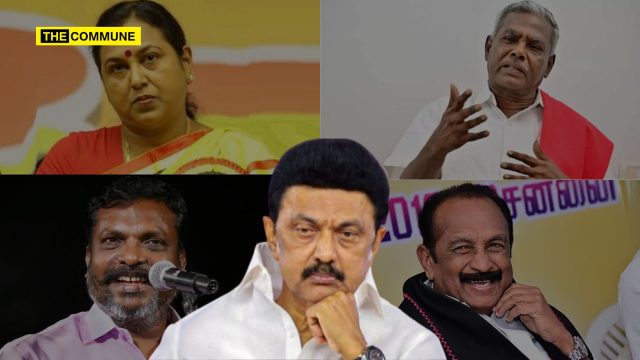
While some post-poll surveys suggest the DMK alliance could return to power, reactions from allies including the Desiya Murpokku Dravida Kazhagam (DMDK), Viduthalai Chiruthaigal Katchi (VCK), Indian National Congress, and Communist Party of India (Marxist) indicate expectations of negotiation, pressure, and post-poll bargaining.
DMDK: Open to Power-Sharing Signals
DMDK general secretary Premalatha Vijayakanth struck a confident tone about the alliance’s prospects but avoided ruling out post-result negotiations.
Responding to questions on a possible hung assembly and power-sharing, she said, “Everyone has worked well in the election field. I will answer this question after the 4th.”
Her refusal to commit before results, coupled with DMDK’s relatively high seat allocation – 10 constituencies and a Rajya Sabha berth has been seen as leaving room for leverage depending on the outcome. At the same time, she asserted, “Our alliance will win decisively, and MK Stalin will once again become Chief Minister.”
Congress: Friction, Demands, and Exit Signals
Tensions between the DMK and Congress have been visible both in negotiations and public messaging.
Seat-sharing talks saw Congress demanding 33-41 constituencies while the DMK held firm at around 25, leading to prolonged deadlock. Senior Congress figures, including Manickam Tagore, publicly criticised what they described as a “disrespectful” approach by DMK leaders. Internal dissent also emerged, with sections of the party exploring alternatives, including possible alignment with Tamilaga Vettri Kazhagam.
Reports of cold interactions between Rahul Gandhi and MK Stalin during the campaign, along with the absence of joint rallies, further added to perceptions of strain.
Ground-level signals suggested dissatisfaction among Congress cadres, with indications that some may not have fully backed the alliance in closely contested constituencies.
VCK: Internal Unity Issues During Campaign
VCK leader Thol. Thirumavalavan acknowledged coordination issues within constituencies during the campaign, even as he defended overall organisational efforts.
He said, “Except for a few constituencies, there is information that comrades in a few constituencies did not work in unity. Information about this is being gathered.”
The admission came amid broader discussions about seat-sharing dissatisfaction and candidate changes within the alliance, reinforcing perceptions of uneven ground-level cohesion.
CPI(M): Explicit Statement on DMK’s Dependence
The most direct articulation came from the CPI(M), where senior leadership openly stated that the DMK cannot secure victory on its own.
Party leader P. Shanmugam said that under current political conditions, it is not possible for the DMK to win on its own and that it must rely on an alliance as it did in 2021.
At the same time, CPI(M) pushed for a larger share of seats, insisting it could not accept fewer than six constituencies, while also indicating it may contest independently in some areas depending on negotiations.
More recently, former CPM state secretary Balakrishnan said, “Despite the various opinion polls that have been cited regarding this election, I want to convey that the Secular Progressive Alliance is set to achieve a notable victory, and the DMK (Dravida Munnetra Kazhagam) is in a position to form the government again in Tamil Nadu. And it is not just the opinion polls, even when we went out for election campaigning and gauged the public mood, we are confident that the Secular Progressive Alliance will win a resounding victory. We want to congratulate the DMK government on forming the government once again. But at the same time, we need to patiently wait and watch what kind of governance and policy the DMK is going to follow going forward. Even during this election, we repeatedly insisted that at least six seats must be allocated to the Marxist Communist Party and the Communist Party of India, but the DMK leadership did not accommodate that. The truth is that the DMK has refused to give the Left parties the recognition they deserve. Nevertheless, on the principle that BJP should not be given a foothold in Tamil Nadu, we contested the election by joining this Secular Progressive Alliance. Till the very end, without any friction or shortcomings, we fought this battle as part of the alliance that opposed the BJP. So, what kind of governance this winning government will deliver, that remains a question mark. The reason is that even today, there is a state of restlessness among youth in Tamil Nadu. The demand to permanently regularize their employment has existed for a long time, but the previous DMK government also failed to fulfill it. Similarly, no meaningful steps were taken to address unemployment either. Even now, Tamil Nadu ministers are boasting a great deal about this year’s government statistics, they are proudly claiming that Tamil Nadu has once again achieved double-digit growth. But instead of acknowledging that the fundamental reason behind this double-digit economic growth is the labour and toil of the working class in Tamil Nadu, the big question remains, what is our government giving back to those workers who are generating this double-digit production and growth? Compared to any previous election, in this election we can see a great awakening among the youth. Usually, during elections, youth would be elsewhere. But this time, unlike before, there is a wave of enthusiasm among youth, a political awareness that Tamil Nadu needs a change has emerged.”
“இடதுசாரிகளுக்கு திமுக உரிய அங்கீகாரம் தர மறுத்துவிட்டது… மாற்றம் வேண்டும் என்கிற மிகப்பெரிய எழுச்சி இளைஞர்கள் மத்தியில் ஏற்பட்டிருக்கிறது”- சிபிஎம் முன்னாள் மாநிலச் செயலர் கே.பாலகிருஷ்ணன்#DMK | #CPM | #TNElection pic.twitter.com/CBLcRsPGJI
— PttvOnlinenews (@PttvNewsX) May 2, 2026
The Unspoken Consensus
Taken together, the statements from DMDK, CPM, Congress, and VCK form a remarkably coherent picture – one that the DMK’s own allies appear unwilling to say out loud but unable to conceal. CPM said it plainly: the DMK cannot win alone. Premalatha said she would answer questions about power-sharing “after the 4th.” Congress cadres are reported to have voted against the alliance in some seats. VCK flagged poor ground coordination.
The DMK’s Secular Progressive Alliance is less a united front and more a coalition of self-interested parties who each believe they are indispensable to the outcome and are already positioning themselves for what comes after May 4.
Whether that outcome is a clean DMK majority, a hung assembly, or something in between, one thing is clear: the allies have already begun counting what they are owed.
Subscribe to our channels on WhatsApp, Telegram, Instagram and YouTube to get the best stories of the day delivered to you personally.