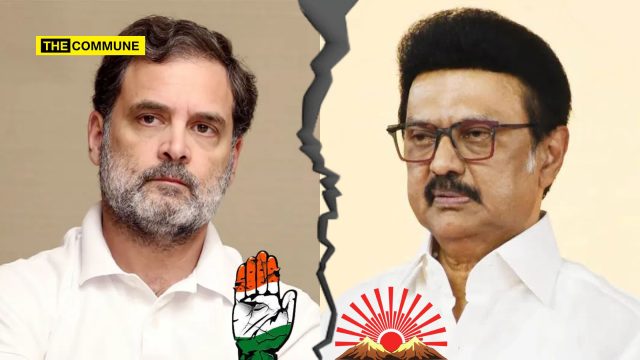
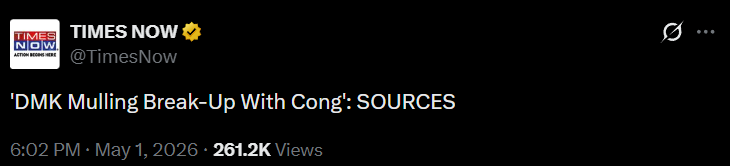
Whispers in Arivalayam corridors suggest the DMK is seriously considering breaking ties with its long-time ally Congress ahead of or following the 2026 Tamil Nadu Assembly polls, according to sources cited by Times Now on May 1, 2026.
The report comes amid a series of escalating tensions documented in recent months, ranging from stalled seat-sharing negotiations and public poster wars to internal Congress discontent and strategic maneuvers in Puducherry.
Seat-Sharing Deadlock And DMK’s Big Brother Attitude
DMK-Congress alliance talks had repeatedly hit roadblocks in the lead-up to the elections. The DMK offered Congress around 25 seats — matching the 2021 allocation — while Congress demanded 33-41 constituencies to restore its earlier share and secure at least one seat per district. Congress submitted a list of over 75 ‘winnable’ seats and pushed for broader representation. DMK sources made clear they were unwilling to concede more to accommodate other alliance partners, creating a prolonged flashpoint.
Adding to the friction, AICC in-charge for Tamil Nadu Girish Chodankar publicly discussed power-sharing at the grassroots level (panchayats, municipalities, and corporations) during high-level talks in Delhi and Chennai. He noted that the DMK had no in-principle objection but highlighted Congress’s focus on strengthening its organisation. DMK leadership was reportedly upset by the public disclosure, preferring confidential negotiations, which stirred fresh unease in the alliance.
Congress Internal Dissent And Feelers For TVK
A significant section of Tamil Nadu Congress functionaries had been fuming over the continued DMK alliance. Many preferred an understanding with actor Vijay’s Tamilaga Vettri Kazhagam (TVK), which had signalled willingness to offer Congress a share in governance.
Congress MP Manickam Tagore (Virudhunagar) slammed the DMK’s disrespectful attitude towards its alliance partner. He took particular exception to Madurai North MLA K. Thalapathi’s public jibes, where the DMK leader had criticised Congress MPs — including Tagore himself and Jothimani — claiming the party could secure only 3,000-4,000 votes per constituency and lacked the organisational muscle to even form booth-level committees. In a sharp rebuttal, Tagore publicly urged Congress president Mallikarjun Kharge to ensure the party contests Madurai North and raised strong objections with Tamil Nadu Congress Committee president K. Selvaperunthagai, calling out Thalapathi’s remarks as an insult to Congress cadre strength.
Jothimani’s vocal push on power-sharing similarly drew DMK ire, highlighting internal Congress dissent against the high command’s preference for continuing the DMK alliance despite perceived slights.
Senior Congress leader Praveen Chakravarthy also poked the DMK occasionally through pointed tweets, subtly criticising aspects of the alliance dynamics and adding to the public perception of simmering discontent within Congress ranks.
Rahul Gandhi’s Cold Behaviour Towards DMK
Rahul Gandhi and MK Stalin did not share a single campaign stage throughout the election period, a notable departure from past alliance norms that fuelled speculation of underlying coldness.
Incidents like Rahul Gandhi appearing to decline a shawl offered by a DMK minister during a public event added to perceptions of discomfort. Reports also circulated of a notably cold or minimal birthday greeting from Rahul to Stalin, contrasting with warmer exchanges in previous years.
Compounding matters was Rahul Gandhi’s gaffe where he praised the AIADMK (a key rival to the DMK) in a manner that embarrassed the alliance, drawing criticism from DMK circles and highlighting perceived political immaturity or lack of coordination on the Congress side. These episodes amplified the narrative of a strained personal rapport at the highest levels, even as the alliance remained formally intact on paper.
Parallel Crisis In Puducherry
Similar alliance fatigue appeared in Puducherry, where DMK and Congress filed nominations in all 30 Assembly seats on March 18, 2026, despite no seat-sharing deal. Talks remained stuck, with both sides filing papers tactically on an auspicious day (Amavasya) while planning withdrawals later. DMK leader Jagathrakshakan claimed talks were “smooth,” but uncertainty lingered just days before the nomination deadline, mirroring the deadlock in Tamil Nadu.
Congress-DMK Divorce?
The cumulative strain — from seat-sharing flashpoints and power-sharing demands to cadre-level sabotage signals and public spats — built to a point where the DMK is now reportedly weighing a clean break if Congress does not accept its terms. While some Congress leaders continued to describe the alliance as “ideological and natural,” ground realities and internal murmurs suggested otherwise. TVK’s emergence as a disruptive force further complicated dynamics, potentially fragmenting votes.
With the Tamil Nadu polls held on April 23, 2026, these past developments have left lingering questions. Arivalayam insiders indicate the DMK is prepared to go it alone or recalibrate if the partnership yields diminishing returns. The current whispers point to a possible post-poll realignment in Tamil Nadu politics.
Subscribe to our channels on WhatsApp, Telegram, Instagram and YouTube to get the best stories of the day delivered to you personally.