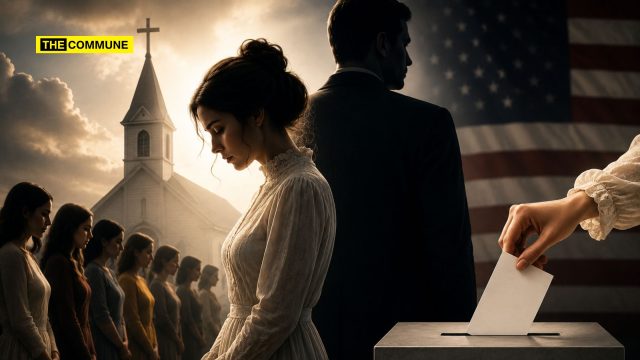
A growing trend within sections of America’s Christian conservative movement is drawing attention after several women publicly expressed support for giving up their own voting rights in favour of a “one household, one vote” system led by male heads of families, as reported in OpIndia.
The debate gained renewed attention following discussions at the recent Turning Point USA (TPUSA) Women’s Leadership Summit in San Antonio, Texas, where a number of Christian conservative women reportedly argued that women should voluntarily surrender their voting rights in pursuit of what they described as a more Christian society.
The event was led by Erika Kirk, widow of conservative activist Charlie Kirk, and featured discussions reflecting broader debates within the American Christian Right over gender roles, family structures and political participation.
According to a report by CBC, one of the most prominent voices advocating the position was conservative influencer Savanna Stone, who has nearly half a million followers on Instagram and is widely associated with the “trad wife” movement that promotes traditional gender roles.
CBC reported that Stone argued against women’s voting rights and supported a one-household-one-vote model. She reportedly claimed that women tend to vote for more liberal candidates and that relinquishing their voting rights would help create a more conservative and Christian America. Stone also reportedly argued that wives should vote the same way as their husbands.
CBC reported that Stone was not alone in expressing such views.
The broadcaster quoted Brooke Foxworthy, a stay-at-home mother, as saying that she would be comfortable with her husband voting on behalf of the household.
According to CBC, Foxworthy stated that if her husband was the head of the household, she considered herself the “neck” and believed they worked together cohesively. She reportedly said she would be comfortable if her daughter also lost the right to vote because she expected her to eventually marry a “biblical man” whose political values would align with hers.
CBC also quoted a 19-year-old nursing student from San Diego who reportedly said that although she personally would want to cast her vote, she believed eliminating women’s voting rights could actually benefit women.
Another participant, Alexus DeGraaf, reportedly told CBC that as a Christian woman she viewed herself and her husband as “one flesh.” According to the report, DeGraaf said she voted the same way as her husband and would therefore be comfortable surrendering her own voting rights because she believed he would represent her interests adequately.
The controversy has revived scrutiny of similar arguments advanced by Christian nationalist figures and organisations in recent years.
In 2025, US Defence Secretary Pete Hegseth faced criticism after reposting an interview featuring Christian nationalist pastor Doug Wilson and members of Wilson’s church discussing why they believed women should not vote.
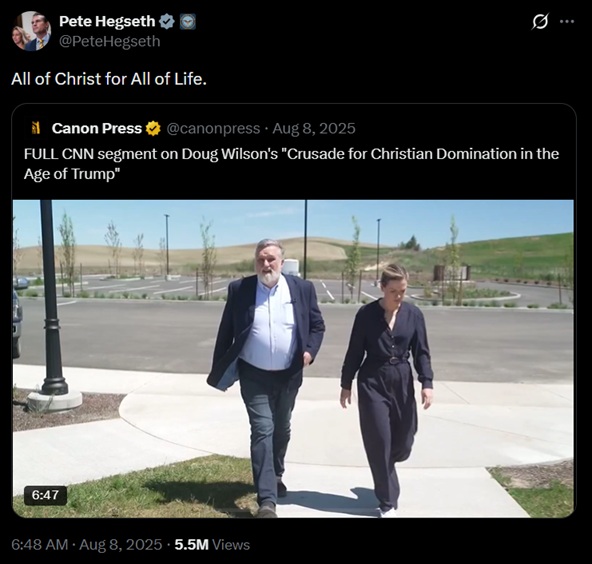
Wilson, founder of Christ Church, has long been associated with Christian nationalist ideas. According to reports, several members of the church have publicly supported restricting women’s participation in political decision-making.
A 2025 report by Politico quoted Jared Longshore, a minister associated with Wilson’s church, as expressing support for a household-based voting model.
Longshore reportedly argued that scripture established a hierarchy in which husbands served as the head of the household while wives occupied a subordinate position. He was quoted as saying that although he was not actively campaigning to repeal the 19th Amendment, which granted women the right to vote in the United States, he would support such a move if asked.
Longshore reportedly stated that America effectively operated under a one-vote-per-household model before the women’s suffrage movement and argued that such a system would be beneficial.
Following criticism, Hegseth responded through a spokesperson, who stated that he was a proud member of the church and appreciated many of Longshore’s writings. Critics interpreted the response as a tacit endorsement of the broader ideological positions associated with the church.
The debate has also prompted renewed discussion about traditional Christian teachings on gender roles.
It is noteworthy that in Christian nationalism several Biblical passages have historically been interpreted as establishing male authority over women.
Among the verses frequently cited are 1 Corinthians 11:3–9, which states that “the head of the woman is man” and that woman was created for man; 1 Timothy 2:11–15, which instructs women not to assume authority over men; and Ephesians 5:22–24, which calls upon wives to submit to their husbands.
For those supporting traditional doctrines, such passages describe complementary roles within marriage rather than political disenfranchisement. It is noteworthy that these interpretations have historically been used to justify restricting women’s participation in public life.
The emergence of women publicly advocating the surrender of their own voting rights has generated significant discussion online, however, the reaction from prominent conservative women and Republican leaders has been comparatively muted.
Democratic activist Sara McGee was among those who publicly criticised the trend. She reportedly suggested that women who genuinely believed they should not vote were free to voluntarily abstain from elections rather than advocating the removal of voting rights for others.
If MAGA women believe that women shouldn’t have the right to vote, then they should go ahead and live their truth now and stop voting. pic.twitter.com/9TrbYP9vH5
— Sara McGee for Texas HD 132 (@SaraForTexLege) June 13, 2026
The controversy has also reignited debate over the influence of Christian nationalism within American politics.
Data from the Public Religion Research Institute (PRRI) indicates that Christian nationalist ideas enjoy significant support among sections of the American electorate.
According to PRRI’s 2024 findings, approximately 29% of Americans either identified as adherents of Christian nationalism or expressed sympathy towards its core ideas.
The study also found a strong correlation between Christian nationalist beliefs and political affiliation.
PRRI reported that among Republicans, 21% qualified as Christian nationalist adherents and 33% as sympathisers. By contrast, the majority of Democrats and independents fell into categories that were sceptical of or opposed to Christian nationalism.
According to the organisation, Republicans were roughly four times more likely than Democrats or independents to qualify as adherents of Christian nationalism, but for Christian.
The controversy reveals an uncomfortable reality: Christian nationalism is not merely a movement seeking greater public visibility for religion, but one that increasingly challenges core democratic norms when they conflict with its interpretation of Biblical authority. Calls to roll back women’s political participation are not aberrations but flow naturally from doctrines that place men above women in both family and society.
That such views are now being voiced openly at major conservative gatherings and defended by women themselves suggests that ideas once considered politically toxic are steadily entering mainstream right-wing discourse. The debate is therefore not simply about voting rights; it is about the growing acceptance of a religious-political ideology that seeks to subordinate individual rights to a rigid, male-dominated vision of social order.
Subscribe to our channels on WhatsApp, Telegram, Instagram and YouTube to get the best stories of the day delivered to you personally.