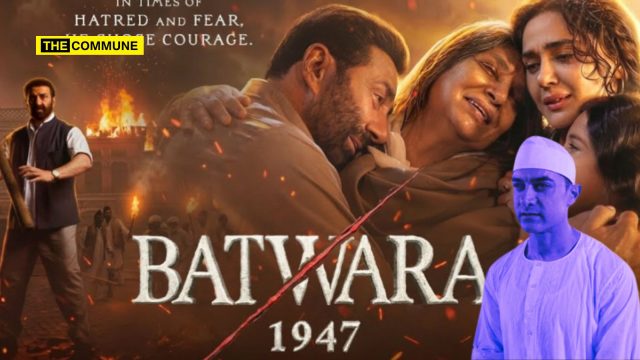
Partition remains one of the darkest chapters in the history of the Indian subcontinent. Millions were displaced, countless families were massacred and entire communities disappeared from regions where they had lived for centuries.
Yet, Batwara 1947, produced by Aamir Khan Productions, appears to approach this tragedy through a strikingly sanitised lens.
Rather than exploring the complexity and brutality of Partition, the trailer centres almost entirely on an idealised Muslim protagonist who repeatedly protects a Hindu woman, safeguards her temple, preaches communal harmony and ultimately becomes the moral conscience of the story.
Instead of Tara Singh storming into Pakistan to rescue his family, Sunny Deol now plays Sikander Mirza, a compassionate Muslim who leaves India to go to Pakistan – because India has become a “Hinduon ka mulk” and once he settles down there, he risks his life protecting an elderly Pakistani Hindu widow portrayed by Shabana Azmi. In a symbolic reversal, a real-life Hindu actor plays the righteous Muslim protector, while a real-life Muslim actor portrays the vulnerable Hindu victim.
A Story Built Around An Exception, Not The Reality
The trailer opens during Independence, with Sunny Deol congratulating his wife (played by Preity Zinta) before the family leaves India because it is portrayed as “Hinduon ka mulk” – a country for Hindus.
Once in Pakistan, his family is allotted a haveli where an elderly Hindu widow (played by Shabana Azmi) still resides. She continues performing puja inside a temple within the house and maintains a Tulsi shrine.
Rather than asking her to leave, Sunny’s character protects her.
From there, the trailer moves into its central message.
Local Muslim mobs attempt to vandalise the temple.
Sunny intervenes.
He declares, “Mandir todna Islam nahi hai.” Later he proclaims, “Maa apne aap mein ek mazhab hai.”
The film repeatedly presents him not merely as a good Muslim, but as the moral voice of Islam itself – someone who educates fellow Muslims about what their religion supposedly stands for while risking everything to save a Hindu woman.
These moments are designed less as organic character interactions and more as moral sermons directed at the audience.
The “Good Muslim” Narrative Dominates The Trailer
There is nothing inherently unusual about portraying righteous Muslim characters.
However, Batwara 1947 pushes the idea to an almost sermonising extent.
Nearly every major emotional beat revolves around Sunny’s character standing against members of his own community, protecting Hindu traditions, safeguarding a temple, defending idol worship inside his own home and preaching religious harmony.
The result is a narrative where one Muslim character is elevated into the ultimate moral authority while those opposing him exist primarily to validate his righteousness.
The Contradiction At The Heart Of The Film
The trailer’s core message directly contradicts several well-known Islamic texts and historical traditions
The trailer repeatedly suggests that protecting temples and rejecting their destruction represents the true spirit of Islam.
However, a look at Islamic scriptures and early Islamic history prove it false.
According to Sahih al-Bukhari, Prophet Muhammad removed and destroyed the idols surrounding the Kaaba after the conquest of Mecca while reciting, “Truth has come and falsehood has vanished.”
Similarly, Sahih Muslim records the Prophet saying he was sent to establish monotheism and break idols.
Classical Islamic historical works also describe several companions, including Khalid ibn al-Walid, Ali ibn Abi Talib, Amr ibn al-As, Jarir ibn Abdullah and others, being sent to demolish prominent pagan shrines across Arabia.
Therefore, the film’s repeated assertion that “Mandir todna Islam nahi hai” wantonly ignores and contradicts historical and scriptural accounts that have long been part of mainstream Islamic tradition. Have we note seen how Aurangzeb and every other Islamic ruler destroy Hindu temples, desecrate idols?
Partition Without Partition’s Realities
The trailer’s larger narrative presents a version of Pakistan that bears little resemblance to the historical experience of Partition.
The trailer itself shows only one side of the brutalities of partition – that Hindus were murdering and attacking Muslims who were leaving for Pakistan. This cannot be further from the truth.
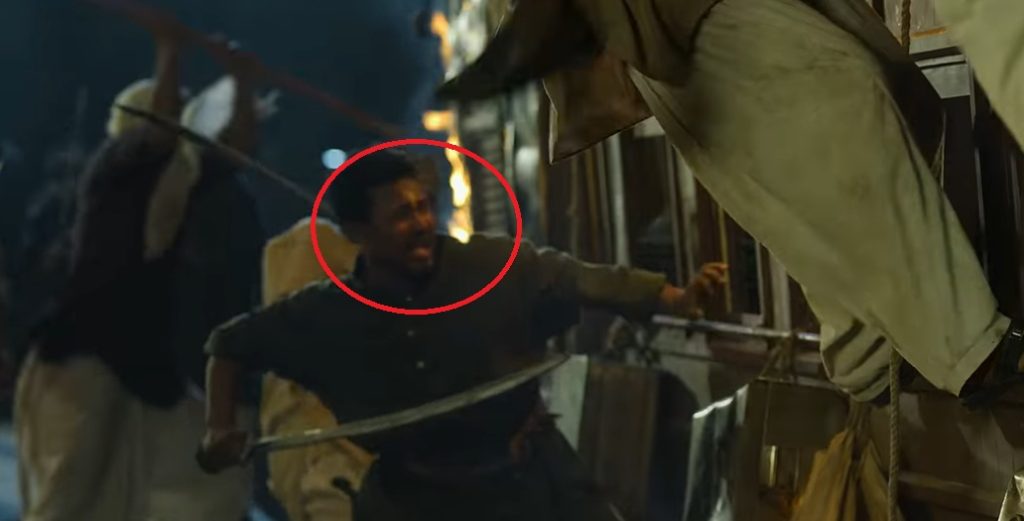
Rather than depicting the systematic displacement of Hindus and Sikhs from large parts of what became Pakistan, the trailer focuses on a noble Muslim family risking everything to preserve a Hindu home, protect a temple and defend an elderly Hindu woman from extremists.
By elevating an exception or rather an anomaly into the defining emotional core of the film, Batwara 1947 romanticizes history instead of confronting it.
A Familiar Pattern From Islamist Aamir Khan
The trailer also reminds one of PK, a film that disproportionately targeted Hindu beliefs and rituals, mocked Hindu gods while avoiding similar scrutiny of other religions.
In Batwara 1947, the approach appears reversed but familiar in structure: instead of examining uncomfortable aspects of partition history, the film presents an idealised moral vision centred on a Muslim protagonist whose role is to repeatedly reassure the audience about Islam’s compassion and tolerance.
Symbolism In The Casting
The casting itself reinforces that messaging. Sunny Deol has long been associated with nationalist cinema and larger-than-life patriotic roles.
Placing him in the role of a Pakistani Muslim who becomes the protector of Hindu traditions lends additional emotional credibility to the film’s central narrative.
His established screen image functions less as the subject of the story and more as the vehicle through which the film asks audiences to accept its interpretation of Partition and religious coexistence.
The Release Date Also Raises Eyebrows
The film is scheduled to release on 14 August 2026, Pakistan’s Independence Day. That choice has also raised eyebrows. Was it a coincidence, it seems not because India observes 14 August as Partition Horrors Rememberance Day.
A film centred on an exceptionally righteous Pakistani Muslim protecting a Hindu woman, defending her temple and repeatedly preaching religious harmony arrives on the very day Pakistan celebrates its creation.
Viewed together with the trailer’s broader messaging, the release date strengthens the perception that Batwara 1947 seeks to project a pretty picture of Pakistan during Partition while downplaying the historical realities faced by its non-Muslim minorities.
Subscribe to our channels on WhatsApp, Telegram, Instagram and YouTube to get the best stories of the day delivered to you personally.