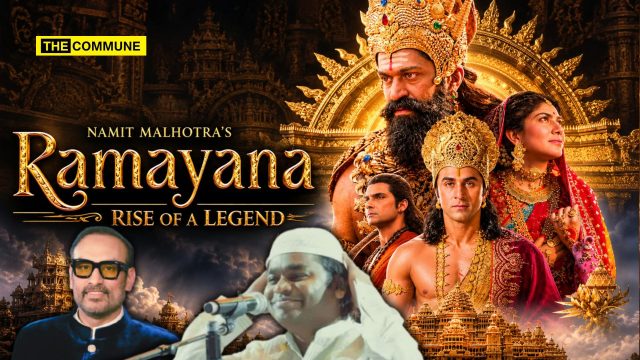
Namit Malhotra’s Ramayana promised something big given its big budget. Yes, at the outset, it is visually grand, boasts impressive VFX and has an impressive lineup of stars. But beneath the spectacle lies a deeply problematic retelling that seems to be determined to turn Ravana into a socialist revolutionary, inject contemporary feminist messaging into the epic and dilute the very characters who make the Ramayana what it is. To make matters worse, AR Rahman’s music fails miserably – it does not provide the emotional and cultural depth that a film of this scale demands.
Didn’t the makers claim the Ramayana was based on or inspired by Valmiki Ramayana? It isn’t – the film is Namit Malhotra’s own fictional version with characters lifted off from the original Ramayana and this version was written to further the oppressed-suppressed-depressed agenda of the usual suspect propagandists.
Warning: Spoilers ahead!
The film’s opening, extending well into the first half-hour before Rama even makes an appearance, glorifies Ravana and portrays the Rakshasas as an oppressed community, confined to dungeons and fed only parched grains by the Devas.
But the bigger problem is the ideological being forcefully shoved down our throats. Upon conquering Lanka, Ravana even delivers a speech promising that none of his subjects will go hungry or remain helpless, declaring that if he lives in a golden house, they too will have one. He promises they will eat what he eats and enjoy equal privileges. Comrade Ravana, anyone? The film even has him promise to fight atrocities and discrimination. A benevolent, communist Ravana is apparently what this adaptation wants us to believe in! And here we have the Ravana that the leftists and Dravidianists celebrate – an oppressed man (born from a Brahmin father) fighting for the rights of his oppressed kinsmen!
And Kubera as is Indra are presented as a dummy piece.
Ravana is initially introduced as a learned person, a veena player, to be later prodded by his mother Kaikasi to seek revenge for the humiliation suffered by their community. This invented motivation fundamentally alters his character. Much later into the film, we see Ravana depicted as a prowess with his fighting skills and killing Shurpanakha’s husband Vidyutjjiva, portrayed as a womaniser, and Ravana is established as a defender of women!
The whitewashing continues with Ravana’s abduction of Sita. Rather than establish his mighty lust for her, the film makes his actions appear motivated by revenge for his sister’s humiliation, revenge against Vishnu. In the Valmiki Ramayana, Ravana lusts for Sita when Shurpanakha describes her beauty, which makes him want to attain her at any cost. Ravana’s knowledge of the Shastras, veena-playing skills and boons from Shiva and Brahma never erased his character as a man who repeatedly misbehaved with all kinds of women. Yet the film goes out of its way to portray him as a morally upright king who respects women, effectively sanitising his character and erasing his lustful nature.
The feminist makeover of Sita is equally bizarre. She is shown fighting Rakshasas with weapons, running around the forest and even participating in the Panchavati battle. In the Valmiki Ramayana, Rama asks Lakshmana to take Sita to safety while he fights the Rakshasas. Sita does not wield swords or knives. Her strength does not need to be manufactured through action-hero sequences. Sita was not born from a womb, she was found; her strength need not be shown the way it is shown in the film-her defiance is enough to even make a blade of grass a weapon. Like Sita, Draupadi too came from fire and that makes them both powerful in their own way. Did we forget little Sita was the one who effortlessly lifted the mighty Shiva Dhanush – do we need any further explanation or demonstration of her skills as a Kshatriya woman?
Moving on to Shurpanakha. Her meeting with Rama, Lakshmana & Sita is even more ridiculous. Sita notices Shurpanakha’s attraction towards Rama and her smile indicates that she seems to want to welcome her as a second wife to Rama! In a second, we are shown Shurpanakha even disguising herself as Sita. This is an entirely unnecessary invention. When Lakshmana finally attacks Shurpanakha, the film gives her only a scratch instead of cutting off her nose and ears. The film even has Sita sermonise about not harming a woman’s beauty!
Other alterations include Sita taking a sword to save Rama during the golden deer episode, challenging Ravana disguised as a sage to recite Rig Veda verses, and the reimagined Jatayu-Ravana fight, in which Jatayu is shown beheading Ravana. Sita’s abduction, resistance and emotional vulnerability are also poorly handled. She barely moves when Ravana abducts her, unlike the resistance described in the traditional account.
There are several other avoidable script errors. Parashurama is casually identified as Vishnu’s sixth avatar, as if it was common knowledge during that era. A young Rama using watermelon used for archery practice and the inconsistent janeu during Ravana’s tapasya are further examples of careless writing. The rakshasa characters even seem to know Rama is Vishnu’s incarnation, with Ravana apparently aware of his divine identity. Eh, how?
The visual effects are impressive, and the action sequences, particularly the Tataka fight, are engaging. However, the production design is inconsistent. Lanka looks like an Italian mansion complex with tiled streets and flower pots, while Ayodhya’s palace flooring resembles Mughal architecture. Mithila has cherry blossoms, and its landscaping resembles an Agra Fort garden. The costumes are equally jarring: designer blouses, lehengas, modern footwear and contemporary sari draping undermine the period setting. Rama already has a fully formed jata when he leaves Ayodhya, and Sita’s forest attire leaves you with more questions than answers.
Yash looks menacing as Ravana and has a strong screen presence, although the writing does him no favours. Lakshmana is a pleasant surprise, with excellent dialogue delivery and an engaging combination of anger and humour. Ranbir Kapoor often looks wooden while attempting to maintain a stoic expression. Sai Pallavi feels totally miscast as Sita. Her voice lacks the sweetness traditionally associated with Sita-it is a lot more manly, and the chemistry between the leads is practically non-existent. Actually, the less said about Sai Pallavi, the better. Kunal Kapoor’s Indra is unimpressive, while Mandodari, played by Kajal Aggarwal, remains largely ornamental.
Then the most perplexing part – Jatayu is seen right from Rama’s birth in Ayodhya till his end after the duel with Ravana. Weirdly, Jatayu breathes his last by saying ‘Hey Ram’ – why did the makers have to do a MK Gandhi there?
And then comes AR Rahman and his music.
The music is a massive letdown. The Ramayana is a story that carries immense devotional and emotional weight. Its music should make the audience feel that weight, whether through the songs or the score accompanying key scenes. That connection is largely missing here. Neither the songs leave a lasting impression, nor does the background score add the grandeur or emotional intensity that the visuals call for.
Rama’s entry is accompanied by Western-style music that sounds like a Warner Bros. fantasy film. The score during the Dhanush-lifting sequence works reasonably well, but an Indian composition could have given it greater cultural depth. When Indra meets Vishnu, Western classical music plays. Ravana’s portions have a Sufi-like soundscape, while the Shivatandava Stotram sequence features Tamil-sounding chants, including what sounds like ‘Vel Vel’. What exactly is the connection between Ravana and Tamil? Just because a Tamil film has a song Ravanan Mavan Daa does not make Ravana a Tamilian.
As previously reported, Mangal Rang has notes reminiscent of Kun Faya Kun, although the rest of the song sounds Indian.
The most frustrating part is that the music repeatedly fails at precisely the moments when it should elevate the film. The departure of Rama, Sita and Lakshmana from Ayodhya begins with an emotionally promising score, only to be interrupted by Rahman’s familiar wailing vocals. Jatayu’s death, which deserved a deeply moving composition, receives almost no impactful musical treatment.
Probably, that was his intention. He didn’t want to be remembered for scoring music for Ramayana.
There are positives: impressive VFX, some good action sequences, Yash’s screen presence and Lakshmana’s performance. But a visually spectacular production cannot compensate for a fundamentally altered narrative.
Filmmakers can exercise creative freedom, but there is a difference between cinematic liberty and rewriting the Ramayana. You cannot turn Ravana into a communist Robin Hood, whitewash his crimes, dilute Rama’s character and turn Sita into a feminist action heroine to accommodate contemporary ideological messaging.
This Ramayana is not referenced from Valmiki Ramayana as the makers claim. It was researched by a Dr Bodhisattva who is known for his Communist leanings. He made some really absurd claims about the Gorakhnath Peeth recently.
So, was this Ramayana written in JNU? Was there a great demand to make a Marxist adaptation of the Hindu epic?
The result is a visually grand but ideologically loaded adaptation, with questionable casting, inconsistent aesthetics, careless writing and music that repeatedly fails to rise to the occasion. This is nowhere close to Valmiki Ramayana. Rather, it is a fictional version of the epic, much like The Palace of Illusions is a fictional version of Mahabharata.
Subscribe to our channels on WhatsApp, Telegram, Instagram and YouTube to get the best stories of the day delivered to you personally.