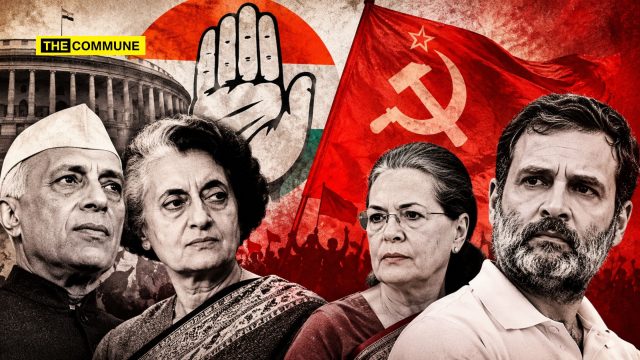
The decline of Congress is usually explained through dynasty, drift and electoral complacency. But there is another part of the story. For much of independent India’s history, Congress served as the principal vehicle through which Left-wing ideas entered the political mainstream. Under Jawaharlal Nehru, the state embraced central planning and a distinctly socialist vocabulary. Under Indira Gandhi, Congress moved further left with bank nationalisation, the abolition of privy purses and the populist slogan “Garibi Hatao”. During the Emergency, the Communist Party of India broke with much of the opposition and supported Indira Gandhi. Decades later, under Sonia Gandhi, the National Advisory Council emerged as a powerful extra-constitutional structure. The pattern is not one of communist control but of sustained Left influence. Congress repeatedly borrowed ideas, personnel and political energy from the Indian Left, often diluting its own identity.
Nehru and the Socialist Consensus
A faction of leftist sympathisers within the Indian National Congress (INC) called itself the Congress Socialist Party (CSP). For the Communists, it offered an avenue to infiltrate the INC and eventually take it over, an objective explicitly stated in several party documents.
The Politburo (PB) issued a common minimum program and guidelines for these ‘Trojan Horses’ to adhere to within the INC. They were given clear instructions on how to promote the common minimum program.
Their plans stalled once Mohandas Karamchand Gandhi came to dominate Congress. But they did not stop there. They sought to develop new channels with the younger leaders of INC, such as Jawaharlal Nehru and Subhas Chandra Bose, and through another growing force within INC, the Congress Socialist Party, led by Jayaprakash Narayan.
That they were unsuccessful with Subhas Chandra Bose is evident from a leaflet the Communist Party issued, titled “Down with Compromises, Forward to the United Front.” It said, “The Congress left led by Jawaharlal and the Socialist Party and mass organisations under communist and anti-imperialist leadership are striving for the United Front of the Congress with Working Class and peasant organisations in the form of collective affiliation, for a programme of mass action combined with revolutionary utilisation of legislatures, for the transformation of the Congress into Anti-Imperialist Front of the People.”
On 24 July 1936, the Communist Party published “For the Anti-Imperialist Peoples Front: Long Live Soviet Hindustan.” This document glowingly praised Jawaharlal Nehru’s presidential address at the Lucknow session of the INC in April 1936. Among other things, they were happy about Nehru abandoning the Bharatiyata of the INC. “Nehru’s was an approach which stood in opposition to all that the orthodox Indian National Congress leadership has stood for so far,” said that document.
Nehru admired state-led development, especially the Soviet model. He was sceptical of private capital and viewed economic planning as an instrument of nation-building. Because Congress was India’s dominant political institution, when Nehru shifted left, the centre of Indian politics shifted with him.
The result was a peculiar arrangement. Communist parties remained electorally marginal, but their core economic assumptions gained legitimacy through Congress governments. Planning commissions expanded. Public-sector enterprises multiplied. State control became a virtue rather than a necessity.
Indira’s Leftward Turn
If Nehru opened the door, Indira Gandhi pushed it wider.
At the Bangalore session of the AICC in 1969, Indira Gandhi presented a paper titled “Stray Thoughts for the Upliftment of the Poor.” This paper announced Congress’s sharp ideological turn. The nationalisation of banks followed, which transformed her political image. The abolition of privy purses reinforced her credentials as a leader willing to confront entrenched interests. “Garibi Hatao” became a slogan and a political strategy. These moves strengthened her position. They also narrowed the space between Congress and the organised Left.
The convergence became more visible during the Emergency. While most opposition parties resisted Indira Gandhi’s suspension of democratic norms, the Communist Party of India chose a different path. It supported the Emergency. The episode revealed something important. The relationship between Congress and sections of the Left was not merely intellectual. At key moments it became political.
The Years of Remote Control
The most consequential communist influence over Congress did not come in the 1950s or the 1970s. It came after 2004.
The Congress-led UPA won power but lacked a parliamentary majority of its own. Survival depended on support from the Left parties. The arrangement gave the communists something they had rarely enjoyed in independent India: leverage over a national government without the burden of governing. The Left repeatedly pushed Congress towards a more interventionist economic posture. Privatisation slowed. Economic reforms faced resistance. Ministers and officials often had to consider not only what Congress wanted but what its Left allies would tolerate.
The limits of the arrangement became visible during the Indo-US civil nuclear agreement. For the Manmohan Singh government, the deal represented a strategic opening. For the communist parties, it represented unacceptable alignment with the United States. The dispute ended with the Left withdrawing support from the government.
This confrontation exposed how much influence had already been ceded. A party that once commanded dominant majorities was now negotiating core national policies with allies who represented only a small fraction of the electorate.
While the alliance collapsed, its legacy endured. The instinct to seek validation from activist circles, ideological fellow travellers and Left intellectual networks remained embedded within the Congress leadership. The National Advisory Council would become the institutional expression of that instinct.
The Creation of a Parallel Court
Nothing symbolised this shift better than the National Advisory Council (NAC) during the UPA years.
The National Advisory Council under Sonia Gandhi functioned as an unelected, extra-constitutional power centre through which a small circle of Left-leaning activists and intellectuals, including Aruna Roy, Jean Drèze, Harsh Mander and N. C. Saxena, exercised significant influence over national policy without a democratic mandate.
Through employment guarantees, food security measures and other rights-based entitlement programmes, they advanced a state-centric model of governance. This expanded bureaucratic control, deepened dependence on government largesse and placed activist priorities above electoral accountability, economic self-reliance and the constitutional primacy of elected institutions.
The NAC was also closely involved in drafting the proposed Prevention of Communal and Targeted Violence (Access to Justice and Reparations) Bill, 2011. This measure would have altered India’s federal balance by extending Union Government authority into matters traditionally reserved for the states. The bill’s definitions and presumptions risked creating unequal standards of legal accountability based on community identity, thereby weakening the constitutional principle of equality before the law. Constitutional scholars and political commentators warned that its enactment could intensify communal polarisation, erode federalism and generate serious legal and administrative complications. After sustained opposition, the bill was never enacted.
Congress increasingly drew its intellectual legitimacy from left-leaning activist networks rather than from its own party organisation.
Rahul’s Red Recruitment Drive
The pattern continues under Rahul Gandhi.
Congress today has little organisational strength in large parts of India. As its traditional social base has eroded, the party has sought new voices and new constituencies. Some of the beneficiaries have emerged directly from Left political traditions.
Kanhaiya Kumar is the clearest example. A former JNU Students’ Union President from the All India Students’ Federation (AISF) and later a national executive member of the Communist Party of India, he is now a Congress leader. The same trend is evident in Neha Bora’s rise. As president of the All India Students’ Association (AISA), affiliated with CPI (ML) Liberation, Bora has become a prominent face of Rahul Gandhi-led protests and opposition campaigns. She has marched alongside Rahul Gandhi and Priyanka Gandhi Vadra and featured prominently at opposition events. Her rapid elevation has reinforced the criticism that Congress is increasingly acting as a platform for activists and leaders from the wider Left ecosystem rather than nurturing and promoting its own cadre.
The most telling criticism came from within Congress itself. Sections of the National Students’ Union of India reportedly questioned why a leader from a Communist-affiliated organisation had been given greater visibility than long-serving Congress workers. Internal objections were reportedly raised over the prominence and access granted to Bora. For critics, the controversy reflects a broader pattern: Congress increasingly elevates figures from the Left while sidelining its own organisational ranks. The result is a party that relies on Communist-linked activists for mobilisation, even as its grassroots workers struggle for recognition.
The Inheritors of a Failed Idea
The old Congress was a coalition of nationalists, liberals, conservatives, socialists, reformers and pragmatists. That breadth was its strength. Over time, many of those traditions weakened while Left-leaning ideas acquired disproportionate influence. The result is that the Congress stopped being a broad political platform and became increasingly identified with a narrower ideological ecosystem.
The irony is striking. Communist parties never succeeded in their grand plan to completely take over the Congress or become India’s dominant political force electorally. Yet many of their assumptions found shelter inside the country’s oldest party.
The Grand Old Party once occupied the centre of Indian politics. Today it struggles to hold ground against both regional parties and national rivals. Parties evolve. That is normal. But Congress’s decline suggests a deeper lesson. A party that spends too long borrowing another tradition’s ideas can eventually forget its own.
நிலத்தியல்பால் நீர்திரிந் தற்றாகும் மாந்தர்க்கு
இனத்தியல்ப தாகும் அறிவு. (Kural 452)
Water altereth and taketh the character of the soil through which it floweth: even so the mind taketh the colour of the company with which it consorteth. – The Kural or The Maxims of Thiruvalluvar by VVS Aiyar.
Raja Baradwaj is a marketing communications professional who works with a leading technology multinational company. He is an avid reader, history buff, cricket player, writer, and Sanskrit and Dharma Sastra student.
Subscribe to our channels on WhatsApp, Telegram, Instagram and YouTube to get the best stories of the day delivered to you personally.