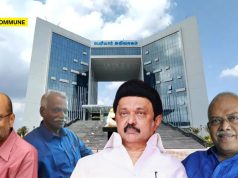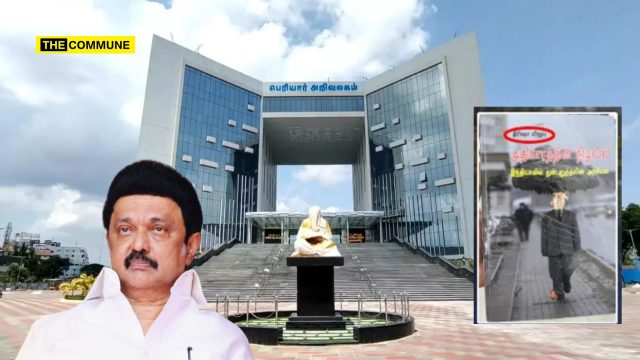
A massive scam involving the procurement of books worth crores of rupees has been unearthed at Periyar Arivulagam, a seven-storey public library inaugurated by Tamil Nadu Chief Minister C. Joseph Vijay in Coimbatore on 16 October 2026, as reported in The Hindu.
The library project was initiated under the previous DMK government and completed under the current TVK regime. According to School Education Minister Rajmohan, around 1,500 books published by Akalvilakku Pathippagam were purchased in February 2026, during the DMK’s tenure. This places the controversial procurement firmly under the previous government’s watch, raising questions about who approved the purchases and how the books were selected.
The library’s collection reportedly includes hundreds of questionable publications containing fabricated historical information, glaring literary errors and content suspected to have been generated using Artificial Intelligence (AI). Several books also carry unusually high price tags, fictitious author names and allegedly invalid ISBN numbers.
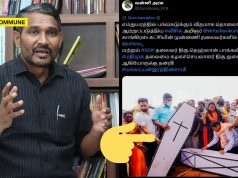
The shocking irregularities were brought to light by Tamil writer Perumal Murugan, who detailed his findings in an article titled Periyar Arivulagathil Periya Oozhal (Major Scam in Periyar Arivulagam), published on the online platform Sindhai.
Murugan, who visited the library and examined its collection, found that approximately 1,800 books published by a single publishing house, Agal Vilakku Pathipagam, occupied the shelves on the fourth floor, which houses Tamil books.
View this post on Instagram
The library, spread across seven acres and built at a reported cost of nearly ₹300 crore, was conceived during the previous DMK government. Murugan said he was shocked by the quality and authenticity of several books procured for the institution.
One such book, Naladiyar Vaazhvin Vazhikaatu, authored by Surya Balu, is priced at ₹1,445. The book describes Naladiyar as an important Tamil poet and philosopher.
Murugan questioned this description, pointing out that Naladiyar is a collection of 400 four-line verses attributed to Jain monks whose individual identities are unknown. He noted that despite having studied Tamil literature for nearly 15 years and taught it for 30 years, he had never encountered the claim that Naladiyar was a poet and philosopher.
Another book, Madurai Kanchi Oru Ilakkiya Payanam, authored by Dev Nilan, is priced at ₹1,395. It claims that Madurai Kanchi was composed by a poet named Madurai Koozhathip Peruvazhuthi and describes him as a warrior king.
Murugan pointed out that the author of Madurai Kanchi is traditionally identified as Mangudi Maruthanar, a poet and not a king. He questioned how the book’s author had arrived at these entirely different claims.
He also flagged a book titled Bharathiyar Kathaikal, credited to Manisha Saravanan, which features a story titled Sadhanaiyin Mugam as a work by Mahakavi Bharathiyar.
Murugan questioned whether the book contained stories written by Bharathiyar or stories about him, and called upon Bharathiyar researchers to establish whether the poet had actually written the story attributed to him.
A book titled Keezhadi Seppum Varalaru, authored by Jothi Hariharan, also came under scrutiny for featuring a photograph of a large Nandi statue purportedly recovered during excavations at Keezhadi.
Murugan questioned the authenticity of the photograph and the claims made in the book.
Perhaps the most glaring example of fabricated history appears in a book titled Tamil Nadu Oru Paarvai, authored by Dhanalakshmi Arjun.
According to the book, Muthuvelu Subbaiah Iyer was the first Chief Minister of Tamil Nadu in 1947. It then refers to a person named M.K. Ramasamy as an important Dravidian political leader before claiming that K. Kamaraj took over from him in 1954.
Murugan highlighted these claims as examples of the extraordinary inaccuracies found in the books supplied to the library.
Murugan highlighted these claims as examples of the extraordinary inaccuracies found in the books supplied to the library.
He also listed several authors whose names appear across Agal Vilakku Pathipagam’s publications, including Trisha Vijay, Jothi Saravanan, Jothi Hariharan, Jothi Lakshmi Anbalagan, Nivetha Anbalagan, Thamarai Panneer, Rani Panneer, Surya Balu, Manisha Saravanan and others.
He further pointed out that another publisher, Phoenix Pathipagam, had supplied more than a hundred books to the library. Hundreds of unopened book cartons were also reportedly lying inside, raising questions about the authenticity and quality of the remaining collection.
Murugan alleged that the books appeared to have been produced using inferior AI technology, with fictitious author names and invalid International Standard Book Numbers (ISBNs). He said that searches for the ISBNs printed in the books did not return valid records.
He also raised questions about the publishing house’s contact details, noting that the books carried only an email address, akalvilakkupathipagam@gmail.com, without any telephone number.
Calling for a thorough investigation, Murugan alleged that the procurement involved corruption worth several crores of rupees. He demanded that the government identify those responsible, investigate the political connections behind the alleged scam, recover the details of the money involved and immediately remove the questionable books from the library shelves.
Government Promises Inquiry
Responding to the allegations, Tamil Nadu School Education Minister Rajmohan, who also handles Tamil Development, Information and Publicity, said that the government would immediately initiate an inquiry.
“There is a scam. I can forgive anything. But a scam in a library bearing the name of Periyar is unacceptable. To borrow the words of my leader and Chief Minister, we will not spare anyone,” he said while participating in a government function in Chennai.
The Minister assured that action would be taken against everyone involved in the alleged irregularities.
He also pointed out that the book on Keezhadi contained photographs apparently sourced from Google, including an image of a Nandi statue that was not recovered during the archaeological excavations.
Questions over the Procurement Process
Speaking to The Hindu on 6 November 2026, Murugan said that he did not know when the questionable books had been purchased and that the government needed to provide an explanation.
Interestingly, Murugan himself was a member of one of the committees constituted to recommend books on modern literature and literary criticism for the library.
He told The Hindu that books had been sent to him online for scrutiny and that he had selected and recommended titles for purchase. However, the committee members were never informed about which books were eventually purchased.
There were around 30 such committees. Professor Dharmaraj Thamburaj, who served on the committee recommending books on culture and folklore, also said that the books shown to them were of good quality and met the required standards. However, the committee members had no information about whether the books they recommended were actually purchased.
An IAS officer familiar with the procurement process told The Hindu that such irregularities could not have taken place without the knowledge of senior officials and politicians. The officer also suggested that the questionable books may have been purchased during the transition period between the Assembly election and the formation of the new government.
The officer added that the English-language books in the library also needed to be examined to determine whether original or pirated editions had been procured.
Subscribe to our channels on WhatsApp, Telegram, Instagram and YouTube to get the best stories of the day delivered to you personally.