Home Blog Page 80

₹640 Crore Worth Joseph Vijay Makes TVK Candidates Pay Out Of Pocket For Election Expenses
vijay tvk joseph vijay

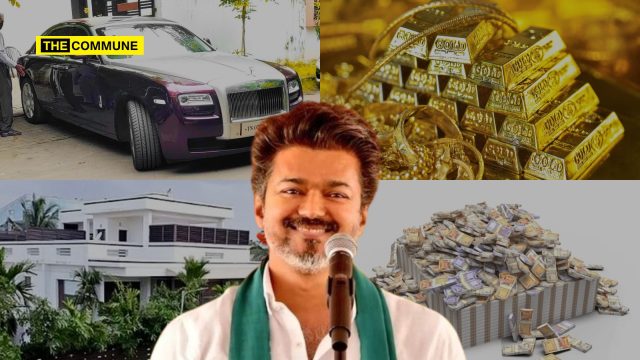
A visible mismatch between crowd enthusiasm and ground-level mobilisation is emerging as a key challenge for actor-politician Vijay’s party, Tamilaga Vettri Kazhagam (TVK), as it attempts to convert popularity into votes in the Tamil Nadu Assembly elections, as reported in The New Indian Express. This comes amid the fact that Vijay who himself declared ₹640 crore in his affidavit submitted in his nomination form.

While Vijay’s rallies continue to draw massive, high-energy crowds, the party’s limited on-ground presence, weak organisational depth, funding shortages, and reliance on inexperienced candidates are hindering campaign effectiveness across multiple constituencies.

During a recent roadshow in Trichy West, the scale of mobilisation appeared starkly modest. The TVK candidate’s convoy was accompanied only by a campaign van, two autorickshaws, a handful of children blowing whistles, a few women, and some men on motorcycles. In nearby Woraiyur, door-to-door campaigning was carried out by small groups of students and women. Even party loyalists acknowledged that such efforts fall far short of the crowds seen at Vijay’s large public meetings.

With Vijay restricting himself to select appearances, the party has been forced to depend on surrogate campaign strategies. In Kumbakonam, an AI-generated hologram of the actor-politician was deployed to attract crowds. Elsewhere, large cut-outs were used in Thiruverumbur, and lookalikes appeared in Kolathur to maintain visibility. However, party insiders concede that these methods have limited impact when it comes to building voter connection at the constituency level.

A functionary from Manapparai told TNIE that unlike other parties, where senior leaders share the stage with candidates and introduce them to voters, TVK candidates are often left unrecognised even during Vijay’s high-attendance events. He pointed out that despite large gatherings during Vijay’s visits, candidates were not introduced to the electorate.

Across districts, candidates, many of them first-time entrants into politics, reported that their campaigns are largely self-funded. With no substantial financial support from the party headquarters, local functionaries and part-time workers are contributing small amounts, typically between ₹300 and ₹500 per day, to sustain campaign activities. A functionary in Karur stated that the party does not have the financial muscle of established political players and is relying heavily on Vijay’s personal popularity to secure at least one vote per household.

In Sengulam, Trichy, local workers said they are pooling funds to cover basic expenses such as event arrangements and music systems, adding that there is no structured funding mechanism in place. In Karur, only about 10 to 15 individuals are consistently engaged in campaign work. Sources indicated that a small group of volunteers has been canvassing for nearly 15 days for candidate V P Mathiyalagan using pre-planned routes, reflecting the limited manpower available.

Functionaries admitted that most of those involved in the campaign are new to politics and are still learning the basics of electoral mobilisation. Several expressed hope that the party would perform better in future elections after gaining experience.

The logistical difficulty of managing large crowds and ensuring security has also restricted Vijay’s ability to conduct widespread physical campaigning. At the same time, allegations of favouritism in ticket allocation have reportedly affected morale among party workers.

In Madurai, functionary S R Thangapandi highlighted the lack of clarity regarding Vijay’s campaign schedule in the region, a concern echoed in several central and delta districts. Similarly, Krishnagiri candidate P Mukundhan acknowledged that Vijay would not be able to visit every constituency.

In Coimbatore, candidates said their campaigns gathered momentum only in the final phase, citing weak coordination, limited funding, and the inexperience of candidates as reasons for the delayed push.

Party sources in Villupuram and Vellore also reported funding constraints affecting outreach efforts. A resident of Kamban Nagar in Villupuram, M Hemavarshini, said that while she follows Vijay’s campaign on social media, she is unfamiliar with the local candidate.

Even in Trichy East, where Vijay himself is contesting, issues of coordination persist, including gaps in district-level leadership. Party leader Aadhav Arjuna has announced cadre training initiatives, but their impact is yet to be seen.

Former TVK functionary A R Basha, who recently defected to the Dravida Munnetra Kazhagam (DMK), attributed his departure to what he described as the party’s lack of preparedness. He said that the absence of cadre training and a structured booth-level organisation has left TVK struggling to mount an effective campaign.

Overall, five key issues define TVK’s current campaign landscape: absence of central funding support, a sharp disconnect between rally crowds and local mobilisation, low voter familiarity with candidates, widespread inexperience among cadres and candidates, and an organisational structure that remains underdeveloped at the booth and district levels.

Subscribe to our channels on WhatsAppTelegram, Instagram and YouTube to get the best stories of the day delivered to you personally.
‘Sekar Babu Has Performed More Temple Consecrations Surpassing Even Rajaraja Chola’, Says DMK Stooge Kamal Haasan

'Sekar Babu Has Performed More Temple Consecrations Surpassing Even Rajaraja Chola', Says DMK Stooge Kamal Haasan

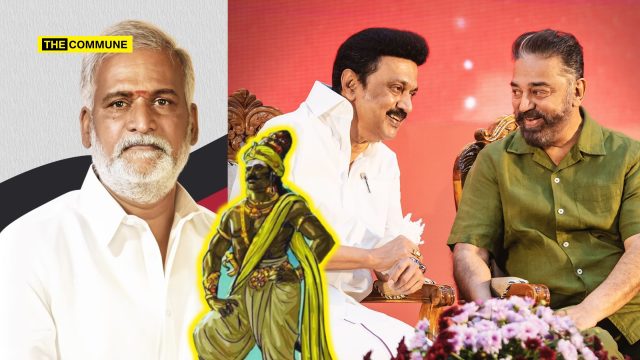
Rajya Sabha MP, DMK stooge Kamal Haasan, also founder of Makkal Needhi Maiam, stated on Friday, 17 April 2026, that his party’s backing of the DMK-led government stems from a commitment to national welfare, not political opportunism. This comes after he refused to contest the upcoming TN Assembly elections thereby denying his party members a chance to participate in the process.

Speaking at a campaign event in the Harbour constituency for DMK candidate PK Sekar Babu, he praised Chief Minister MK Stalin, saying that the administration’s work is consistently reflected in daily news coverage and will shape how history records this period.

Describing himself as part of the Dravidian movement, Haasan called on voters to carry the ideals of national unity and Dravidian philosophy beyond Tamil Nadu, particularly to northern India.

Addressing the crowd introducing Sekar Babu, Kamal Haasan said, “O life, O kinship, O Tamil – greetings (Vanakkam). There is no need to introduce my friend, the Harbour constituency candidate Sekhar Babu – his service itself stands before him as his introduction. He won’t say it himself, but I can. He is the one who has performed temple consecrations (Kuda Muzhukku) surpassing even Rajaraja Chola. He would say we shouldn’t say all that, but I am telling the truth of what happened.”

He continued, “When I say, ‘the Harbour constituency and I,’ the memory of Kalaignar naturally comes to me. This is the harbour that the great Arungalam has touched many times. Don’t ask what Arungalam is because they are already making us learn Hindi, and now they will start telling us to learn Tamil too. Arungalam means a beautiful ship, a ship that no one has seen, that rare and magnificent vessel. Many came aboard such a ship, and I am one of them, and so are you. I have come back to this constituency, which I had already visited for our party, so that his son MK Stalin may return here again, as he too is a reason for all the progress this Harbour constituency has achieved. The fact that my volunteers are here now reflects a rightful desire not greed, not excessive ambition but a rightful, nation-necessary desire to see this government come back to power. There is no need to list the achievements of my friend Mr. Stalin in many places, just walk through the constituencies and you will see it for yourself.”

It is noteworthy that MNM refused to contest in any of the seats but promised to support the DMK, continuing as its ally.

Subscribe to our channels on WhatsAppTelegram, Instagram and YouTube to get the best stories of the day delivered to you personally.
How DMK Shot In The Foot Of Southern States By Opposing Delimitation & Women’s Reservation Bills

The 131st Constitution Amendment Bill 2026 has failed in the Lok Sabha, defeated 278-211 – falling short of the required two-thirds majority. The opposition, led aggressively by DMK and its allies, is celebrating this as a victory for federal rights. It is not. It may be one of the most consequential political miscalculations made by southern parties in decades.

What Happened 

The bill that was defeated proposed expanding the Lok Sabha from 543 to 815–850 seats, with a guaranteed 50% proportional increase for every state, meaning Tamil Nadu’s share of Parliament would have gone from 39 seats to 59, while its percentage share of Parliament would remain nearly identical. The bill also included the constitutional mechanism to implement 33% women’s reservation ahead of the 2029 elections.

The opposition voted it down. Now let us examine what comes next.

The Constitutional Trap That DMK Has Led Southern States Into – The Freeze Is Expiring Whether Anyone Likes It or Not

The 84th Constitutional Amendment of 2001 froze Lok Sabha seat allocation based on the 1971 Census until the first census after 2026. That deadline is now here. The 2027 Census, once completed, constitutionally triggers a mandatory delimitation under Articles 81 and 82. This was always going to happen. It is not a BJP invention – it is a constitutional clock that has been ticking since 1976.

Article 81: The Provision That Should Terrify The South

Article 81(2)(a) of the Constitution mandates one principle above all else: the ratio of Lok Sabha seats to population must be as equal as possible across all states. There is no provision in the unamended Article 81 for a 50% flat increase. There is no guarantee of proportionality protection. There is only population-based allocation.

The 131st Amendment Bill would have amended Article 81 itself to insert the 50% proportional increase guarantee as a constitutional protection. The opposition killed that amendment. They have now left Article 81 in its original population-first form.

The Commission That Cannot Be Stopped

This is not a parliamentary process. Once the 2027 Census data is published, the President automatically appoints a Delimitation Commission – a retired Supreme Court judge, the Chief Election Commissioner, and state election commissioners with no parliamentary vote required. The Commission redraws seats based on population, publishes orders in the Gazette, and those orders carry the force of law. Parliament cannot modify or reject them – the orders are merely laid before the houses for information. Courts can review only in cases of manifest arbitrariness, not the seat allocation itself. The south cannot vote this down. It cannot filibuster it. It cannot take it to court. It will simply happen.

Simple Majority vs. Special Majority – The Critical Distinction

Here is the constitutional trap in full detail. The defeated bill required a two-thirds special majority to pass which is why the opposition could block it. But under the surviving constitutional framework, the government can now pass the Delimitation Act (a regular law, not a constitutional amendment) with a simple majority in Parliament.

The PRS India analysis of the bill confirms: “Parliament could make these decisions [on timing and census to use] with a simple majority. Given that the government will have a simple majority in Lok Sabha… the government could have the power to decide the timing of delimitation and which census to use.”

In short: the southern parties blocked the safeguard (the 50% proportional guarantee requiring special majority) while leaving the underlying power (post-census delimitation by simple majority) entirely intact.

What Comes Next – The Scenarios

Scenario 1 – Delimitation Based On 2027 Census Population

When the Delimitation Commission reconstitutes after the 2027 Census and redistributes 543 seats on the basis of raw population, Tamil Nadu, Kerala, and Karnataka will lose seats – not because of any BJP conspiracy, but because Article 81 mandates population-proportional allocation. Under this scenario, Tamil Nadu could drop from 39 to approximately 33-35 seats. Kerala, which has 20 seats today, could fall to 16-17. Uttar Pradesh, by contrast, could rise within the same 543 total.

This is the scenario the 131st Amendment was explicitly designed to prevent. The opposition just removed the prevention mechanism.

Scenario 2 – BJP Brings Back The Bill In 2029 With A Larger Mandate

The BJP has now been handed a powerful political narrative: they championed women’s reservation and increased parliamentary representation; the opposition specifically the Congress, DMK – the INDI Alliance, blocked both. Between 2027 and 2029, expect this to become a centrepiece of BJP’s electoral messaging particularly effective in Uttar Pradesh, where the Samajwadi Party will have to explain to women voters why it opposed a bill that would have increased women’s representation.

If BJP wins a stronger mandate in 2029 with explicit women’s reservation as a poll promise, they will have the political capital to bring the 131st Amendment back – this time with less need to negotiate with opposition parties. Come 2034, the south’s bargaining position will be structurally weaker than it is today.

Shah’s 50% Promise Was Constitutionally Impossible

Here is where the story gets more complicated and the opposition’s position even harder to defend. Amit Shah’s floor assurance of a “uniform 50% increase” for all states was structurally undeliverable. Article 81(2)(a) mandates equal population-per-seat ratios across states. Section 8 of the Delimitation Bill itself forces the Commission to use the latest census figures. A flat 50% hike, regardless of differential population growth, directly contradicts both. You cannot amend your way out of a contradiction you wrote into the same bill.

So the south was not choosing between a safe deal and a dangerous one. It was choosing between a federally protected guaranteed seat increase offer and a constitutionally certain reduction in seats. The 50% promise may not have survived a Supreme Court challenge but it would have set a political and legislative precedent that any future government would have had to work hard to undo. Instead, the south now has neither the promise nor the protection.

DMK’s Self-Goal

DMK’s miscalculation is structural and multi-layered:

They opposed a deal that was constitutionally unprecedented. No previous delimitation in India’s history has ever offered a flat proportional protection to all states. The 50% increase guarantee was a concession tailored specifically to address southern concerns. DMK rejected it.

They confused optics for strategy. Blocking the bill looks like a win for DMK today. But the constitutional obligation to delimit after the 2027 Census cannot be blocked. DMK has no mechanism to stop what comes next and what comes next, under unamended Article 81, is far worse for the south.

They handed BJP a narrative weapon. The BJP is now positioned as the party that offered women’s reservation + south seat protection and was blocked by parties who “prioritised politics over women.” The first part will resonate in Hindi-belt state elections in Rajasthan, MP, and UP and the second party will be realized by the people later which in turn determine BJP’s Lok Sabha majority in 2029.

They undermined their own long-term federal negotiating position. The time to extract maximum concessions from a government is when it needs your votes. DMK had leverage in April 2026. Once BJP wins 2029 without needing southern cooperation, that leverage disappears permanently.

Bottom Line

The south’s fear of delimitation is constitutionally grounded – Article 81’s population principle is a real threat to southern representation. But the way to fight that threat was to lock in proportional protection through a constitutional amendment while you had the power to demand it. Instead, DMK led the charge to defeat the very amendment that would have provided that protection and left the population-based delimitation trigger fully intact.

The only remaining legal mechanism to stop post-census delimitation is a fresh constitutional amendment extending the freeze which requires a two-thirds majority in Parliament and ratification by at least half the state legislatures. The north-south demographic math makes that nearly impossible. UP, Bihar, MP, Rajasthan, and Gujarat alone command enough legislative assembly numbers to block ratification of any freeze extension the south tries to push.

DMK did not reject a flawed bill. It rejected the last political window before an automatic, court-proof, parliament-proof constitutional process takes over. Today’s “victory” press conference will age very badly, roughly around the time the 2027 Census results are published.

The DMK has gravely undermined the nation’s interests by blocking the Delimitation and Constitutional Amendment Bill. As the Article 81 freeze expires following the first post-2026 census, the upcoming population count will trigger a seat reallocation based solely on numbers, likely slashing representation for southern, northeastern, and smaller states. The NDA’s initiative was a genuine push to maintain federal equilibrium, safeguard the influence of these regions, and guarantee 33% women’s quota. It wisely acknowledged that high-performing states on development metrics shouldn’t face democratic penalties. Regrettably, short-term political motives trumped enduring national priorities. Celebrants of this should reflect—we’ve squandered a vital chance for equitable, constitutionally protected representation.

This article is based on an X thread by Tushar Gupta.

Subscribe to our channels on WhatsAppTelegram, Instagram and YouTube to get the best stories of the day delivered to you personally.
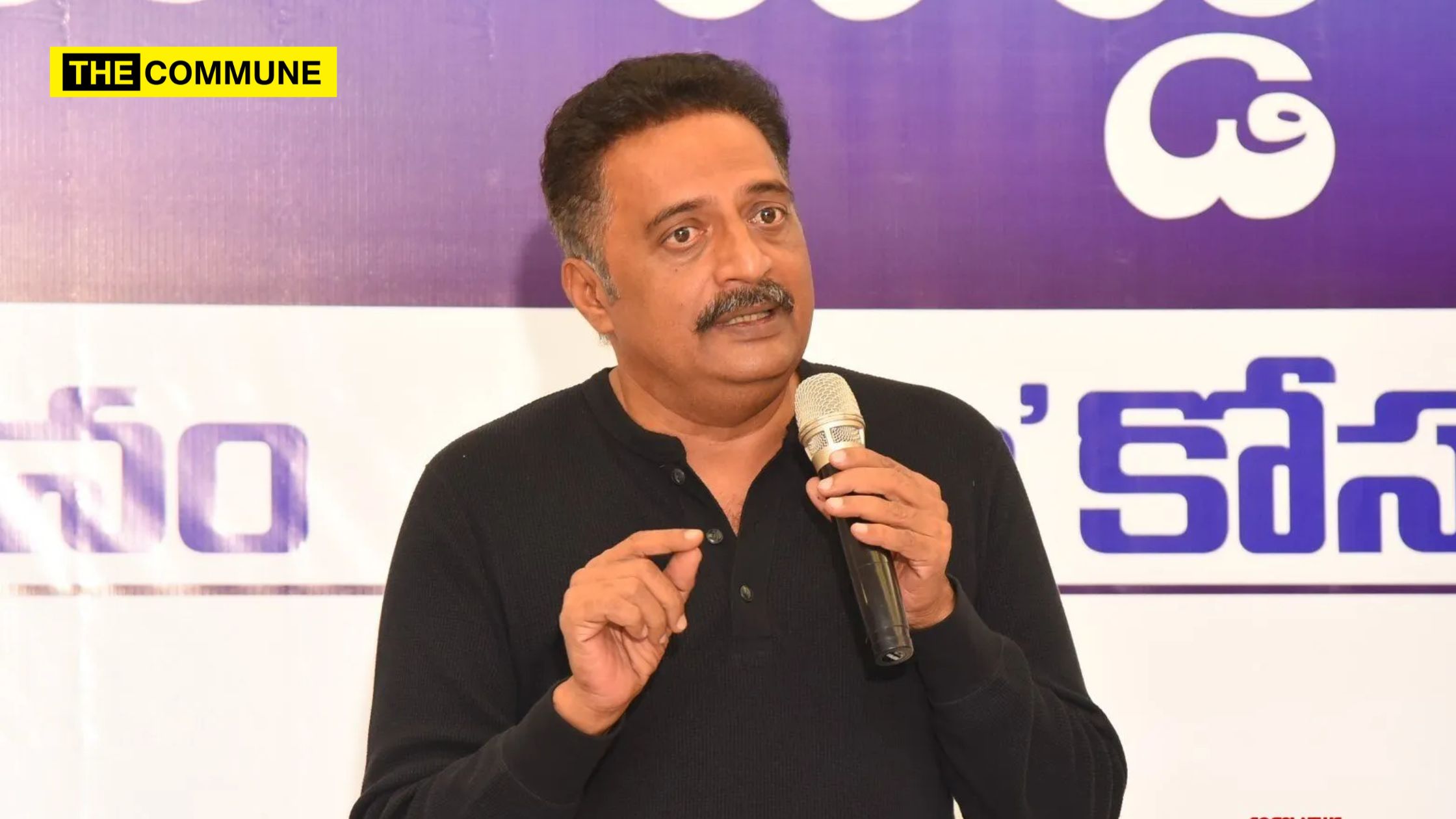
‘North Is Landlocked, Has No Culture, No History; South Is Diverse & Rich’, Says Radical Leftist Prakash Raj

prakash raj

Radical leftist and actor Prakash Raj has come under criticism after remarks made during his speech at the Kerala Literature Festival in January 2026 resurfaced online, with clips from the talk, published in March on YouTube, now circulating widely on social media.

A criminal case has been filed against him for making the inflammatory remarks. But there is another aspect in his speech that has been missed. He, like every other leftist, propagates the North-South divide and also goes to the extent of saying North has no culture and diversity while the South has.

Talking about Hindi cinema, Prakash Raj said, “See once cinema just becomes a business, they lose. I think probably me, Rajamouli and Prashant, we were discussing that why are dubbed films doing very well in the B, C centers. Then he was saying no after the multiplexes the Bombay film industry started making films only for multiplexes you know very cute films and things like that because they were earning well and they went into that page three and they lost touch with rural Rajasthan Bihar and they see this loud films dubbed, there’s some connection and also I think in Hindi cinema when post-independence whether it is fantasy or commercial films, it was nation building you know there would be Amar akBar Anthony where three people can give blood of three religions to one mother so those sort of lot of nation building films were happening. now it is not so, now it is money, it is fake, reels, how much of page three I am there trying to create promotions yelling at the top of the voice and I think that is where they have lost that connect with the audience.”

When asked whether the ‘Hindutva regime was using
films as a propaganda vehicle’, he said, “See you have to give me that because four years back I said they’re going to invest crores of rupees into it, they are investing but do you think they are successful yes they make a film on Mr. Modi, it runs it earns only 30 crores but they banned a film like Padmawati which earned 500 crores. Now the greatest joke is Dhurandhar. They thought it is a propaganda film. I asked people the villain has become popular. So it has backfired for them. Anybody ask not propaganda not the commercial film. My god what swag the villain was now. Now they don’t know the the it is like that brahmastra or something it has come back and ricocheted to them and all the piles they are making whatever files they are making it is sinking – emergency Kangana Ranaut, where are they, where are they just I don’t know.”

Responding to a question on whether cultural resistance is possible in the present context, he said, “Cultural resistance is also the answer. culture, cinema, art has always showed it resilience has always fought back in all the histories of the world whenever the fascists or racists have come from Hitler has been a cultural revolution and I think that is what we are doing here today.”

He continued, “Today KLF (Kerala Literature Festival) is witness and I wish the right wing or the bhakts should understand, who is coming here a noble laureate is coming here Romila Thapar is coming here, great writers are coming here, actors are coming here and all of them are talking about love and there is a resilience which has started. You can’t bury a voice and cultural resistance is happening; it is happening through songs, through theater, through discussions and it is the only hope and art will fight back.”

Next the interviewer asked, “But our cultural resistance in India it is there in south but when you go to the north what is the condition?”

Prakash Raj snaps instantly saying, “Because they are not rich culturally there. What are they? I was talking the other day, they are a landlocked place, they have only inland experiences of somebody coming on them, taking them. I’m sorry we might have not had the pain of partition, they have suffered more but they have not learned the lesson, but we south India is not a landlocked place. We have grown with collaborations. We have had St. Thomas coming down to preach his this thing. We have had Vasco da Gama who has come here because of the seas and we have five four different languages. We have collaborating and living. We have every 100 kilometers we have different food, different language, different dialects. We are a very robust space. We are diversity and we are rich. Why they can’t come here is because of that. What history do they have? So I understand that that is why the right wing is more strong and more brainwashed there. But now they are also getting the heat. Look at the migration. They are coming here to Kerala to live, coming to Karnataka coming to Chikmangalur, coming to Tamil Nadu, coming to Bangalore. And that is our problem. We are open because we have always accepted diversity. We have always accepted diversity but don’t come and impose. Don’t come and impose.”

Subscribe to our channels on WhatsAppTelegram, Instagram and YouTube to get the best stories of the day delivered to you personally.
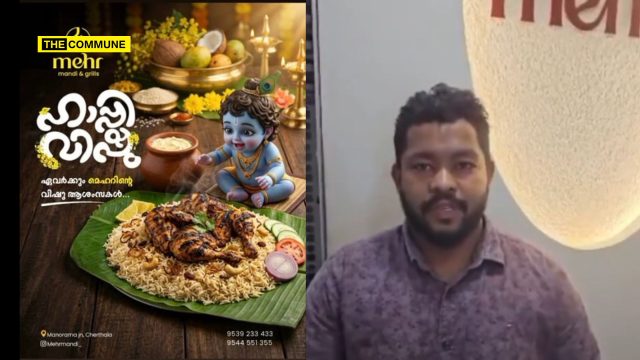
Krishna Meat Poster: Two Held For Circulating Poster On WhatsApp, Owner Blamed Designer & Issued Apology

Kerala Restaurant Uses Lord Krishna's Image To Promote Non-Veg Dish On Vishu; Issues Apology After Outrage

Two individuals were arrested on Friday, 17 April 2026, for circulating on WhatsApp a Vishu promotional poster of the Mehr Mandi & Grill restaurant that depicted a young Lord Krishna seated in front of a serving of “kuzhi manthi,” an Arabian non-vegetarian dish, as reported in Deccan Herald.

According to officials from the Cherthala police station, the accused were booked under Section 192 of the Bharatiya Nyaya Sanhita, which deals with wantonly giving provocation with intent to cause a riot. Police confirmed that their arrests were formally recorded.

The First Information Report stated that the poster was shared on WhatsApp with the alleged intention of hurting the religious sentiments of the Hindu community.

Police said the action came amid rising tensions in the area, with a Hindu organisation announcing a protest march to the restaurant later in the day. Authorities indicated that precautionary measures were being put in place to prevent any escalation or law and order issues.

Meanwhile, the restaurant owner issued a public apology over the controversy surrounding the poster. In a video message, he claimed that the design work had been outsourced to a third-party agency and claimed that the controversial imagery resulted from a lack of judgment on the part of those who created it.

Subscribe to our channels on WhatsAppTelegram, Instagram and YouTube to get the best stories of the day delivered to you personally.
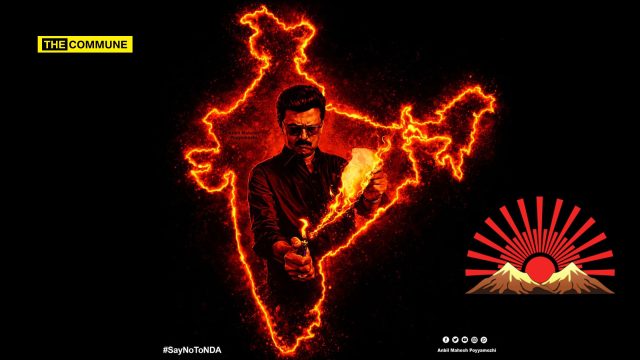
DMK Posts Provocative ‘Burning India’ Imagery Over Delimitation

Opposition to the Central government’s Delimitation Bill 2026 is loudly proclaimed as legitimate by southern parties. But the government’s own position, stated by Home Minister Amit Shah on the floor of Parliament, is that the bill will not reduce southern states’ proportional representation, and that all states will receive a uniform 50% increase in seats.

The DMK’s campaign has been built on a fear narrative that the Centre itself has categorically refuted on record – yet the protests, the fire imagery, and the rhetoric have continued unabated.

The Burning Poster  

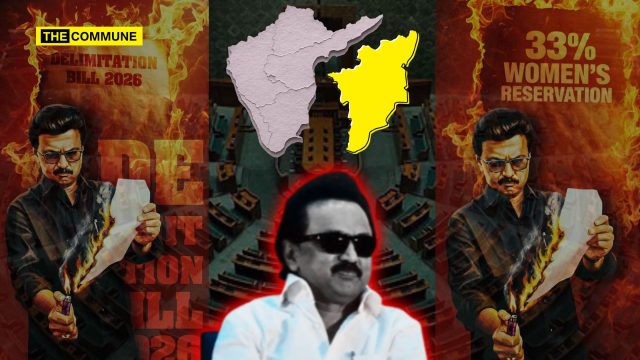
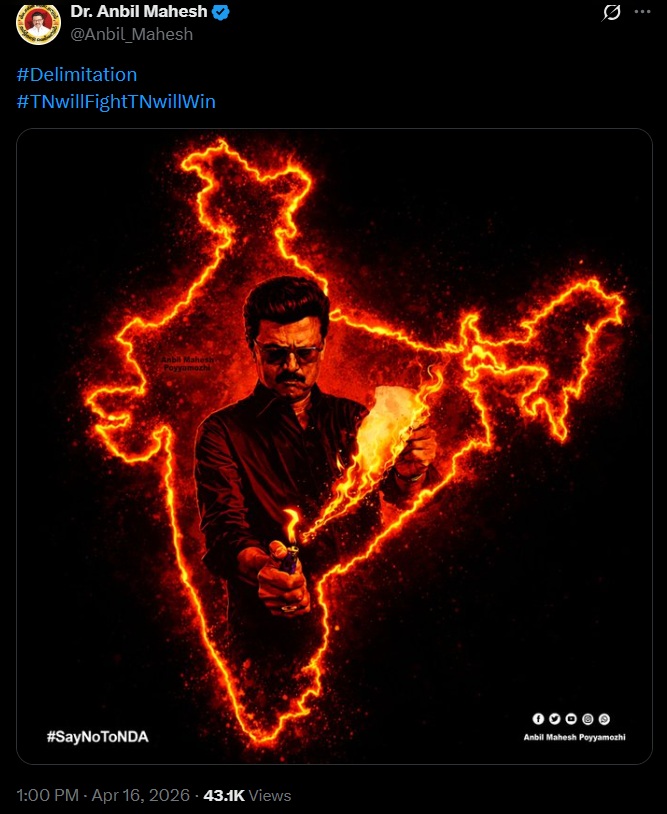
On 16 April 2026, the same day Parliament convened its special three-day session to pass the Delimitation Bill, DMK minister and party leader Anbil Mahesh Poyyamozhi and several other DMK handles shared a striking digital artwork on his official social media handles. The image showed MK Stalin holding a lighter and a burning piece of paper, set against the flaming outline of India’s map, with the hashtag #SayNoToNDA emblazoned at the bottom.

The imagery is unambiguous in its visual language: India is on fire. A DMK leader, that too the Chief Minister of a state holds the flame.

Supporters of the party will argue that fire is a metaphor for protest in Tamil political culture – reminding one of the Anti-Hindi protests. But metaphors have consequences. In a politically charged environment, with a parliamentary session underway, sharing an image of a party leader appearing to set India ablaze sends a signal that goes well beyond peaceful democratic opposition.

Stalin’s Warning: “Not a Threat” – But Heard as One

Days before the protest, Chief Minister MK Stalin addressed the nation on the delimitation issue. His words were carefully chosen, yet unmistakably combative. “You will witness a Tamil Nadu you have never seen before,” he declared. He then added, pointedly: “This is not a threat, this is a warning.”

The distinction he drew between a threat and a warning may satisfy legal scrutiny. But politically, the difference is thin. A warning from the Chief Minister of Tamil Nadu, delivered on video, aimed at the Central government, that the state would take unprecedented action carries the weight of an ultimatum. It was received that way across India, and it was designed to be.

Stalin followed up by publicly burning a copy of the Delimitation Bill at a protest event, flanked by party functionaries.

Burning the constitution or its proposed amendments, even symbolically, is a provocation that has historically been treated as a serious political act in India.

Protest or Provocation? The Pattern of Escalation

What makes the DMK’s campaign noteworthy is not any single act, but the cumulative pattern of escalation:

  • A Chief Minister warning the Centre of consequences “never seen before”, “the Tamil Nadu of the 60s”
  • Public burning of a parliamentary bill
  • Black flag protests organised statewide on the day Parliament sat to discuss the bill
  • A senior minister sharing imagery of India in flames under a DMK party figure

Each of these acts, individually, is within the bounds of democratic protest. Collectively, they form a coordinated campaign of maximal confrontation – one that is deliberately designed to push the boundaries of acceptable political language.

Tamil Nadu has a proud tradition of political agitation. But there is a difference between agitation that pressures the government and agitation that frames constitutional legislation as an act of war against a state.

North-South Politics

The DMK has not presented delimitation as a policy disagreement – it has presented it as a civilisational attack on Tamil identity. North vs South. Hindi vs Tamil. Delhi vs Chennai. Every fire poster, every protest, every Stalin speech reinforces this manufactured binary.

This is electoral strategy dressed as existential crisis.

Home Minister Amit Shah stated on record, in Parliament, that southern states will not lose representation. The DMK has willfully ignored it and kept the outrage machine running because Tamil Nadu votes in weeks.

Subscribe to our channels on WhatsAppTelegram, Instagram and YouTube to get the best stories of the day delivered to you personally.
Mistake Or Deliberate? Kerala Restaurant Owner Blames Designer Over Krishna Meat Poster As More Similar Ads Surface

Vishu is one of the biggest festivals in Kerala, especially celebrated by Hindus. Lord Krishna is an integral part of the festival. However, owners of non-vegetarian food outlets which in and around Kozhikode, Alappuzha, Kottayam regions seem to want to rile up Hindu sentiments during the religious festival.

Advertisements for offers during Vishu have caused outrage in Kerala and beyond. A controversy that began with outrage over a Vishu advertisement in Cherthala, Alappuzha has now snowballed into a wider agitation across Kerala, with multiple restaurants coming under scrutiny for using imagery of Lord Krishna alongside non-vegetarian dishes in their festival promotions. What was initially seen as a single incident is now being seen as a larger picture – a broader and deliberate pattern to demean and insult Hindus and Hindu rituals and gods.

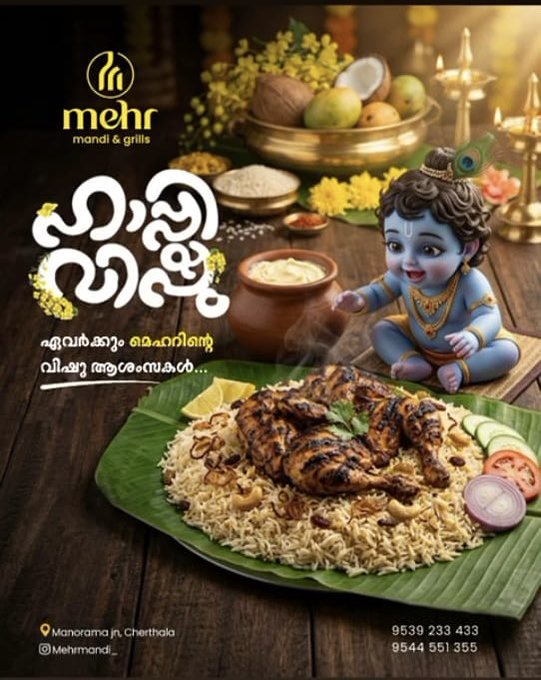
It started off with demeaning imagery used by Mehr Mandi & Grills in Alappuzha.

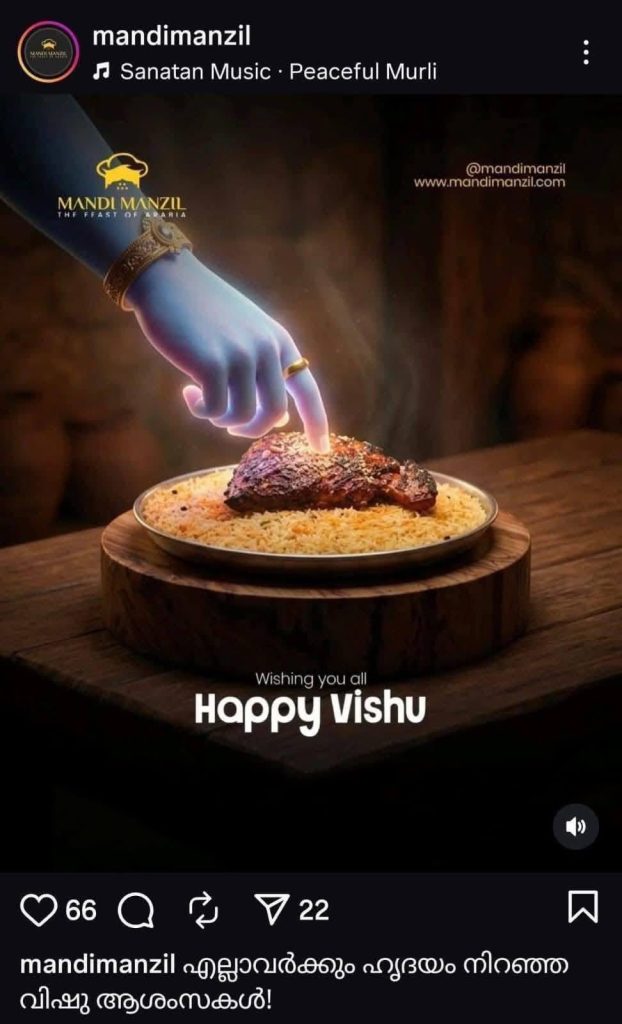
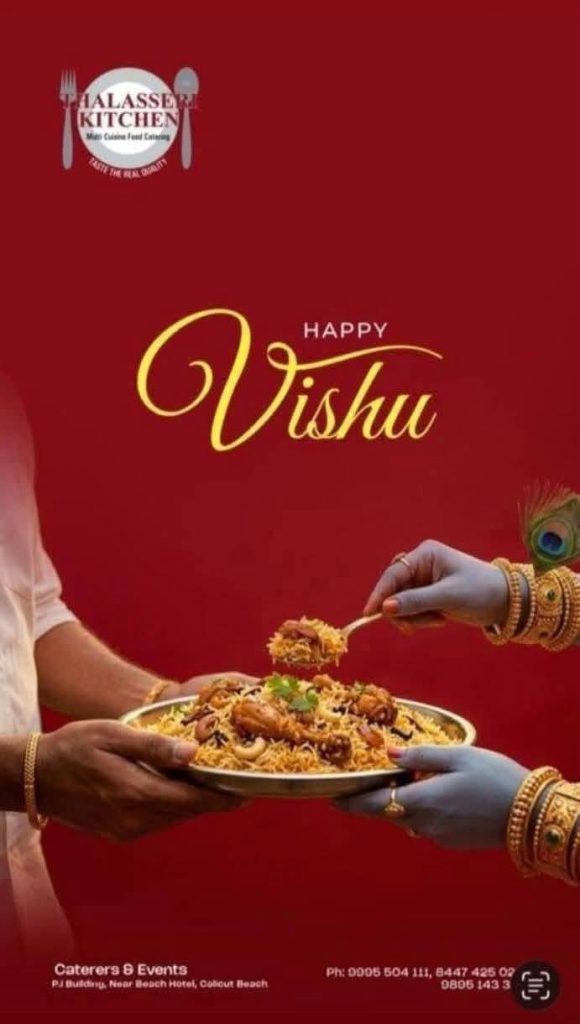
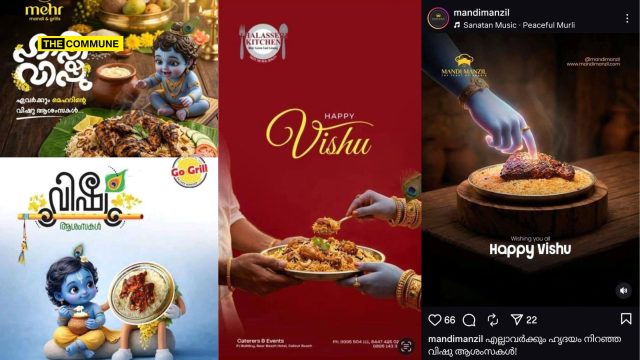
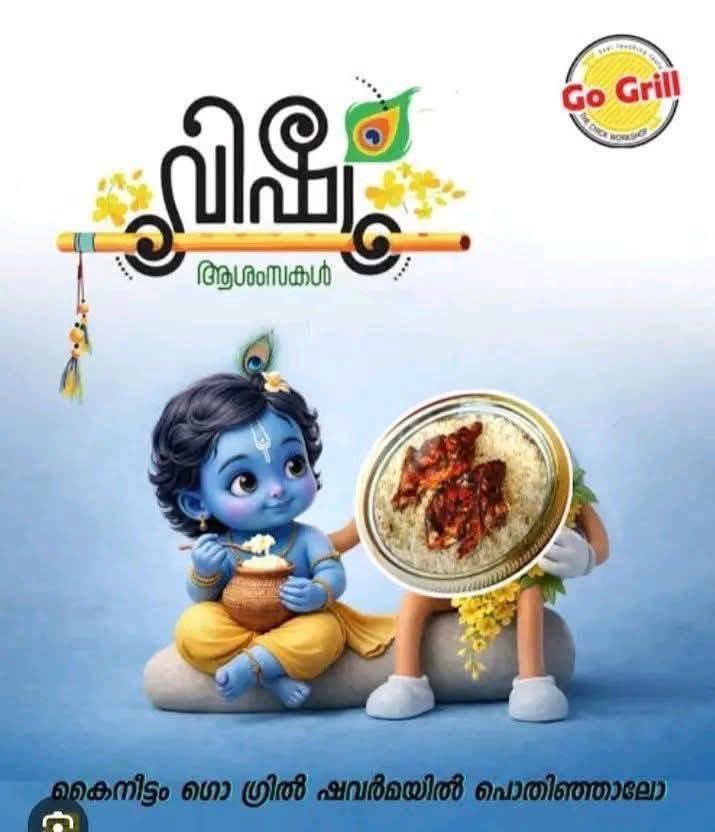
Slowly, posters of such promotions from various other restaurants also started surfacing. These include Go Grill Mandi Mahal Hotel in Erattupetta, Mandi Manzil Hotel Group with outlets in Thiruvananthapuram, Kollam and Alappuzha, and Thalassery Kitchen in Kozhikode.

Across these businesses, Vishu-themed advertisements have drawn sharp reactions for placing a revered Hindu deity in close visual association with meat-based food items.

As the news spread further, even more posters emerged.

All these promotional posters follow a strikingly similar visual template. In some instances, Lord Krishna is depicted directly in front of biryani platters, while in others, fried chicken is arranged around or above the deity’s image. Some designs seem to integrate Lord Krishna into elaborate food spreads dominated by non-vegetarian dishes, blurring the line between devotional symbolism and commercial marketing. The repetition of these elements across districts has led to suspicions that this is not a series of isolated creative choices but something more coordinated.

As reported in Organiser, during Ramadan, promotional campaigns from these businesses seemed to focus on themes of fasting, prayer, and community, without hurting religious sentiments or portraying them in contentious contexts. In contrast, their Vishu campaigns prominently feature Lord Krishna in proximity to meat dishes, something that demeans the spiritual tone traditionally linked to the festival.

Vishu, which marks the Malayalam New Year, is centred around the Vishukkani ritual and carries deep religious significance in Kerala households. The presence of Krishna in Vishu observances is not merely decorative but tied to longstanding devotional practices. Against this backdrop, the repeated use of such imagery in commercial advertising is a serious deviation from established norms.

The flashpoint of the controversy was the advertisement released by Mehr Mandi & Grills, owned by Mohammed Shameer along with other partners. The poster, which showed Krishna alongside a non-vegetarian dish as part of a Vishu greeting, quickly went viral and triggered protests. Hindu organisations, including the Vishwa Hindu Parishad, announced demonstrations outside the restaurant.

Following the backlash, Mehr Mandi & Grills apologised and reportedly removed the posters. They claimed that the controversial poster was never shared on any of their official platforms or social media pages, and that it was blocked immediately upon learning of the issue. They reportedly replaced it with a different Vishu greeting poster and apologized to those affected.

Mandi Manzil seems to have deleted the imagery from their Instagram handle.

The remaining restaurants have not yet issued any apology; there seems to be no posts on their social media as well.

All this points to just one question – how did such a coordinated campaign come to be? Mehr Mandi & Grills blamed the outsourcing partner for such an idea – do all the restaurants outsource their marketing to the same company? Did no one in the restaurant management side take a look at the imagery before publishing? Are the restaurants so naïve that they trust their partners so much? Would the restaurants have kept quiet if such derogatory and demeaning imagery was used for their religious festivals?

Subscribe to our channels on WhatsAppTelegram, Instagram and YouTube to get the best stories of the day delivered to you personally.
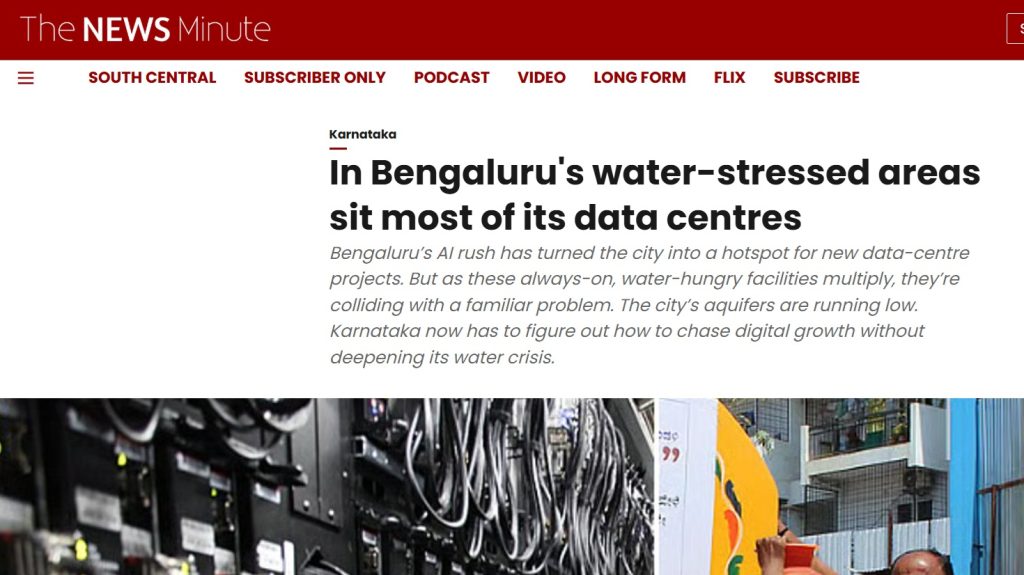
“500 ml For 5 Questions?”: TNM Peddles Debunked ChatGPT Water Myth, Dhanya Rajendran Gets Community Noted

Leftist rag, The News Minute’s investigation into Bengaluru’s data centre water problem seems to position itself as raising legitimate policy questions, but several of its central claims are either outdated, arithmetically inconsistent, or unverified.

When an article is used to drive public policy, atleast the numbers have to be right.

The ChatGPT Claim Is Off by Two Orders of Magnitude

The most attention-grabbing line in the article belongs to IT Minister Priyank Kharge, who told the Karnataka Assembly: “If you ask five questions on ChatGPT, 500 ml of water is needed.”

This figure is not just imprecise. It is approximately 100 times higher than what the evidence supports and it has been publicly debunked since October 2024.

The 500 ml claim traces back to a paper titled Making AI Less Thirsty, published in October 2023, based on GPT-3’s power consumption figures that were themselves drawn from a 2020 estimate . As software engineer Sean Goedecke meticulously documented: “That figure in the 2020 paper is per-page, which the 2023 paper interprets as per-request. The amount of inference for 500ml of water is thus better understood as 10-70 pages. An average ChatGPT conversation is much shorter than that, more in the order of 3-8 messages, or 1-2 pages at most.” That alone reduces the figure by roughly 10 times.

But there is a second, larger correction: GPT-3, the model the original paper studied, has been superseded by GPT-4o and GPT-4.1, which are “widely estimated to be in the ~20B parameter range [vs GPT-3’s 175B], similar in speed to GPT-3.5, which I think is a fair proxy for total power usage. That’s another 10x improvement right out of the gate,” Goedecke writes.

Combining both corrections, conversation length and model efficiency, “an average conversation with ChatGPT is going to consume closer to ~5ml of water, not ~500ml,” he concludes. Sam Altman went further: in June 2025, he publicly stated that the average ChatGPT query uses just 0.3 ml of water. Five questions at 0.3 ml each = 1.5 ml, not 500 ml.

The TNM article quotes the Minister’s claim verbatim, with no verification, no caveat, and no contextualisation. For a piece that positions itself as a fact-driven investigation into data centre policy, uncritically amplifying a viral myth that has been debunked in public domain for over a year is a significant editorial failure.

Had a Hindu/BJP minister or MP made any such claim, the same TNM would have dissected it down to the letter, but here, they just quote verbatim and use that as a vehicle to parrot their propaganda.

The Problem With Getting the Numbers Wrong

Data centres do consume enormous quantities of water. That concern is legitimate, scientifically grounded, and urgently needs policy attention. But when a Minister cites a debunked viral statistic in the Assembly, and a publication reprints it without verification, it is pretty clear that there is an agenda behind the entire exercise. Does TNM not want data centres in India in the future? Is it trying to prevent Google from setting one up in the near future?

Subscribe to our channels on WhatsAppTelegram, Instagram and YouTube to get the best stories of the day delivered to you personally.
Ignored Thirumavalavan, Met Voters with Gloves – DMK Ally DMDK Head Premalatha Practicing Untouchability?

Ignored Thirumavalavan, Met Voters with Gloves - DMK Ally DMDK Head Premalatha Practicing Untouchability?

In the heat of Tamil Nadu’s 2026 assembly election campaign, DMK ally and DMDK General Secretary Premalatha has found herself at the centre of two deeply troubling incidents – both pointing toward the same uncomfortable question: Does the leader of a party that markets itself as a voice of the people harbour a deep-seated aversion toward marginalised communities?

The incidents, both of which went viral within days of each other, have drawn sharp reactions from cadres, rights activists, and political observers and together, they paint a picture that cannot be dismissed as coincidence.

Incident 1: The Calculated Silence at Cuddalore

Over a week ago, at a DMK alliance public meeting in Cuddalore district, VCK president and sitting MP Thirumavalavan, chief of the Viduthalai Chiruthaigal Katchi and a Dalit leader was on stage, formally introducing all DMK alliance candidates to the gathering.

As he called out the name of Premalatha, she did not stand up.

Every other candidate acknowledged the introduction. Premalatha did not. The moment was caught on camera and went viral overnight. While one can claim it was noisy or she was distracted and hence she did not get up, she instantly stood up when MK Stalin announced her name.


View this post on Instagram


A post shared by Polimer News (@polimernews)

VCK cadres erupted in protest across the state, as reported in Tamil Samayam. To them, this was not a lapse in attention. It was a deliberate act of disrespect directed at a Dalit leader on a public stage, a stage shared by allies in front of thousands of supporters.

Thirumavalavan claimed this was a conspiracy to split the alliance.

But the image had already burned itself into public memory.

Incident 2: The Gloves That Said Everything

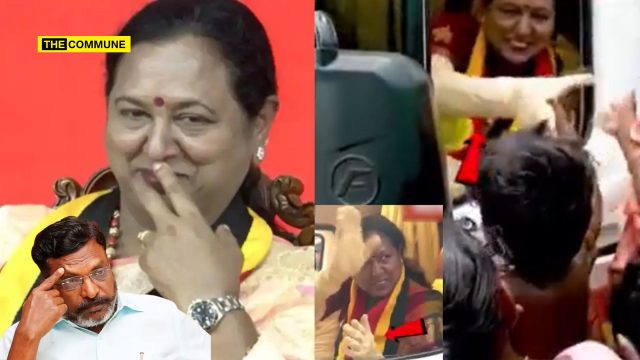
During the election campaign trail, a video emerged showing Premalatha wearing gloves while meeting and greeting people, specifically in the context of canvassing among a section of voters. The video triggered immediate outrage, with social media users and activists calling it a blatant act of caste-based untouchability.

Critics pointed out that no such protective measure was visible when Premalatha met other leaders, party functionaries, or members of the political establishment. The gloves seemed to have appeared exclusively in the context of meeting ordinary people from marginalised communities.

For many observers, this was not a hygiene precaution. It seemed like a statement.

In a democracy built on the principle of equal dignity, a political leader’s body language speaks volumes. And Premalatha’s gloves, whether consciously or unconsciously seemed to communicate something that no political speech can undo: you are untouchable to me?

Pattern Or Coincidence?

Taken individually, each incident can be explained away – gloves for hygiene, not standing up due to distraction. But taken together, as part of a campaign trail where communities are being directly canvassed for votes, the pattern is impossible to ignore.

Premalatha is seeking votes from voters of marginalised communities. She needs their support to win. And yet she did not touch them without gloves, she did not stand in acknowledgement of their foremost political leader.

Is this the definition of political opportunism layered over social contempt using community votes while refusing to extend dignity?

Tamil Nadu’s Dravidian political tradition was built on the revolutionary dismantling of caste hierarchy. The DMK’s alliance with VCK is itself a statement of that commitment. But DMDK and Premalatha in particular has never had a clear ideological stance on caste annihilation. The party’s identity was built entirely around the persona of Captain Vijayakanth.

With the Captain gone, what remains of DMDK is an organisation without ideological moorings, now aligned with the DMK for electoral survival, but clearly uncomfortable with the social values that underpin that alliance.

Subscribe to our channels on WhatsAppTelegram, Instagram and YouTube to get the best stories of the day delivered to you personally.
Kerala Restaurant Mehr Mandi & Grills Uses Lord Krishna’s Image To Promote Non-Veg Dish On Vishu; Issues Apology After Outrage

Kerala Restaurant Uses Lord Krishna's Image To Promote Non-Veg Dish On Vishu; Issues Apology After Outrage

A restaurant in Cherthala, Kerala, has landed in controversy after using an image of Lord Krishna alongside a non-vegetarian dish in a Vishu greeting poster, drawing sharp criticism from Hindus across the board who called it deeply disrespectful to Hindu sentiments.

The Poster and the Backlash

Meher Mandi & Grills, located at Manorama Junction, Cherthala, released the promotional poster on the occasion of Vishu, the Keralite New Year. The poster featured an image of baby Krishna placed next to a mandi rice and grilled chicken dish, with a Vishu greeting in Malayalam. The image quickly went viral on social media, triggering outrage among Hindus who condemned the restaurant for using a sacred deity as a marketing prop for non-vegetarian food on a religiously significant occasion.

Netizens questioned whether the establishment, whose management appears to be Muslim, led by a person named Mohammed Shameer, would ever produce similar content involving symbols or figures sacred to Islam or Christianity.

The Apology

Following the widespread backlash, Meher Mandi & Grills released a video apology. In the video, a representative of the management stated: “On the occasion of the recent Vishu festival, we had made a small greeting poster. We had that poster designed entirely by an outside person. However, due to his lack of awareness, that poster caused discomfort to our brother communities. This was absolutely not done with our knowledge. Rather, it happened because of his ignorance.”

The management claimed that the controversial poster was never shared on any of their official platforms or social media pages, and that it was blocked immediately upon learning of the issue. They replaced it with a different Vishu greeting poster and apologized to those affected.

Subscribe to our channels on WhatsAppTelegram, Instagram and YouTube to get the best stories of the day delivered to you personally.